Creamy Garlic Parmesan Pasta
There are foods that arrive like a remembered conversation—warm, familiar, and somehow stitched to a place even when that place no longer exists on the map of our lives. Creamy Garlic Parmesan Pasta is one of those recipes: humble in its ingredients, lavish in its comfort, and portable enough to be a house-guest in kitchens from coastal Italy to apartment blocks in Toronto and beyond. As a travel writer who follows markets, kitchens, and the stories that simmer on stovetops, I’ve found this dish lubricates conversation and memory in equal measure.
Its simplicity invites improvisation and intimacy: a copper pan warmed over a gas flame, a head of garlic crushed with the impatience of someone who’s been cooking all day, a handful of Parmesan grated with the ritual attention of a child learning how to serve. For those who seek variations that lean toward proteins or vegetables, I’ve traced recipes that swell the plate into a centerpiece—just one example is how people adapt it into an indulgent chicken pasta that feeds a table and echoes the season’s generosity, as seen in this detailed adaptation I admired online: creamy garlic-parmesan chicken pasta variations.
In the paragraphs that follow I’ll unfold the recipe, its history, and the ways in which this modest sauce becomes a map of regions, seasons, and the households that keep it alive.
The origin story & regional influence behind this dish
Pasta cloaked in a cream-and-cheese sauce reads like an elegy to European dairy culture. Though Parmesan (Parmigiano-Reggiano) anchors the flavor, the dish as we commonly know it—silky cream melded with garlic and cheese—is less a single-origin artifact and more an accretion of culinary intentions across regions. In northern Italy, where cows graze on verdant pastures and butter and cream are welcome on the table, pasta sauces have historically leaned richer. Southern Italy prefers tomato and olive oil; the north is where dairy thickens a sauce and becomes a language.
Yet this particular combination truly blooms outside Italy, in kitchens shaped by migration and adaptation. Italian immigrants arriving in the Americas found different cheeses, new varieties of cream, and a hunger for warmth. The result: a dish that retained its old ways of comforting and sharing while adopting local measures and speed. In restaurant kitchens and family dining rooms, creamy garlic sauces became a shorthand for celebration and also for solace—dinner for a tired new parent, a first dish made by a teenager, or the late-night meal after a long voyage.
Beyond Italy, the recipe resonates in Central Europe’s dairy-rich traditions, in the French affection for butter and cream, and in modern globalized palates that favor immediate comfort. It is less a singular recipe from a single village and more a culinary conversation among places that prize dairy, bread, and the company of others.
How to make Creamy Garlic Parmesan Pasta
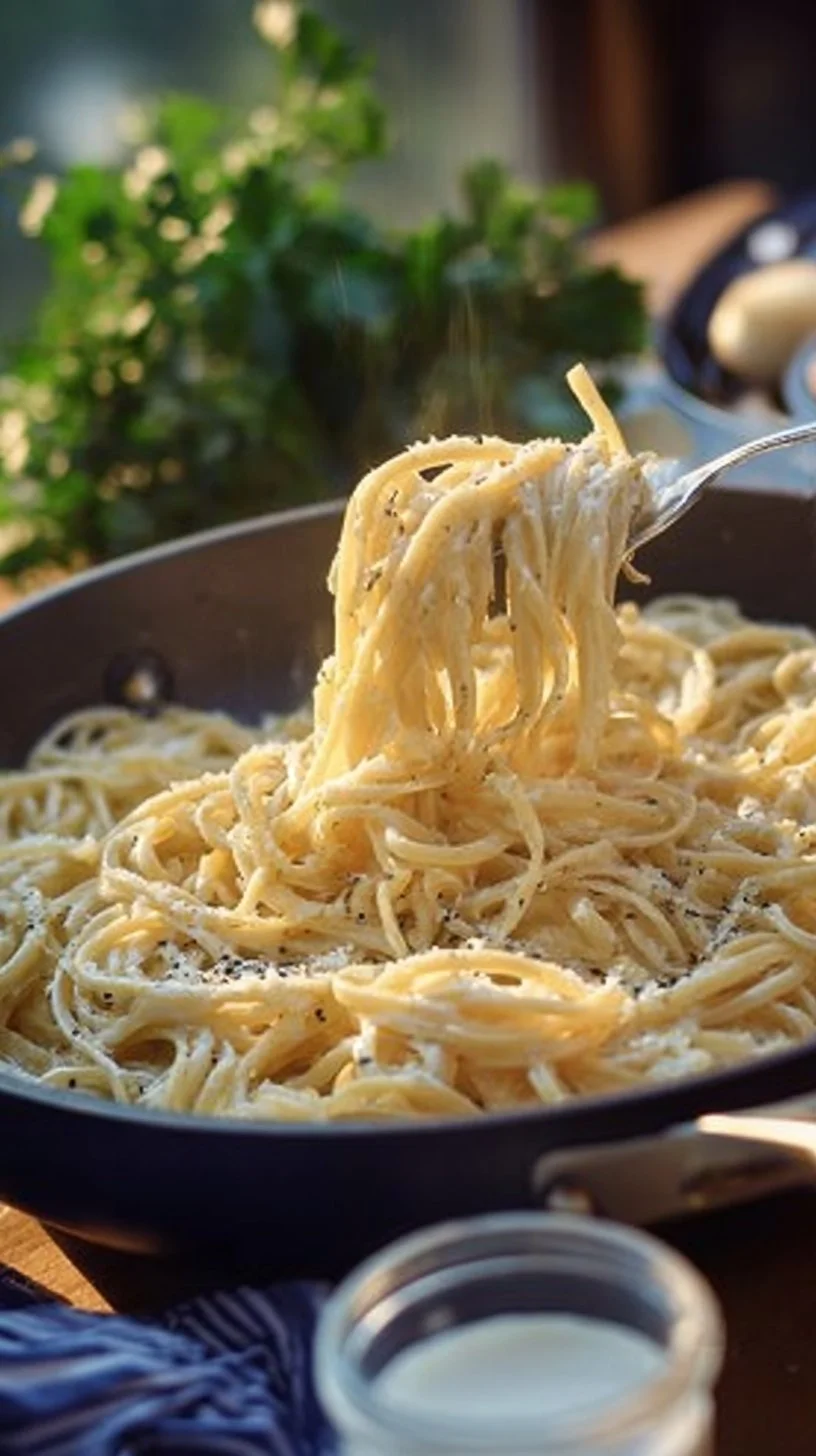
The making of this pasta is a quiet ceremony: a few ingredients, gestures repeated, a small alchemy of heat and time that yields something both simple and indulgent. The steps are straightforward, almost meditative—boiling water, letting garlic bloom in butter, coaxing Parmesan into the cream until it softens into a velvet ribbon that clings to each strand of pasta. Here is the recipe in its pure, unaltered form, as passed along from pan to pan in countless homes.
Ingredients :
8 oz pasta (spaghetti or fettuccine), 2 tablespoons butter, 3 cloves garlic, minced, 1 cup heavy cream, 1 cup grated Parmesan cheese, Salt and pepper to taste, Chopped parsley for garnish
Directions :
- Cook the pasta according to package instructions. Drain and set aside., 2. In a large skillet, melt the butter over medium heat., 3. Add the minced garlic and sauté for about 1 minute, or until fragrant., 4. Pour in the heavy cream and bring to a simmer., 5. Stir in the Parmesan cheese until melted and smooth., 6. Season with salt and pepper., 7. Toss the cooked pasta into the sauce until well coated., 8. Serve hot, garnished with chopped parsley.
Read plainly, the directions are a recipe. Read lived, they are a ritual: the swift motion of a wooden spoon, the steam rising fragrant with garlic, the quiet patience of cheese surrendering into cream. Each instruction becomes a note in a melody that friends and families hum to one another when the weather turns cool or when comfort is the evening’s chief order.
Ingredients through a cultural & historical lens
Each line of the ingredients list reads like a small archive. Pasta, whether spaghetti or fettuccine, carries its own histories—wheat milled from particular regions, dried versus fresh, and the ways a noodle humbles or elevates a sauce. Butter and cream narrate a dairy story: pastoral landscapes where cows graze, the seasonal rhythms that produce richer milk, and the technologies—like separateurs and churns—that made cream widely available. Parmesan is perhaps the most storied: Parmigiano-Reggiano is a product bound by regulation and terroir, its granular texture and umami depth a result of months or years of aging. Even parsley is a note in the cultural alphabet—a green punctuation that ties the dish to gardens, markets, and an intuitive desire for freshness.
For immigrant communities, these ingredients were both scarce and sacred. Parmesan in old-country economies could be a preserved luxury, grated sparingly to honor a loaf of bread. In new countries, cheap supermarket cheeses sometimes replaced the real thing, changing the sauce’s flavor and texture and thereby creating new regional identities. The dish thus becomes a palimpsest of memory: recipes layered over time with substitutions born of necessity, nostalgia, and creative joy.
Cooking the dish: sensory notes & traditional techniques
When garlic hits butter, the kitchen will change sound and smell. The sizzle is like a small herald, and the scent is immediate—sharp at first, then mellowing into something nutty and warm. In a home kitchen in the evenings, that aroma reaches across rooms: teenagers doing homework at a table, grandparents pausing their conversation, a radio playing a distant song. Bringing cream to a simmer introduces a velvet hush; the sauce thickens slowly, a visual softening that seems almost like a restorative breath. Parmesan joining the cream is where the sauce gains its personality: the cheese melts, releasing salty, nutty, crystalline notes that cling to pasta like weathered silk.
Traditional techniques here are less about precision and more about attention: the garlic must not be burnt (a bitter note that cuts through the sauce), the cream should be warmed gently to maintain silkiness, and the Parmesan should be stirred in patiently to avoid clumping. In many family kitchens, there’s a practiced rhythm—someone holding the pasta pot, someone stirring the sauce, someone at the table with the parsley—and the dish becomes a choreography of shared labor and affection.
How different regions prepare their version
Around the world, this simple combination is interpreted with local temperament. In northern Italy, a hint of nutmeg might appear in cream sauces; in France, a splash of white wine could seam through the cream before the cheese arrives. In parts of the United States, cooks expand the dish with proteins—chicken, shrimp, or pancetta—turning a side or light dinner into a celebratory plate. In Eastern Europe, cooks might add a dollop of sour cream or a scattering of dill or chives, transforming the texture and bringing herbaceous brightness.
For quick one-pan versions that suit busy urban life, cooks have adapted it to smaller kitchens and quicker timelines: cooking pasta directly in a skillet with the sauce or finishing everything together to save time and washing up. I find these adaptations fascinating because they tell a story of place—how small apartments of Tokyo or New York create pressure for efficiency, while country kitchens in Tuscany might allow for a longer, more leisurely simmer. For those curious about speedy, single-pan approaches that keep the same comforting heart, this example of a consolidated preparation offers practical inspiration: one-pot creamy garlic pasta.
Traditional ways this dish is shared or served
This pasta arrives at many tables for many reasons: as a weeknight anchor, a celebratory centerpiece, or a comfort food served across generations. In Italy, meals are often communal and slow, with courses that allow conversation to blossom; while Creamy Garlic Parmesan Pasta is not classical in every region, its convivial nature fits seamlessly into those gatherings. In immigrant kitchens it frequently appears on Sunday tables, where family members fold inward after a week of labor to share stories and plates.
Serving it is often ritualistic: a large bowl in the center, tongs circling as plates are filled, an elder insisting on the last drizzle of sauce for a favorite grandchild. Garnishes—parsley, lemon zest, cracked black pepper—are small acts of personalization that signal both respect for tradition and an invitation to adapt.
Storing the dish without losing its cultural essence
Leftovers are as much a part of the story as freshly plated pasta. Stored with care, the sauce can survive refrigeration for a couple of days, and reheating gently over low heat with a splash of milk or cream often brings it back to life. The important cultural element is how leftovers are respected: in many households, reheating is ritualized—stirring slowly, tasting for seasoning, adding a final sprinkle of fresh cheese or parsley to restore brightness.
In places where communal eating is central, leftovers become a new meal for others—packed for a neighbor, taken to a friend, or shared between roommates—extending the social value of the dish. The act of storing and sharing is not merely about practicality; it is a continuation of the social ritual that began when the pot was first stirred.
Cultural questions people often ask
People often wonder whether this dish is “authentically” Italian, or which cheese is indispensable, or how one can transform it while staying true to its spirit. Authenticity, in this context, is a moving target. The dish’s essence lies in warmth and comfort, and whether you use Parmigiano-Reggiano or a local aged hard cheese, whether you choose spaghetti or fettuccine, the cultural truth is in the sharing. Others ask how to keep it light without losing creaminess; the common answer across regions is to embrace balance—less butter, more attention, a bright herb or a squeeze of lemon to cut the richness.
Above all, the recurring question I hear on my travels is practical and sentimental: “Who taught you to make it?” The answer is often a person—a mother, a neighbor, a grandmother—whose gesture of teaching was itself an act of love.
Conclusion
In kitchens from Emilia-Romagna to the suburbs of Buenos Aires, Creamy Garlic Parmesan Pasta carries stories. It is a testament to how simple ingredients can travel, transform, and belong to many places at once. For those who wish to explore variations, techniques, and written recipes that inspired many home cooks, you might appreciate this classic rendition of the dish on Allrecipes, which captures a familiar comfort: Creamy Garlic Pasta Recipe – Allrecipes. If you prefer a cozy one-pot approach that streamlines the ritual for hurried evenings, this version offers a friendly, efficient take: Garlic Parmesan Pasta (One Pot!) – The Cozy Cook. For a family-centered perspective that keeps the dish approachable and homey, see this easy adaptation that emphasizes warmth and simplicity: Easy Garlic Parmesan Pasta – Together as Family. And for an inspired home-cook’s take that balances technique with accessibility, consider this thoughtfully composed rendition: Garlic Parmesan Pasta | Get Inspired Everyday!.
Cooking and sharing this pasta is more than following a set of instructions; it is an act of remembrance and belonging. Where the garlic browns and the cheese dissolves, there is a small geography of feeling—homes remembered, journeys completed, meals still to be imagined.
Creamy Garlic Parmesan Pasta
Ingredients
Method
- Cook the pasta according to package instructions. Drain and set aside.
- In a large skillet, melt the butter over medium heat.
- Add the minced garlic and sauté for about 1 minute, or until fragrant.
- Pour in the heavy cream and bring to a simmer.
- Stir in the Parmesan cheese until melted and smooth.
- Season with salt and pepper.
- Toss the cooked pasta into the sauce until well coated.
- Serve hot, garnished with chopped parsley.