Oreo Truffles
Introduction
I first tasted an Oreo truffle in a small kitchen perched above a cobbled street in Sofia, where an expat baker had gathered neighbors for an evening of tea and talk. The city’s creaking tram tracks and the distant bell of the cathedral were an unlikely soundtrack for a confection rooted in American supermarket aisles, yet the truffle — that dusted, chocolate-sheen orb — felt utterly at home. It was a moment that taught me something simple and true: food migrates not only in recipe but as ritual, and the most humble of sweets can become a vessel for belonging wherever it lands.
In Bulgaria, the truffle arrived without ceremony but found one quickly. People who once shared pickled peppers and strong coffee now clustered around plates of these glossy little spheres, comparing childhood memories with spoonfuls of cream cheese and cookie crumbs. The Oreo truffle, despite its modern, manufactured parentage, slipped comfortably into the older, slower languages of hospitality, conversation, and late-night sharing. That intimacy — the way a single bite could stitch strangers into the same story for a brief hour — is the mood I carry when I write about this recipe. It’s modern folklore: packaged industrially, then reanimated in kitchens across continents into something intimate, immediate, and deeply human.
The origin story & regional influence behind this dish
Oreo cookies debuted in 1912, an emblem of industrial baking and the rise of mass-consumed sweet biscuits in America. The truffle, as a form, carries a much older lineage: its name evokes the French truffle and the chocolate-coated bonbons of the early 20th century, where creamy centers were enrobed in glossy shells. The Oreo truffle is a late 20th-century, distinctly American invention — a playful, no-fuss confection made by blending the most unassuming of cookies with softened cream cheese and dressing the little spheres in chocolate.
Its regional influence is paradoxical. Born from an American grocery staple, the truffle has become cosmopolitan. In New Orleans, these bite-sized sweets might surface at second-line parties where praline flavors and jazz meet suburban ingenuity. In Tokyo, a bento-box-inspired café stacks them beside delicate castella, offering a sweet contrast between Western density and Japanese restraint. In Sofia and São Paulo, they anchor community tea and coffee, becoming a conversation starter rather than a star. This chameleon-like nature reveals a broader truth: foods that are simple, tactile, and affectionate tend to travel best, because they are easy to adapt into local rituals without losing their emotional core.
How to make Oreo Truffles
Making Oreo truffles feels like folding two worlds into one: the gritty, comforting grain of cookie crumbs and the silken coolness of cream cheese, united into a small, perfect orb. In kitchens where time is honored rather than measured, people crush the cookies on wooden boards, not in whirring machines; they press the mixture with thumb and palm, speaking softly as they do, remembering grandmothers, neighbors, or children who taught them.
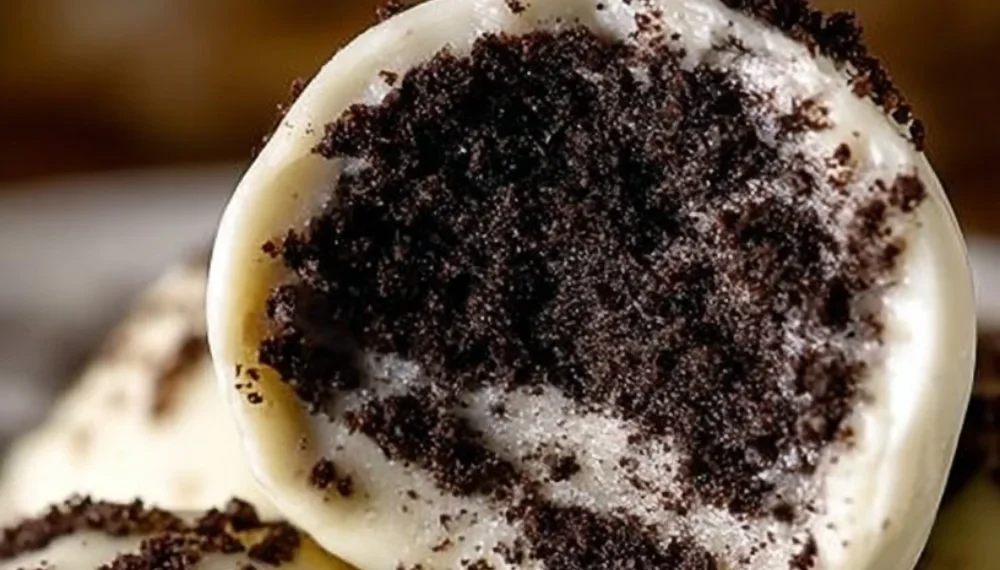
The process is meditative. There’s a particular joy in listening to the sound of cookies being crushed — a brittle, papery percussion — and then watching the crumbs gather like dark sand. Mixing with cream cheese is tactile and essentially human: fingers, bowls, and spoons become instruments of translation, turning packaged anonymity into something handcrafted. Chilling tightens the shape, giving the truffle its clean silhouette; dipping in molten chocolate bestows a glossy armor that will crack with a delicate snap in the mouth, releasing the soft, sweet center. The drizzle of white chocolate or a scatter of sprinkles is where personality surfaces: the personal signature, the small aesthetic choice that tells you who gathered these truffles and why.
Ingredients :
1 package Oreo cookies (approximately 36 cookies), 8 ounces cream cheese, softened, 12 ounces semisweet or dark chocolate for coating, Optional: white chocolate for drizzle, decorative sprinkles
Directions :
- Place the Oreo cookies in a food processor and process to fine crumbs. Alternatively, seal the cookies in a heavy-duty plastic bag and crush with a rolling pin until uniformly fine., 2. Transfer the crumbs to a bowl and add the softened cream cheese. Mix until the mixture forms a homogeneous paste with no visible streaks of cream cheese., 3. Portion the mixture into 1-inch balls using a small cookie scoop or spoon. Place on a parchment-lined tray and freeze or refrigerate until firm, typically 15–30 minutes., 4. Melt the coating chocolate using a double boiler or short bursts in a microwave, stirring frequently until smooth., 5. Using a dipping fork or two forks, submerge each chilled ball into the melted chocolate, gently tap to remove excess, and set back on parchment to allow the coating to set., 6. If desired, drizzle with melted white chocolate and finish with decorative sprinkles. Store chilled until served.
Ingredients through a cultural & historical lens
When I consider these ingredients — industrial cookies, soft cream cheese, and chocolate — I see an intersection of commerce and intimacy. Oreos embody the industrial era, a product of standardized production that allowed families across economic strata to share a common treat. Cream cheese, with its roots in European dairy traditions, was once a richness reserved for special occasions; now it softens and binds without ceremony. Chocolate, long a symbol of luxury and colonial trade, becomes both cloak and symbol: it hides the homely interior while elevating the truffle into the realm of celebration.
Taken together, they tell a story about how global trade and local kitchens collaborate. The bundled, shelf-stable cookie meets perishable dairy in the cool of a kitchen, and somewhere between the two a ritual is created. As ingredients traverse markets and epochs, they gather new meanings: the Oreo becomes a token of childhood in one city, an available luxury in another, and a base for community-making wherever it’s adopted.
Cooking the dish: sensory notes & traditional techniques
The sensory profile of an Oreo truffle is simple and exacting. The aroma is immediate: dark cocoa and sweet cream, nostalgic and compact. Texture is the real drama — a hard, shiny shell that gives under a gentle bite to reveal a strike of dense, velvety interior. The mouthfeel balances the sandy grain of crushed biscuits with the smoothness of cream cheese; sometimes you get a whisper of salt that cuts the sweetness, sometimes the chocolate coating leans bitter to offer contrast.
Traditional techniques here are less about precision and more about ritual. Chilling is an act of patience and promise; it’s akin to letting dough rest or letting flavors be calm before a meal. The dipping step is almost ceremonial: a moment of attention where each truffle is turned, coaxed, and finished. In many households, this is the time for stories — children line up to be the “sprinkler,” an elder will insist on the drizzle pattern that “works,” and the kitchen band of voices folds into the small, ritualized work.
How different regions prepare their version
Across regions, minor variations reveal cultural priorities. In the American Midwest, truffles might be rolled in chopped nuts or dusted with powdered sugar; in the South, a warm evening might see them paired with sweet tea or a bourbon glaze. Scandinavian adaptations favor darker, under-sweetened chocolate, aligning the truffle more closely with restrained Nordic palates. In parts of Latin America, you might find a wash of dulce de leche or a sprinkle of toasted coconut, adapting the truffle to local affinities for caramel and tropical textures. In urban Asia, cafes sometimes pair them with matcha dust or yuzu zest, folding in local flavors while keeping the straightforward mechanics intact.
These variations are instructive: the core remains resilient, but each locale nudges the truffle toward flavors that echo their landscape — citrus near coasts, toasted seeds where palms are common, or intensely dark chocolate where bitter notes are culturally prized.
Traditional ways this dish is shared or served
The truffle’s small size makes it almost ritual-ready. It appears on holiday platters, in wedding favor boxes, and along the periphery of afternoon tea. In some families, making truffles is itself a tradition: a group activity where children press and shape, and elders dip and decorate. In others, they appear as a gift — a tin of handmade truffles is a universal sign of care, like knitted mittens or a jar of jam.
Serving can be ceremonial or casual: placed on a porcelain plate with a linen napkin for formal gatherings, or set on a kitchen counter in a casual bowl for friends who drop by. In community gatherings, they’re often passed around on small paper doilies — a tactile reminder that even packaged foods can be made into communal offerings.
Storing the dish without losing its cultural essence
Storage is practical, but it can be ceremonial as well. Keeping truffles chilled preserves texture and creates the quiet ritual of retrieving them from a cool box, handing them over like a small treasure. In warmer climates, extra attention to sealing and cooler boxes becomes part of the caregiving: wrapping truffles in waxed paper, stacking them carefully, and transporting them to celebrations in insulated carriers carries a language of preservation and respect.
The cultural essence is tied less to temperature and more to intention. A tin stored for guests communicates forethought; a bowl left on a coffee table says “stay awhile.” Even when refrigerated, a truffle retains the memory of its kitchen origin if it’s shared with conversation and eye contact.
Cultural questions people often ask
People ask where such an unpretentious sweet fits within more formal culinary traditions. Is it “real” confectionery? The answer often reveals cultural attitudes toward what counts as handmade or artisanal. Others wonder about origins: did someone invent it on purpose, or did it emerge from resourceful improvisation? The common theme in responses is humility — the Oreo truffle is a kind of culinary patchwork, born of convenience and affection.
Questions about authenticity are frequent too. Some insist on precise technique; others celebrate variation. In many conversations, what matters less is orthodoxy and more whether the truffle is offered with warmth. Cultural critics sometimes ask whether factory-made components cheapen the handmade. Travelers, by contrast, admire the ease with which these truffles become local, proof that culinary innovation thrives when people make a recipe their own.
A closing note on food, memory & travel
In my travels, I have learned that the most meaningful dishes are often the simplest: a cookie, some cream, a ribbon of chocolate can carry the same heft as a centuries-old stew. Oreo truffles are modern, yes, but they are also vessels for memory. They arrive at gatherings like postcards — small, signed “wish you were here” moments — and they help stitch together lives that are often scattered across cities and continents.
In Sofia, those glossy orbs were less about their ingredients than about the translates of being together. In a world that accelerates constantly, such small acts of making and sharing insist on pause, on the humility of a handmade truffle passed in quiet conversation. They remind us that taste is not just a sense but a map, tracing where we’ve been and who we’ve chosen to keep near.
Conclusion
For a close variation and step-by-step inspiration, this resource offers two approachable methods and lovely finishing ideas: Oreo Balls Oreo Truffles – Cooking Classy.
Oreo Truffles
Ingredients
Method
- Place the Oreo cookies in a food processor and process to fine crumbs. Alternatively, seal the cookies in a heavy-duty plastic bag and crush with a rolling pin until uniformly fine.
- Transfer the crumbs to a bowl and add the softened cream cheese. Mix until the mixture forms a homogeneous paste with no visible streaks of cream cheese.
- Portion the mixture into 1-inch balls using a small cookie scoop or spoon. Place on a parchment-lined tray and freeze or refrigerate until firm, typically 15–30 minutes.
- Melt the coating chocolate using a double boiler or short bursts in a microwave, stirring frequently until smooth.
- Using a dipping fork or two forks, submerge each chilled ball into the melted chocolate, gently tap to remove excess, and set back on parchment to allow the coating to set.
- If desired, drizzle with melted white chocolate and finish with decorative sprinkles. Store chilled until served.