3-Ingredient Orange Candy
Introduction
There are some foods that travel with you like a photograph: small, luminous, capable of unspooling a whole day when you hold them to the light. The 3-Ingredient Orange Candy is one of those quiet artifacts. It is modest in its parts — orange juice, sugar, cornstarch — and extravagant in the memories it can summon. As a traveler who chases markets and kitchens across continents, I have found that the simplest confections often say the most about a place: the patience of a village grandmother stirring a pan in a kitchen warmed by an oven; the sharp citrus tang of an orange grove at dusk; the hush of a festival where sweets are offered to neighbors and strangers alike.
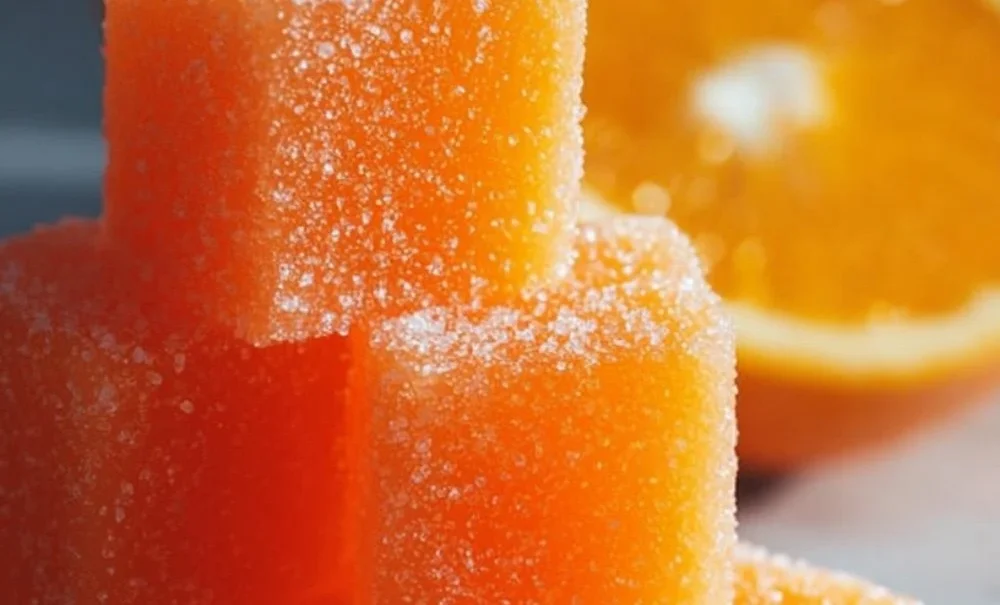
This candy lives between preserves and confection, a glossy slab of sunshine that can be cut into jewel-like cubes or strips. Its smell is immediate — bright, citrusy, an echo of groves where fruit grows close to the ground and wind brings the sea’s salt into the trees. Its texture sits in the mouth like a memory: somewhere between springy marmalade and a firm jelly, sticky at first until a dusting of powdered sugar turns each piece into a sugar-sanded jewel. To me, these candies are less about recipe precision and more about place: they are the taste of late harvests, of kitchens that transform what’s abundant into lasting sweets.
The origin story & regional influence behind this dish
Orange confections have an ancient lineage. Citrus itself began in Southeast Asia and has been a cargo of empires — spreading along the Silk Road, traveling with Arab traders into the Mediterranean, flowering in Moorish Spain and later in the sun-scorched orchards of Sicily and southern France. The idea of cooking fruit with sugar into a preserved, sliceable form is a Mediterranean and Middle Eastern tradition: think of candied peel, pâte de fruits in French kitchens, and Turkish lokum in its soft, fragrant versions.
This particular three-ingredient approach — fresh juice, sugar, and a thickening agent — is an elegant distillation of those older practices. It suggests a domestic ingenuity: an abundance of fruit, perhaps at season’s crest, met with a desire to slow time. In places where granulated sugar and cornstarch became common household items in the 19th and 20th centuries, cooks adapted older techniques to what was on hand. The result is a confection that nods to French fruit pastes and Italian cedro preserves, while being thoroughly modern in its simplicity.
Regionally, you will find echoes of this candy across coastal and island cultures where citrus is king: in Spain’s Andalusia, where bitter orange marmalade perfumes the air near Seville; in Morocco, where orange blossom water and preserved citrus are staples of hospitality; in Portugal and Brazil, where candied peel is folded into cakes and brigadeiros wear the scent of citrus on festival days. Each place adds a tilt: a rinse in bitter liqueur, a dusting of local sugar, or a pairing with dark chocolate.
How to make 3-Ingredient Orange Candy
Making this candy is less an act of chemistry than a ritual. It asks for attention: the patient stirring that keeps sugar from catching, the slow transformation of a bright liquid into something glossy and set. On the road I have watched women in small kitchens stir by windowlight, folding stories into each rotation, and I have cut into chilled pans on picnic blankets in olive groves. The procedure is simple and, when done with patience, almost meditative: watching steam gather, smelling sugar caramelize subtly beneath the citrus perfume, feeling the spoon trace a thickened trail.
This is a candy that invites improvisation after the cooking: cut it into tiny cubes to serve with tea, slice it into ribbons to tuck into a pastry box, or lay it over a slice of warm cake. The making is straightforward enough to happen in a hostel kitchen or an antique range in a family home; its result is intimate and generous, the kind of thing a traveler might offer from a small tin to a new friend and be rewarded with a smile that spans a language.
Ingredients :
1 cup fresh orange juice (strained), ½ cup granulated sugar, 2 tablespoons cornstarch, Optional: powdered sugar for coating
Directions :
In a saucepan, stir together orange juice and sugar over medium heat until dissolved., Mix cornstarch with 2 tablespoons of water to make a slurry. Slowly add to the saucepan while stirring constantly. Cook until thick and glossy, about 10–15 minutes., Pour the mixture into a parchment-lined or greased small pan. Let cool, then refrigerate for 2–3 hours until firm., Slice into cubes or strips and optionally coat with powdered sugar to prevent sticking.
Ingredients through a cultural & historical lens
Look closely at the list and you see a conversation between old and new. The orange, once a rare and prized fruit, became commonplace only through centuries of cultivation, trade, and imperial tastes. Sugar, another historical traveler, was for centuries a luxury imported from afar before becoming a staple in households worldwide. Cornstarch is a more modern entrant, an industrial product that changed home cooking by offering a reliable, everyday thickener.
Taken together, these ingredients tell a story of accessibility: where once fruit preserves required long, slow reductions and sometimes multiple cookings with whole peel, now a home cook can coax the essence of the orange into a set candy with a handful of pantry staples. Yet the cultural echoes remain — the final dusting of powdered sugar as a nod to the sugared finishes favored across Europe; the use of bright, fresh juice rather than extracts or concentrates, which keeps the candy tethered to place and season.
Cooking the dish: sensory notes & traditional techniques
The cooking stage is a small theater of transformation. The saucepan becomes a set where steam, smell, and sound signal change: the initial hiss of liquid coming to simmer, the soft settling of sugar as it dissolves, and ultimately the gentle click and thrum of a wooden spoon tracing a thickening pool. Aromatically, the kitchen fills with a citrus that is both floral and sharp, sweet with a green note that tells you the fruit was ripe and fresh. As the mixture thickens it takes on a gloss, like sunlight collected on glass.
Traditional techniques are less about exact timing and more about feel: knowing when the spoon leaves a clean trail, when the mixture runs like a slow waterfall back into the pan, or when a droplet will hold its shape on the spoon. In many homes I visited, the candy was judged by touch and sight, not by a thermometer. The catastrophic notes — burning sugar or an overcooked rubbery set — are avoided by that attentiveness: by stirring, tasting, remembering. When cooled and cut, the texture should be yielding and springy, a joyful resistance before melting into the warm, bright juice of the orange on the tongue.
How different regions prepare their version
Every region gives the idea of orange candy a different voice. In the Mediterranean, cooks often incorporate peel or orange blossom water to anchor the sweet in a bitter or floral counterpoint. In North Africa, citrus confections are sometimes softened with honey or perfumed with rose water. In parts of Latin America, where oranges grew alongside cacao, it is not uncommon to see candies paired with chocolate or rolled in toasted coconut. In Provence, the texture might skew firmer and the sugar finishing finer; in Sicily, a drizzle of local liqueur or the inclusion of blood orange juice will deepen the color and make the flavor more rustic.
These regional variations arise from what is abundant and what is revered. Where sugar was historically more expensive, cooks might stretch the orange flavor with peel or aromatic water; where chocolate is a cultural companion, orange finds itself wedded to bitter cacao. Yet the unifying trait is a desire to preserve the season’s fruit in a form that is portable, giftable, and bright with the sun.
Traditional ways this dish is shared or served
Sweets carry social currency. Across cultures, small candies are offered as tokens of welcome, shared during ceremonies, or placed on a plate with coffee after a meal. In Mediterranean towns, a small box of orange candy might be given to guests as a sign of hospitality. In some households, they appear on holiday tables, cut into diamonds and wrapped in tissue to be handed from elder to child. At weddings and religious festivals they may be part of a larger assortment of confections, each sweet marking a blessing or a wish for prosperity.
For travelers, the candy becomes a portable story: a piece passed across a café table, a handful put into a pocket for a hike, a slab wrapped in wax paper and given to a bus driver as thanks. It is served simply — often with tea, coffee, or on its own — and is valued as much for the sharing as for the eating.
Storing the dish without losing its cultural essence
Storage is practical but also cultural. To keep these candies is to preserve a moment — a harvest, a gathering, a conversation. Refrigeration will extend their life and preserve their glossy texture, while a dusting of powdered sugar will prevent sticking and add a visual finish that echoes sugared markets and festival stalls. In climates where humidity is a threat, airtight containers and sheets of parchment between layers will protect the candy’s texture.
But storage can also be ceremonial: tin boxes lined with fabric, passed down through families, become the vessel for memory. A traveler might tuck candies into a suitcase, their scent returning upon opening, an olfactory map of the places the sweet has been. The manner of storage — careful, reverent, almost shrine-like — becomes part of the candy’s cultural resonance.
Cultural questions people often ask
People often ask: is this a marmalade, a jelly, or a candy? The answer is that it is all three: a hybrid that sits in a culinary hinterland. Others ask whether the bright orange flavor is best from navel oranges, blood oranges, or a mix. The truth is that each choice tells a different story: blood oranges bring a rich, almost berry-like depth suited to winter traditions; navel oranges offer a clean, sunny sharpness favored in summer. Another common question is about the sugar: can it be reduced? Tradition encourages balance rather than austerity — the sugar is not merely sweetness but preservation, a historical act that gives summer’s bounty winter’s longevity.
Travelers also ask about pairing: with tea, coffee, or wine? Again, the answers multiply with culture. In some places, a bitter espresso cuts through the candy’s sweetness; in others, a tea scented with bergamot or orange blossom is the natural companion. Each pairing becomes a local conversation, a way to fold the candy into the rituals of a place.
A closing note on food, memory & travel
Sweets like the 3-Ingredient Orange Candy are tiny maps. They plot routes of trade and migration, trace the seasons, and hold domestic gestures — the folded napkin, the offering handed through a kitchen door. For the traveler, they are proof that complexity can be contained within modest means: a pan, a spoon, a jar of citrus. They teach us patience and attention, the slow pleasure of waiting for a mixture to set and the joy of cutting into cool, bright blocks.
I have carried these candies in my bag across borders, given them to strangers at bus stations, and received them in return in little ceramic dishes at kitchen tables. Each exchange has been a lesson: that food is an economy of hospitality, a language of generosity. When you make this candy, you’re doing more than following steps — you are joining a lineage that values sweetness as an act of preservation, and a small, molten way of saying, “This is my place, and you are welcome in it.”
Conclusion
If you enjoy the bright simplicity of this candy and want to explore a chocolateed counterpart, you might appreciate this take on orange and dark chocolate: 3-Ingredient Orange Dark Chocolate – Pickles & Honey.
3-Ingredient Orange Candy
Ingredients
Method
- In a saucepan, stir together orange juice and sugar over medium heat until dissolved.
- Mix cornstarch with 2 tablespoons of water to make a slurry. Slowly add to the saucepan while stirring constantly.
- Cook until thick and glossy, about 10–15 minutes.
- Pour the mixture into a parchment-lined or greased small pan.
- Let cool, then refrigerate for 2–3 hours until firm.
- Slice into cubes or strips and optionally coat with powdered sugar to prevent sticking.