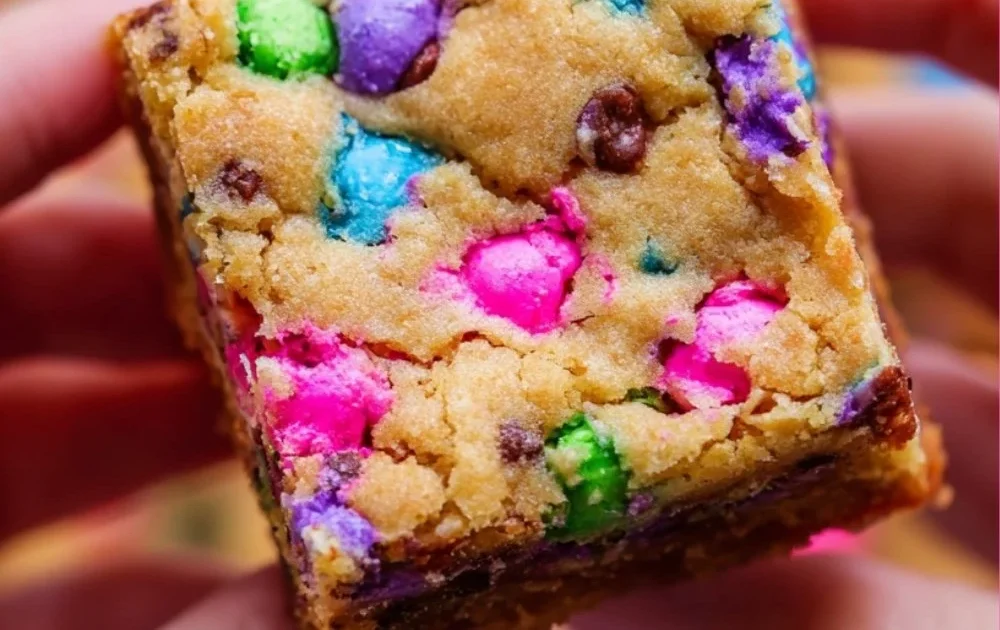
Easter Cake Mix Cookie Bars
Introduction
This recipe for Easter Cake Mix Cookie Bars condenses a familiar household shortcut into a methodically controlled baking application. The simplicity of a single-box cake mix combined with oil and eggs produces an aerated, sugar-forward matrix that browns predictably and sets quickly; treated with a chef’s attention to technique it can yield bars with an even crumb, glossy edges, and clean sliceability. For a focused primer on related methods and to compare structural results, consult this detailed cake-mix cookie bars method, which illustrates how ingredient ratios affect texture.
In the sections that follow I will analyze ingredient function, outline the procedural logic that justifies each step, and provide timing and heat-management guidance suited to both home ovens and a small professional environment. The goal is to enable repeatable results: uniform color, balanced sweetness, controlled moisture, and a pleasing contrast between tender interior and lightly caramelized perimeter.
The culinary logic behind this dish
At its core the recipe is a simplified genoise-like approach: a dry pre-mix provides leavening agents, flour, and sugar in fixed proportions, while the oil and eggs supply fat and liquid to create an emulsion. Because commercial cake mixes are calibrated for volume production, their sugar and leavening levels are often higher than in scratch recipes; they also contain emulsifiers and stabilizers that influence setting behavior. Understanding these components explains why the batter spreads and bakes rapidly and why timing is critical to avoid over-drying.
Flavor development is largely dependent on Maillard reaction and caramelization at the surface; the thin profile of a 9×13 pan accelerates both. Adding chocolate chips introduces localized pockets of fat and sugar that melt and re-solidify, offering textural contrast. For perspective on how inclusions change bake dynamics in similar bar treatments, see the pistachio-dream cookie bars which demonstrate how nuts and different fats alter heat transfer and mouthfeel.
How to make Easter Cake Mix Cookie Bars
Executing this recipe with professional consistency requires attention to emulsion quality, pan preparation, and oven calibration. The direction sequence is intentionally compact, reflecting the recipe’s simplicity; however, precision in mixing and heat control will determine whether the finished bars are cakey or dense, brittle or tender.
A strategic workflow is as follows: preheat early to stabilize oven temperature; measure and assemble ingredients at mise en place; combine wet and dry with minimal shear to preserve tender crumb; distribute batter evenly for uniform bake; monitor the bake using color and a small insertion test rather than relying solely on timing. For technique cross-references on spreading and pan management used in similar sheet-bar preparations review this sugar cookie bars technique.
Follow the provided Directions verbatim to maintain intended balance and don’t alter quantities or sequence.
Ingredients :
1 box cake mix (any flavor), 1/2 cup vegetable oil, 2 large eggs, 1 cup chocolate chips or sprinkles (optional), 1/2 teaspoon vanilla extract, 1/4 teaspoon salt
Directions :
- Preheat your oven to 350°F (175°C) and grease a 9×13 inch baking pan., 2. In a large bowl, combine the cake mix, vegetable oil, and eggs. Mix until well combined., 3. Stir in chocolate chips or sprinkles if using., 4. Spread the batter evenly into the prepared baking pan., 5. Bake for 20-25 minutes or until a toothpick inserted in the center comes out clean., 6. Allow to cool before slicing into bars and serving.
Note: The directions above are presented exactly as provided. The following sections expand on the rationale and technique to optimize each step without changing the recipe.
Ingredient analysis through a chef’s lens
- Cake mix: Acts as pre-weighed flour, sugar, leavening, and flavor base. It contains particulate emulsifiers that retain moisture and produce an initially aerated batter; it also drives browning via high sugar content. Because cake mixes vary by brand and flavor, expect subtle differences in color and caramelization rate.
- Vegetable oil: Provides an unctuous mouthfeel and keeps the crumb tender. Unlike butter, oil remains liquid at room temperature, which promotes a softer, moister bar but reduces buttery flavor and surface crispness.
- Eggs: Function as binders and structural agents. They incorporate water and protein which coagulate during baking, enabling clean slices and structural integrity.
- Chocolate chips or sprinkles: Chocolate chips introduce fat-rich pockets that melt and provide concentrated flavor and textural contrast; sprinkles offer color and minimal texture but can sometimes bleed color into the batter during baking.
- Vanilla extract and salt: Small-volume aromatics and flavor enhancers that round and balance the sweetness. Salt accentuates flavor; vanilla provides volatile aromatic compounds that register in aroma and perceived sweetness.
For comparative insights on how sugar and fat interplay affect chew and spread in bar and cookie systems, review the structural notes in this reference to high-fat cookie formulas: chewy maple-cinnamon cookies.
Kitchen workflow & technique breakdown
Mise en place is essential: preheat the oven first so thermal ramp is consistent. Grease the pan thoroughly—use an even coat of neutral oil or a release spray; if using butter, expect slightly faster browning at the edges. Combine the dry and wet components in a single bowl to minimize equipment and avoid over-aeration. Overworking an oil-based batter can lead to a denser result because gluten hydration is immediate; mix until homogeneous and stop at the point where no dry streaks remain.
When folding in chocolate chips or sprinkles, do so with a gentle, deliberate motion to ensure even distribution without degrading the batter’s structure. Transfer the batter to the pan and use an offset spatula to build an even layer; this is not merely cosmetic—an even thickness yields uniform bake and consistent internal temperature gradients.
Place the pan on the center rack for even air circulation. If you operate an oven with hot spots, rotate the pan halfway through the baking window. For precise control, an oven thermometer and an instant-read probe will allow you to monitor ambient and core temperatures respectively.
Texture control, heat management & timing
The bars’ texture will land on a continuum from cake-like to sliceable cookie-bar depending on bake time and batter hydration. The recommended 20–25 minute window exploits the thinness of the batter in a 9×13 to reach doneness before significant moisture loss. Key indicators of doneness are uniform golden color at the edges, slight spring when the pan is gently nudged, and a clean or near-clean toothpick.
If the insert test shows moist crumbs that smear, bake in two-minute increments to avoid over-drying. If the edges are darkening too quickly while the center remains underdone, reduce oven temperature by 10–15°F and extend bake time; this allows internal set without over-caramelizing the rims.
Cooling is equally important. Allow the pan to cool on a rack to ambient temperature; this permits residual steam to equilibrate and the structure to set. Removing too quickly and cutting warm can yield tearing and crumb smearing; cutting after adequate cooling produces clean, professional slices.
Professional variations
Without changing the base ingredients, technique adjustments can create distinct results:
- Crisper edge, tender center: Bake at 350°F for the lower end of the time range, then blast with 375°F for the last two minutes to increase surface caramelization.
- Denser, fudgier bar: Reduce bake time toward 20 minutes and consider chilling briefly before slicing to firm the interior.
- Decorated presentation: Use sprinkles for visual effect added before bake; for glossy toppings, melt chocolate chips into a ganache post-bake and spread thinly once bars have cooled.
- Flavor layering: Select cake mix flavors intentionally—vanilla for neutrality, lemon for brightness, or chocolate for intensity—and consider omitting vanilla extract when using a strongly flavored mix to avoid aromatic overload.
Each variation relies on controlling bake time and heat exposure rather than altering ingredient quantities.
Finishing touches & plating philosophy
Finishing should complement the structural characteristics. For moist, tender bars, a thin layer of tempered chocolate or a sheet of ganache adds contrast and bite. For lighter, more cake-like bars, a powdered sugar dusting or a simple glaze (confectioners’ sugar mixed with a minimal amount of water or milk) adds shine and delineation.
When slicing, use a large chef’s knife warmed under hot water and wiped dry to produce glossy, even edges. Cut in a single, decisive motion rather than a sawing action to prevent tearing. Present bars on a shallow tray in straight rows for a restrained, bakery-style display; for plated service, balance a bar with a small quenelle of lightly whipped cream or a smear of fruit reduction to provide acidity against the sweet base.
Maintaining quality after cooking
Storage affects both texture and flavor. Because the formula contains oil rather than butter, the bars retain moisture longer and are less prone to staling via retrogradation. Store in an airtight container at room temperature for up to 3 days; for longer storage, refrigerate for up to 7 days or freeze individually wrapped for up to one month.
To refresh chilled bars, allow to return to room temperature for 30–60 minutes or warm briefly in a 300°F oven for 5–8 minutes to restore tenderness. Avoid microwaving for extended periods, which can create localized overheating and syneresis (weeping).
Label and rotate your production to ensure consistent service quality: note bake time, oven position, and inclusion type so subsequent batches replicate successful outcomes.
Questions from home cooks (chef answers)
Q: Why does my batter sometimes spread unevenly in the pan?
A: Uneven spread is typically the result of inconsistent batter viscosity or an uneven pan surface. Ensure eggs are fully incorporated and the batter is homogeneous before transferring. Use an offset spatula to coax batter into corners; tap the pan gently on the counter once to remove trapped air and level the surface.
Q: My bars are too dry—how do I prevent that?
A: Reduce bake time incrementally and verify oven accuracy with a thermometer. Also ensure your pan is the correct size; a larger pan produces a thinner layer and dries faster. If using a dark pan, reduce temperature by 10°F.
Q: Can I substitute butter for vegetable oil?
A: Butter will increase surface browning and add richness but will change texture because of its water content and solid fat properties. If substituting, melt the butter and use the same volume, but anticipate a slightly firmer set and quicker surface coloration.
Q: Sprinkles bleed color in the batter—how to avoid it?
A: Use high-quality nonpareils or add sprinkles only on top of the spread batter, minimizing movement into the wet matrix. Alternatively, freeze sprinkles briefly to reduce color migration during bake.
Final chef notes
This recipe’s elegance resides in its economy: a pre-mixed base converted into a reliable sheet bar by controlling heat, emulsification, and timing. Small technical attentions—accurate oven temperature, homogeneous mixing, and patient cooling—deliver professional results. Embrace the recipe as a platform for technique rather than a limitation; with consistent execution it is reproducible at scale or in the home kitchen without modification to ingredients.
Conclusion
For an alternative presentation and detailed photography that complement the techniques discussed here, review this external recipe page which demonstrates a similar approach to assembly and finishing: Easter Cake Mix Cookie Bars • The Diary of a Real Housewife. For an instructive variation and additional serving ideas that align with the texture adjustments recommended above, consult this resource: Easter Cake Mix Bars – Cookie Dough and Oven Mitt.
Easter Cake Mix Cookie Bars
Ingredients
Method
- Preheat your oven to 350°F (175°C) and grease a 9×13 inch baking pan.
- In a large bowl, combine the cake mix, vegetable oil, and eggs. Mix until well combined.
- Stir in chocolate chips or sprinkles if using.
- Spread the batter evenly into the prepared baking pan.
- Bake for 20-25 minutes or until a toothpick inserted in the center comes out clean.
- Allow to cool before slicing into bars and serving.