Sugar Cookie Bars
Introduction
There are recipes that arrive like postcards from childhood—smudged with the butter of late afternoons, stamped with the laughter of cousins, mailed from kitchens that smelled of vanilla and sticky sugar. Sugar Cookie Bars are one of those postcards: a slab of simplicity that carries within it the soft cadence of home rituals and the bright, celebratory flash of decorated holidays. In my travels I have met these bars in school bake sales in the Midwest, at seaside picnics in New England towns, and layered between the tins of biscuits in Southern kitchens. Each taste unlocks a geography of small, intimate places, and the texture—more tender than a crisp cookie, flatter than a cake—becomes a language of comfort.
Walking through a market in a provincial town, I once saw a grandmother arrange a tray of pale frosted squares with the care of a jeweler placing stones. She told me they were a local favorite because they were forgiving—easy to make, easy to share—and tolerant of the idiosyncrasies of small pantries and busy lives. That is the magic of this recipe: it asks little, and gives much. For a modern nod, some bakers transform boxed shortcuts into new memories; if you enjoy exploring variations, you might also appreciate the nostalgic twist found in the cake mix cookie bars, which riff on the same idea of transforming humble ingredients into something communal and celebratory.
The origin story & regional influence behind this dish
Sugar cookies themselves are descendants of a long lineage of simple sweet doughs—European shortbread and butter-based biscuits—that traveled with settlers and adapted to new shelves and seasons. In the United States the sugar cookie found particular favor in areas where winter celebrations made portable, decorated sweets desirable: the Midwest, with its tradition of church socials and school events; New England, with its bake-sale culture; and the American South, where tea-time and potluck shaped smaller, easily transported confections.
Sugar Cookie Bars are a pragmatic cousin of the classic cut-out cookie. When a household needed to feed a crowd, or hurried hands could not spare the time to chill and roll dough, spreading the batter into a pan produced the same gentle vanilla-scented comfort in larger quantity. The tradition of flattening a cookie into a slab is also echoed in other cultures—think of Jewish rugelach adapted into traybakes, or the Mediterranean practice of making large sheets of simple nut-studded pastries—which suggests that many regions independently concluded that time and abundance favor the pan.
Regional variation often hinged on the choice of extracts, the richness of the butter, and the nature of the frosting. In immigrant communities, for instance, a whisper of almond extract—an heirloom flavor—could turn a plain bar into a remembrance of old-country confections. Thus, these bars became more than a quick dessert; they became a palette for memory, each nuance revealing migration, adaptation, and the practical poetry of home cooking.
How to make Sugar Cookie Bars
Ingredients :
1/2 cup butter, 3/4 cup sugar, 1 whole egg, 1 tsp. vanilla extract, 1/2 tsp. almond extract, 3 Tbsp. cream cheese; softened, 1 tsp. baking powder, 2 cups all-purpose flour, 1/4 cup butter; softened, 2 cups powdered sugar, 2 Tbsp. milk, 1/2 tsp. vanilla extract, pink food coloring gel (optional), sprinkles (optional)
Directions :
Pre-heat oven to 350 degrees F. Line a 9 x 9-inch baking pan with parchment paper and set aside., In a large bowl with a hand or stand mixer, beat together the softened butter and sugar until fluffy, then add the egg, vanilla extract, almond extract, and cream cheese until combined. Be sure to scrape down the sides of the bowl., Slowly add in the flour and baking powder until a thick cookie dough batter has formed. Be sure not to overmix., Spread the cookie dough into the prepared baking pan and evenly spread with a spatula. Bake for 20-25 minutes, or until set and the top is a light golden brown. Let cool for a few minutes., In the meantime, you can make the frosting. In a medium bowl, beat together the butter, powdered sugar, milk, vanilla extract, and pink food coloring gel. Add more milk if the frosting is too thick and you can add more powdered sugar if the frosting isn’t thick enough., Once cooled, spread the frosting generously on top of the cookie bars. Top with sprinkles, and cut into 16 square bars. Enjoy!
Ingredients through a cultural & historical lens
A list of measures can seem clinical, but each ingredient in these bars carries cultural weight. Butter speaks of regions where dairy was abundant and where cream was churned by hand; sugar suggests trade routes and transformed economies, once luxury now pantry mainstay. The small flourish of almond extract is telling: a commonly used nod to European baking traditions, it transports the palate to marzipan-studied tables and Northern European pastries. Cream cheese in the dough is a more modern intervention—an American innovation of the 20th century that lends tenderness and tang, a sign that this is not a centuries-old pastry untouched by adaptation but a living recipe.
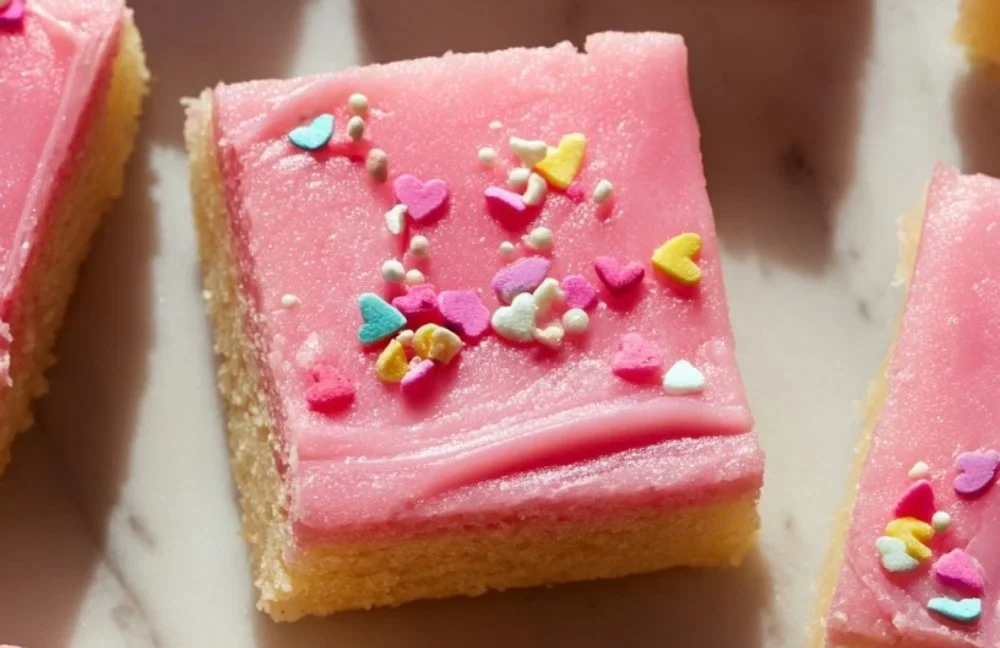
Powdered sugar and milk for the frosting are a shorthand for celebration. Across many communities, the act of frosting is communal—children gather with spoons and hands to spread sweetness—and the optional pink color and sprinkles become a local dialect of festivity. Pink frosting in particular carries gendered and generational connotations in some places; in others, it simply signals joy. The ingredients show how migration, commerce, and convenience converge: a damask of history in a humble pan.
Cooking the dish: sensory notes & traditional techniques
There is a distinct scent that announces the sugar cookie bar: the warm, clean perfume of vanilla, the fatty sweetness of butter, the faint, nutty note of almond. As the pan bakes, the smell spills into rooms and down stairwells, an olfactory invitation that draws family members to the kitchen. The texture is an essential part of the story—less crisp than a cut-out sugar cookie, softer at the center, with a delicate crumb that yields to the bite and a top that holds the frosting like a pale, edible canvas.
Traditionally, techniques were less about precision and more about rhythm. In many homes the butter is softened by hand at room temperature rather than precisely measured by digital clocks; the dough is spread into the pan with the back of a spoon or a flattened measuring cup. These small gestures matter: they produce a particular tenderness and warmth. Frosting is slathered not for symmetry but for generosity—gloves of sugar smoothed in broad, forgiving strokes that often carry the thumbprint of the baker. The result is one of intimacy rather than perfection.
How different regions prepare their version
Across the map, Sugar Cookie Bars arrive with regional signatures. In New England, the bars may carry a dusting of coarse sugar on the top before baking, a nod to the region’s love of texture. In the South, versions might subtly emphasize richness—higher butter and cream cheese content—or be served alongside coffee and fruit preserves for communal mornings. In Midwestern gatherings, vibrant frosting and an abundance of sprinkles signal school events and fundraisers; the bars become a social currency, bright squares that travel well in foil-lined pans.
In cosmopolitan kitchens, bakers sometimes fold in flavors from other traditions—citrus zest, cardamom, or a whisper of rose water—transforming the straightforward sugar bar into something transnational. Yet even with variation, the form remains: a pan of tender, frosted squares designed to be shared. For a perspective on how other traybakes reinterpret familiar textures and flavors, there are charming takes like the chewy maple cinnamon cookies, which retain the spirit of approachable sweetness while speaking clearly of place and palate.
Traditional ways this dish is shared or served
The act of sharing sugar cookie bars is itself a cultural ritual. At church bazaars they are boxed and labeled with apologies for the mess made by enthusiastic hands; at birthday parties they are stacked in colorful tiers; at a neighborhood potluck they are set, unassuming, beside casseroles and salads, and disappear in a civilized stampede. In many families, these bars are the dessert that travels—tucked into a casserole carrier or wrapped in wax paper, they survive short journeys and long conversations.
There are also ceremonial occasions: bridal showers where ribboned trays of pink-frosted squares echo the soft nuance of the day; school recitals where the simplicity of the bar gestures toward childhood; holiday cookie exchanges where the bars are cut into perfectly even squares, as if to offer equality and care in every portion. The ritual of cutting—into 16 squares, as this recipe prescribes—creates a choreography: the baker slices deliberately, then stacks, hands one to another. For bakers seeking easy-but-impressive treats that perform well at gatherings, the technique and portability are akin to the virtues one finds in an easy baked donut bars, which similarly prioritize convivial sharing.
Storing the dish without losing its cultural essence
Storage is a small act of preservation and reverence. Wrapped well, these bars keep their intended softness: a single layer in an airtight container, parchment between stacks, and refrigeration if the house is warm. But the method matters as much as the temperature. Many families insist the frosting set at room temperature before the bars are stacked—an ethical stance as much as a practical one—so that the decoration remains intact and the first bite is unmarred by smeared sugar.
When sending these bars to loved ones, I have noticed an etiquette: include a small note about whether they are best served slightly chilled or at room temperature. This gentle instruction preserves the baker’s intent and the memory the bars were meant to carry. Long-distance sharing also invites adaptation—individuals freeze the uncut slab for a future moment, thawing and frosting anew as if reviving a shared day—so the act of storage becomes another chapter in the recipe’s life.
Cultural questions people often ask
People ask whether sugar cookie bars are “authentic” in the way one might ask about a dress bought on a trip—what counts as original? Authenticity here is porous. The bars are less a fixed artifact and more a vernacular practice: they exist because people needed something simple, shareable, and sweet. Another frequent question is about substitutions—can this be made dairy-free or gluten-free? Such adaptations are acts of inclusion, allowing different tables to receive the same hospitable gesture. When substitutions enter the conversation, they carry stories too: of dietary necessity, of innovation, and of the desire to keep ritual alive.
Others wonder about the decorative aspect: do sprinkles cheapen or celebrate? The answer is resolutely cultural—sprinkles are celebration in many American contexts, signaling school days and childhood parties, while elsewhere a more restrained finish might be preferred. The bar’s strength is precisely its capacity to carry whatever meaning a community prefers, from plain and honest to jubilant and bedazzled.
Conclusion
In the quiet geography of the kitchen, Sugar Cookie Bars are a map of belonging: a slab of dough that tracks through migration, economy, and domestic life. They are at once humble and ceremonious, a single pan capable of producing comfort for the small and spectacle for the many. If you want to explore similar traybake sensibilities or see other home bakers’ interpretations, Sally’s recipe for Frosted Sugar Cookie Bars offers a well-loved, approachable take, while Tastes Better From Scratch’s version of Sugar Cookie Bars presents another affectionate perspective on this enduring favorite. Both act as companions on a journey that begins with a simple list of ingredients and ends, inevitably, at the table.
Sugar Cookie Bars
Ingredients
Method
- Pre-heat oven to 350°F (175°C). Line a 9 x 9-inch baking pan with parchment paper and set aside.
- In a large bowl with a hand or stand mixer, beat together the softened butter and sugar until fluffy, then add the egg, vanilla extract, almond extract, and cream cheese until combined. Be sure to scrape down the sides of the bowl.
- Slowly add in the flour and baking powder until a thick cookie dough batter has formed. Be sure not to overmix.
- Spread the cookie dough into the prepared baking pan and evenly spread with a spatula.
- Bake for 20-25 minutes, or until set and the top is a light golden brown. Let cool for a few minutes.
- In the meantime, make the frosting. In a medium bowl, beat together the butter, powdered sugar, milk, vanilla extract, and pink food coloring gel. Add more milk if the frosting is too thick and adjust powdered sugar if not thick enough.
- Once the cookie bars are cooled, spread the frosting generously on top. Top with sprinkles, cut into 16 square bars, and enjoy!