Decadent Raspberry Coconut Balls That No One Can Resist
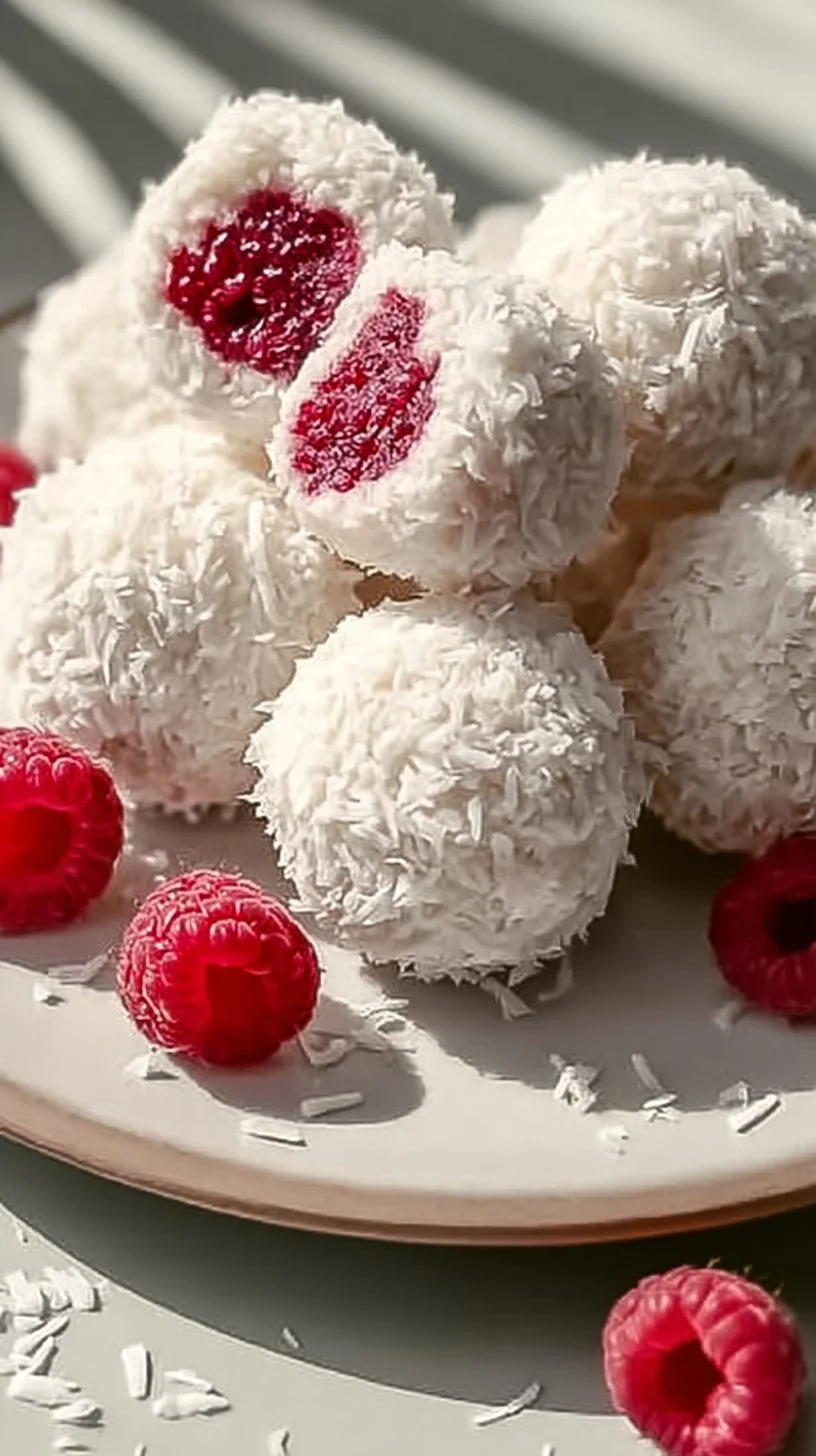
There are recipes that announce themselves with oven heat and timers, and there are recipes that arrive like postcards: small, intimate, and carrying a scent that pulls you backward through years and across seas. The Decadent Raspberry Coconut Balls That No One Can Resist belong firmly to that second kind. They are not merely sweet morsels; they are portable memories—soft, fragrant orbs that sit cool in the mouth, a tiny architecture of tropical coconut and bright, tart raspberry. In markets and kitchens from Bali to Brittany, cooks fold fruit into coconut fat and press it into palm-sized offerings for guests. When I first tasted a version of these balls in a seaside guesthouse, a woman pressing raspberries into each center told me she made them for sailors who came home for a night. If you want something to pair with that memory, try a similar, playful treat like this coconut dome with chocolate spread, which echoes the same tropical simplicity in a different register.
What makes these balls so arresting is not complexity but the way they balance two climates: the humid, creamy world of coconut and the cool acidity of raspberries. They sit comfortably in the palm, their outer shell of shredded coconut catching light, their heart a ripe, sudden burst. Writing about them feels like tracing old trade routes—coconut palms leaning over white sand, berry-laden hedgerows in northern valleys—and threading together stories that belong to people who make small, generous things to celebrate homecomings, rituals, and the ordinary kindness of offering food.
The origin story & regional influence behind this dish
The pairing of coconut and berry is a modern folk-migration—an editorial flourish played out on a global pantry. Coconut, with its roots along tropical coasts, traveled by canoe and cargo ship: a muscle of commerce and subsistence in the Indian Ocean, the Caribbean, and the Pacific. Raspberries, on the other hand, tell a colder tale: hedgerows and mountain clearings in Europe, highland farms where the fruit ripens quickly and must be eaten fresh or preserved. When migrations, trade, and colonial kitchens met, ingredients crossed cultural borders like languages.
In colonial kitchens of the 18th and 19th centuries, cooks borrowed techniques—preserving fruit with sugar, creating sweet patés and small confections—and adapted them with local staples. Coconut found its way into puddings, candies, and ceremonial sweets in places as varied as Goa and Jamaica, while European cooks experimented with adding tart preserves and fresh berry to creams and pâte de fruits. The result was hybrid dishes that carry the imprint of two worlds: the dense, soothing mouthfeel of coconut and the clarifying brightness of berry.
These balls also reflect modern sensibilities: a turn toward small, elegant bites that can be offered at gatherings without fuss, and a reclaiming of old flavors in a no-bake, healthful format. In island communities, sweets made from coconut were often reserved for celebrations—weddings, harvests, the arrival of friends. In temperate regions, raspberries carried their own rituals—summer fêtes, afternoon tea, the careful passing of a bowl from hand to hand. Combine the two, and you have a confection that can travel between traditions, a sweet that feels at home both in a seaside hamlet and at a metropolitan potluck.
How to make Decadent Raspberry Coconut Balls That No One Can Resist
The act of making these balls is an anthropology of touch as much as it is a kitchen ritual. You gather the coconut like a small flock, coax the coconut cream into velvet, and prepare the raspberries like secrets ready to be tucked away. There is a slow, intimate cadence to the work: a little melt, a little chill, a gentle press. If you enjoy other playful, no-bake confections that transform simple pantry items into celebration pieces, you might delight in the craft and whimsy found in this Easter egg Oreo cookie balls, which, like these raspberry coconut spheres, turn common ingredients into something festival-ready.
To make them is to practice hospitality in miniature. The recipe asks for very little: coconut and cream, a binding oil, a whisper of sweetener and vanilla, and the raspberries themselves—each one a flash of color at the center. As you shape the balls, you are also shaping a moment: the way a host offers a tiny thing that promises delight, the way friends lean forward when you present a tray, curious and delighted by such an efficient, tactile pleasure.
Ingredients :
1 cup shredded coconut (Choose sweetened or unsweetened based on your preference.), 1/2 cup coconut cream (Ensure it’s thick and chilled.), 1/4 cup coconut oil (Melted; acts as a binding agent.), 1 tablespoon honey or maple syrup (Opt for maple syrup to keep these treats vegan.), 1/2 teaspoon vanilla extract (Adds depth of flavor; almond extract is a good substitute.), fresh raspberries (These make the sweet surprise at the heart of each ball.), extra shredded coconut (For rolling the balls.)
These words—measured, clean—are the bones of the recipe. But each ingredient carries a story. Shredded coconut can be the product of hand-grating in a village kitchen or the finely flaked, bright white stuff wrapped in cellophane in a city grocer’s aisle. Coconut cream, thick and gleaming, suggests the island women who knead and press coconut until the milk separates into silky fat. Coconut oil is at once a binding agent and a memory of pan-fried breads and healing balms. Honey or maple syrup gestures toward local sweeteners: honey from a neighbor’s backyard hives, maple syrup gathered in a northern sugarhouse. Vanilla, with its soft floral perfume, is a reminder of the colonial spice routes and the labor of hands who tend the vines. And raspberries—delicate, ephemeral—connect the recipe to cool summers and hedgerow walks, the small rituals of picking and tasting the first ripe fruit.
Directions :
How to Make Raspberry Coconut Balls
Ingredients through a cultural & historical lens
Cooking the dish: sensory notes & traditional techniques
How different regions prepare their version
Traditional ways this dish is shared or served
Storing the dish without losing its cultural essence
Cultural questions people often ask
A closing note on food, memory & travel
How to Make Raspberry Coconut Balls
Think of this as a small meditation. The coconut cream should be cool and thick, almost like soft whipped cream in feel. When you fold it into the shredded coconut with a touch of melted coconut oil, you are creating a dense, pliable paste—an edible clay that will embrace the raspberry. Each raspberry is a tiny, perishable jewel; the moment you press it into the center of the coconut mixture, you lock in a summer that will travel with you.
There is a quiet choreography to the assembly: spoon the mixture into your palms, form a shallow nest, lay the raspberry within, and close the coconut around it as if sealing a letter. Rolling each ball in extra shredded coconut is both decorative and practical—it keeps them from sticking and gives a frosted appearance reminiscent of snow, a visual contrast that makes the interior berry feel even more vivid. Chill them to set; the cold sharpens the textures and lets the flavors settle.
The making is often done in conversation—children counting raspberries, elders watching the rhythm of hands, friends standing close enough to steal a taste. These moments are the invisible ingredient that turns a simple recipe into a carried memory.
Ingredients through a cultural & historical lens
Every ingredient is a waypoint on a map of human movement. Coconut tells of banana-shaped boats and colonial plantations, of backyard processing and industrial packaging. Raspberries tell of cottage gardens and market stalls; their presence in a tropical coconut ball is a signifier of global kitchens learning from one another. Sweeteners—honey, maple, cane—mark local economies and seasonal work: the beekeeper’s summer, the sugarmaker’s late winter boil.
Vanilla extract has its own fraught history: a fragrance harvested laboriously from pods and cultivated under particular climates. To mention it in this recipe is to nod to those complex legacies, where sweetness is entwined with trade, labor, and the slow, patient cultivation of plants.
When you choose sweetened or unsweetened shredded coconut, you are making a small cultural decision: do you want the confection to lean toward the richly saccharine treats of some tropical festivals, or toward the cleaner, more restrained sweets of northern patisseries? Each choice carries an inherited taste.
Cooking the dish: sensory notes & traditional techniques
This is a no-bake ritual where temperature and patience matter more than flame. The first sensory note is the smell: a warm, faintly floral coconut aroma when the oil is melted, followed by a perfume of vanilla that lifts the base. The texture is what makes people close their eyes—soft coconut enveloping a burst of juice. The mouthfeel is a contrast between the slightly granular shredded coconut and the velvet richness of the coconut cream, punctuated by the raspberry’s tiny seeds and juice.
Traditional techniques—pressing, chilling, hand-rolling—are tactile and communal. In many cultures, sweets are formed by hand, the maker’s hands bearing the imprint of time, work, and care. A grandmother’s palm-shaping is as much a transmission of taste as is a recipe card. The act of chilling is often done in handmade wooden chests or cool cellars in older homes; in modern kitchens, a refrigerator suffices, but the slow setting of the balls gives them a firmness that makes them pleasurable to hold and bite.
How different regions prepare their version
Across the world, the same recipe will bear different signatures. In coastal communities where coconuts are abundant, there may be a preference for using freshly grated coconut and freshly squeezed coconut milk, giving the balls a green-fresh note. In northern kitchens, where raspberries are prized like jewels, the fruit may be macerated first with a drop of syrup to intensify the sweetness, or a dusting of powdered sugar might crown the finished bites.
Some chefs fold toasted coconut into the mixture for a smoky depth; others substitute different berries or add citrus zest to pull the flavors toward the cool, tart end of the spectrum. In certain festivals, the balls are studded with a single nut or wrapped in decorative leaves, adapting the form to local ritual aesthetics. In these shifts, you can trace local resources and tastes: whether kitchens lean on toasted notes, floral vanillas, or the pure, raw green of fresh coconut.
For an example of how no-bake treats take on local character and playfulness, you can see a whimsical transformation of common ingredients in this no-bake Grinch pie, where imagination reinterprets pantry staples into something celebratory and regionally resonant.
Traditional ways this dish is shared or served
These balls are made to be offered. They appear on dessert plates at intimate dinners, carried in picnic baskets to afternoon gatherings, and arranged on platters at weddings. In some cultures they are given as tokens of hospitality—three for a returning friend, a small gift wrapped in paper for neighbors. They travel well for long journeys because the coconut shell keeps the raspberry snug and the cold keeps them fresh.
Serving them is often ceremonial in its own small way: placed on lacquered trays, sprinkled with a little extra coconut like powdered snow, or accompanied by tea that contrasts the sweetness with tannin and warmth. When served at festivals, they may be arranged in concentric circles, a visual language of abundance.
Storing the dish without losing its cultural essence
Storage is part of the care. These balls prefer the cool and the short term; refrigeration keeps the coconut firm and the raspberry intact. If you are packing them for travel, place them in a single layer on waxed paper to prevent sticking. When we move food from one place to another—across time zones, across seasons—we also move its stories. Labeling a container with who made them and when becomes a small act of preservation, ensuring that the recipe is more than an ingredient list; it is a memory bank.
Avoid freezing if you want to preserve the raspberry’s texture—thawing tends to make the berry lose its shape. But if long-term storage is necessary, freezing in an airtight container with parchment between layers will keep them serviceable, if not quite the same as fresh.
Cultural questions people often ask
People ask whether the raspberry will leak, whether the coconut will be too sweet, whether a substitute can honor the recipe’s integrity. The answers are often pragmatic but poetic: a firm raspberry will hold better, unsweetened coconut will allow the berry’s brightness to sing, and substitutes—like using blueberries—transform the identity of the ball in ways that are not right or wrong, simply different. There is always a tension between preservation and innovation in food: the desire to honor a form and the urge to make it your own.
Another common question is about ritual: when is it appropriate to serve such a sweet? The answer varies: morning tea in some homes, a closing touch to a sunlit luncheon in others, or a small blessing at a rite of passage. The context you choose writes its own history.
A closing note on food, memory & travel
Food carries us. A bite of coconut and raspberry can be a compass, pointing to beaches where palms shade nets, to hedgerows heavy with fruit, to kitchens where hands moved without looking because they had done so for decades. These Decadent Raspberry Coconut Balls are modest in scale but generous in what they hold: climate, migration, ritual, and the small economies of domestic love.
In another kitchen, centuries ago, someone might have combined a tropical and temperate ingredient on whim; today, we do it more knowingly, aware of the routes and stories that make such a union possible. To serve one of these balls is to offer a conversation between regions and memories, sweet and tart, cold and creamy. It is to say: taste this, and remember that the world is stitched together by little acts of making.
Conclusion
If you want to see a floral, peppered take on similar petite raspberry treats, there’s an evocative version in which rose and pink peppercorn transform the flavor profile—see this delicate preparation at Raspberry, Rose and Pink Peppercorn Love Bites. For another riff that celebrates the blissful simplicity of raspberry and coconut in a no-bake format, explore the comforting take in Raspberry coconut bliss balls – Panaceas Pantry, which echoes many of the textures and emotions described above. And if you are inspired by the broader family of fruit-forward desserts and want a personal essay on how certain pies become heirlooms, read this reflective piece about a cherished family dessert at Taste the decadent, dark chocolate and strawberry pie my dad describes as a keeper.
Raspberry Coconut Balls
Ingredients
Method
- In a mixing bowl, combine the shredded coconut, coconut cream, melted coconut oil, honey (or maple syrup), and vanilla extract.
- Mix until a dense, pliable paste forms.
- Take a small amount of the mixture and form a shallow nest in your palm.
- Place a raspberry in the center and close the coconut mixture around it.
- Roll the ball in extra shredded coconut to coat.
- Place the formed balls on a plate and chill them in the refrigerator for about 30 minutes to set.