White Chocolate Raspberry Cheesecake Balls
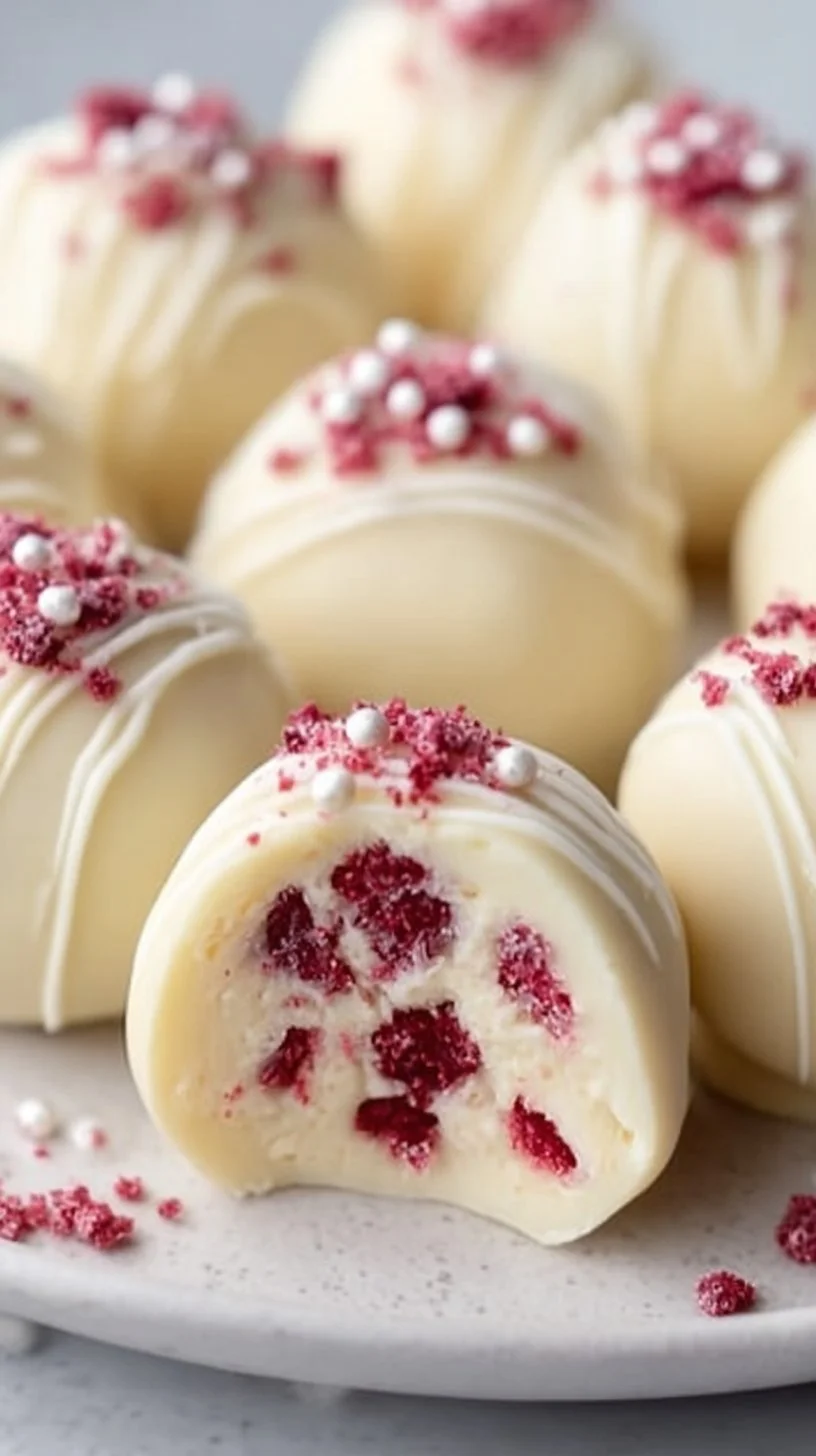
There are recipes that arrive like postcards from a place you’ve never been—small, intimate, and freighted with scent. White Chocolate Raspberry Cheesecake Balls are one such postcard: a no-bake confection that tastes like late-summer hedgerows and candlelit kitchens. When I first encountered these little orbs in a seaside village café, they arrived on a plate like polished stones—cool to the touch, lacquered with powdered sugar thoughts and wrapped in the buttery warmth of graham crumbs. The first bite was a memory: the gentle tartness of raspberry pressing against the milk-sweet hush of white chocolate, a texture that held and then softly gave like pressed velvet. These are desserts that travel easily in a tin, that appear at impromptu celebrations, and that function as tiny acts of hospitality.
In cities and villages from the Mediterranean to the Midwest, people adapt small cheesecakes into pastries and bonbons; there is a kinship between these cheesecake balls and other portable sweets such as white chocolate Easter bark, which also feels like an edible photograph—simple, bright, and instantaneously readable for what it is. The cheesecake ball is a small ritual: a chilled sphere unwrapped from a crumbly coat, revealing a creamy center that bears the mark of where it was made—whether in a cramped urban flat, a farmhouse kitchen, or a café overlooking a harbor.
The origin story & regional influence behind this dish
This recipe is a hybrid of American dairy traditions and European indulgences. Cheesecake itself has roots that can be traced back to Ancient Greece, where dense, cheese-based cakes offered to athletes were a form of sustenance and celebration. Over centuries, the technique traveled west, absorbing influences: the airy versions of German Käsekuchen, the ricotta-rich Italian variations, the dense New York style that champions cream cheese. The idea of converting cheesecake into small, bite-sized balls is modern and practical, born of a culture that relishes portability, small plates, and communal grazing.
Raspberry and white chocolate together tell a story of late 20th-century dessert fashion. White chocolate—an invention of industrial confectionery—paired with the tartness of raspberries creates a balance that became popular in American and European patisseries in the 1990s and 2000s. The graham cracker coating is a distinctly North American gesture; graham crackers are a child of 19th-century American pantry culture, a sweetened whole-wheat biscuit that has become shorthand for a certain marshmallow-and-firelight comfort. So the cheesecake ball, rolled in graham crumbs, reads as a product of cross-pollination: old-world cheese traditions meeting new-world convenience and sweetness.
Regionally, you’ll find variations: in the Pacific Northwest, for example, where raspberries are abundant, these balls may be wrapped in toasted hazelnut crumbs; in Britain, digestive biscuits may replace graham crackers; in parts of Latin America, dulce de leche might be swirled through the center. Each iteration reflects availability and the local imagination, and with each one the dish accrues a new human story—grandmothers folding berries into cream at family fêtes, café owners experimenting during slow afternoons, children pressing crumbs into round shapes as an introduction to making pastry.
How to make White Chocolate Raspberry Cheesecake Balls
The pleasure of making these is less about technique than about the quiet rhythm of hands and time. There is a domestic choreography: beating cream cheese until it remembers its softer self, watching white chocolate melt into a glossy pool, coaxing raspberries into bright little pockets of acid. The steps are unpretentious, designed so that anyone can make them and, in making them, speak a little language of care.
Ingredients :
8 oz cream cheese, softened, 1 cup white chocolate chips, 1/2 cup raspberries, fresh or frozen, 1 cup graham cracker crumbs, 1/4 cup powdered sugar, 1 teaspoon vanilla extract
Directions :
- In a mixing bowl, beat the softened cream cheese until smooth., 2. Melt the white chocolate chips in a microwave or double boiler, then let it cool slightly., 3. Add the melted white chocolate, raspberries, powdered sugar, and vanilla extract to the cream cheese and mix until well combined., 4. Refrigerate the mixture for about 30 minutes to firm it up., 5. Once chilled, scoop out small amounts and roll them into balls., 6. Roll the balls in graham cracker crumbs until fully coated., 7. Place on a baking sheet lined with parchment paper and refrigerate until set., 8. Serve chilled and enjoy your delicious no-bake dessert!
There is an economy of gesture in those directions. Each sentence is a steady breath: smooth the cheese, melt the chocolate, fold the berries like tiny red secrets into the mixture. If you were to watch an elder of the family follow these steps, you would notice things not in the written instructions: a pause to smell the vanilla, the way they pinch a raspberry and let its juices fall like a small blessing, the hum of the refrigerator as it firms the balls into shape. These are the human additions—timing measured by feel, not strictly by the clock.
Ingredients through a cultural & historical lens
Ingredients are not neutral: they are markers of place and economy. Cream cheese, for instance, carries with it the history of refrigeration and industrial dairy—an American invention that reconfigured desserts in the 20th century. White chocolate chips are a nod toward confectionery economies, the product of cocoa butter rather than cocoa solids. Raspberries, whether wild or cultivated, evoke hedgerows and farmers’ markets, their tartness a bright punctuation against the richness.
Graham crackers, used here as a coating, are at once poetic and prosaic. They were invented in the 1800s by Sylvester Graham, who advocated a diet he believed was morally salutary. Over time, graham crackers shifted from moral remedy to scrappy, beloved pantry staple—used for crusts, crumbs, and as a fingerprint of childhood. Powdered sugar and vanilla are seasoning that transcend borders: powdered sugar has an old-world confectionary pedigree, while vanilla—once an exquisite spice sourced from distant orchids—connects this dish to global trade routes and colonial histories.
When you assemble these elements, you are layering histories: indigenous berry-picking and European dairy craft, industrial sweeteners and domestic ingenuity. The result is a modern confection that tastes of many places at once.
Cooking the dish: sensory notes & traditional techniques
Making these cheesecake balls is primarily a tactile and aromatic affair. The softened cream cheese has a cool, supple texture, and when beaten, it yields a whisper-smooth base. Melted white chocolate becomes a glossy stream that cloaks the cheese in sweetness and gives the interior a satiny mouthfeel. Fresh raspberries, when folded in, burst their skins with a tiny, satisfying pop; frozen ones release a gentler, more diluted jewel of flavor.
Traditional technique here is less about precision and more about timing and touch. The refrigeration step is a small patience test, a lull in which flavors knit together and the mixture becomes friendly to rolling. The act of rolling—small palms shaping spheres—carries its own rhythm; rolling evenly ensures the crumb coating adheres, a final tactile flourish before the cold sets the ball into something firm and presentable.
When you serve them, notice the temperature contrast: the chill of the center and the dry warmth of the graham crumbs. Notice how the white chocolate softens on the tongue, how raspberry acid slices through the sweetness, how the powdered sugar clings to the lips like a memory of frost. Such details are the texture of travel: small observations that root a taste in place.
How different regions prepare their version
Across the globe, cooks make these balls speak local dialects. In northern Europe, cooks might favor a shortbread crumb over graham, or fold in lingonberries in place of raspberries, producing a tartness that is woodsy and firm. In Latin America, dulce de leche ribbons or a sprinkle of cinnamon may enter the mixture, tying the ball into broader traditions of caramelized sweetness. In Japan, where small, artistically rendered confections are prized, these balls could be dusted with matcha powder or presented atop miniature rice-paper doilies, each one a study in restraint and aesthetic.
In the American South, you might find pecan crumbs pressed into the outer layers, an homage to the region’s nut harvest. In coastal Mediterranean towns, chefs might add a few drops of lemon zest and trade graham crumbs for finely crushed amaretti, introducing an almond lift. Even within a single city, boroughs will reinvent them: a café with a Scandinavian menu might opt for cardamom in the mix; a patisserie influenced by New York styles will lean into the cream cheese’s boldness, sometimes adding a hint of sour cream or mascarpone.
And yet, despite these differences, the core remains: a creamy center, a bright berry note, and a thoughtful exterior that connects to place.
Traditional ways this dish is shared or served
These cheesecake balls are small ceremonial acts. They appear at potlucks, tucked in between other offerings like miniature ambassadors; they are placed on dessert tables at birthday parties, where the smallness becomes democratic—no one takes more than one, everyone is given a chance. In some communities they are presented with tea, their sweetness balancing astringent leaves. In others they accompany coffee, a soft counterpoint to the quick, bitter sip.
There are seasonal rituals too. In summer, they arrive with raspberries plucked hot and still sticky; in winter, frozen berries stand in as memory-makers. At weddings, they may be served as petit fours, an intimate alternative to layered cakes. In many families, rolling the balls is a communal activity—children press crumbs onto balls, elders taste and adjust, stories are traded as easily as crumbs. These moments transform a simple recipe into an anchor of family lore.
Storing the dish without losing its cultural essence
Storage is practical but also symbolic: how you keep food says something about how you value it. These balls keep well in the refrigerator for several days, and if you must freeze them, they travel remarkably well wrapped in parchment and kept in a sealed container. Yet consider the subtle sacrifices: raspberries lose some of their bright vibrance after freezing; white chocolate can bloom under fluctuating temperatures. To preserve the sensory integrity—what you might call the recipe’s cultural essence—store them in a single layer, with a sheet of parchment between layers, at a steady chill. Bring them back to the table from the fridge a little before serving so their texture loosens and the flavors bloom.
When moving these balls between places—say, from a kitchen to a picnic under plane trees—pack them with intention. Use shallow tins, and cushion them as you would a small artifact. The care you take in transport is itself part of the story you tell with the dessert.
Cultural questions people often ask
People often ask: is this a “real” cheesecake? The answer depends on what you mean by real. If “real” is dense, baked, and sliceable, then perhaps not. But if “real” means a vehicle for memory and communal sharing, then yes. Others wonder whether white chocolate is too sweet, and the reply is that balance comes from the berry—the raspberry’s acid lifts and clarifies the white chocolate’s creamy sweetness.
Questions about substitutions come up too. Can you use other berries? Absolutely; blueberries or blackberries change the perfume of the ball in interesting ways. Can you make them vegan? Yes, but the texture will shift, and you will enter a different culinary conversation—one informed by alternative dairy cultures. The most tender question, though, is often about ritual: who gets the first one? And the customary answer in many houses is simple: offer it to the eldest or to the guest of honor. This small etiquette carries the weight of gratitude and hospitality.
A closing note on food, memory & travel
Food is a way of carrying places with you, whether in a suitcase or a jar. White Chocolate Raspberry Cheesecake Balls are small repositories of time and place—childhood summers, the hush of a late-night kitchen, the bright bustle of a farmers’ market. They are portable enough to travel but intimate enough to anchor you. When you make them in a new town, they will taste of that town; when you share them on a road trip, they will collect the dust of the miles and the conversations shared over them.
In many wayfarer’s tales, small things—like a single pastry—become lodestars. They point back to a moment: the taste of raspberry on a cliffside, the stick of crumbs on a child’s chin, or a friend’s hands rolling dessert as an apology. These spherical sweets remind us that culinary travel is often about compression: taking the vast, diffuse experience of a culture and rendering it into a small, repeatable act of care.
Conclusion
If you want to see how other cooks translate similar flavor combinations into different formats, there are lovely variations that expand on the same conversation—one takes the concept into truffle form in a Valentine’s setting, another transforms it into a bar you can slice and share, and a third offers a bar that balances white chocolate and raspberry in a way that emphasizes texture. For inspiration and further reading, explore a recipe for Raspberry Cheesecake Truffles | Valentine’s Day Dessert Recipe, a richly detailed take on bars at White Chocolate Raspberry Cheesecake Bars – Sally’s Baking, and another bar-focused interpretation at White Chocolate Raspberry Cheesecake Bars – Lemons & Zest. Each link opens a doorway to a slightly different cultural translation of a simple, beloved pairing—white chocolate and raspberry—so you may continue your own culinary travels from home.
White Chocolate Raspberry Cheesecake Balls
Ingredients
Method
- In a mixing bowl, beat the softened cream cheese until smooth.
- Melt the white chocolate chips in a microwave or double boiler, then let it cool slightly.
- Add the melted white chocolate, raspberries, powdered sugar, and vanilla extract to the cream cheese and mix until well combined.
- Refrigerate the mixture for about 30 minutes to firm it up.
- Once chilled, scoop out small amounts and roll them into balls.
- Roll the balls in graham cracker crumbs until fully coated.
- Place on a baking sheet lined with parchment paper and refrigerate until set.
- Serve chilled and enjoy your delicious no-bake dessert!