Oreo Sushi Rolls
Introduction
There are small pleasures that stitch themselves into the map of a life: a cup of tea at dawn in a foreign kitchen, the crunch of a pastry under a palm tree, the accidental discovery of a flavor that seems to unlock a room of memory. Oreo Sushi Rolls belong to that class of pleasures — modest, mischievous, and inexplicably global. I first encountered them at a late-night house party in a city that refuses to sleep; a friend, laughing and precise, laid out a tray of glossy, chocolatey discs that had been lovingly transformed into something that looked like a tiny, elegant morsel of sea—only sweeter. The aroma was almost absurdly familiar: cocoa, cream, and the faint whiff of a freezer where a newly formed confection had rested. The first bite was both a memory and a new map: childhood cookies, a beloved chocolate-hazelnut smear, and the delicate spectacle of a dessert pretending to be sushi.
As a travel food writer, I learn that the most interesting dishes are often hybrids — born of curiosity, necessity, or a collective joke that becomes tradition. Oreo Sushi Rolls are emblematic of how modern food travels: they arrive as a meme, as a TikTok challenge, as a midnight experiment, yet they quickly root themselves into kitchen rituals across continents. What fascinates me is not only the recipe’s playful imitation of another culture’s staple but how people the world over make it their own — rolling, slicing, decorating, and sharing it in ways that reveal family histories, regional tastes, and the simple human desire to create beauty from what’s at hand.
The origin story & regional influence behind this dish
The story of Oreo Sushi Rolls is less a tale with a single birthplace and more a panorama of internet-age creativity. The Oreo cookie itself is an American invention with a history rooted in the early 20th century; sushi, of course, carries centuries of Japanese practice, ritual, and aesthetic. When these two worlds collide in the form of a chocolatey roll meant to be sliced and admired, they create a small cultural conversation about imitation, homage, and the democratization of culinary play.
This dessert’s rise is distinctly modern. It resembles nothing more than the kind of dish that blooms where globalized snack culture, social media virality, and the poetry of home kitchens intersect. In many ways, the Oreo Sushi Roll is a descendant of earlier playful desserts — the rolled jelly cakes of Europe, the pinwheel cookies of childhood parties, and the Asian tradition of transforming rice and fillings into neat, portable bites. Its regional influence is therefore less about geography and more about interpretation: in the American Midwest it might be crowded with sprinkles and bright fruit slices for a school fête; in southern Europe a spoonful of thick chocolate spread might be replaced with mascarpone and coffee; in Southeast Asian dormitories it might be a late-night craft, laughter punctuating the soft thud of rolling pins.
What unites these regional adaptations is the human story — children learning to roll with patient grandmothers, roommates inventing midnight treats between study sessions, festival stalls offering bite-sized novelties. The Oreo Sushi Roll becomes a lens through which we can see how modern comfort food moves and mutates, absorbing local ingredients, humor, and ceremonial practices.
How to make Oreo Sushi Rolls
There is a gentle choreography to this recipe that feels less like following instructions and more like a small, deliberate performance. It rewards the unhurried: crushing, pressing, smoothing, and finally slicing with the reverence we often reserve for more formal desserts. The making is tactile and forgiving, a reminder that great comfort often requires only patience and a good roll.
Ingredients :
Oreo cookies, Nutella or other sweet filling, Fruit (optional), Sprinkles (optional)
Directions :
- Crush the Oreo cookies in a bowl until they form a fine crumb., 2. Add your choice of sweet filling (like Nutella) to the crumbs and mix until it forms a dough., 3. Roll out the dough on a clean surface, creating a rectangle., 4. Spread a layer of your chosen filling over the dough evenly., 5. If desired, add fruits or sprinkles on top of the filling., 6. Roll the dough tightly from one end to the other, forming a log., 7. Chill the roll in the refrigerator for about 30 minutes., 8. Once chilled, slice the roll into bite-sized pieces resembling sushi and serve.
Ingredients through a cultural & historical lens
List the ingredients on paper and they look almost banal — cookies, a spread, perhaps fruit or confetti. But each of those items carries a cultural freight. The Oreo cookie, with its black-and-white contrast, has been a global ambassador of American snack culture for decades. Nutella, with its jarred, glossy allure, speaks to post-war European innovation in portable, indulgent spreads. Fruit and sprinkles, optional though they are, whisper of localized interpretations: citrus zest in the Mediterranean, fresh mango in parts of Asia, colorful sugar sprinkles in North American children’s parties.
Viewed historically, this dessert is an example of what culinary anthropologists call “ingredient portability”: mass-produced items that travel widely and become raw material for new traditions. In many households, the presence of a beloved packaged item can catalyze creative reinterpretation; the Oreo Sushi Roll is simply one outcome of that energy. The act of mixing cookie crumbs with a sweet paste echoes older peasant practices — using leftover cake or bread to construct new confections — yet it is suffused with contemporary aesthetics, an homage to neat presentation and playful mimicry.
Cooking the dish: sensory notes & traditional techniques
The making of Oreo Sushi Rolls invites a focus on texture and rhythm rather than complex technique. There is a pleasing resistance when you crush the cookie against the side of a bowl, a dry crumble that smells of cocoa and sugar. When the oily sheen of your chosen spread meets the dry crumb, the mixture sings: it becomes pliable, workable, almost like modelling clay. Rolling the dough into a rectangle is an exercise in evenness; the hand learns to coax the dough into a smooth sheet, feeling for lumps and smoothing them away.
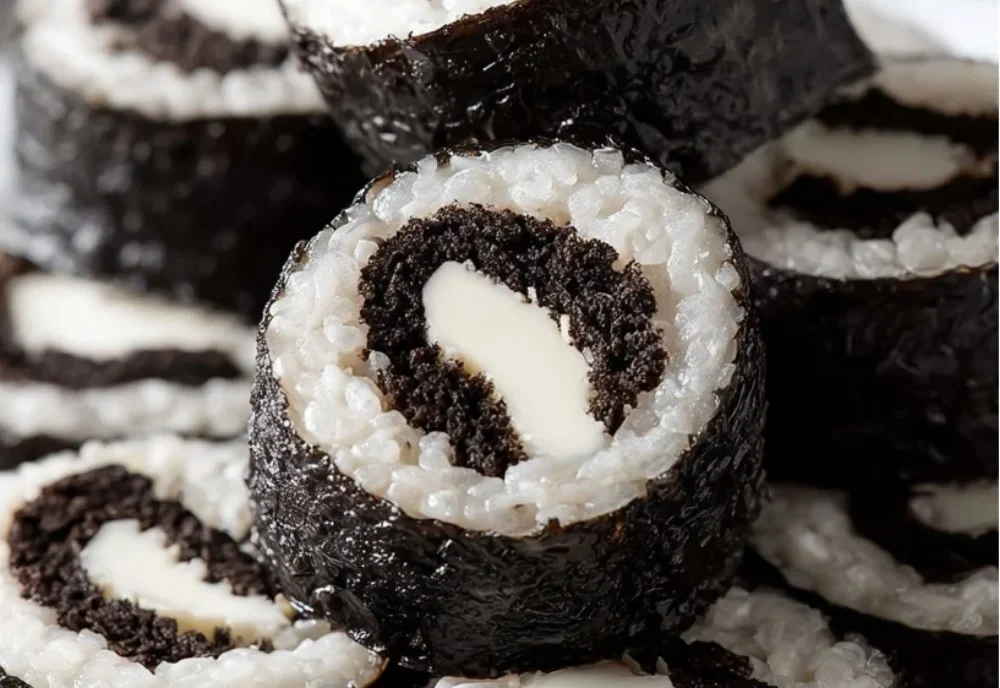
Chilling is crucial not because of any archaic ritual but for a simple sensory reason: it solidifies the log so slices hold their shape, and it concentrates flavors. The cold tightens the textures; when you slice, the reveal is dramatic — the dark exterior, the pale swirl, the little flecks of fruit or sprinkle like confetti. Eating one is a study in contrasts: the initial snap or give of the chocolatey exterior, the creamy middle, and the cold that brightens sweetness like a brisk wind sharpening the smell of oranges.
Although the steps are easy, many people treat the process as a ritual of hospitality. Rolling and slicing in front of guests, like carving a roast, becomes performative and generous. The slicing itself, neat and deliberate, invites conversation: who will get the end piece, who remembers a grandmother’s trick for even slices, who learned to decorate with finding joy rather than perfection?
How different regions prepare their version
If you travel with the Oreo Sushi Roll in your suitcase of stories, you’ll find it reimagined beautifully. In a coastal Spanish town, someone might fold in a spoonful of orange marmalade and top slices with thin lemon zest, introducing a bitter brightness that cuts the sweetness. In Tokyo, a student might import the idea but swap Nutella for a silken white bean paste and add yuzu rind — an homage that respects both texture and the Japanese palate. In Mumbai, a street-vendor-inspired version could incorporate chopped pistachios and rose petal jam, transforming the simple roll into something lush and floral.
Across Latin America, the roll may wear dulce de leche like a second skin; in Scandinavia, a whisper of cardamom in the dough nods to the spice cupboards of winter. Each version is an act of translation: the original idea remains legible, but local ingredients and seasonal impulses push it into something new. These regional permutations reveal how a viral novelty can become an object of local pride, a vessel for the flavors that communities cherish.
Traditional ways this dish is shared or served
Though not a centuries-old tradition, Oreo Sushi Rolls quickly found ritualized modes of sharing. In many households they are the dessert at casual gatherings — a tray of neat slices passed around in the hum of conversation. For children’s birthdays, they sit like jewels among cupcakes and sandwiches, their playful shape making them perfect for parties where aesthetics matter as much as sugar.
There is also a quiet, domestic tradition: the late-night kitchen console. I have seen roommates assemble these rolls under the forgiving light of a refrigerator bulb, whispering and snacking between study sessions. In some families, the act of making them together becomes a rite of passage — teenagers learning to roll, grandparents advising on firmness and chill time, siblings arguing over whether fruit belongs at all.
The dish travels well in picnic baskets and tawdry hotel fridges alike. It is an intimate share, meant to be eaten with fingers, laughter, and stories. Because its appearance references another culture’s cuisine, it often sparks conversations about authenticity, respect, and the joy of playful homage — conversations that broaden the moment beyond the simple act of eating.
Storing the dish without losing its cultural essence
Preserving the charm of Oreo Sushi Rolls is as much about texture as memory. Stored in an airtight container in the refrigerator, slices retain their shape and the contrast between the firm exterior and creamy interior. Left too long, the drier cookie components can absorb moisture and become less distinct; chilling rather than freezing preserves the delicate mouthfeel.
There is a cultural lesson in storage as well. In many homes where food is a communal trust, storing is not merely practical but ceremonial: leftover slices are wrapped in cling film and placed on the topmost shelf for a child to discover at dawn, or they are set aside and gifted to a neighbor as a token. The ways we keep food — whether in careful, labelled containers or in a tangle of foil — tell stories about value, urgency, and the place a dish occupies in daily life.
Cultural questions people often ask
The dish invites questions that are as much about identity as they are about flavor: Is it cultural appropriation to mimic sushi in this way? Is it an affectionate homage, or an erasure? People also ask about authenticity: who “owns” a recipe that is born of commercial cookies and a global spread? My answer, formed at kitchen tables and festival booths, is that context matters. When the dish is made with awareness and a spirit of playful gratitude, it often becomes a bridge rather than a battleground. Conversations sparked by the roll can be opportunities to explore culinary histories, the meaning of ritual, and the ways cultures intersect today.
Other questions are sweeter: how to get the spiral perfect, whether fruit will make it soggy, and how long it keeps. These pragmatic concerns are windows into the ways form and memory interact — everyone wants their version to look as good as it tastes, to be photographed on the porch as proof that simple pleasures can be made with a flourish.
A closing note on food, memory & travel
There is a particular joy in tracing the life of a recipe that began as a playful experiment and grew into a global comfort. Oreo Sushi Rolls remind us that food is a living archive: every ingredient carries a history, every technique is an inheritance, and every bite is a conversation with place. As I move between markets, living rooms, and midnight kitchens, I notice how small inventions like this one become a means of storytelling. They allow us to make sophisticated gestures — referencing distant traditions, honoring familiar tastes — without pretense.
In the end, these rolls are less about imitation and more about connection. They reveal how people across the world borrow, adapt, and create rituals that speak to kinship and creativity. To eat one is to join a fleeting but earnest lineage of makers: those who turn what is at hand into a shared delight. It is to remember that travel is not only about geography but also about the tastes, textures, and tiny domestic rituals that make a place feel like home.
Conclusion
If you want to see one version of this playful dessert laid out step by step, there is a charming recipe and visual guide on Oreo Sushi · i am a food blog that captures the whimsy of the idea. For a look at how the trend has moved through social media and offering practical tips from a home-cooking perspective, read the accessible piece on How to Make the 2-Ingredient “Oreo Sushi” on TikTok Right Now.
Oreo Sushi Rolls
Ingredients
Method
- Crush the Oreo cookies in a bowl until they form a fine crumb.
- Add your choice of sweet filling (like Nutella) to the crumbs and mix until it forms a dough.
- Roll out the dough on a clean surface, creating a rectangle.
- Spread a layer of your chosen filling over the dough evenly.
- If desired, add chopped fruits or sprinkles on top of the filling.
- Roll the dough tightly from one end to the other, forming a log.
- Chill the roll in the refrigerator for about 30 minutes.
- Once chilled, slice the roll into bite-sized pieces resembling sushi and serve.