Cheesy Garlic Chicken Wraps
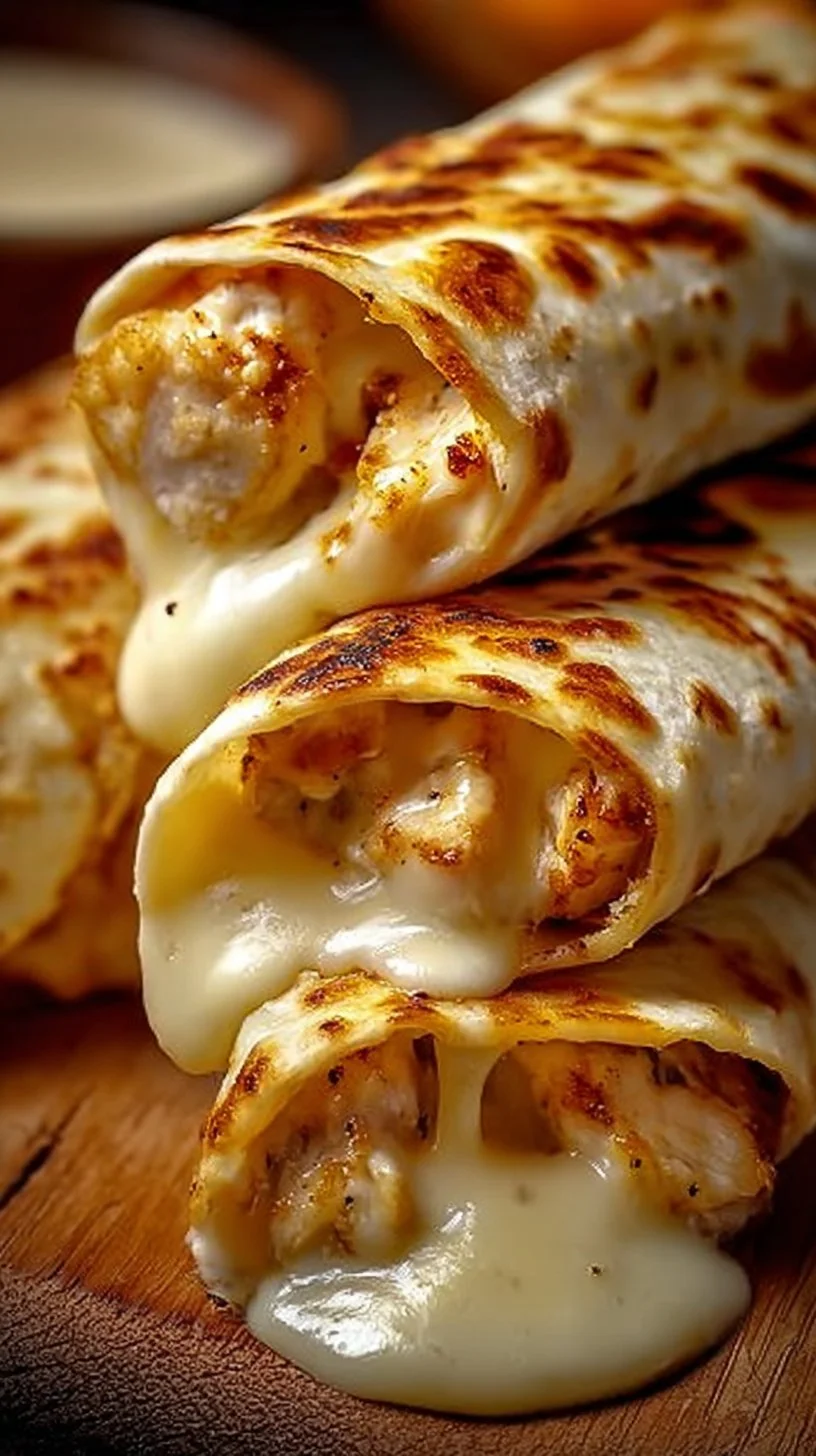
There are foods that arrive like a whisper and others that stride into a room, all garlicky breath and warm, melting cheese, claiming attention with a confident, familiar voice. The Cheesy Garlic Chicken Wraps belong to the latter category. They are a compact parcel of comfort: tender shredded chicken, softened cream cheese threaded with garlic, strands of mozzarella pulling like a sunset of warmth, and the green snap of fresh spinach and tomato. Eating one feels like slipping into a beloved jacket on a cool evening — an intimate layering of texture, aroma, and memory.
I first encountered a version of this wrap at a roadside café where the proprietor, a woman who had grown up in one country and cooked in three others, described it as a family shortcut for weeknight supper. She spoke of its convenience and of the way the kitchen filled with the scent of garlic and melting cheese — the smell so persuasive it had neighbors knocking on the door. In that small moment I understood how food travels with people far more readily than recipes ever do: it carries the cadence of a household, the improvisational grace of migration, and the map of seasons, markets, and shared plates. This article walks that route — from the recipe’s simple ingredients and instructions to the deeper currents of regional influence, memory, and communal life that have made it so beloved.
A related dish I once wrote about captured a similar impulse — take a few pantry staples, love them, and in doing so, create a new comfort that belongs to a place and a person.
The origin story & regional influence behind this dish
Wrapped foods are among the oldest and most democratic of dishes: dumplings, burritos, kimbap, and shawarma each show how humans gather filling and fold it into a portable form. The Cheesy Garlic Chicken Wrap is a contemporary heir to this lineage, an American-born cousin perhaps, borne from the mid-20th-century tendency to translate hearty, homestyle ingredients into hand-held convenience. Its bones — chicken, cheese, garlic — speak of Mediterranean and European affinities, while the idea of assembling and pan-grilling a filled tortilla draws from Mexican and Tex-Mex traditions where the tortilla is canvas, shelter, and spoon.
Across the United States, the wrap evolved in kitchens that wanted the warmth of melted cheese and the savor of roasted or leftover chicken without the ceremony of a sit-down meal. In suburban households, it solved the problem of weeknight hunger; in city cafés, it became a lunchbox romance — portable, satisfying, and cheap to make. But its story doesn’t stop there. Immigrant cooks introduced their own aromatics and techniques, turning the recipe into a global conversation: garlic intensity changed, the choice of herb shifted, and the bread might become pita or flatbread. Each iteration carries the imprint of a particular place and the practical poetry of feeding a family.
How to make Cheesy Garlic Chicken Wraps
There is something almost ceremonial in the simple act of gathering the filling into folds and turning it toasting-golden in a pan. Make this dish in the kitchen of a traveler and you will hear stories while it cooks; make it at home alone and it will feel like nourishing company.
Ingredients :
2 cups cooked chicken, shredded, 1 cup shredded mozzarella cheese, 1/2 cup softened cream cheese, 1/4 cup sour cream, 2 cloves garlic, minced, 1 teaspoon garlic powder, 1 teaspoon onion powder, 1/2 teaspoon salt, 1/4 teaspoon black pepper, 4 large flour tortillas, 1 cup fresh spinach leaves, 1/2 cup diced tomatoes, 1/4 cup chopped fresh parsley (optional), olive oil for cooking
Directions :
- In a large bowl, mix shredded chicken, mozzarella, cream cheese, sour cream, minced garlic, garlic powder, onion powder, salt, and pepper until well combined. 2) Divide the filling among the tortillas, then top with spinach leaves and diced tomatoes; add parsley if desired. 3) Roll the tortillas tightly, then cook seam-side down in a skillet with a drizzle of olive oil over medium heat for 3-4 minutes per side until golden brown. 4) Slice in half and serve warm.
The directions above are deliberately plain; they allow speech and memory to fill the spaces. In my travels, the same simple instructions became points of departure: a grandmother in Athens would add a drizzle of lemon to the chicken, a street vendor in Guadalajara would swap the flour tortilla for a corn one, and a market cook in Marseille would toss in a handful of herbs from the windowsill. The technique is less important than the ritual — the way a kitchen smells when garlic hits the fat, the small applause of a tortilla browning in a pan, the soft sigh as the knife halves a hot wrap and steam escapes.
Another garlic-forward recipe I keep returning to evocatively shows how a simple aromatic can anchor a dish to a place.
Ingredients through a cultural & historical lens
Examine each ingredient and you find a map of trade routes, seasonal habits, and culinary encounters. Chicken, now ubiquitous in global cuisine, was once a luxury in many regions — its rise to everyday status parallels urbanization and industrial farming. Cheese is a record of pastoral life; mozzarella specifically carries with it the breadth of Italian culinary influence, yet in this wrap it becomes an emulsifying comfort, melting without fuss. Cream cheese and sour cream are emblematic of American dairy culture, whipped into spreads and dips across kitchen tables.
Garlic is the most revealing ingredient of all. It is at once rustic and cosmopolitan, revered in Mediterranean kitchens, celebrated in Asian traditions, and central to the flavor scaffolding of Latin American cooking. Its presence in this wrap ties the recipe to the kitchens of many lands where garlic is more than seasoning — it is a statement of hospitality and robustness. Even the flour tortilla speaks of transcontinental exchange; it is both the product of indigenous Mesoamerican ingenuity and of centuries of adaptation, now co-opted by global palates and shaped into new hybrid forms.
The parsley, optional yet aromatic, denotes an aesthetic choice — a nod to brightness, to the garden’s insistence amid creamy textures. Altogether, these ingredients narrate the social history of easy, portable meals that have become staples of modern communal life.
Cooking the dish: sensory notes & traditional techniques
Cooking these wraps is a sensory geography. When you mince garlic and it hits the softened cream cheese, the scent lifts soft and pungent, floral almost, like laundry dried in a Mediterranean courtyard. As the filling comes together, the consistent texture of shredded chicken meets the elastic, cool resistance of mozzarella threads, promising a soft tug when bitten. The dressing of sour cream and cream cheese lends an indulgent, rounded mouthfeel — the sort of tactile comfort that asks you to slow down.
Pan-frying the seam-side down until golden is a technique that reads like domestic theater: the sizzle is applause, the tiny browned bubbles on the tortilla a seal. A drizzle of olive oil at the skillet’s edge brings another olfactory memory — green and slightly fruity if the oil is good, or deeper and toastier if it has been heated. The final halving of the wrap is an unwrapping, a reveal of steam, melty cheese, and the fresh, cool contrast of spinach and tomato.
Traditional techniques matter less here than the way they are performed in a household. In some kitchens the filling is left to rest — flavors marrying like old friends — while in others it is assembled and cooked immediately, an expression of urgency and hunger. Both are valid; both tell a story about time, about the rhythm of a home.
You can trace a family’s garlic technique through small habits that change the aroma and the memory of a meal.
How different regions prepare their version
Across regions, small edits create distinct variants that say a great deal about place. In the American South, a version may include a slaw tucked inside for crunch and a tang of vinegar; in Mediterranean kitchens, the chicken might be seasoned with lemon and oregano and the tortilla replaced by pita or lavash. In South Asia, cooks might fold in a dash of garam masala or a smear of chutney, turning the wrap into a bridge between cuisines. Street-food cultures favor speed and portability; café culture favors artisanal breads and attention to thermal contrast — warm filling, cool greens.
In Mexico and the Southwestern United States, the tortilla is often charred slightly over open flame before assembly, lending a smokier note. In parts of Europe where flatbreads are less common, this wrap transforms into a toasted sandwich, made with rustic slices of bread pressed until the cheese sighs. Each adaptation preserves the heart of the dish while allowing local terroir and taste to rearrange its accents.
Traditional ways this dish is shared or served
This wrap is a social food. It appears at the edge of potlucks, on picnic blankets, in the hands of commuters balancing a paper cup of coffee. In family kitchens it is often part of rotational moisture — a way to use yesterday’s roast chicken and the last of the mozzarella. Across households, the wrap becomes ceremonial in small, reliable ways: children claim the halves with particular fillings, elders carve them to share, friends build an impromptu assembly line on a Friday evening.
In some cultures, similar wraps are cut into small pieces and served as appetisers, passed around at gatherings with toothpicks as conversation starters. The Cheesy Garlic Chicken Wrap lends itself to this generosity; its filling is forgiving, its form portable, and its warmth communal. To serve it is to invite conversation, to create a moment where tastes and stories are exchanged with equal appetite.
I have seen this pattern play out in countless family dinners where one garlic-rich dish begets another.
Storing the dish without losing its cultural essence
Leftovers are part of the dish’s narrative. To store a Cheesy Garlic Chicken Wrap is to choose between preserving crispness and preserving warmth. Wrapped in foil and stored in the refrigerator, the wrap will keep its filling flavors for a day or two, but its exterior will lose the freshly-toasted Maillard notes that make it sing. Reheating in a skillet — gently, seam-side down to revive the golden skin — reanimates some of that original character. Keep the greens separate in a small container if you want to retain their snap and color.
Beyond practical tips, storage practices reflect cultural values: the family that eats leftovers as-is versus the household that reinvents them into a casserole or a salad speaks of attitudes toward waste, time, and creativity. Each reheating is another chapter in the dish’s life, an invitation for reinterpretation.
Cultural questions people often ask
Why garlic? Because it is at once humble and persuasive — a flavor that anchors a recipe to the human desire for warmth and generosity. Why cheese? Because melting is a kind of culinary alchemy that signals comfort. Why a tortilla? Because the idea of wrapping is universal, and the tortilla is both vessel and flavor.
People also ask whether such a dish is “authentic.” Authenticity is fluid; the wrap is authentic to kitchens that make it, to families who pass it along, and to cooks who adapt it to their markets. The more revealing question is not whether the recipe is authentic but how it becomes meaningful: which memories it hoards, which markets it maps, and which stories it helps tell at a table.
A closing note on food, memory & travel
Food travels more faithfully than passports. A simple wrap can carry with it the cadence of a grandmother’s voice, the smoke of a street vendor’s grill, the aroma of a well-worn skillet, and the intimacy of a quiet kitchen. Cheesy Garlic Chicken Wraps are small witness to that mobility — an edible ledger of migrations, markets, and the everyday ingenuity that feeds families.
If you make this wrap on a rainy afternoon, let the garlic scent anchor you to the present. If you share it with someone far from home, notice how a single bite can open an entire conversation about birthplace, workplace kitchens, and longed-for flavors. In the hands of a traveler, it is both map and souvenir; in the hands of a host, it is an act of care. Wherever you are, let this simple recipe remind you that culture is not only preserved in monuments and archives but is whispered into being on stovetops, in the fold of a tortilla, and in the warm, reassuring tug of melted cheese.
Conclusion
For a modern take on this comforting wrap, you can view a popular version at Cheesy Garlic Chicken Wraps – Cooked & Loved, which showcases how home cooks customize the filling. If you’re curious about another spin, see the community adaptation at Recipe: Cheesy Garlic Chicken Wraps, where local variations appear alongside serving suggestions. For a high-protein commercial interpretation, consider the packaged style described at Cheesy Garlic Chicken Wrap | High Protein – Hummus Fit to understand how producers translate home recipes for retail. And for broader inspiration on cheesy wraps and their place in everyday cooking, this take at Cheesy Chicken Wraps | Spicedblog offers creative fillings and serving ideas.
Cheesy Garlic Chicken Wraps
Ingredients
Method
- In a large bowl, mix shredded chicken, mozzarella, cream cheese, sour cream, minced garlic, garlic powder, onion powder, salt, and pepper until well combined.
- Divide the filling among the tortillas, then top with spinach leaves and diced tomatoes; add parsley if desired.
- Roll the tortillas tightly, then cook seam-side down in a skillet with a drizzle of olive oil over medium heat for 3-4 minutes per side until golden brown.
- Slice in half and serve warm.