Raspberry Cream Napoleons
Introduction
Raspberry Cream Napoleons distill three fundamental pastry concepts into a single composed dessert: laminated crispness, aerated cream, and bright, acidic fruit. The success of this classic relies on control of layers and contrasts—crisp, buttery sheets against a light stabilized cream and fresh raspberries that provide acidity and textural counterpoint. When working at brigade scale or in a small kitchen, the same technical principles govern savory work; for a reminder of cross-application technique in handling rich sauces and temperature control, consult garlic butter steak with parmesan cream sauce. This dish is deceptively simple but technically exacting: each stage—baking, whipping, cutting, assembly—must be executed with intention so that the finished Napoleon offers clean layers, no soggy pastry, and a cream that holds structure without being cloying.
The culinary logic behind this dish
A Napoleon functions by juxtaposition. The laminated dough provides a large surface area of thin, crisp layers; the cream fills and lubricates those layers without collapsing them; raspberries cut through the richness with acidity and juice. The key culinary logic is to preserve textural separation until the moment of service. Strategically, you create a barrier of dry, crisp pastry and an aerated cream that is stable enough to resist immediate water absorption from the fruit. Temperature management is central: keep pastry cool enough during handling to prevent fat smear, and keep cream cold to maintain peaks. For broader perspectives on layering desserts with complementary textures and how to manage moist ingredients alongside crisp elements, see techniques illustrated in parmesan-crusted chicken with creamy garlic sauce, where searing and sauce stabilization follow similar logic.
How to make Raspberry Cream Napoleons
Approach this preparation as a sequence of discrete technical tasks: bake the pastry to maximum crispness and color, whip cream to a point of stability without graininess, and assemble with speed and purpose so fruit juices do not compromise the pastry. Begin with chilling and preheating logistics—laminated dough benefits from a cold environment during handling to keep the butter layers intact; an oven temperature and rack position that encourage rapid steam formation will deliver lift and lamination collapse into crisp sheets. During whipping, focus on sensory cues: look for a satin sheen transitioning to firmer peaks; listen for the slight difference in sound when the whisk moves through an approaching-m-stiff cream versus overwhipped curdled fat. For a demonstration of composed, layered desserts that balance chocolate and fruit components, the structure and timing mirror those used in raspberry chocolate lasagna.
Ingredients :
Puff pastry sheets, Heavy cream, Powdered sugar, Vanilla extract, Fresh raspberries
Directions :
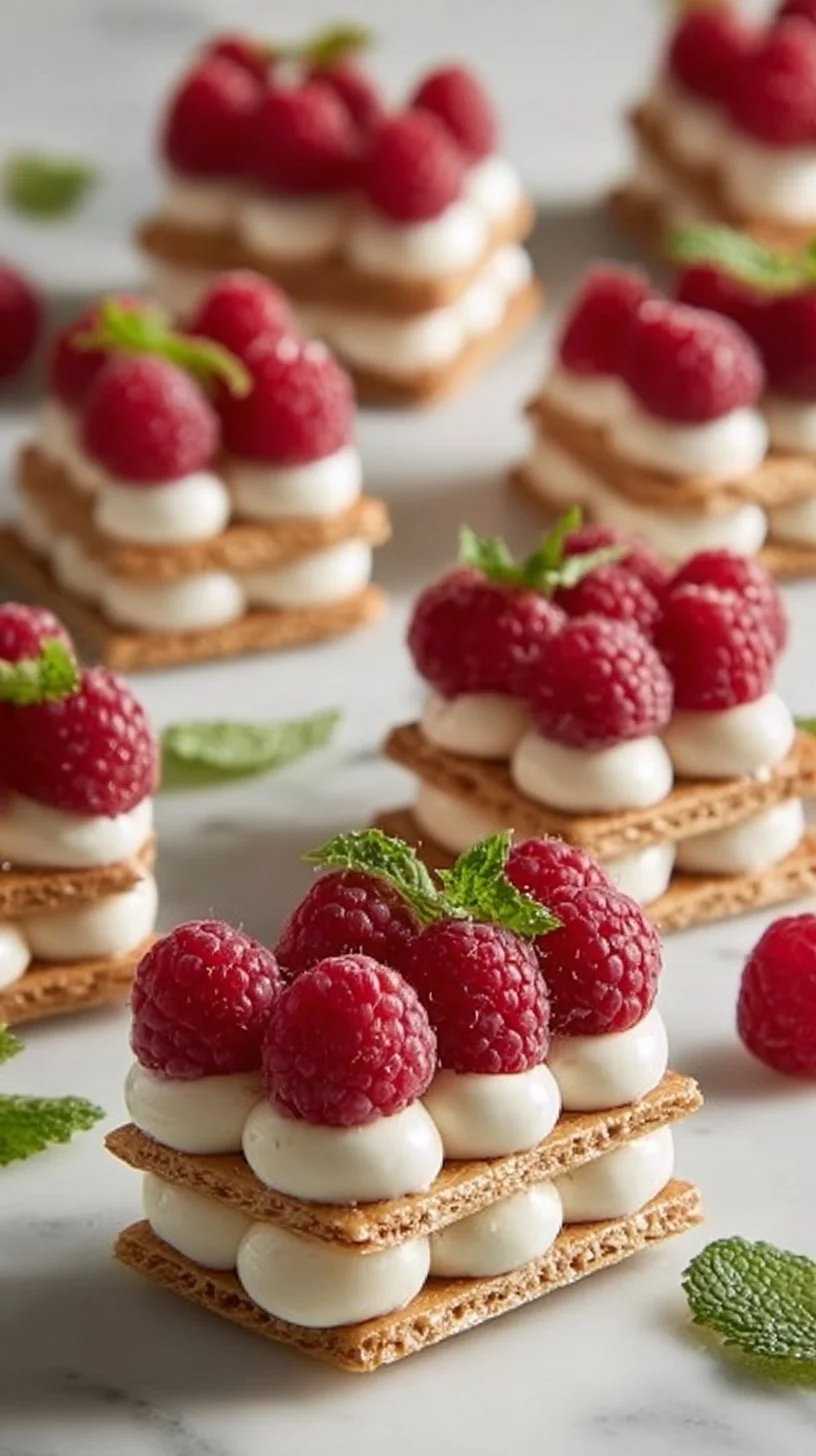
- Preheat the oven and bake the puff pastry sheets until golden and crispy., 2. In a bowl, whip the heavy cream with powdered sugar and vanilla extract until stiff peaks form., 3. Once the pastry is cooled, cut it into rectangles., 4. Layer a piece of pastry, add a layer of whipped cream, and top with fresh raspberries., 5. Repeat the layers and finish with another piece of pastry on top., 6. Dust with powdered sugar and serve.
Ingredient analysis through a chef’s lens
Puff pastry is the structural element; its performance depends on lamination quality, fat content, and how it was thawed or handled prior to baking. Butter-based puff provides superior flavor and flaking compared with hydrogenated fats, but it demands more strict temperature control. Heavy cream supplies richness and aeration; its fat percentage dictates whipping speed and stability—higher fat yields firmer peaks and smoother texture. Powdered sugar functions as both sweetener and a light stabilizer because of its cornstarch content; the fine grain also dissolves rapidly, preventing a sandy texture. Vanilla extract is the aromatic bridge—use a pure extract for clarity rather than imitation which can impart chemical notes. Fresh raspberries are fragile and very high in juice; choose berries that are firm, bright, and uniform in ripeness to prevent variable moisture release. Each ingredient contributes a mechanical property—structure, aeration, sweetness, aroma, acidity—that must be balanced.
Kitchen workflow & technique breakdown
Sequence the workflow to minimize moisture migration and to optimize texture retention. First, preheat the oven and bake the puff pastry; allow it to cool completely on a rack so residual steam escapes and the layers set. Second, whip the cream immediately before assembly so it retains its structure. Third, cut and assemble just prior to service to avoid sogginess. On a practical line, set up three stations: baking and cooling, whipping and holding, and final assembly. Keep the whipped cream in a chilled bowl on ice if assembly will be delayed more than ten minutes. For efficient single-portion production, use a ruler and sharp bench scraper to cut pastry into consistent rectangles; consistency ensures predictable bite and heat transfer when plated. If your operation includes frequent composed desserts, adapt a mise en place that mirrors savory production—organization reduces time between steps and preserves texture. For cross-training in line organization and mise en place, review the workflow methods used in other composed recipes such as parmesan-crusted chicken with creamy garlic sauce.
Texture control, heat management & timing
Texture control hinges on preventing pastry moisture uptake and preserving whipped cream aeration. Bake the puff pastry at a high initial temperature to encourage rapid steam generation; this expands pockets and separates layers, creating a crisp, dry matrix. After baking, place sheets on a wire rack, not a flat tray, to avoid steam condensation beneath the pastry. The whipped cream should be made to stiff peaks but stopped before graininess or butter separation occurs—this typically corresponds to a glossy appearance and peaks that hold their shape when the whisk is lifted. Keep cream below 10°C until assembly; use chilled bowls and beaters to slow thermal creep. Assembly timing is critical: assemble napoleons within 15–20 minutes of applying fruit to prevent juices from migrating. If you must hold the composed pastry, refrigerate uncovered on a rack to maintain crispness, but accept that any holding beyond 30 minutes will result in gradual softening.
Professional variations
From a professional perspective, variations are tactical, not arbitrary. For increased stability, fold a small proportion of stabilized pastry cream or mascarpone into the whipped cream—this will reduce water migration while maintaining aeration. To add complexity of flavor, macerate a fraction of the raspberries in a minimal amount of powdered sugar and lemon juice, then press through a sieve for a coarse coulis layer; apply this carefully so that liquid does not contact the pastry directly. For contrast, interleave thin sheets of toasted almond praline or thin tempered chocolate shards between layers for crunch continuity. If offering a plated dessert, consider portioning the pastry into smaller rectangles and assembling in a façon that accentuates height for visual drama, but remember that increased surface-to-volume ratio accelerates moisture transfer.
Finishing touches & plating philosophy
Finishing is a moment of restraint. A light dusting of powdered sugar provides a visual signal and a slight textural dusting, but avoid heavy application that will melt into the cream. Garnish sparingly with whole raspberries aligned to reinforce the linear architecture of the napoleons. Plate on a chilled surface to slow melting and maintain the cream’s structure. When selecting plates, matte or slightly textured ceramic absorbs light and accentuates pastry color; glossy plates can make components appear flattened. Serve alongside a small quenelle of additional whipped cream or a restrained drizzle of concentrated raspberry reduction, but keep components separate to prevent cross-soaking on the plate.
Maintaining quality after cooking
Short-term holding matters. If you must prepare components in advance, bake and cool the pastry in advance and store in airtight containers with desiccant silica packets or a paper barrier to avoid humidity. Whip cream to just before service; stabilized creams with gelatin or mascarpone can be used for longer holds but will alter mouthfeel. For transport, assemble in rigid containers with support to maintain vertical alignment, and keep chilled. Avoid refrigeration with the assembled napoleons for extended periods; the pastry will absorb moisture. If reheating is required, re-crisp pastry in a 200°C oven for 3–4 minutes prior to final assembly, but do not heat the cream or fruit—reassembly is always the best path for texture recovery.
Questions from home cooks (chef answers)
Q: How do I prevent the cream from becoming runny when mixed with raspberries?
A: Minimize direct contact between fruit juices and cream. Use whole raspberries and layer them between cream strata rather than pureed fruit directly against pastry. If a purée is required, apply it sparingly and isolate it with an intervening cream or praline layer.
Q: My puff pastry collapsed—what happened?
A: Collapse often results from overbaking at too low a temperature, which drives moisture out slowly instead of converting it to steam rapidly. It can also occur if the dough warmed and the butter smeared before baking. Maintain cold dough, dock sparingly if needed, and use a hot oven to generate rapid steam for lift.
Q: Can I substitute frozen raspberries?
A: Frozen berries release significantly more water when thawed. If used, they must be fully drained and patted dry, and ideally macerated and then reduced to a concentrate to limit free moisture. Fresh berries remain the superior choice for textural control.
Q: How long can assembled Napoleons be held?
A: Aim to serve within 20–30 minutes of assembly for optimal texture. If assembly must occur earlier, use stabilized cream and accept some softening of the pastry over time.
Final chef notes
Precision and restraint govern the success of Raspberry Cream Napoleons. Execute each technical step with purpose: bake until the pastry is a dry, golden, and fully separated matrix; whip the cream to functional stability; cut with a sharp implement to preserve flake and prevent compression; assemble swiftly to maintain textural contrast. Small adjustments—cooling bowls, chilled tools, quick assembly—compound into a dessert that reads cleanly on the palate: brittle butter, airy cream, and bright berry acidity. In a professional setting, standardize portion dimensions and timing so that each plate presents uniformity of texture and flavor.
Conclusion
For further reading and alternate presentations of raspberry Napoleon-style desserts, explore this interpretation of a Raspberry Napoleon on Culinary Ginger at Raspberry Napoleon – Culinary Ginger. For a variation that pairs chocolate and fresh raspberries with a similar layered approach, see the recipe at Chocolate and Fresh Raspberry Cream Napoleons. For additional crowd-tested variations and user feedback on technique, consult the Raspberry Napoleons recipe page on Allrecipes at Raspberry Napoleons Dessert Recipe – Allrecipes.
Raspberry Cream Napoleons
Ingredients
Method
- Preheat the oven to 400°C (200°C) and prepare a baking sheet.
- Bake the puff pastry sheets until golden and crispy, about 15-20 minutes.
- Allow the pastry to cool entirely on a wire rack.
- In a mixing bowl, whip the heavy cream with powdered sugar and vanilla extract until stiff peaks form.
- Once the pastry is cooled, cut it into rectangles.
- Layer a piece of pastry, add a layer of whipped cream, and top with fresh raspberries.
- Repeat the layers and finish with another piece of pastry on top.
- Dust with powdered sugar and serve immediately.