White Sparkle Candy Apples
Introduction
White Sparkle Candy Apples are an exercise in balance: a crisp, slightly acidic fruit encased in a glassy, hard sugar shell that refracts light and texture. The success of this confection depends on controlled heat, crystal-free sugar, and precise timing. As a chef, I treat candying not as a simple coating operation but as a technique-driven transformation of ingredients—sugar chemistry, thermal profiles, and surface tension all dictate the final bite. This introduction will orient you to the technical priorities—temperature control, surface finish, and textural contrast—so you understand the reasoning behind each subsequent step and the adjustments you might make on the fly.
For comparative technique and tempering ideas that inform finishing and chocolate pairings, review a related approach such as the controlled-sugar set used in white chocolate Easter bark; the parallels in heat management and finish are instructive.
The culinary logic behind this dish
Candying apples is fundamentally about converting a simple sugar syrup into a hard, clear shell that adheres evenly to an irregular surface. The syrup must reach the hard crack stage—300°F—to create a brittle, glass-like shell rather than a tacky or chewy layer. This requires complete dissolution of sugar in the liquid medium and the exclusion of stray crystals that can seed premature recrystallization. Light corn syrup functions as an anti-crystallizing agent, and water provides the medium for heat transfer and controlled boiling. The apple itself must be dry and cold to promote adhesion and rapid setting; residual moisture causes the syrup to slide or wrinkle and can create a cloudy finish.
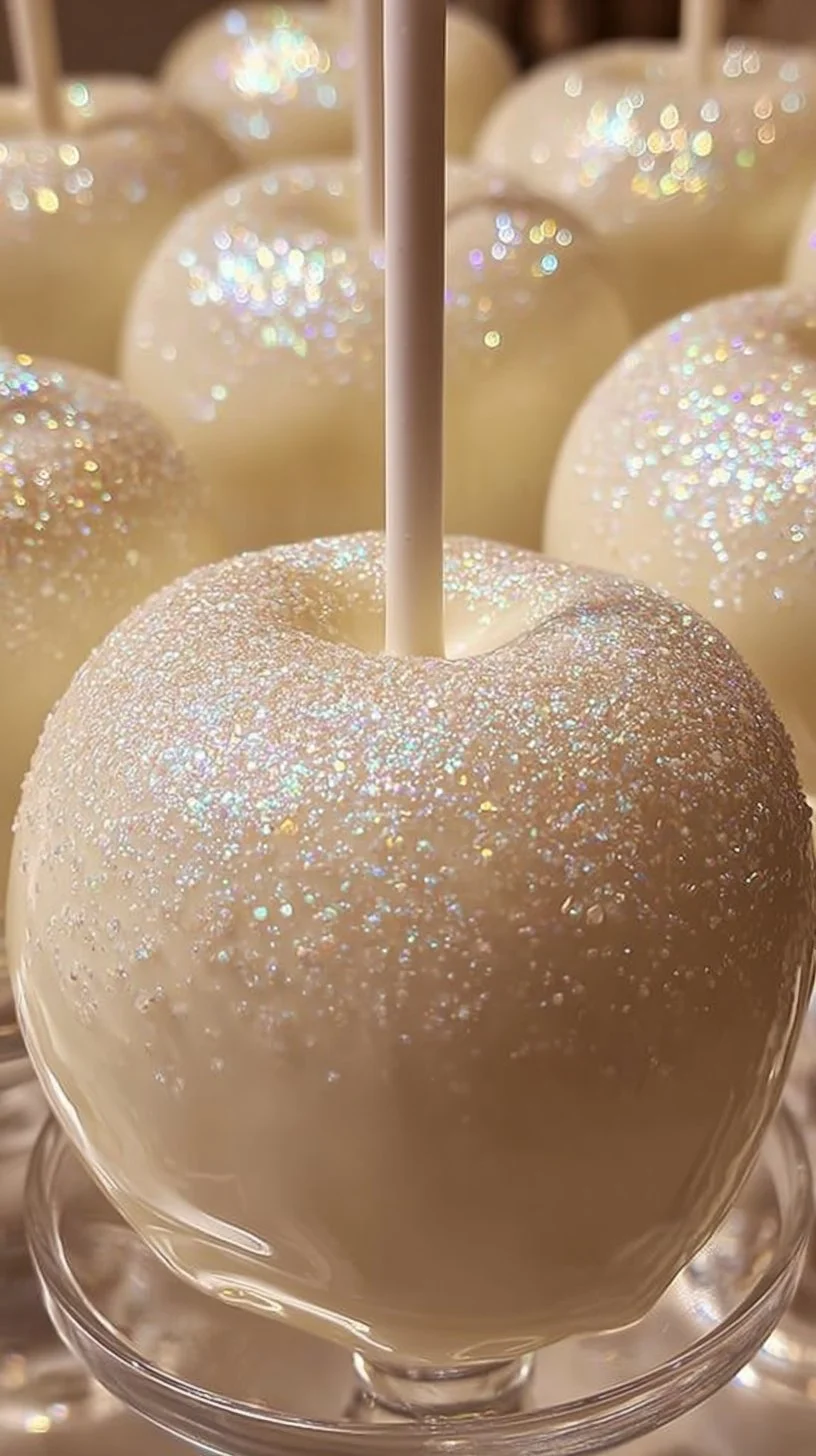
Edible glitter is a purely visual finish, but its application affects texture perception—fine glitter disperses across the surface and enhances perceived crispness by catching light, while overly large particles disrupt the bite. The candy thermometer is a sensory extension of the cook’s hands; accurate readings eliminate guesswork and ensure the structural integrity of the shell.
For an exploration of finish techniques and textural contrasts that can complement this process, consult an analogous recipe such as white chocolate Easter bark where finish and texture are similarly prioritized.
How to make White Sparkle Candy Apples
Ingredients :
Apples, Granulated sugar, Light corn syrup, Water, Edible glitter, Candy thermometer
Directions :
- Insert a stick into the top of each apple.
- In a saucepan, combine sugar, corn syrup, and water, and bring to a boil.
- Use a candy thermometer to measure the temperature until it reaches 300°F (hard crack stage).
- Remove from heat and let cool slightly.
- Dip each apple into the candy mixture, coating evenly.
- Place on parchment paper to cool and harden.
- Once set, dust with edible glitter for a sparkly finish.
The list above is the procedural skeleton; what follows expands on why each movement matters and how to optimize outcome and consistency.
Ingredient analysis through a chef’s lens
Apples: Choose firm, taut-skinned varieties—Honeycrisp, Granny Smith, or Fuji. Firmness ensures the interior remains crisp against the dense sugar shell. Any bruising or soft spots will compromise adhesion and appearance. Skin waxes on commercially sold apples can impede coating; wash with warm water and a mild brush, then dry thoroughly. Cold apples reduce the chance of syrup sliding and promote a clean set.
Granulated sugar: Sucrose provides the structural matrix for the shell. It must be fully dissolved before boiling becomes vigorous; undissolved crystals will seed failure. A neutral, fine granulated sugar dissolves fastest.
Light corn syrup: Acts as an inhibitor to crystal formation and improves clarity. It also slightly modifies the shell’s brittleness—too much makes for a harder set with less glassiness; the recipe’s balance gives a translucent sheen.
Water: Controls the initial boiling temperature curve and provides even heat distribution. Reduce water only if you understand the implications: less water accelerates temperature rise and increases risk of uneven cooking.
Edible glitter: Select a food-grade option rated for confectionery use. Particle size should be fine to medium; larger flakes can create visual interest but will alter mouthfeel.
Candy thermometer: Use a reliable, calibrated instrument. An instant-read digital thermometer with clip is preferable for consistent placement in the syrup without touching the pot’s bottom; false high readings occur if the probe contacts metal.
For reference on complementary finishing techniques, professional confectioners often adapt methods from chocolate-based confections such as white chocolate Easter bark, where tempering and surface sheen are decisive.
Kitchen workflow & technique breakdown
Station organization determines efficiency and quality. Lay out three zones: preparation, cooking, and finishing.
- Preparation: Wash and dry apples; insert sticks centrally to balance weight distribution. Line a tray with parchment in the finishing zone to accept coated apples. Place the edible glitter in a shallow dish for dusting.
- Cooking: Use a heavy-bottomed saucepan sized to allow the syrup to bubble without splashing. Attach the candy thermometer with the probe hanging in the syrup but not touching the pot. Heat over medium to medium-high to achieve a controlled simmer; aggressive rolling boils elevate syrup onto the thermometer and produce spattering.
- Finishing: Have one hand clear to lift and twirl apples; rapid, confident motion removes excess syrup and promotes an even shell. Rotate the apple to allow excess to drip back to the pan, then set on parchment. Timing is tight between reaching temperature and coating—prepare every apple beforehand.
Keep a small saucepan of warm water accessible to clean the thermometer probe if it accumulates sugar. A chilled baking sheet can expedite setting, but avoid shocking the candy which can induce fracturing and dullness.
Texture control, heat management & timing
The textural outcome—brittle and glassy—relies on reaching 300°F and a quick, even coating. If you underheat (below ~295°F), the shell may be soft or tacky and will not shatter cleanly. If you overheat, the sugar will darken, flavoring with burnt notes and compromising clarity. Precise heat management requires watching both color and temperature: the syrup should be clear and viscous, not amber.
Timing during the dip is critical: coat apples immediately upon removing the pot from heat to capitalize on syrup fluidity. Allow a brief 20–30 second cooldown off-heat if the temperature is slightly above target; this reduces run-off while retaining workability. The syrup’s heat also continues to rise briefly after removing from the burner, so anticipate carryover.
Use wrist rotation to thin the coating to a uniform thickness. A thicker coating takes longer to set and can trap bubbles; a very thin coat may fracture under bite. Aim for a shell that is firm to the touch within 2–3 minutes and fully set within 10–15 minutes at ambient room temperature.
Humidity affects setting dramatically: if ambient relative humidity exceeds ~60%, the shell can become sticky due to moisture absorption. In such conditions, quick refrigeration in a single layer can accelerate setting but may cause condensation when returned to room temperature—avoid unless necessary.
Professional variations
Maintain the recipe’s measurements and steps while exploring technique-level variations:
- Controlled color: For a whiter, more opaline finish, extend the final off-heat rest slightly to allow the syrup to cool from 300°F to ~290°F before dipping; the color will remain pale and the shell still sets hard.
- Double-coating for thickness: After the first coat sets, reheat reserved syrup to 300°F for a second dip to create a thicker shell. Ensure the first coat is fully set to avoid merging layers, which creates an uneven surface and possible bubbling.
- Textured glitter application: Rather than dusting, apply glitter immediately after dipping while the surface is tacky but not molten; this allows adherence without sinking the particles. For a matte sparkle, sift glitter through a fine mesh; for concentrated sparkle, press lightly with a gloved fingertip.
- Flavor infusion without altering measurements: Introduce a neutral extract (vanilla or almond, not exceeding 1/2 teaspoon per batch) added off-heat to avoid volatilization. Do not add liquid prior to reaching hard crack stage; that will change temperature kinetics.
Finishing touches & plating philosophy
Presentation should reinforce the confection’s qualities: clarity, shine, and contrast. Once set, place apples on a clean platter with neutral tones to emphasize the sparkle. Arrange them with stems aligned to create rhythm. A small, heat-resistant pedestal or mirrored tray amplifies the reflective qualities.
When plating for service, consider texture balances: pair with a simple salted butter cookie for crumb contrast, or a crisp frisée salad to cut sweetness. The dish benefits from restraint; heavy sauces or dense garnishes compete with the apple’s clarity and the candy shell’s visual impact.
Dust glitter sparingly—over-application reads as visual noise and distracts from the shell’s glass-like elegance.
Maintaining quality after cooking
Storage is about preserving texture and appearance. Hard candy shells are hygroscopic; they absorb moisture and become tacky over time. Store in a cool, dry environment at 50–60°F in a single layer separated by parchment to prevent sticking. Avoid airtight plastic containers in humid areas which can trap moisture. For longer storage (2–3 days), refrigeration is possible if the apples are placed in a sealed container with desiccant packs to control humidity; allow them to return to room temperature before service to prevent condensation.
Avoid stacking apples; even slight pressure can fracture the shell. If you must transport them, use molded compartments or padded separators to maintain integrity.
Questions from home cooks (chef answers)
Q: Why did my coating become cloudy?
A: Cloudiness typically results from crystallization or steam/moisture contact. Ensure sugar is fully dissolved before boiling, avoid stirring once boiling begins, and remove the pot from direct steam sources. Use a clean pan and a small amount of corn syrup to inhibit crystallization. Do not apply glitter while the surface is steaming.
Q: My syrup hardened too quickly during dipping. What went wrong?
A: The syrup cooled below workable temperature—either the pot was off heat too long or ambient conditions were cool. Work faster between removing the pot from heat and dipping, or maintain a low back-heat under the pan while you dip to keep syrup at target viscosity.
Q: How do I prevent bubbles in the coating?
A: Avoid vigorous boiling which introduces air. Skim foam before reaching final temperature and dip with a steady motion, allowing excess to drip away. If bubbles appear, a quick torch pass can smooth the surface on professional sets, but be cautious with sugar’s flammability.
Q: Can I use a candy thermometer alternative?
A: A calibrated digital probe is essential for accuracy. Visual cues alone are unreliable; sugar color can change quickly. If using an infrared gun, note it measures surface rather than internal syrup temperature and can under-read due to steam.
Final chef notes
Precision governs success with White Sparkle Candy Apples. Respect the sugar’s behavior, control heat methodically, and time each action to the syrup’s thermal state. Cleanliness and organization reduce variables that cause crystallization or uneven setting. The edible glitter is an aesthetic choice—apply deliberately to preserve the shell’s integrity. With disciplined technique, the result is a confection that marries a pure, crisp apple with a flawless, glass-like shell that fractures cleanly, offering a refined texture and visual impact.
Conclusion
For additional inspiration on shimmering candy finishes and related confectionery techniques, review a demonstration of glittery candy apples such as Jolly Rancher Glittery Candy Apples – Emmymade which illustrates decorative approaches compatible with this method. Historical context and a written take on the White Sparkle Candy Apples can be found in a column at White Sparkle Candy Apples – The Galena Sentinel Times. For sourcing commercial white candy apple finishes and supplies, consult the collection at White Candy Apples – wholesalecandyapples.com.
White Sparkle Candy Apples
Ingredients
Method
- Wash and dry apples thoroughly to remove any wax.
- Insert a stick into the top of each apple for easy handling.
- In a saucepan, combine sugar, corn syrup, and water. Bring to a boil.
- Use a candy thermometer to monitor the temperature until it reaches 300°F, the hard crack stage.
- Once achieved, remove from heat and let cool slightly.
- Dip each apple into the candy mixture, ensuring an even coating.
- Place coated apples on parchment paper to cool and harden.
- Once set, dust with edible glitter for a sparkly finish.