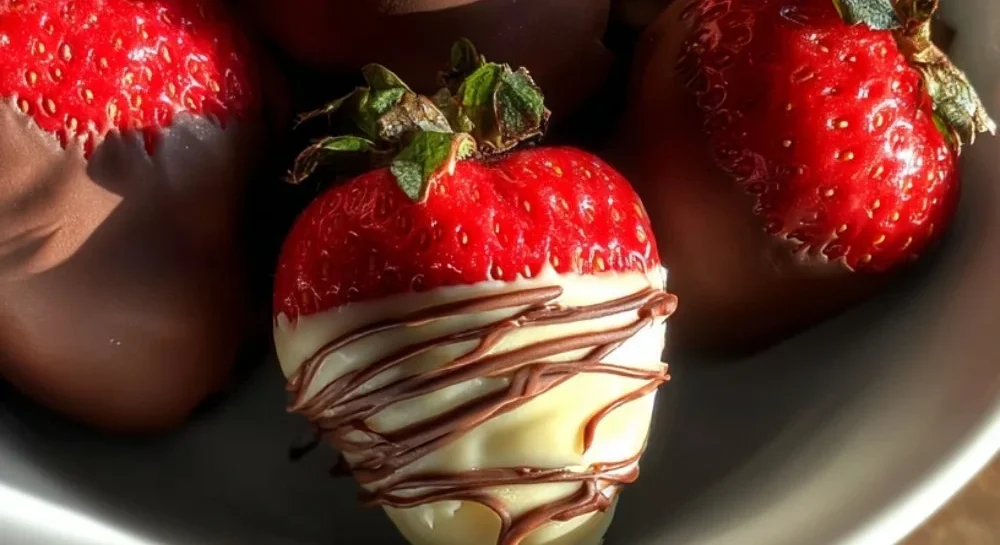
Chocolate Covered Cheesecake Strawberries
Introduction
There are flavors that arrive like postcards from other lives: small, concentrated, and packed with the weather and social rituals of a place. Chocolate Covered Cheesecake Strawberries are one of those little postcards — a bite-sized convergence of summer fields, festive kitchens, and a modern desire to fold decadence into the familiar. As I travel, I find that simple sweets often tell the truest stories of a region: the strawberries whisper where they were grown, the chocolate hints at trade and taste, and the cheesecake center bears the memory of kitchens where hands learned to soften cream cheese by feel and intuition rather than by instruction.
In Sofia, sitting in a café courtyard that feels half Ottoman courtyard, half European salon, I first encountered a version of this treat at a wedding dessert table. The late afternoon light turned the chocolate glossy and the strawberries jewel-like. People gathered in a kind of small celebration around them — not for the dessert alone, but for the social punctuation it provided: a bite shared between cousins, a hush of approval when the filling proved light and tangy. That is what these strawberries do. They are tiny ritual objects, bridging the intimate and the communal, the local strawberry patch and the long-traveled cocoa bean.
The origin story & regional influence behind this dish
The union of berry, chocolate, and cheese might feel modern and Instagram-ready, but its roots are quietly global. Strawberries have long been cherished in Europe since Roman times when they were considered medicinal as much as pleasurable. Chocolate, with its origins in Mesoamerica, arrived in European courts as a luxury and gradually became part of everyday celebrations by the 19th and 20th centuries. Cheesecake, in various guises, has traveled for millennia — Greek and Roman elders wrote of early versions, while the creamy, cream-cheese-style cheesecake we know today crystallized in the United States and parts of Europe during the 19th century.
What emerges in the Chocolate Covered Cheesecake Strawberries is a meeting of traditions: the European celebration of fruit and chocolate, the New World’s cheesecake decadence, and a modern sensibility that prefers hand-held elegance. Regions with strong strawberry seasons — from California’s central valleys to the wild coasts of Brittany — lend a particular terroir. The berry’s sweetness and acidity change the feel: a sharply acidic alpine strawberry makes the cheese filling sing in a different key than a lush, sugar-heavy variety from a sunburnt California field. The dish is thus a small map of trade routes and climates, stitched together with human appetite.
How to make Chocolate Covered Cheesecake Strawberries
Ingredients :
1 pound (about 12-15) large strawberries (thoroughly rinsed and pat dry), 6 ounces (1 cup) semi-sweet chocolate chips, 4 ounces cream cheese (softened), ½ cup powdered sugar, 1 teaspoon vanilla extract, ¼ cup heavy cream (cold)
Directions :
Line a baking sheet with parchment paper and set aside., Rinse strawberries and pat them dry. Remove the tops and hull the center using a small paring knife., Place chocolate chips in a microwave-safe bowl. Heat in 30-second intervals, stirring between each until completely melted., Dip each strawberry in melted chocolate. Place on the parchment-lined baking sheet to set. While the strawberries set, prepare the cheesecake filling., In a large bowl, combine softened cream cheese, powdered sugar, and vanilla extract. Use a hand mixer to blend until smooth. Add heavy cream and beat for an additional 2 minutes until light and fluffy. Place the bowl in the refrigerator for 15 minutes to allow the filling to chill., Transfer the chilled cheesecake filling to a piping bag with a tip. Pipe some filling into each chocolate-covered strawberry., If the filling seems soft, place strawberries in the refrigerator for 10-15 minutes to set the cheesecake filling., Serve immediately or within 12 hours for the best texture and flavor.
This modest sequence of steps gives you something elegant and portable — a dessert that appears to need ceremony but in fact asks only for attention to a few sensory cues: the sheen of melted chocolate, the cool density of chilled filling, the delicate snap when you bite into the shell.
Ingredients through a cultural & historical lens
Close your eyes and consider the ingredients as if they were travelers arriving at a port. The strawberry carries the scent of the field: green leaves, a faint musk of earth warmed by sun, sweetness layered with a sharp back note. Historically, privileging fruit in desserts was a way for peasant and aristocrat alike to celebrate seasonality; before refrigeration, the arrival of strawberries meant festival.
Chocolate arrives with resonance — once rare, later democratized. In Europe, it connoted luxury and after the industrial revolution began to mingle with everyday confections. Semi-sweet chocolate chips are an American convenience, a postwar gift of industrial confectionery that enabled home cooks to make glossy coatings without tempering. Their presence in this recipe is a small testament to the 20th century’s shaping of home kitchens.
Cream cheese, powdered sugar, and vanilla form the cheesecake heart. Cream cheese itself is a relatively recent invention, an industrial-age refinement of fresh cheeses. Its smoothness and tang have made it an emblem of modern cheesecakes, contrasting with older, denser curd-based versions in places like Italy or Greece. Heavy cream gives the filling a whisper of richness, a reminder of dairying traditions where cream signified abundance.
Together, these ingredients tell an arc from field to factory to festive table, each one a marker of technological change and cultural exchange.
Cooking the dish: sensory notes & traditional techniques
Preparing Chocolate Covered Cheesecake Strawberries is less about mastering method and more about listening to signals. The chocolate, when melted, must read glossy and fluid but not scorched — the aroma should be deep, cocoa-forward with a slight roast. The strawberries need to be dry; moisture on the fruit will dull the sheen of chocolate and create a subtle compromise in texture. The dunking is a moment of ceremony: tilt the chocolate, let it coat the berry like a cloak, and set it down with care.
The cheesecake filling is a gentle alchemy of tang and aeration. As you beat cream cheese with powdered sugar and vanilla, there is a moment when the aroma shifts from dairy to perfume — vanilla blooming, sugar smoothing sharp edges. Adding cold heavy cream and whipping briefly lightens the filling into a cloud that still holds a pleasant density. Chill it so the filling pipes cleanly and holds its shape within the chocolate cup. These sensory beacons — sheen, aroma, texture — guide the cook in lieu of precise temperature charts, and in many kitchens around the world, this intuitive practice is the scholarship handed down across generations.
How different regions prepare their version
Every place remixes this idea according to local tastes and resources. In parts of the Mediterranean, cooks might fold a bit of citrus zest into the filling — a reed of orange oil that aligns with the region’s perfumed desserts. In Japan, where meticulous presentation is a craft, strawberries might be smaller, with the chocolate applied in fine filigree and the filling piped with geometric precision, producing a dessert that reads as an art object.
In Latin America, where chocolate’s heritage runs deep, you might find the coating infused with a hint of spice — a brush of cinnamon or even a wisp of ancho chile for a smoke-tinged warmth. Northern European versions sometimes invert the ratio, favoring a thicker, almost mousse-like filling and using dark chocolate to offset abundant cream. The American adaptations often embrace convenience: pre-made chocolate chips and piping bags are welcomed as modern tools that make the dessert widely accessible for parties and potlucks.
These regional variations are less about rigid authenticity and more about dialogue — the dessert listens to the place and answers with a tweak.
Traditional ways this dish is shared or served
Although compact, these strawberries often assume outsized social roles. They appear at weddings, where their bite-sized nature makes them perfect for circulating trays and for guests who wish to taste multiple sweets. In many cultures, small, ornate desserts signal hospitality: offering something that requires no cutlery and can be enjoyed standing up is a gesture of inclusion, as it allows conversation to continue without interruption.
On terraces and gardens, they are served with tea or a light sparkling wine; in colder months, with a deep coffee that offsets the cheesecake’s sweetness. In communities where gatherings are intimate and long — think extended family dinners in Balkan kitchens or slow Sunday gatherings in the American South — these strawberries are often plated on shared dishes, their bright color placed at the center like a small, edible bouquet. Eating one can be a private pleasure; offering them is a way to say “stay, taste, remember.”
Storing the dish without losing its cultural essence
A frequent worry is that refrigeration strips fruit of its immediacy. Yet in modern kitchens refrigeration is part of our collective ritual for preserving food for gathering. To maintain the dessert’s essence, store the strawberries in a single layer on a tray, loosely covered to avoid condensation, and consume within the suggested window. The texture is happiest within 12 hours: the chocolate maintains its snap, the strawberry preserves its juiciness, and the cheesecake filling keeps its airy tang.
When traveling, I learned to speak about preservation with reverence. In Bulgaria, a hostess once placed a plate under a light shawl on a cool veranda rather than tuck it hastily into a fridge — a choice shaped by trust in evening breezes and the communal pace of that table. Those are the kinds of small, local decisions that change how food tastes and how it is remembered. Respecting those methods — be they practical or ritual — keeps the dessert connected to place.
Cultural questions people often ask
Why combine these three elements? The question taps a larger curiosity about why certain flavor pairings feel inevitable. The answer lies in contrast: the bright, fleeting sweetness of the berry, the rich, slightly bitter chocolate, and the creamy tang of cheesecake create a miniature arc of taste that mirrors many ceremonial courses — an opener, a body, a finish. People also ask whether this is a modern invention. In form, yes: the stuffed, chocolate-dipped strawberry as we know it is a fairly recent creation, a culinary bricolage made possible by 20th-century ingredients and an era that prizes shareable, photogenic food.
Another common query is about health and indulgence. In many cultures, smallness is a moral design: a tiny, rich dessert can signal both care and restraint. In a world where abundance often feels like excess, the compactness of these strawberries allows indulgence without bloat — and that balance resonates differently across regions, reflecting local attitudes toward sweetness and celebration.
A closing note on food, memory & travel
Travel teaches a simple truth about food: it is less a recipe than a moment. A Chocolate Covered Cheesecake Strawberry carries within it a field’s season, the hum of a kitchen, a conversation held over the sink while someone dips strawberries into chocolate, and the small silence when a good bite lands on the tongue. As a traveler I collect those silences. I map them not by latitude but by sensation: the hush of a courtyard at the moment the filling is piped, the low music in a bakery while strawberries cool, the laughter of cousins reaching for a shared plate.
When I think of this dessert, I remember a summer night in Sofia where the aroma of coffee braided with the warmth of chocolate and the clean, green smell of strawberries. People passed plates without ceremony and then paused, savoring the small sweetness together. Food like this becomes a mnemonic device; its texture and scent open doors to memory. This is why, wherever I am, I carry a recipe not as a set of instructions but as a prompt: to gather, to listen, to taste the world in small, luminous bites.
Conclusion
For further inspiration and variations that echo the themes discussed here, see these resources: Chocolate Covered Cheesecake Strawberries « LikeHotKeto, which explores a low-carb twist; Chocolate Dipped Cheesecake Stuffed Strawberries – I Wash You Dry, offering lovely step-by-step photos; Chocolate Covered Strawberry Mini Cheesecakes – Away From the …, presenting a miniature cake take on the idea; and No Bake Cheesecake with a Surprise Inside – Savor the Best, useful if you’re exploring other no-bake surprises for gatherings.