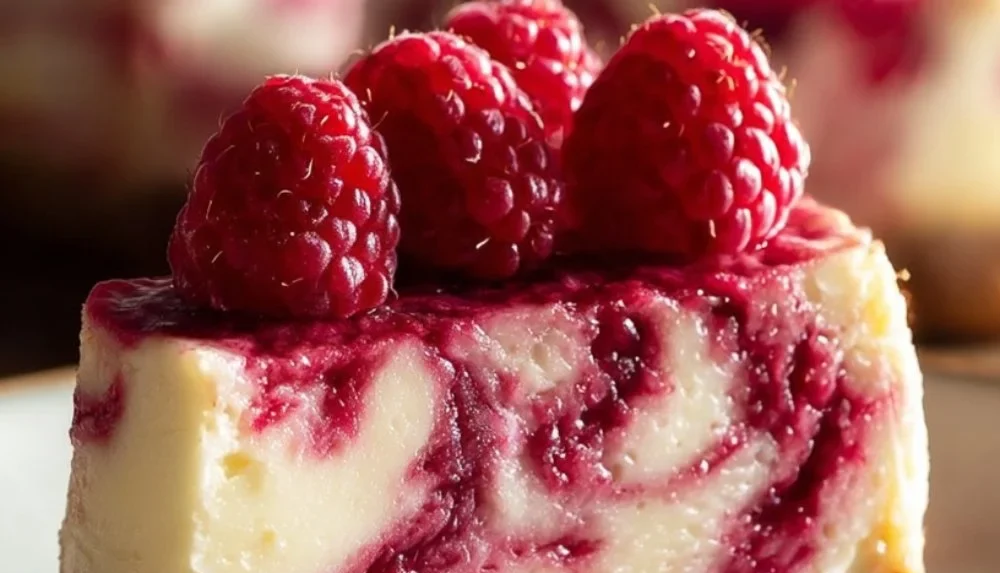
Baked Raspberry Cheesecake
Introduction
The origin story & regional influence behind this dish
Cheesecake is a kind of culinary memory that travels in time. Its earliest footprints are found in ancient Greece, where dense cakes of cheese and honey were offered to athletes and gods alike. Over centuries, like so many recipes carried on the backs of merchants and migrants, cheesecake became a palimpsest — rewritten by local dairies, pantry staples, and the seasonality of fruit. The Baked Raspberry Cheesecake I return to again and again is a distinctly modern chapter in that long story: a creamy American invention with a crust that speaks of 19th-century ingenuity and a bright crown of raspberries that recall summer markets from Maine to Mallorca.
The present version, anchored by cream cheese and a graham cracker crust, is unmistakably American in character. Cream cheese emerged in the late 1800s in the United States — a softer, tangier relative of European fromage frais — while the graham cracker has its own story of reform and domestic industry. Yet the raspberries are the true international chorus in this duet. Fragile, fragrant, and quick to bruise, raspberries carry with them the cool hillsides of Northern Europe, the home gardens of Eastern Europe, and the warm, wild edges of North American forests. In the Baked Raspberry Cheesecake, the berry becomes both garnish and memory: a wild, tart counterpoint to the dense sweetness beneath.
This dish therefore sits at a crossroads: an American technique applied to ingredients that speak of Europe, Britain, and the New World. It is both a local comfort and a global conversation — a dessert you might find in a small coastal café in Nova Scotia, a refined dinner party in Buenos Aires, or a wedding table in Melbourne. Each place leaves its fingerprint, whether in the crust, the ripeness of the berries, or the hush and reverence with which it is shared.
How to make Baked Raspberry Cheesecake
Ingredients :
2 cups graham cracker crumbs, 1/2 cup unsalted butter, melted, 4 (8-ounce) packages cream cheese, softened, 1 cup granulated sugar, 4 large eggs, 1 teaspoon vanilla extract, 1 cup sour cream, 1 cup fresh raspberries, 1/4 cup raspberry puree (optional for topping)
Directions :
- Preheat your oven to 325°F (163°C). Grease a 9-inch springform pan., 2. In a medium bowl, mix graham cracker crumbs and melted butter. Press the mixture into the bottom of the prepared pan to form the crust., 3. In a large mixing bowl, beat the cream cheese until smooth. Gradually add sugar and mix until combined., 4. Add eggs one at a time, mixing well after each addition. Stir in vanilla extract and sour cream until smooth., 5. Gently fold in the fresh raspberries., 6. Pour the cheesecake mixture over the crust in the springform pan., 7. Bake for 50-60 minutes or until the center is set but slightly jiggly., 8. Turn off the oven and let the cheesecake cool in the oven with the door slightly ajar for 1 hour., 9. Remove from the oven, chill in the refrigerator for at least 4 hours or overnight., 10. Before serving, drizzle with raspberry puree if desired and garnish with additional raspberries.
Ingredients through a cultural & historical lens
Every ingredient in this recipe carries a small civic history. The graham cracker crumb crust—a simple union of sweet biscuit and butter—was born from a 19th-century dietary movement that prized whole grains and home baking. The humble graham becomes, in this context, a foundation both textural and moral: a symbol of American domesticity and thrift that pairs surprisingly well with luxurious filling.
Cream cheese, for its part, is the product of American dairying meeting European cheesemaking techniques. It’s an emblem of industrialized comfort: spreadable, rich, and adaptable. Sour cream brings a whisper of Eastern European kitchens, where cultured creams brighten dense, rich sweets and savory dishes alike. Eggs and sugar — the alchemy of custard — have been the backbone of desserts for centuries, and vanilla, once an exotic and costly import, now perfumes the cake with its warm, familiar scent.
Raspberries are the poem tucked into the recipe. In European lore they have been associated with abundance and protection; in many cultures they are foraged rather than farmed, a taste of the wild. Their tartness cuts through the richness of cheese and sugar, adding a brightness that is as geographical as it is gustatory: a hint of cooler climates, hedgerows, and sun-soft afternoons.
Cooking the dish: sensory notes & traditional techniques
Baking this cheesecake is an exercise in patience and in listening. The oven’s steady heat coaxing the filling into set cream is less drama than quiet transformation, and the small jiggle in the center of the cake is a proof of gentle perfection — signifying a custard that will set beautifully as it cools. That period of cooling in the oven with the door ajar is at once practical and ritual: a respite in which steam leaves the cake slowly, preventing cracks and lending the final slice a satin-smooth texture.
The aroma as it bakes is an intimate thing — a rounded, milky perfume, threaded with vanilla and the faint, warm scent of buttered biscuit from the crust. When served chilled, the first bite is a textural conversation: the brittle, sanded crust yielding to a dense, velvet interior; a pop of berry that releases its tart juice against the full creaminess of the cheese. Raspberries introduce acidity and scent — floral and slightly wild — that lifts the whole.
In homes across regions, this baking is often an act of care. Families leave the oven door ajar not because a recipe insists but because the slow cool has become tradition: an inherited method, a grandmother’s whisper passed down to avoid cracks and to teach patience. It is a technique that is more about the rhythm of domestic life than the exact temperature — a culinary metaphor for the time it takes to let sweetness settle.
How different regions prepare their version
The form of cheesecake is malleable to local ingredients. In the northeastern United States, the graham crust and dense, slightly tangy cream cheese filling is king — a version that values mouthfeel and richness. Move south or west, and you’ll find variations that fold in citrus or local berries, or lighten with whipped cream.
Across the Atlantic, British bakers may favor a digestive biscuit base, offering a nuttier, sturdier crust, while in Italy the ricotta-based cheesecake sings a different song: grainier and lighter, often without a crumbly bottom. France tends to refine the dessert with delicate textures and a subtle sweetness, sometimes taking influence from flans and tarts. In Japan, the cheesecake becomes ethereal — less dense, more soufflé-like — an embodiment of local preferences for airy, less-sweet confections.
When raspberries are abundant, the fruit becomes the talking point: whole berries folded into the filling as here, or simmered into glazes and coulis. In regions where raspberries are not native, preserves or frozen berries might feature instead, and the dessert acquires a slightly different texture and color — a reminder of how local ecology shapes what we call a single dish.
Traditional ways this dish is shared or served
In many places the Baked Raspberry Cheesecake is Sunday-lunch fare: a quiet crescendo after a long afternoon meal, sliced thin and offered with strong coffee. Elsewhere it will be the centerpiece at summer weddings, its white expanse dotted with pink fruit like small celebrations. In cafés it arrives on a porcelain plate, a hush-piece between strangers’ conversations; at home it is passed around at birthdays, each slice carrying laughter and little stories about who made it last and who burned the crust once.
Raspberries themselves lend the dessert a seasonality that dictates tradition. When they come into mind-numbing ripeness in July, the cake marks a season of abundance — picnics beneath chestnut trees, breakfasts with sunlight droning through windowpanes, and markets where farmers call out their morning harvest. In colder months the cheesecake can be a memory of those summers, the berry a preserved echo in puree or jam.
Serving rituals differ by culture: some prefer a drizzle of puree, some a dusting of powdered sugar, others a smear of crème fraîche. Pairings also tell a cultural story — a tart late-harvest wine in Europe, espresso in Italy, a tall, milky tea in South Asia — each accompaniment a regional comment on sweetness and balance.
Storing the dish without losing its cultural essence
Chilling is part of the cheesecake’s identity. The slow cool and subsequent refrigeration are not merely technical; they are a pause, a period in which the flavors harmonize. Storing the cake covered in a cool place preserves its texture and the memory of the day it was made. Wrapping it tightly keeps the crust from softening and the berries from bleaching into a muted memory of themselves.
For those who travel with a slice, the cultural essence is preserved in gestures: carrying the cake in a communal tin, placing it at the center of a picnic blanket, or sliding it onto a family table as a shared reward. Even when freezer space is used — an option for long journeys — the story remains intact if the cake is thawed gently and presented as something made earlier, a bridge between places rather than a pristine, lab-perfect artifact.
Cultural questions people often ask
Why raspberries, people often ask, instead of strawberries or blueberries? The answer lies partly in texture and partly in voice: raspberries have a fragile tartness and a perfume that punctuates the richness of the cheese without overwhelming it. Others ask about the graham crust — why not pastry? The crumbly bottom speaks of comfort and simplicity; it asks for no fluting, no fuss, and allows the filling to be the main event.
Dietary adaptations are often raised, too: how to keep the spirit of the cake while changing its ingredients. The cultural response usually focuses less on substitution and more on intent: what matters is that the dessert functions as a ritual of sharing, whether lightened, veganized, or made with local substitutes. And then there is the perennial question: baked or no-bake? Culturally, baked versions carry the authority of tradition and the texture of a proper custard — a slow, reassuring work — while no-bake renditions often belong to summer improvisations and quick hospitality.
A closing note on food, memory & travel
Recipes like this Baked Raspberry Cheesecake are less about exactitude and more about inheritance. They are stories composed of smells and textures: butter on warm fingers, the faint grain of graham between teeth, the burst of raspberry bright as a foreign street sign. When I travel, I carry such recipes with me — not to reproduce them in a laboratory, but to find their echoes in new places: in the tartness of a Greek berry roadside, in a New Zealand farmhouse kitchen, in a Lisbon pastelaria where a different kind of custard informs a similar craving.
Each slice is a map and each crumb a compass. To taste this cheesecake is to be reminded that food is where the domestic and the global meet, where seasons and migrations leave fingerprints on plates. It is a dessert that invites conversation: about the people who tend raspberries at dawn, the hands that press crumbs into pans, the patient cooling that seems like a small act of faith. In its sweetness and restraint, it holds the kind of openness that every traveler hopes to find — a table where strangers become friends, and where the past can be tasted, quietly, in the present.
Conclusion
If you want to compare variations from home bakers and food bloggers, this Raspberry Cheesecake – Sugar Spun Run offers one perspective on fruit-forward finishes. For a simple, accessible version that mirrors the warmth of home kitchens, see Easy Baked Raspberry Cheesecake – The Loopy Whisk. To explore another take with step-by-step visuals, visit Baked Raspberry Cheesecake – VJ Cooks. And for a broader dive into techniques and flavor notes across recipes, this piece on The Best Raspberry Cheesecake | Foodelicacy can be a useful companion.