Pink Chocolate-Dipped Wafers
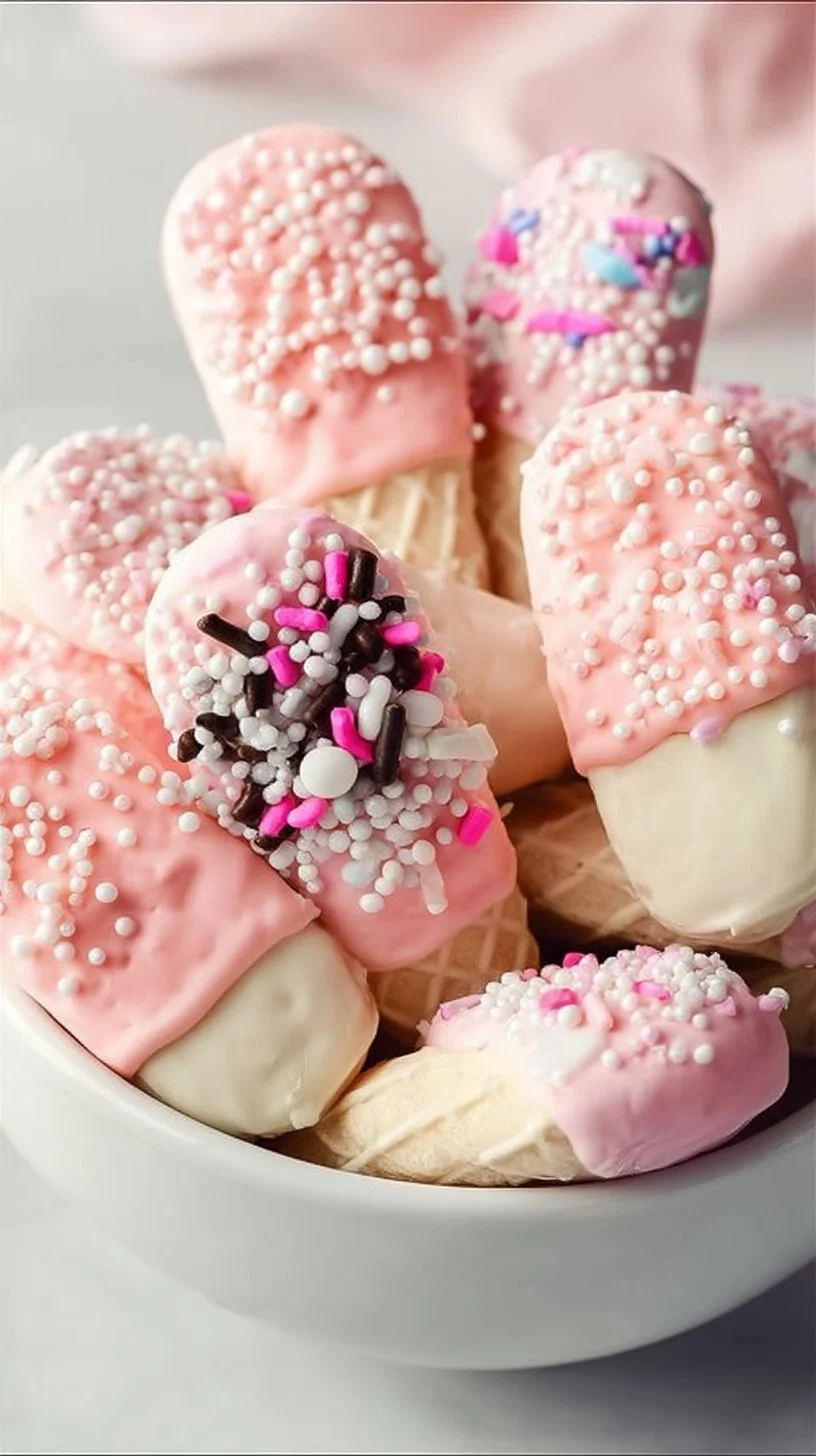
There are small gestures of joy that travel with you — the taste of a childhood kitchen, the sweetness of a market stall at dusk, the quiet ritual of tea and something crisp. Pink Chocolate-Dipped Wafers are one of those gestures: humble wafer cookies transformed by a glossy, rosy coat into something celebratory, intimate, and strangely cosmopolitan. They sit at the crossroads of confection and memory, the kind of morsel that can stop a conversation and pull a smile from a stranger. As a travel writer who follows food like a map, I find that these little dipped wafers reveal more than a recipe: they reveal how place, color, and ritual adorn even the simplest bites.
Imagine a seaside café where the light lowers to gold and a plate of these wafers is passed around — children with chocolate-stained fingers, an elderly couple recalling the first time they tasted something pink and sweet, a visitor tracing the wafer’s delicate grid with a fingertip. The perfume of cocoa and the faint tang of strawberry coloring mingle with the coastal air. Texture—crackle, then melt—becomes a language. From a pantry shelf in a Scandinavian summer cottage to a bustling festa in Brazil, pink-dipped wafers nod to a universal human inclination: to celebrate small, sweet things.
The origin story & regional influence behind this dish
Wafers themselves are ancient, their thin, layered architecture a common thread through Europe’s baking history and beyond. The wafer cookie’s ancestry threads through medieval holy days and simple household treats; in different tongues they are known as ostie, oblea, or gaufrette. The idea of dipping a biscuit or wafer into chocolate is more recent, an invention of modern confectionery that married the brittle snap of a wafer with the smooth, luxurious depth of chocolate. Pink chocolate — whether a strawberry-infused confection or white chocolate colored in rosy hues — belongs to the era of industrial confectionery, where color and novelty join tradition.
This combination became especially meaningful in places where celebrations lean on bright color: think pastel dessert tables at European holiday markets, or the tinsel-bright sweets of Latin American fiestas. In the United States and parts of Western Europe, the pastel palette of pink and mint evokes baby showers and spring gatherings; in Japan, sakura season lends a cultural resonance to pink sweets that is floral and ephemeral. In each region, the pink-dipped wafer has been folded into local rituals, absorbing meanings that are both global and intimately local: femininity, festivity, nostalgia, or simply the thrill of color on the tongue.
How to make Pink Chocolate-Dipped Wafers
To make Pink Chocolate-Dipped Wafers is to practice an act of transformation that requires very little time but yields a generous share of delight. Here the technique is uncomplicated: melt, dip, decorate, and let set. It’s the sort of recipe that invites participation — a tray at a party where hands come and go, each guest customizing their own with sprinkles or leaving theirs plain. The ease of the method belies its social power; making these wafers can become a communal ritual, a modern hearth around which stories are traded.
What matters most is atmosphere: the sound of a kettle, a record spinning softly in the background, the way light falls on a marble countertop as chocolate shimmers in a bowl. Those small sensory details—warmth in the hands, the decisive half-moon dip of a wafer, the sprinkle of confetti-like sugars—make the act of making them as meaningful as the eating. Here are the exact lists and instructions that bring that domestic theater to life.
Ingredients :
Wafer cookies, Pink chocolate melts or white chocolate with pink coloring, Sprinkles (optional)
Directions :
- Melt the pink chocolate in a microwave-safe bowl, stirring every 30 seconds until smooth., 2. Dip each wafer cookie halfway into the melted chocolate, allowing excess to drip off., 3. Place dipped wafers on a baking sheet lined with parchment paper., 4. If desired, sprinkle on colorful sprinkles before the chocolate sets., 5. Let the chocolate harden at room temperature or refrigerate for faster setting., 6. Serve and enjoy!
Ingredients through a cultural & historical lens
Each item on that short ingredients list carries its own cultural biography. Wafer cookies recall street vendors, church fairs, and picnic baskets across Europe and Latin America. In the Netherlands and Belgium, thin waffles and wafers are heritage sweetmakers’ calling cards; in Central America, obleas—thin, circular wafers often layered with dulce de leche—represent communal confections sold by vendors who know every customer’s face. To use a mass-produced wafer cookie is to tap into that lineage, to participate in a global confection story.
Pink chocolate melts are emblematic of modern confectionery’s fascination with color. Whether made from real fruit like strawberry or a flavored compound created to mimic that scent and hue, pink chocolate conjures a visual narrative: innocence, festivity, sweetness. The choice to use sprinkles, optional though they may be, is a cultural flourish. Sprinkles are celebratory: Scandinavian “nonpareils” at a child’s birthday, American jimmies on ice cream cones, Brazilian confeitos brightening a festa junina table. Each tiny sugar bead carries its own regional memory and adds a pop of color that signals the wafer’s desire to be more than sustenance—it wants to be part of a story.
Cooking the dish: sensory notes & traditional techniques
When the pink chocolate meets the wafer’s crisp edge, the sensory moment is quiet and exacting: a delicate crack, a powder that gives way to glossy melt. The scent of the melted chocolate—warm, sweet, slightly floral if pink chocolate includes berry notes—fills a tiny room like incense. There is a tactile pleasure in the act of dipping: the bowl’s warmth under the wrist, the careful wrist-flick to remove excess, the satisfaction of watching drips solidify into a smooth satin surface.
Traditionally, thin wafers are best used because their lightness allows the coating’s flavor to shine without overwhelming. In older European kitchens, confectioners might temper chocolate by hand to achieve a sheen and snap; today’s melts offer a pragmatic shortcut. Even so, the old techniques inform the modern ritual: patience while chocolate cools, the reverence for a smooth finish, the way a baker inspects a finished edge as if reading a face. These small traditions—passed down in family kitchens or gleaned from market stalls—are what keep a simple recipe tethered to a larger cultural practice.
How different regions prepare their version
Across regions, the core idea remains the same, but the accents change. In parts of Italy, wafers may be layered with creams or liqueurs; a pink-dipped wafer might be flavored lightly with amaretto or lemon zest to echo local tastes. In Japan, where confectionery celebrates seasonal motifs, a pink dipped wafer could be dusted with sakura powder or matched with green tea’s bitter edge. Latin American vendors might swap colored sprinkles for shredded coconut or a brush of dulce de leche before setting, integrating the wafer into a sweeter, more lush palette.
On European café tables, pink-dipped wafers might be served alongside espresso, the bitter coffee cutting through the saccharine glaze. In American party contexts, they often appear en masse at baby showers or bridal showers, aligned like tiny flags on a dessert table. Each version reflects local taste and ritual: how sweet a community likes its sweets, what textures are prized, what colors signify celebration.
Traditional ways this dish is shared or served
Serving these wafers is an act of hospitality, scaled up or down depending on context. In a home, a small plate with a linen napkin becomes an invitation: take one, have another. At a festival, they are handed out wrapped in cellophane or arranged on tiered stands, guests sampling as they move through the crowd. At weddings and showers, they become favors tied with ribbon, small keepsakes that carry the event’s color palette and the host’s intent to give sweetness as a memory.
There is also intimacy in the solitary serving: a cup of tea and a single pink-dipped wafer shared between a traveler and a journal late into the night. Such solitary rituals are as traditional as the social ones; they too are a way of marking time. The visual of pink against a white plate, the trail of tiny sprinkles on a tablecloth—these are the small, repeatable theatrics that make the wafers a fixture in many gatherings.
Storing the dish without losing its cultural essence
The practicalities of storage are modest, but they matter to the experience. Keep wafers in an airtight container to preserve crispness; layer it with parchment or wax paper if you are stacking them to avoid marring the glossy finish. Refrigeration can speed setting, but long-term cold storage risks condensation when the wafers return to room temperature, softening the crispness that is their charm. In many cultures, preserving a confection’s texture is part of honoring the treat’s integrity — an almost reverent act.
But cultural essence is not simply a matter of texture. Presentation is part of storage: bundling wafers in small paper envelopes for a festival, placing them in glass jars on a countertop, or wrapping them in muslin for gifting. These methods turn storage into storytelling, a way to carry the wafer’s meaning from kitchen to celebration to memory.
Cultural questions people often ask
People often ask: Are these a cookie or a candy? The answer is happily both. Are they gourmet or everyday? They can be either; a simple pantry snack becomes a ceremony with the right company. Travelers ask whether the pink color has an inherent flavor — sometimes yes, when strawberry or raspberry is used, sometimes no, when coloring alone is responsible for the hue. Many also wonder about the best occasions for serving them: any moment that calls for a small sweetness—a meeting, a farewell, a child’s triumph—can be right.
Another common curiosity is how such a simple confection gained cross-cultural traction. The explanation lies in its adaptability: it is easy to make in any kitchen, easy to transport, and visually arresting without being pretentious. Its accessibility makes it a democratic dessert, one that can be uplifted by context and companionship.
A closing note on food, memory & travel
Small sweets teach large things. A pink chocolate-dipped wafer, offered at an airport cafe or a grandparent’s table, carries with it the gravity of simple pleasure. It can be a marker of place—a bright treat at a seaside fête, a pastel comfort in a rainstorm—or a bridge between strangers, passed across a picnic blanket. For a traveler, these wafers are talismans: tasteable souvenirs that travel better than many objects, sharing flavor tied to a time and place.
They remind us that culinary travel is not always about seeking the exotic; sometimes it is about recognizing how the familiar is remade by light, company, and memory. A wafer dipped in pink chocolate is an invitation to notice: the way a color can make a moment feel ceremonial, the way textures can map the contours of a childhood, the way simple recipes become the scaffolding of communal stories. Keep a jar in the bag, share one with someone you’ve just met, and listen. You will hear more travel tales than you might expect—told between bites.
Conclusion
For practical inspiration and variations on chocolate-dipped wafer treats, The Kitchn offers a recipe that evokes similar nostalgia and presentation in their piece on Chocolate-Dipped Strawberry Wafer Cookies – The Kitchn, while home cooks can find an approachable take in the recipe collection at Chocolate Dipped Wafer Cookies – Easy Peasy Meals. These resources can help you adapt the simple ritual of dipping wafers into a personal tradition of your own.
Pink Chocolate-Dipped Wafers
Ingredients
Method
- Melt the pink chocolate in a microwave-safe bowl, stirring every 30 seconds until smooth.
- Dip each wafer cookie halfway into the melted chocolate, allowing excess to drip off.
- Place dipped wafers on a baking sheet lined with parchment paper.
- If desired, sprinkle on colorful sprinkles before the chocolate sets.
- Let the chocolate harden at room temperature or refrigerate for faster setting.
- Serve and enjoy!