Peanut Butter Brownie Swirl Cookies
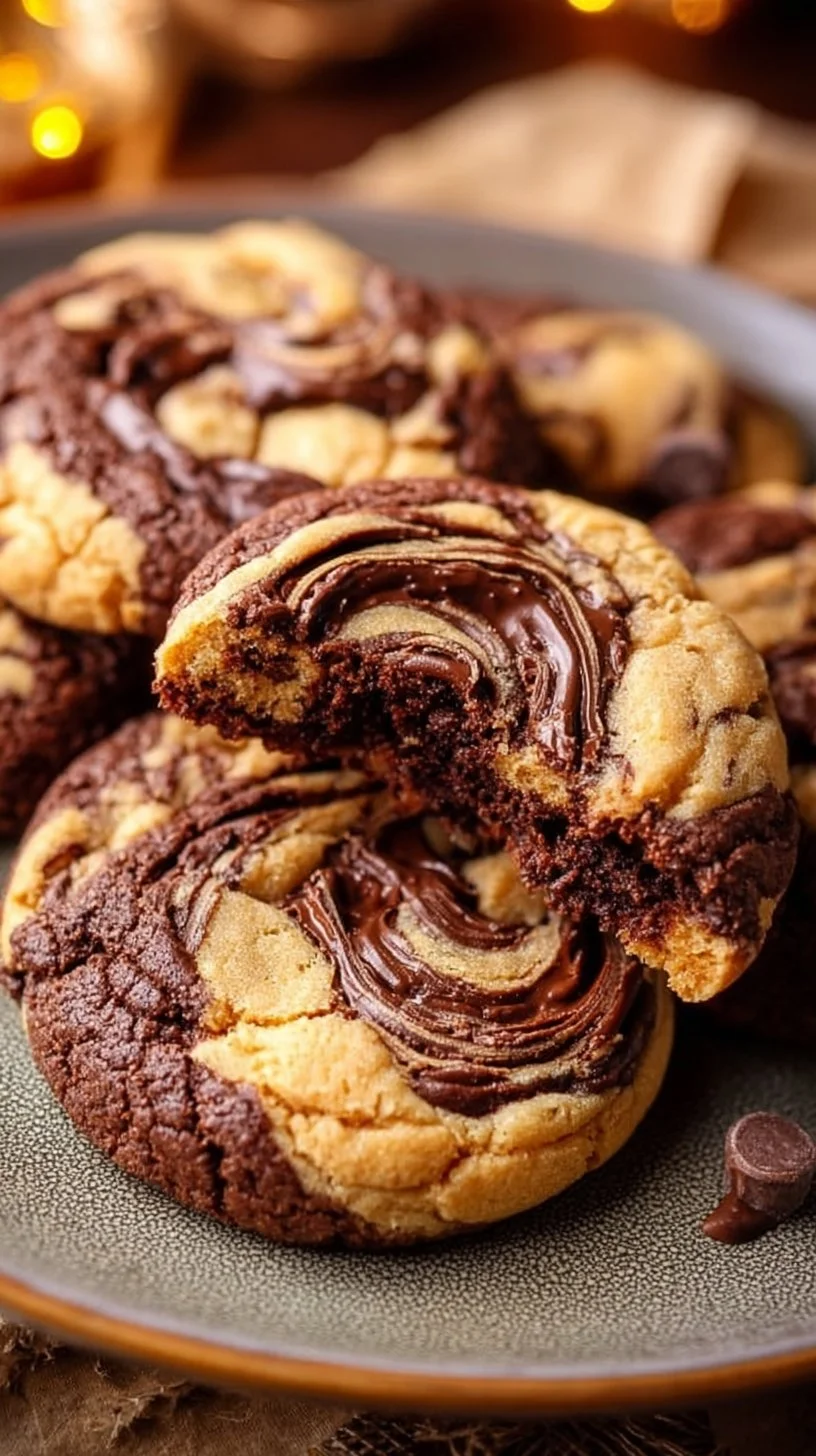
I first met the peanut butter brownie swirl cookie on a rainy afternoon in a small café that smelled of roasted coffee and warm flour, in a city whose name changed with my passport stamps but whose human rhythms did not. It arrived on a chipped ceramic plate, a modest jewel: a round of salted, nutty dough threaded through with a dark, glossy crescent of chocolate-brown batter. One bite carried me from the present to a stitched memory — a children’s picnic, a roadside bakery on a summer highway, a grandmother’s laughter — all layered like the swirl itself. This is the kind of cookie that travels not only in suitcases but in stories, and as a wandering food writer I have found that places often claim a version of it, folding local history and mood into a treat that is at once comfort and curiosity.
In many homes, where condensed memories are kept in mason jars and recipe cards, this cookie functions like a map. Its flavors are universal — peanut and chocolate — yet each region bends them toward its own textures and rituals. If you want a companion while reading about it, consider how other simple confections carry map-like memories, as in the case of chewy maple cinnamon cookies, which anchor northern woodlands and winter markets in a single, sticky bite. The peanut butter brownie swirl cookie is no less a passport.
The origin story & regional influence behind this dish
The marriage of peanut butter and chocolate is an American romance with roots in New World agriculture and 20th-century industrial food culture. Peanuts, domesticated and cultivated across the American South, became a staple after innovations in agricultural science and marketing; peanut butter entered the pantry as both nutrition and nostalgia. Brownies, with their fudgy, cocoa-rich cores, emerged from urban bakeries and home kitchens where chocolate — once a luxury — grew more accessible.
The swirl cookie is a later invention: an improvisational riff that appears wherever home bakers have the curiosity to marry two beloved batters. Its exact birthplace is diffuse: not a single bakery but a collage of kitchens, community centers, and church basements. In the South it often nods to a pocketed, slightly salted peanut butter that echoes late-summer fairs and pecan trees; in urban Northern apartments it can recall youthful late-night baking experiments, dark chocolate smeared on fingertips. The form — a peanut dough1 braided with a brownie slick — speaks of economies and improvisations: a dollop of leftover brownie batter is given stage atop a sturdy peanut base.
Across diasporas, this cookie also finds cousins. In parts of Latin America, where peanuts and chocolate both thrive, similar combinations appear in candy-like confections. In Europe, nutty chocolate bakes take refuge in butter-rich pastry traditions. Yet the American swirl remains singular in its casualness: it is not refined to a patisserie statement but celebrated as everyday magic. It is less about provenance than about the act of layering comfort — the communal choice to combine what people love most.
How to make Peanut Butter Brownie Swirl Cookies
There is a domestic theater to this recipe: the oven’s gentle hum, the slow ritual of mixing, and the patient watching as edges set while centers remain tender. Below are the precise building blocks and steps for recreating that small domestic theater in your own kitchen.
Ingredients :
1 cup peanut butter, 1 cup brown sugar, 1/2 cup granulated sugar, 1 large egg, 1 tsp vanilla extract, 1/2 cup all-purpose flour, 1/2 tsp baking soda, 1/4 tsp salt, 1 cup brownie batter
Directions :
- Preheat your oven to 350°F (175°C)., 2. In a large bowl, mix together the peanut butter, brown sugar, and granulated sugar until smooth., 3. Add in the egg and vanilla extract, mixing well., 4. Gradually add the flour, baking soda, and salt to the mixture, stirring until combined., 5. Drop spoonfuls of the peanut butter dough onto a baking sheet lined with parchment paper., 6. Add a small dollop of brownie batter on top of each cookie., 7. Swirl the brownie batter into the peanut butter dough using a toothpick or knife., 8. Bake for 10-12 minutes, until the edges are set., 9. Let cool on the baking sheet for a few minutes before transferring to a wire rack to cool completely.
These lines — ingredients followed by warm instructions — are best read as a story’s skeleton. The measurements are anchors that allow improvisation in rhythm, not in content: the recipe above must remain intact for the cookie to be what it is.
Ingredients through a cultural & historical lens
Every ingredient tells a story that is part geography, part commerce, and part family myth. Peanut butter is the most obvious storyteller here: born from the peanut’s migration from Indigenous cultivation to international commodity, it became an economical source of protein and affection in the 20th century. Brown sugar — molasses-laced and golden — perfumes dough with a hum of molasses that evokes plantation histories, Caribbean production, and the granular sweetness of community feasts. Granulated sugar speaks to the global sugar trade and the industrial lantern light in factory towns. Flour and baking soda are modern alchemy, the chemistry of leavening that enabled home baking to flourish in compact urban dwellings.
The brownie batter, dark and molten, is a descendant of early chocolate confections and café culture. It insists on a small extravagance: chocolate being added as a counterpoint to the humbler peanut. In kitchens where rationing was once routine, a spoonful of leftover brownie batter became gilding. In households where chocolate meant celebration, the swirl becomes ceremonial — a marker that this afternoon is for visiting, tidings, or solace.
Taken together, these ingredients fold global trade routes and local economies into one compact pastry: sugar grown on distant islands, peanuts picked in nearby fields, vanilla from a tropical vine, and flour milled in the county down the road. Each bite is a map with layered coordinates.
Cooking the dish: sensory notes & traditional techniques
The making of the swirl cookie is as tactile as it is aromatic. When you first stir the peanut butter with sugars, the air fills with warm nuttiness, like a sunlit barn. The brown sugar’s moisture gives the dough a soft, almost ribboned texture, while granulated sugar adds a crystalline snap that sings lightly against the tongue. As egg and vanilla fold in, the mixture takes on a cooperative, mellow sheen.
The act of dropping spoonfuls onto parchment is meditative: small islands waiting for a dark tide. The brownie batter, dense and luxurious, sits like a gloss atop each mellow mound. To swirl is to invite contrast: a delicate knife or toothpick pulls the chocolate into the peanut mass, creating marbling that bakes into a skin of glossy cake and a heart of tender crumb.
Traditional techniques vary. Some households press the cookie with a fork in crosshatch patterns — a Southern hallmark for peanut-based cookies — while others leave the swirls untouched so the brownie can spread its own art. The baking time is brief, producing cookies whose edges are set with a faint, buttery crust and centers that retain chew. Cooling on the baking sheet is a small mercy: the change in temperature allows structure to assert itself, making the cookie easier to transfer and revealing the internal gradients of moistness and cocoa-rich pockets.
Aroma is decisive: while baking, the kitchen smells of roasted peanuts and chocolate, with the caramel-sweet note of brown sugar rising like a memory. That scent is often what lingers in travel recollections: a winter market, a seaside boardwalk, or the belly-warming of a mountain lodge.
How different regions prepare their version
Across regions, the cookie takes on local accents. In the American South, bakers may fold in a hint of cornmeal or a dusting of coarse salt, aligning the cookie with savory-sweet barbecue and porch-swing afternoons. In the Midwest, where peanut butter has a homely centrality, the cookie might be thicker, rolled in sugar for a crackled exterior, or punctuated with chopped roasted peanuts for texture. Coastal bakers sometimes swap standard brownie batter for darker, sea-salted chocolate blends that echo maritime salt and the mineral tang of ocean air.
In Latin-influenced neighborhoods, the swirl can receive spicy inflections: a pinch of cinnamon tucked into the peanut dough, or the brownie accented with a whisper of chili to recall mole-like warmth. In urban patisseries, the cookie may be composited into ensembles — layered with salted caramel or pressed into sandwich form with whipped ganache — transforming a humble swirl into a pastry counterpoint.
Regional bakers also adapt for ritual. For holiday platters, cookies may be trimmed into uniform disks and arranged in concentric rings; for roadside stands they are substantial and unadorned, perfect for paper wrappers and hungry travelers. For a sense of continuity, see how sweet confections adapt to place, as in the pairing of nut and fruit in chocolate-covered strawberry brownies, which marry seasonal produce to chocolate’s steadfastness. Each adaptation preserves the cookie’s essential identity while allowing local memory to taste its way through.
Traditional ways this dish is shared or served
The swirl cookie shines in company. It is the kind of thing you pass around at a potluck, slip into a toddler’s lunchbox, or present on a tray at housewarmings. In many communities its sharing signals belonging: a plate left on a neighbor’s doorstep after illness, a stack wrapped in wax paper for a student leaving for college, a tin sent across miles at Christmas. It is, in short, a cookie of benediction.
Tea ceremonies, community bake sales, and school fundraisers have adopted the cookie because it offers both immediate pleasure and a pull into memory. It is often served with coffee or cold milk — a pairing that is practically ceremonial: the sip cleanses the palate and invites another bite, and the ritual is as much social glue as gustatory satisfaction. In more formal settings, the cookie may be plated with a dusting of powdered sugar or a smear of extra brownie ganache, elevating it without erasing its friendly origins.
Families inherit specific serving rituals. Some insist the swirl be eaten at room temperature so the textures can be fully appreciated; others prefer a slight chill that firms the brownie center. These small insistences become identity markers, handed down with the recipe itself.
Storing the dish without losing its cultural essence
Storage is an act of care that prolongs both flavor and meaning. Kept in an airtight tin at room temperature, these cookies remain tender for two to three days; in cooler climates they might keep a bit longer. If you want to preserve the marbled appearance and the nuanced textures, avoid stacking too many layers without parchment between them, as the brownie can stick and carry the swirl into a muddle.
Freezing is a practical solution for travelers who wish to dispatch tins to distant kin. Lay cookies flat on a sheet to flash-freeze before wrapping, a method that safeguards the swirl’s pattern and the cookie’s integrity. When thawed, they regain a near-fresh quality; reheat briefly in a warm oven to reawaken the aroma and soften the crumb.
But storing is also cultural: in some households cookies are kept in a blue tin passed through generations, which itself carries scents of spice and time. In other places they are communal fare, meant to be consumed quickly and fresh, the very perishability being part of their charm.
Cultural questions people often ask
People ask many kinds of questions about a humble thing like this cookie. Is it better with crunchy or creamy peanut butter? Should the brownie be fudgy or cakey? Must it be swirled, or can it be sandwiched? Each question is really a way of asking about heritage and preference. A crunchy peanut butter suggests a working-class thriftiness — textural fortitude reminiscent of hands that have tended soil — while creamy implies urban convenience.
Another common query is about pairing: what to drink with it? Milk and coffee remain the default; for more ritualistic settings, tea or an aged porter beer offer balance. When asked about making it for guests with dietary needs, bakers often respond with the gentle pragmatism of those who feed others: substitute mindfully, preserve ritual.
Often the most sincere questions are conversational: “Who made this for you?” or “Where did you learn this?” People want to place the cookie within a lineage, to know whether it was an heirloom recipe or a serendipitous discovery at a bakery. Those answers map social networks as surely as they map flavors.
A closing note on food, memory & travel
Food is the world’s most portable archive. A cookie like this one carries climate, commerce, and kinship in its improbable swirl: the agricultural histories of peanuts and cocoa, the improvisational spirit of home cooks, and the social customs that set one dish into the center of gatherings. For the traveler, every bite is an encounter — a doorway into how people make belonging with sugar and heat. In far-flung places and familiar kitchens, the peanut butter brownie swirl cookie insists on being both ordinary and luminous. It is, simply, a small object that holds a great many returns: to tables, to childhoods, to slow moments when stories are traded over the clink of china.
Conclusion
If you would like to see other playful variations on the peanut-and-chocolate theme, a lovely riff can be found at Peanut Butter Swirl Brownie Cookies – Sugared & Stirred, which offers a different ornamentation for the same comforting marriage. For another take that explores the idea of filled cookies and the joy of surprise centers, consider the inventive approach at Peanut Butter Filled Brownie Cookies – Sally’s Baking Addiction.
Peanut Butter Brownie Swirl Cookies
Ingredients
Method
- Preheat your oven to 350°F (175°C).
- In a large bowl, mix together the peanut butter, brown sugar, and granulated sugar until smooth.
- Add in the egg and vanilla extract, mixing well.
- Gradually add the flour, baking soda, and salt to the mixture, stirring until combined.
- Drop spoonfuls of the peanut butter dough onto a baking sheet lined with parchment paper.
- Add a small dollop of brownie batter on top of each cookie.
- Swirl the brownie batter into the peanut butter dough using a toothpick or knife.
- Bake for 10-12 minutes, until the edges are set.
- Let cool on the baking sheet for a few minutes before transferring to a wire rack to cool completely.