Tomato Bruschetta
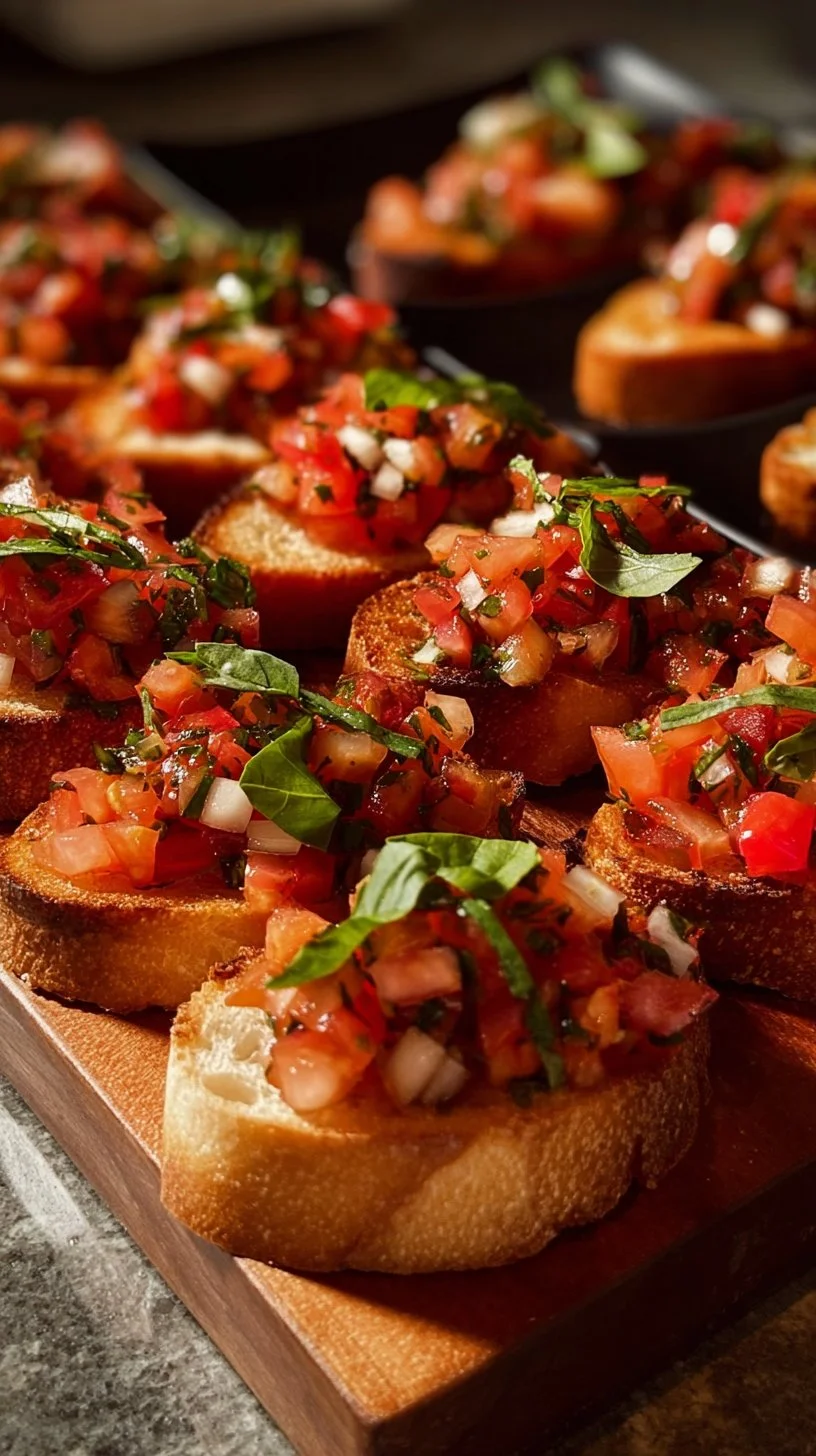
There are dishes that arrive at the table like old friends, carrying the weathered accents of the places they came from and the quiet insistence of rituals repeated for generations. Tomato Bruschetta is one of those simple, luminous gatherings — a small, open-faced promise of summer that travels easily in luggage and memory. I first met it on a sun-baked terrace in a village where tomatoes were as red as the clay roof tiles, and the air smelled of sea, basil, and the low smoke of night fires. It was offered between cups of strong coffee and stories of harvest; it was eaten by hands that had shaped loaves and raised children and had time to notice how salt made the tomato brighter.
As a travel writer I’ve learned that food often serves as an immediate map: a way to locate a place not only on a map but in the cadence of its people’s lives. A slice of toasted bread smeared with garlic, cradling a spoonful of glossy tomato and a ribbon of melting mozzarella, carries more than flavor. It carries geography in its olive oil, history in its vinegar, and the intimate human logic of sharing. In this piece I will walk through the origin and influence of Tomato Bruschetta, guide you through the recipe as given, and trace how this humble plate connects to kitchens, festivals, and family tables from one region to another. Expect the aroma of charred bread, the soft press of tomato against tooth and tongue, and the timpani of conversations that often accompany the first bite.
The origin story & regional influence behind this dish
Bruschetta, in its essence, predates tomatoes in Italy. The word likely comes from the Roman verb “bruscare,” meaning to roast over coals — an act of toasting bread to make it more digestible and longer-lasting. In the agrarian dialects of central Italy, bruschetta became shorthand for any slice of charred bread rubbed with garlic and doused in local olive oil. Before tomatoes crossed the Atlantic and became central to Mediterranean tables, bruschetta might have been served with salt, olive oil, and perhaps a smear of local cheese or preserved vegetables.
Tomato Bruschetta as we recognize it — diced tomatoes brightened with basil, salt, and olive oil — emerged with tomatoes’ entrenchment in Southern European cuisine. The tomato’s journey from wild New World fruit to Mediterranean staple is itself a story of adaptation and desire. Where the tomato thrived, it was quickly folded into the local patterns of eating: the long bread tradition of Italy, the abundant olive groves of Tuscany and Puglia, and the basil leaves that perfume markets from Genoa to Sicily.
Region matters. In Rome and its environs the emphasis is on simplicity: ripe tomatoes, a generous stream of extra virgin olive oil, and the fragrant green of basil. In Naples and along the Amalfi coast, the tomato’s sweetness might be accentuated with an interplay of sea salt and lemon or with the locally produced mozzarella di bufala, creamy and assertive. Northern regions, with their softer tomatoes and different bread traditions, sometimes adapt bruschetta to reflect cooler climates and the influence of neighboring France and Austria. But across regions, bruschetta remains a small ritual of conviviality — an offering to friends, a snack between meals, an element of antipasti that announces the tone of a shared dinner.
How to make Tomato Bruschetta
This recipe is straightforward and revelatory: the alchemy happens in the quality of ingredients and the care with which they are combined. In a tiny kitchen in a coastal town, the same method is used as in a bustling city trattoria: the bread is toasted to a point where it sings beneath fingers; garlic is allowed to mingle with oil without the hurry of overcooking; balsamic is reduced until it is syrupy and dark like an evening sky. The directions below are preserved exactly, honoring the balance intended by the original measurements and steps.
Ingredients :
8 oz tomato (seeds removed, chopped), 8 oz baguette bread (cut into 1-inch slices), 4 oz fresh mozzarella cheese (thinly sliced), 2 oz onions (chopped), 4 tbsp extra virgin olive oil (divided), 2 tbsp minced garlic, 4 tbsp balsamic vinegar, 2 tsp honey, 1/8 tsp salt, 0.5 oz fresh basil (chopped)
Directions :
- Preheat the oven to 350°F., 2. In a bowl, mix together 2 tbsp of extra virgin olive oil and 2 tbsp of minced garlic. Set aside., 3. Brush each bread slice with the garlic mixture and place on a baking sheet. Bake the garlic bread in the oven for 10 minutes or until lightly browned. Remove from the oven and leave to cool., 4. While the bread is baking, make the balsamic glaze: in a small saucepan, heat 4 tbsp of balsamic vinegar over medium-low heat for 8 minutes or until reduced by half. Add 2 tsp honey and stir for 2 minutes or until thickened. Turn off the heat and set aside., 5. In a bowl, combine the remaining 2 tbsp of extra virgin olive oil, the chopped tomatoes, chopped onions, salt, and chopped basil. Mix well., 6. To assemble the bruschetta, place a slice of fresh mozzarella cheese on each toasted bread slice. Top each with a spoonful of the tomato salad. Drizzle with the balsamic glaze and serve.
Ingredients through a cultural & historical lens
When you list the ingredients — tomatoes, bread, olive oil, garlic, basil, and cheese — they read like a map of Mediterranean agriculture and trade. Olive oil is not merely a fat; it is a cultural statement. In Tuscany and Puglia, olive oil is the principal seasoning, the binder of flavors and the memory of the grove where the olives were pressed. Balsamic vinegar, a concentrated sweetness born of long-aged grape musts in Modena and Reggio Emilia, historically denoted craft and patience. Its inclusion as a glaze in this recipe nods to the Italian taste for balancing acid and sweet in small, precise measures.
Mozzarella’s presence evokes the pastoral life of southern Italy, where buffalo and cows graze the marshes and feed local cheesemaking traditions. Bread is the most democratic ingredient: everywhere, it carries the fingerprint of local grain, milling, and baking practices. Even the modest teaspoon of salt speaks of local seas and mineral sources. Each component is a cultural signpost: lean on one and you begin to understand the ecology and economy from which the dish arose.
Cooking the dish: sensory notes & traditional techniques
The technique here is gentle and deliberate rather than technical. To brush the bread with a garlic-infused oil is to whisper the memory of wood smoke and communal ovens; to bake it until “lightly browned” is to coax out the toasty notes that will contrast with the succulent tomato. Listen for the crackle as the bread leaves the oven and cools; it is a tiny percussion section that signals readiness.
The tomato salad should smell of sun-warmed flesh, aromatic basil, and the bright sting of raw onion. When you drizzle the balsamic glaze, watch it catch the light like liquid mahogany, pooling briefly before sinking into the mozzarella’s shallow wrinkles. In the mouth, the sequence matters: the toasted crunch yields to a creamy, ancestral chew of mozzarella; acidity from the glaze lifts the tomato’s sweetness; the basil’s minty green finish leaves a herbaceous after-note. These are sensory conversations — textures negotiating space with aromas, flavors building like small architectural gestures.
Traditional techniques worth noting are simple: rubbing garlic directly on warm bread, using the best olive oil you can afford, allowing a reduction to become syrupy rather than burned. There is no need for speed, only for attention. Many families will tell you that bruschetta tastes best when assembled at the last moment so the bread keeps enough structure to support the tomato but not so much that it is cold or stiff.
How different regions prepare their version
Across Italy, bruschetta transforms with local produce and temperament. In Tuscany you might find a rustic version with coarsely chopped tomatoes and a drizzle of extra-virgin oil, served as a peasant’s snack with the pride of local chestnut or wheat flour bread. In Campania, home to Naples, you might meet bruschetta topped with chunks of mozzarella di bufala, the tomatoes seasoned with oregano and a breath of sea salt. Along the Ligurian coast, where basil grows in abundance for pesto, the herb may be more finely integrated, lending a peppery sweetness.
Outside Italy, the concept has been adopted and adapted. In Spain, similar tostadas may incorporate cured ham or anchovies; in Greece, a bruschetta-like dish might emphasize feta and oregano. In the United States, chefs often experiment — heirloom tomatoes, flavored balsamics, and artisanal breads — but the spirit often remains: a small, communal snack that celebrates seasonality. Each variation is a conversation between a place’s produce and its culinary soul.
Traditional ways this dish is shared or served
Bruschetta is often an act of welcome. In small villages, a neighbor might arrive with a plate of warm slices, an offering that says “sit, rest, taste what we have.” In urban trattorie, it can be an antipasto meant to open a meal, prompting conversation and an unfolding of courses. At summer festivals and outdoor markets, vendors will toast bread on portable grills and top it with freshly chopped tomatoes — a hands-on, ephemeral pleasure consumed standing beneath flags and laughter.
Because it is easy to assemble and share, bruschetta frequently occupies the role of bridge between people. It appears at family gatherings, summer picnics, and as a communal welcome when friends arrive unannounced. The dish’s informality encourages conversation; it’s meant to be eaten while talking, while gesturing, while watching the light change on a piazza or the coastline.
Storing the dish without losing its cultural essence
Bruschetta is at its best immediately after assembly — the texture contrast between crisp bread and juicy tomato is central. If you must store components, do so thoughtfully: keep the tomato mixture and balsamic glaze refrigerated in separate airtight containers, and store the toasted bread in a paper-lined container to retain some dryness. Reheat the bread briefly under a low oven or a hot skillet to revive the crust; do not microwave, as that will collapse the texture.
Avoid dressing the tomatoes too far in advance; they release juices and risk turning the bread soggy. If you anticipate leftovers, keep the cheese and tomato salad separate from the bread and assemble again just before serving. This small choreography preserves the dish’s integrity and honors the cultural priority placed on freshness and communal timing.
Cultural questions people often ask
Why is bruschetta so universally loved? Part of the answer lies in its immediacy: it is simple enough that anyone can make it, but its components are elevated through technique and quality. People often ask whether bruschetta is an appetizer or a meal; the answer depends on context — in Italian households, a plate of bruschetta can be a light lunch in summer or a first act to a substantial dinner.
Is the balsamic glaze authentic? Balsamic reduction is a contemporary flourish grounded in traditional ingredients. While purists may prefer raw vinegar, many regions now embrace a subtle reduction to add complexity. Others ask about substitutions: buffalo mozzarella can be swapped with cow’s milk mozzarella depending on availability and preference, but these variations also tell stories about place and resource.
A closing note on food, memory & travel
Food does what maps cannot: it stores weather, seasons, and the gestures of hands long used to shaping dough or plucking basil. Tomato Bruschetta is a compact vessel for such memories. It is a dish that can be reconstructed in a tiny apartment thousands of miles from its origin and still evoke the warmth of a Mediterranean afternoon. When you make it, consider that each ingredient may carry a personal geography — the market where you bought tomatoes, the friend whose olive oil you borrowed, the grandmother who taught you to tear basil rather than chop it.
Travel changes the way we eat, but it also reframes the way we remember. A single bite can transport you back to a terrace in October light or to a frenzied market stall at dawn. In making and sharing Tomato Bruschetta, you participate in that migration of memory: you are both guest and keeper of a small, portable tradition.
Conclusion
For a clear, step-by-step home-friendly take on Tomato Bruschetta that mirrors the spirit of what I’ve described, see this helpful resource: Easy Tomato Bruschetta Recipe – Inspired Taste. For a version that emphasizes rustic charm and simple, bold flavors, this guide offers useful perspectives and serving ideas: Tomato Bruschetta Recipe – Host The Toast.
Tomato Bruschetta
Ingredients
Method
- Preheat the oven to 350°F.
- In a bowl, mix together 2 tbsp of extra virgin olive oil and 2 tbsp of minced garlic. Set aside.
- Brush each bread slice with the garlic mixture and place on a baking sheet. Bake the garlic bread in the oven for 10 minutes or until lightly browned. Remove from the oven and leave to cool.
- While the bread is baking, make the balsamic glaze: in a small saucepan, heat 4 tbsp of balsamic vinegar over medium-low heat for 8 minutes or until reduced by half. Add 2 tsp honey and stir for 2 minutes or until thickened. Turn off the heat and set aside.
- In a bowl, combine the remaining 2 tbsp of extra virgin olive oil, the chopped tomatoes, chopped onions, salt, and chopped basil. Mix well.
- To assemble the bruschetta, place a slice of fresh mozzarella cheese on each toasted bread slice. Top each with a spoonful of the tomato salad. Drizzle with the balsamic glaze and serve.