Beet Salad with Spinach and Mandarin Oranges
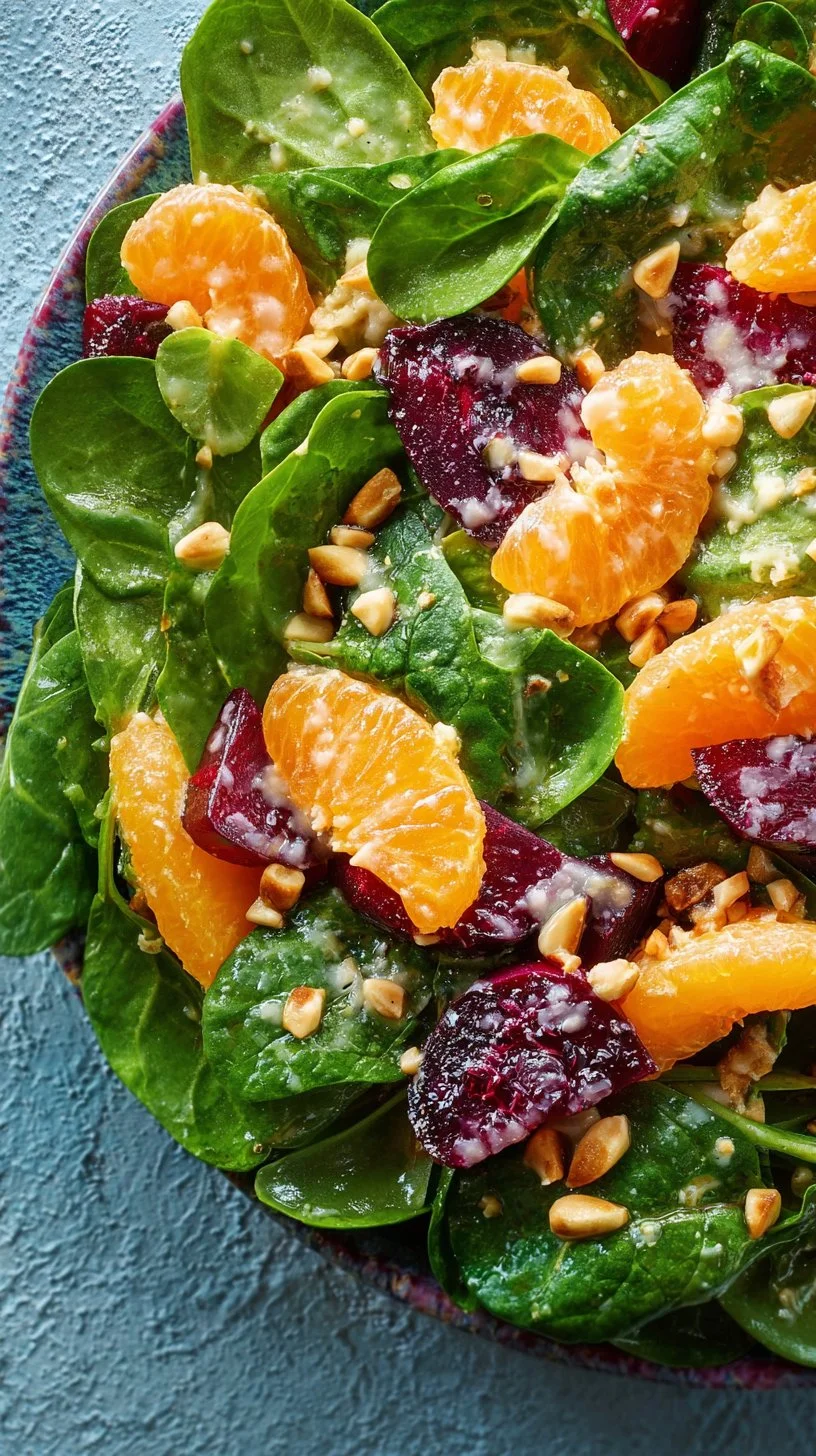
There is a pleasure in stumbling upon a simple salad at a roadside café or in the quiet dining room of a countryside inn—the kind of dish that feels like a map: each ingredient a place, each flavor a memory. The Beet Salad with Spinach and Mandarin Oranges is one of those maps. It pairs earthy, roasted beets with the bright, sunlit sweetness of mandarin segments and the green hush of spinach, finishing with a whisper of honey and lemon that reminds you of afternoon markets and small, cherished kitchens. In my travels this salad has turned up at tables from coastal California to inland Mediterranean towns, always generous in spirit and quietly cosmopolitan in its composition. For a contrasting comfort in leafy casseroles, I sometimes think of how spinach transforms in richer dishes like a creamy chicken and spinach bake, where the leafy green takes on an entirely different story—yet still carries the same vegetal heart.
The origin story & regional influence behind this dish
This salad is less a singular origin tale than a convergence of histories. Beets—rooty, robust, and deep as old soil—carry a long Eurasian lineage. They were cultivated in the Mediterranean and later carried inland by traders and farmers. Spinach came to Europe from Persia and the Levant, and mandarin oranges hail from subtropical Asia, their blossoms and peel steeped in centuries of ritual and celebration. When these threads are woven together on a single plate, the result reads like a Mediterranean port city: produce from different climates meeting on a table shaped by migration, trade, and seasonal rhythms.
In Northern Europe, beets often appear in hearty winter preparations; in Eastern Europe, they are the heart of borscht and celebratory spreads. The citrus and lighter greens, however, speak of sunnier latitudes—Spain, Greece, the coasts of California—where citrus groves line roads and salads live as antidotes to heat. The honey-mustard vinaigrette that dresses this salad is a modern, transatlantic flourish: mustard seeds and honey crossing borders and centuries to make a dressing that is both sharp and generous. Taste this salad and you will taste that movement—roots meeting sun, old world meeting new.
How to make Beet Salad with Spinach and Mandarin Oranges
To make this salad is to practice a gentle choreography: roast or boil the beets until yielding, assemble the greens and fruit with care, whisper the dressing over everything, and let the components sit long enough to exchange stories. The following steps are simple and patient, more act of tending than of complex technique.
Ingredients :
2 medium beets, 2 cups fresh spinach, chopped, 1 cup mandarin oranges, peeled, 1/2 red onion, thinly sliced, 1/4 cup pine nuts, toasted, 1/4 cup feta cheese, crumbled, 2 tablespoons honey, 2 tablespoons Dijon mustard, 1 lemon, juiced, Salt and pepper to taste
Directions :
- Preheat the oven to 400°F (200°C)., 2. Wash the beets and wrap them in aluminum foil. Roast in the oven for about 45-60 minutes or until tender. Alternatively, boil the beets in water for about 30-40 minutes until fork-tender., 3. Let the beets cool, then peel and cube them., 4. In a bowl, combine spinach, mandarin oranges, red onion, pine nuts, and feta cheese., 5. In a small bowl, whisk together honey, Dijon mustard, lemon juice, salt, and pepper to make the vinaigrette., 6. Toss the salad with the vinaigrette and add the roasted or boiled beets., 7. Serve immediately or chill before serving.
Ingredients through a cultural & historical lens
Each ingredient carries a cultural weight. Beets—their ruby flesh and honest bite—have been associated with endurance and fertility in folk traditions; they were once used medicinally and symbolically in rural communities. Spinach, with its tender leaves, has been prized for its quickness from soil to table; it often signifies spring and renewal. Mandarins introduce a seasonal and regional rhythm: in many cultures, citrus arrives as a festive fruit, a bright punctuation at winter feasts. Pine nuts recall Mediterranean and Middle Eastern kitchens, where their oily, resinous crunch appears in sauces and pastries. Feta is a compact testament to pastoral life, the taste of sheep and goat milk cured by tradition. Honey and mustard together are an alchemy of sweetness and heat that has historical roots in diverse cuisines, from ancient Roman preserves to more recent European condiments. Put together, these elements tell a story of landscapes—mountain soil, coastal orchards, grazing hills—and of the people who have tended them.
Cooking the dish: sensory notes & traditional techniques
Cooking beets changes them as surely as travel changes a traveler. Roasting brings out caramelized notes, a deepening sweetness, and a hint of smoke on the edges; boiling keeps them more vegetal and pure, their texture more immediate. In markets where beets are sold still covered in soil, there is a ritual in washing and wrapping them for the oven—the slow, almost ceremonial act of releasing flavor through warmth. Toasting pine nuts is another small, transformative gesture: the kitchen fills with a scent like resin and fresh bread crust, and the nuts’ texture snaps beneath the teeth in a way that echoes sunlit afternoons.
The vinaigrette is a conversation rather than a command. Honey tempers mustard’s assertive voice; lemon adds a bright punctuation that lifts the beet’s sweetness and the spinach’s green austerity. A traditional cook might taste, adjust with a history-learned hand, and remember the preference of a grandmother who liked hers tarter or a neighbor who preferred a heavier hand of feta. The sensory pleasures—satin beets, crisp onion, juicy mandarins, and the contrasting chew of feta—make the salad sing in the mouth.
How different regions prepare their version
Regional variations read like postcards. In coastal Mediterranean kitchens, cooks might add chopped herbs—parsley or mint—brought in from windowsills. In parts of the American West, chefs roast beets with a touch of sea salt and pair them with locally made goat cheese rather than feta. In Eastern Europe, the beet might be dressed more plainly, its earthiness tempered by sour cream or a sharper vinegar. In some Asian-influenced kitchens, a sprinkle of sesame or a whisper of soy appears, translating the salad into a fusion of citrus and miso-sour notes. Even within a single country, there are family versions: a grandmother’s insistence on extra onion for bite; a cousin who always substitutes walnuts or candied pecans. These differences are not contradictions but dialogues—each region and family adding its accent to a shared phrase.
In one coastal town I visited, a street vendor sold beets roasted over coals, their skins blistered and smoky, pairing them with local mandarins so fragrant the peel perfumed the air. In a mountain village, the salad was served with a stronger, tangier cheese, the combination intended to fortify travelers against evening chill. These are small adaptations, but they reveal how place shapes palate. For those curious about other ways spinach finds new life in comfort dishes, recipes like a creamy low-carb chicken casserole with broccoli and bacon show another horizon of the same leafy green.
Traditional ways this dish is shared or served
This salad tends to be a social food—placed in the center of a table, meant for passing. In warm seasons it arrives chilled, a bright companion to grilled fish or roasted meats. At holiday tables, mandarins can be a nod to winter abundance; in spring, the dish becomes a celebration of early greens and the first citrus of the year. In many households it is a starter, a palate-awakener, meant to open conversation as much as appetite. In cafés it is a midday solace, a dish eaten slowly alongside newspapers and the human traffic of the street. I remember one family who set bowls of this salad at an outdoor wedding—sometimes simple dishes feel most ceremonial. The tactile act of breaking bread, of scooping flecks of feta, of sharing slices of beet, carries a ritual intimacy that elevates the salad beyond the sum of its parts.
Storing the dish without losing its cultural essence
Leftovers offer their own kind of memory. Keep the components slightly separate—dress the greens only when ready to eat, store beets in their own container to preserve texture, and keep citrus segments airtight so they do not dry. When you reassemble the salad, think of it as a gentle reunion: a quick toss brings the components back into conversation. If the vinaigrette has settled, give it a gentle whisk; if the spinach weeps a little in the chill of the fridge, let the salad sit at room temperature for a few minutes before serving. These small attentions echo traditional kitchen habits: food treated with respect, preserved thoughtfully, and shared slowly. The cultural essence—hospitality, seasonality, attentive preparation—survives best when storage is an extension of those values.
Cultural questions people often ask
People often wonder whether this salad is old-world or new, and the answer is both. They ask if mandarin oranges are authentic in a beet dish; they are, once you see the salad as a meeting place of ingredients rather than a relic. There are questions about substituting cheeses, nuts, or dressings—each substitution is a breadcrumb in the story of how food migrates. Some ask why pine nuts instead of walnuts, or honey instead of a sugar-based syrup; these choices speak to texture and tradition—pine nuts with their resinous crunch nod to Mediterranean practice, honey to ancient sweetness. Another frequent curiosity: can the salad be made ahead? Yes, but with the same caveat: keep components separate and recompose them with care so the salad arrives at the table with its textures intact.
A closing note on food, memory & travel
Food is a way we carry place with us. A salad like this one is portable memory: the beet remembers the soil, the mandarin remembers the sun, the spinach remembers rain and soil tilled by hands that know a plot of land. Travel only sharpens these recollections, showing you how similar ingredients tell different stories in different places. The act of making and sharing this salad becomes an act of translation—a way of saying, here is what our land and seasons give us, and here is how we have learned to celebrate them together. When you sit down to eat it, you are tasting centuries, geographies, and private remembrances; you are, briefly, at every table that ever set similar produce before someone who loved it.
Conclusion
For more variations and inspirations that echo the themes in this salad—citrus-bright greens, beet-forward compositions, and honey-mustard dressings—explore recipes like a bright mandarin and spinach salad, or see a complementary take in a beet salad with honey-mustard and lemon. If you enjoy the contrast of sweet citrus with tangy cheese and roasted root vegetables, you might appreciate a spinach salad with beets, candied pecans, and goat cheese for its nutty-sweet accents, or a roasted beet salad with mandarin oranges and goat cheese for another regional interpretation that plays with similar balances.
Beet Salad with Spinach and Mandarin Oranges
Ingredients
Method
- Preheat the oven to 400°F (200°C).
- Wash the beets and wrap them in aluminum foil. Roast in the oven for about 45-60 minutes or until tender. Alternatively, boil the beets in water for about 30-40 minutes until fork-tender.
- Let the beets cool, then peel and cube them.
- In a bowl, combine spinach, mandarin oranges, red onion, pine nuts, and feta cheese.
- In a small bowl, whisk together honey, Dijon mustard, lemon juice, salt, and pepper to make the vinaigrette.
- Toss the salad with the vinaigrette and add the roasted or boiled beets.
- Serve immediately or chill before serving.