Strawberry Banana Smoothie Bowl
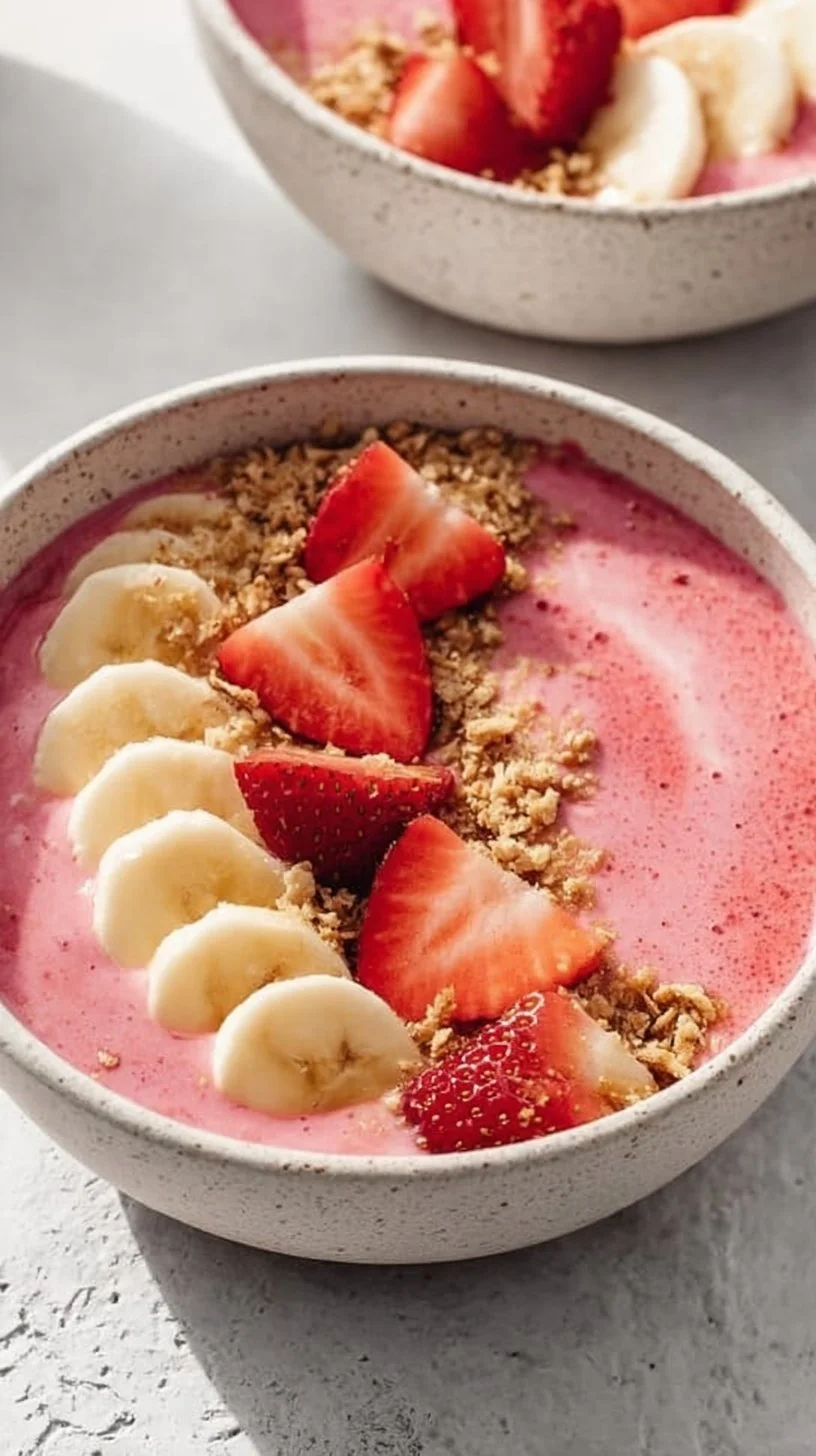
Strawberry Banana Smoothie Bowl is a single-component preparation where ingredient selection, freezing technique, and mechanical emulsification define the final texture and flavor. When executed with deliberation it yields a dense, spoonable puree that reads like a hybrid of sorbet and thick yogurt — cold, concentrated, and cleanly flavored. The recipe’s economy of components demands attention to proportion and surface area: frozen fruit versus liquid governs shear stress on the blender blades and determines whether the result is velvety or runny. For complementary breakfast and dessert contexts, consider how this bowl might sit alongside other fruit-forward preparations, such as a well-structured banana-strawberry bread, to provide contrasting textures and temperature.
This article will unpack the technique, ingredient logic, and professional refinements that convert a straightforward list into reproducible kitchen technique. Every step has a functional rationale: why frozen bananas rather than fresh, how vanilla interacts with strawberry acidity, and how blender geometry alters shear and air incorporation. The goal is consistent, thick, and intensely flavored bowls served with controlled melt and a clean, bright aromatic profile.
The culinary logic behind this dish
At its core this smoothie bowl is an exercise in concentration and fat-free emulsification. Frozen bananas act as both the primary body and the cryo-textural agent: their high sugar and pectin content, when frozen and sheared finely, create a network that traps minute ice crystals and air, producing a creamy mouthfeel without dairy. Strawberries bring acidity, pigment, and aroma — their volatile compounds (esters and terpenes) are delicate and easily masked; minimal liquid and a touch of vanilla are used to magnify their floral notes rather than dilute them.
The balance between sugar concentration and acidity is essential. Too much liquid lowers freezing point and yields a slurry; too little liquid prevents even blending and increases heat generation at the blade interface. Vanilla extract functions as a flavor bridge, smoothing perceived acidity and rounding the top notes. Optional add-ins like nut butter or protein powder alter both flavor and rheology; fats and proteins change mouth-coating and suspension stability, so they must be integrated mindfully to maintain the intended spoonable consistency.
How to make Strawberry Banana Smoothie Bowl
Ingredients :
2 frozen bananas, peeled before freezing*, 1 and 1/2 cups frozen strawberries, 1 tsp vanilla extract, 1/2 cup non-dairy milk, Optional add-ins (protein powder, almond butter, chia seeds, etc)
Directions :
Add all ingredients to a blender., Blend ingredients until smooth and creamy. I recommend using a blender with a tamper (a stick that is inserted into the center) to push the ingredients toward the blades while blending. This will help you achieve a thick and creamy consistency., Transfer the smoothie to a bowl. Add your choice of toppings. Enjoy!
Begin by assembling mise en place: remove frozen bananas from the freezer and ensure they are cut into uniform chunks if they were frozen whole; uniformity reduces localized blade stress and improves consistency. Measure the strawberries and milk precisely; this 1:3 ratio of total frozen fruit to liquid is calibrated to produce a dense bowl rather than a pourable drink. When blending, a tamper allows direct force application to the mass, preventing cavitation and helping the blender work against a concentrated frozen mass without excessive warm-up. After blending, let the bowl rest briefly at cool room temperature (30–60 seconds) to allow micro-relaxation of the network before topping; this reduces overt drip and preserves spoonable texture.
Ingredient analysis through a chef’s lens
Every ingredient serves a tactile and chemical purpose. Frozen bananas provide the structural matrix: their internal cell walls, once ruptured by freezing and shearing, release pectic substances and soluble solids that thicken the suspension. Flavor-wise, bananas add ripe, rounded sweetness and mid-palate weight. Strawberries supply bright top notes and acidity, which accentuate perceived sweetness while keeping the bowl from tasting cloying. Vanilla extract complements strawberry esters and fills in aromatic gaps without contributing sweetness.
Non-dairy milk acts primarily as a lubricant to facilitate blade movement; its choice affects mouthfeel — almond milk adds subtle nutty notes, oat milk contributes a fuller, creamier texture due to its soluble beta-glucans, and soy milk supplies protein that marginally increases viscosity. Optional add-ins must be considered for their technical impact: protein powders, particularly whey or concentrated plant proteins, elevate viscosity and can make the mixture gummy if overused, while nut butters introduce fat that softens freezing point depression and produces a silkier mouthfeel. Incorporating chia seeds will thicken on contact with the bowl’s residual moisture and can change the texture over time, useful for a later-eaten bowl.
Kitchen workflow & technique breakdown
Efficient workflow minimizes time between assembly and service — critical here because temperature changes rapidly affect texture. Work in stages: defrost any components that may be over-frozen on the surface (a 60–90 second interval at room temperature is sufficient), portion liquids and extracts, and prepare toppings while the blender does the high-energy work. Use a heavy-duty blender that can handle frozen solids; blade profile and speed settings matter. For small household blenders, pulse mode followed by short high-speed bursts with the tamper engaged will prevent motor strain and ensure even shearing.
Sequence matters: place liquid and extract in the blender first, then add frozen fruit in layers with the heaviest items nearest the blades. This ordering reduces air entrapment and promotes consistent shear. Blend in controlled intervals rather than continuous runs exceeding 20–30 seconds to avoid heat transfer from the blades that can thaw the mixture and introduce excess liquidity. If you want to incorporate delicate toppings or swirl in an add-in, pause when the body is still slightly under-blended; the residual shearing from the tamper and a final low-speed fold yields visible streaking and maintained texture.
For technique inspiration on integrating chocolate, strawberry, and banana into composed preparations, study how chocolate and fruit are balanced in confections such as chocolate-covered strawberry brownies; the same principles of contrast and restraint apply in a bowl format.
Texture control, heat management & timing
Texture is controlled through two levers: the proportion of frozen solids to liquid and the duration/intensity of blending. Too much mechanical energy produces heat at the blades, melting micro-ice crystals and producing a soupy consistency. Prevent this by using short bursts, allowing the blade assembly to coast between intervals, and employing a tamper to reduce recirculation time. Conversely, insufficient blending leaves large ice shards and a gritty mouthfeel.
Timing the service is also technical: after blending, the bowl should be served within two to three minutes for optimal density and cold temperature. The sensory profile evolves rapidly: initial aroma is most pronounced immediately after blending, while melting increases perceived sweetness and texture slipperiness. If you need to hold the bowl for longer, place it briefly in the freezer for 5–8 minutes to reconsolidate the matrix; avoid long-term freezing after toppings are applied as this damages garnish textures.
For textural experimentation — for instance, to replicate dense, fudgy accents in a bowl — small, preformed inclusions such as frozen nut butter droplets or chilled chocolate chips can be folded in at the end, preserving contrast akin to the compact bite found in chocolate peanut butter banana bites.
Professional variations
From a professional standpoint, variations adjust mouthfeel and flavor without changing the ingredient list. Swap different non-dairy milks to alter viscosity: oat milk for body, almond for clarity, or coconut for a pronounced fatty gloss. Introducing a small amount (1–2 teaspoons) of neutral-flavored oil can emulate dairy richness while keeping the preparation vegan. If the bowl will be used as a base for additional processing (e.g., piped into molds or frozen as bars), reduce milk slightly to maintain structural integrity.
For protein-focused versions, use conservative amounts of protein powder (no more than 1/2 scoop per batch) and compensate by increasing fruit solids; otherwise the texture will become pasty. For a refined dessert application, macerate a small portion of strawberries with a teaspoon of sugar and a few drops of lemon juice to create a high-acid garnish that contrasts the mellow banana body.
Finishing touches & plating philosophy
Plating a smoothie bowl is an exercise in temperature, texture, and color contrast. Choose toppings that retain their structure when chilled: toasted grains, crisp seeds, fresh fruit sliced thinly for immediate consumption, and a scatter of freeze-dried powder for intensity without introducing moisture. Apply larger, weighty toppings (granola clusters, nut halves) first so they settle evenly; lighter items (micro herbs, edible flowers) can be placed last to avoid compression.
Aim for an arrangement that balances bite size and melting rate. Place components that will melt quickly — fresh banana slices or soft nut butters — closer to the bowl edge to slow heat transfer, while crisp elements can be centralized. A restrained drizzle of nut butter or syrup warmed slightly (no more than 5–10°C above bowl temperature) will flow without disrupting the frozen network.
Maintaining quality after cooking
Although this preparation is not cooked, quality maintenance follows the same logic as chilled desserts. If you must hold portions, keep them at 0 to -3°C to limit structural collapse while avoiding full freezing, which alters texture. Store toppings separately; moisture migration from granola or fresh fruit will degrade crispness. For batch production, portion into rigid containers to prevent crushing and allow quick thawing in a refrigerated drawer rather than at room temperature to preserve mouthfeel.
Label containers with time and composition if using add-ins that change over time (chia or nut butter) since these ingredients influence shelf stability and textural evolution.
Questions from home cooks (chef answers)
Q: Why use frozen bananas rather than fresh?
A: Frozen bananas create the structural matrix needed for a dense, spoonable texture. Fresh bananas introduce excess free water and require more ice to achieve coldness, increasing dilution.
Q: My blender struggles — what can I do?
A: Work in smaller batches, cut the frozen components into smaller uniform pieces, and use pulse mode with brief high-speed bursts. Allow the motor to rest between cycles. A tamper reduces recirculation and blade cavitation, improving efficiency.
Q: How do I avoid a gritty texture?
A: Ensure uniform freezing of fruit and use short, high-shear bursts rather than prolonged blending. Overly large ice crystals (from slow freezing) or incomplete shearing yield grit; rapid, even freezing and adequate pulse blending are remedies.
Q: Can I sweeten the bowl?
A: If fruit sweetness is insufficient, use a liquid sweetener like maple or agave sparingly. Solid sugars will not dissolve at low temperatures and can create graininess.
Final chef notes
This Strawberry Banana Smoothie Bowl rewards precision. Small adjustments in frozen-to-liquid ratio, blending strategy, and choice of non-dairy milk have outsized effects on mouthfeel and flavor clarity. Treat the process as you would an emulsification: manage temperature, control shear, and time service to preserve the intended sensory profile. With attention to these variables you produce a bowl that is cold, concentrated, and texturally refined — a summation of technique over gimmick.
Conclusion
For a straightforward, tested variation and visual inspiration, consult the recipe on Purely Kaylie for compositional ideas and topping suggestions: Strawberry Banana Smoothie Bowl – Purely Kaylie. For an approach emphasizing quick assembly and paleo/vegan options, see the Bakerita interpretation that focuses on timing and pantry swaps: 5-Minute Strawberry Banana Smoothie Bowl – Bakerita. For additional plating and garnish concepts that pair fruit with textural contrasts, reference Bucket List Tummy’s methodical breakdown: Strawberry Banana Smoothie Bowl – Bucket List Tummy.
Strawberry Banana Smoothie Bowl
Ingredients
Method
- Remove frozen bananas from the freezer and cut them into uniform chunks.
- Measure the frozen strawberries and non-dairy milk accurately, keeping a 1:3 ratio of frozen fruit to liquid.
- Add all ingredients to a blender in the following order: non-dairy milk, vanilla extract, then frozen bananas and strawberries.
- Blend ingredients until smooth and creamy, using a tamper to push the mixture towards the blades as needed.
- Blend in controlled intervals to avoid overheating and ensure the mixture remains dense.
- Transfer the smoothie to a bowl and add your choice of toppings.
- Serve immediately for best texture and temperature.