How to Make Blueberry Cheesecake Stuffed French Toast at Home
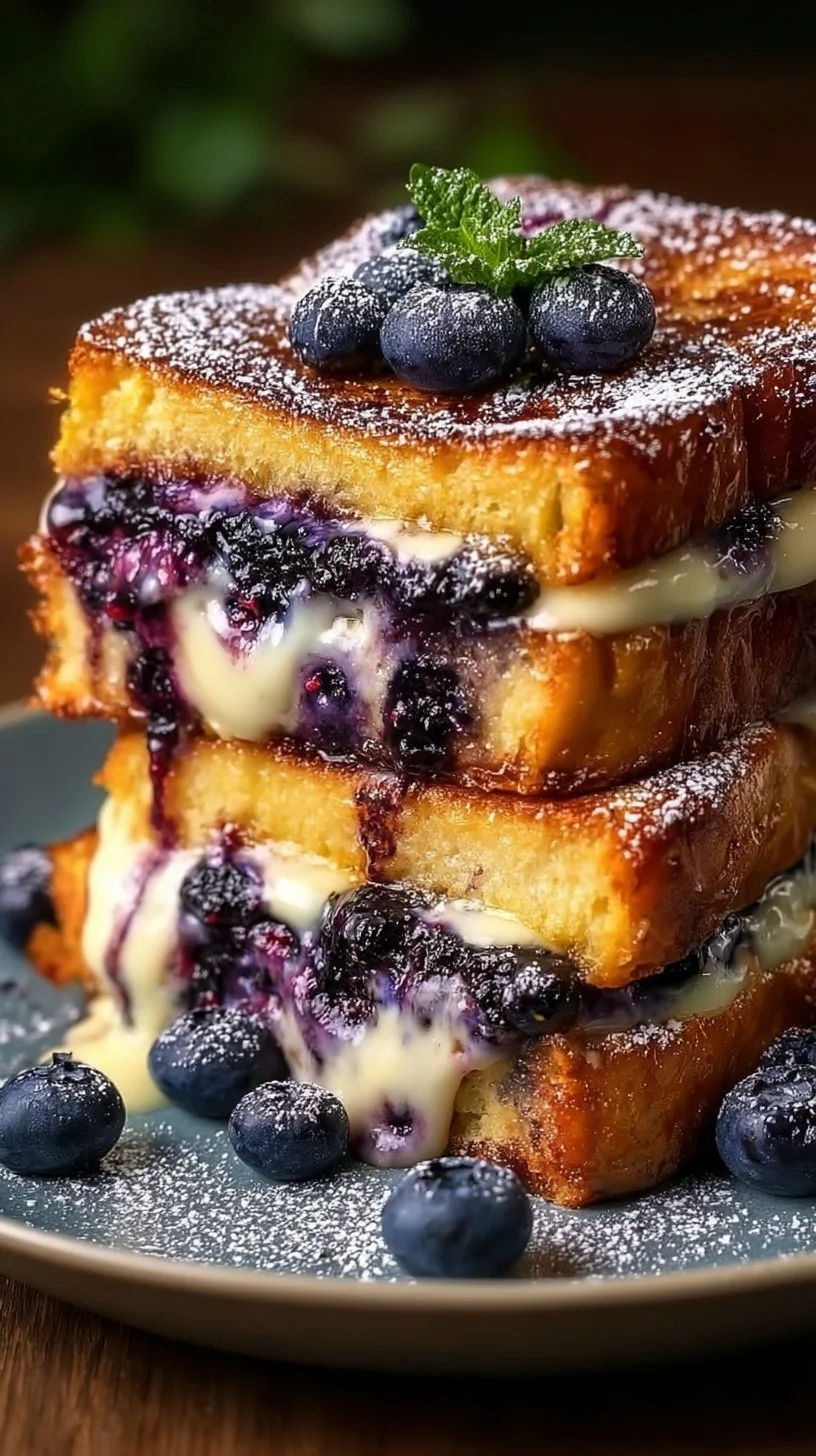
Blueberry Cheesecake Stuffed French Toast at Home is a composed technique that combines the acid-cream balance of a cheesecake filling with the caramelized exterior and custardy interior of classic French toast. The dish hinges on three parallel processes: preparing a stable, spreadable cheesecake filling; structuring the brioche to receive that filling without failing during cooking; and managing heat to produce a crisp, evenly browned crust while preserving a tender, slightly molten center. For focused practice on balancing sweet and dairy elements in a small-format dessert, consult an explicit technique reference such as easy homemade chocolate fudge to sharpen your sense of sugar calibration and texture control.
This article approaches the recipe from a professional perspective. Each step is examined for its purpose, how it affects flavor and texture, and how to execute it so the final plate reads with clarity: bright blueberry, tangy-sweet cheesecake, and an egg-spiked brioche with a lacquered crust. Precision in timing and heat management will convert a pleasing idea into a replicable culinary result.
The culinary logic behind this dish
At its core this recipe is a study in contrasts and structural restraint. The cheesecake component provides acidity and fat—cream cheese carries milk fat that softens at warm temperatures, yielding a silky mouthfeel that mimics a molten center. Blueberries add bursts of acidity and juiciness that cut through that richness; their juices, when folded into the cream cheese, will leach some liquid but also provide aromatic top notes when warmed.
Brioche is selected for its high butter and egg content; it toasts and browns readily while maintaining a tender crumb that can accept a filling without disintegrating. Using day-old brioche reduces the variable of over-absorption: slightly stale bread absorbs the custard mix without collapsing because its structure is firmer and less prone to becoming gluey.
The custard bath (egg, milk, cream, cinnamon) is calibrated to create a protective coating that cooks into a thin, set layer inside and out, delivering custard-like significance to each bite. Butter for frying supplies both flavor and a fat medium that promotes even browning; its milk solids contribute to aroma and color development through Maillard reactions.
How to make Blueberry Cheesecake Stuffed French Toast at Home
The method divides into three operational phases: prepare the filling; construct and enclose the brioche; and execute the cook with strict temperature control. Preparation and assembly are as critical as the cook itself—skipping mise en place or rushing the sealing of the pocket will produce leakage and a soggy pan.
Begin by stabilizing the cheese mixture so it is spreadable but not runny; the inclusion of caster sugar and vanilla extract serves both to season and to influence the texture by drawing moisture and providing a subtle glaze when warmed. The folding of whole blueberries rather than macerated purée preserves textural contrast and prevents premature bleeding of color into the filling.
Once constructed, the stuffed slices enter the custard briefly — just long enough to coat without saturating. The panwork that follows is about energy transfer: moderate heat to set the custard into the surface before the interior temperature spikes; enough fat to encourage even browning without burning; and a finish that highlights the contrast between sugar-dusted peaks and syruped valleys.
Ingredients :
150g (5.3 oz) cream cheese, softened, 2 tablespoons caster sugar, 1 teaspoon vanilla extract, ½ cup blueberries (fresh or thawed if frozen), 1 loaf day-old brioche, sliced thick (8 slices), 1 egg, ½ cup milk, ½ cup cream, 1 teaspoon cinnamon, Butter, for frying, Extra blueberries, Icing sugar, for dusting, Maple syrup, for drizzling
Directions :
In a bowl, combine the softened cream cheese, caster sugar, and vanilla extract.
Gently fold in the blueberries.
Mix until smooth and well combined.
Slice brioche into thick 1.5-inch slices.
Using a sharp knife, create a deep pocket in the middle of each slice OR sandwich two slices together.
Fill each brioche slice with 1–2 tablespoons of cheesecake mixture.
If using two slices, press edges gently to seal.
In a shallow dish, whisk together the egg, milk, cream, and cinnamon until well combined.
Heat a large skillet over medium heat. Add a small knob of butter.
Dip each stuffed slice of brioche into the egg mixture, coating both sides.
Place in the skillet and cook for 3–4 minutes per side, or until golden brown and crisp.
Transfer to a plate.
Top with icing sugar, extra blueberries, and a generous drizzle of maple syrup.
Serve warm and enjoy!
Ingredient analysis through a chef’s lens
Cream cheese: its fat and protein profile enable a spreadable texture that softens when warmed without fully liquefying, providing a semi-stable core. Softening at room temperature is essential to avoid lumps and to allow even folding with blueberries.
Caster sugar: finer granulation than standard granulated sugar, it dissolves quickly into the cream cheese, creating a smoother mouthfeel and avoiding a grittiness that would disturb the delicate texture.
Vanilla extract: concentration of volatiles that enhance perceived sweetness and round the dairy flavors. Use pure vanilla for a cleaner aromatic profile.
Blueberries: fresh or thawed whole berries add a burst of bright acid and a skyline of purple color. Whole berries are preferred here because broken berries would generate excess liquid and compromise the filling’s structural integrity.
Day-old brioche: slightly dry bread that will absorb the custard evenly without becoming paste-like. The richness of brioche complements the cream cheese fat, forming a harmonious flavor profile.
Egg/milk/cream/cinnamon: the custard mixture must be measured precisely. The ratio yields a coating that sets on the exterior while lending a custard bite internally. Cinnamon is a gentle spice—subtle, aromatic, and complementary to fruit and dairy.
Butter: recommended for its flavor and its milk solids that support browning. Clarified butter could raise the burn point but sacrifices those milk solids; use whole butter and moderate heat for the signature aroma and color.
Icing sugar, extra blueberries, maple syrup: finishing components that introduce texture contrasts (powdered sugar vs. syrup), visual highlights, and a final lift of acidity and sweetness.
Kitchen workflow & technique breakdown
Mise en place determines success. Soften the cream cheese until plastic but not melting. Whisk the custard in a shallow dish wide enough for the slice to lay flat; this increases surface contact and speeds coating. Slice the brioche to uniform thickness—1.5 inches ensures a favorable bread-to-filling ratio and consistent cooking time across slices.
When creating pockets, use a sharp paring knife and remove crumb patientl y, leaving a solid rim of bread to prevent leakage. If sandwiching two slices, press edges with a little custard or a light scoring along the seam to help adhesion.
Preheat the skillet to medium and add butter just before the first slice. The pan should be hot enough to hiss softly upon contact but not so hot that the butter smokes. Work in batches to avoid overcrowding; overcrowding reduces surface temperature and yields pale, soggy exteriors. Rest plated slices briefly on a wire rack rather than a plate to preserve the crust.
For workflow efficiency, assemble all stuffed slices, place them on parchment, then dip and cook sequentially. This prevents the filling from re-warming excessively and leaking.
For related multi-component timing and assembly strategies used in composed dishes, review a comparable baked, layered technique such as garlic butter steak cheddar potato bake to refine staging and batch control.
Texture control, heat management & timing
Achieving the correct texture is an exercise in thermal gradients. The exterior must reach 150–160°C (302–320°F) in surface temperature to trigger Maillard browning without burning. Medium heat and a slightly increased mass of butter allow the surface to brown steadily over 3–4 minutes per side as specified. If the heat is too high, the crust will darken before the interior has had a chance to coax the cream cheese to a pleasant molten state.
Monitoring is largely visual and tactile: the crust should be uniformly golden with small, even blistering; the slice should feel set and resilient when lifted with a spatula. Use the thickness of the slices and the filling quantity as guides for timing—the 1–2 tablespoons per slice recommendation constrains thermal mass so the interior will warm without becoming moltenly liquid.
If an interior that is slightly more set is desired, after a pan sear finish the slices in a 160°C (325°F) oven for 3–4 minutes; this is a professional technique to equalize the internal temperature without additional surface coloring. That method preserves surface texture while gently raising core temperature.
For a discussion of custard setting and heat transfer in small-format desserts, consult textural comparisons such as Japanese sweet potato creme brulee, which typifies how residual heat and gentle oven finishing impact cream-based centers.
Professional variations
Maintain fidelity to the ingredient list while exploring technique-level variations: instead of a pocket, prepare small sandwiches and press the seam with a minimal amount of beaten egg to create a stronger seal. For a more intensely flavored crust, sprinkle a pinhead of caster sugar on the surface immediately before flipping to encourage localized caramelization. Alternatively, finish with a brief baste of butter and maple syrup in the final minute to build a glossy, flavored exterior.
Alternate presentation techniques include serving halved slices to expose the filled center or torching a light dusting of sugar for a brûlée-like finish—these do not alter ingredients or directions but leverage technique to produce different sensory impressions.
Finishing touches & plating philosophy
Plating must respect the textural contrasts: arrange the toasted slices to expose cross-sections, allowing the guest to perceive the molten filling. Dust icing sugar through a fine sieve for even coverage; apply the syrup sparingly as a ribbon or a pooling element—excess syrup will reintroduce moisture and compromise the crust.
Garnish with extra blueberries placed strategically to provide acidity and visual elevation. Temperature contrast is useful: warm toast against cooler berries heightens perception of sweetness and richness. Use a shallow bowl for syrup and a warmed plate for the toast; an overly cold plate will cool the toast rapidly and dull aromas.
The plating should emphasize restraint: let the structural integrity and textural interplay carry the dish rather than decorating to distract.
Maintaining quality after cooking
If service is delayed, hold the cooked slices on a wire rack in a low oven at 75–90°C (170–195°F) for up to 20 minutes to preserve crispness without overcooking the interior. Avoid stacking or covering with foil which traps steam and softens the crust. Reheat gently in a skillet or under a broiler for brief intervals rather than a microwave which will collapse textures.
For transporting, cool the slices slightly so residual steam dissipates, then reheat briefly at the point of service. Prepare the filling and custard ahead; assemble shortly before cooking to limit moisture migration.
Questions from home cooks (chef answers)
Q: Can I use other berries or fruit?
A: Yes, but water-rich fruits (e.g., very ripe strawberries) will release more liquid. If substituting, reduce the quantity slightly or pat fruit dry to prevent filling run-off.
Q: My pockets leaked—how can I prevent that?
A: Ensure a sufficient rim of bread remains when hollowing, avoid overfilling, and press seams firmly if sandwiching. A brief chilling (10–15 minutes) after assembly will help the filling set and reduce leakage during cooking.
Q: The interior was too cold while the exterior browned.
A: Reduce pan temperature slightly and extend cooking time by one minute per side, or use the oven finish technique (3–4 minutes at 160°C/325°F) to bring the core up without overcoloring the crust.
Q: Can I scale this recipe?
A: Yes, but maintain proportional custard-to-bread ratios and cook in manageable batches to keep pan temperature stable.
Final chef notes
Precision in this recipe is not about rigidity but about control: controlling moisture, heat, and structural form to present a coherent tasting experience. The recommended quantities and sequence were designed to deliver balance—richness tempered by acidity, crispness counterpointing creaminess. Respecting the techniques—softening the cream cheese, hollowing or sealing the brioche correctly, and managing pan temperature—will consistently produce the intended result.
Practice the assembly and pan technique on a single slice to calibrate your stove and skillet before committing to a full batch. Record small adjustments to heat and timing; these marginal gains convert a competent execution into a reliably excellent dish.
Conclusion
For recipe inspiration and comparative approaches to blueberry and cream cheese-stuffed French toast, review this practical example on Blueberry Cream Cheese Stuffed French Toast – Away From the Box which demonstrates a similar assembly and finishing approach. If you prefer a version emphasizing a compact sandwich technique, the recipe on Blueberry Cream Cheese Stuffed French Toast – Cooking for Keeps offers useful variations on sealing and filling. For an additional take with photographic guidance and plating ideas, consult Blueberry Cream Cheese Stuffed French Toast | A Bountiful Kitchen.
Blueberry Cheesecake Stuffed French Toast
Ingredients
Method
- In a bowl, combine softened cream cheese, caster sugar, and vanilla extract.
- Gently fold in the blueberries.
- Mix until smooth and well combined.
- Slice brioche into thick 1.5-inch slices.
- Using a sharp knife, create a deep pocket in the middle of each slice or sandwich two slices together.
- Fill each brioche slice with 1–2 tablespoons of cheesecake mixture.
- If using two slices, press edges gently to seal.
- In a shallow dish, whisk together the egg, milk, cream, and cinnamon until well combined.
- Heat a large skillet over medium heat and add a small knob of butter.
- Dip each stuffed slice of brioche into the egg mixture, coating both sides.
- Place in the skillet and cook for 3–4 minutes per side, or until golden brown and crisp.
- Transfer to a plate and top with icing sugar, extra blueberries, and a generous drizzle of maple syrup.
- Serve warm and enjoy!