Heaven on Earth Cake
Introduction
There are recipes that arrive like postcards from a life you’ve not yet lived, and there are recipes that feel like homecoming. Heaven on Earth Cake belongs to the latter—a confection whose very name promises solace and small, incandescent pleasures. I first encountered it in the humming kitchen of a Midwestern potluck, where a friend named Sofia carried a glass tray like it was a relic. The cake’s surface was a soft, cloud-like white, streaked with cherries and strawberries, and when she set it down it released the gentle perfume of vanilla and summer fruit that seems to exist outside of time.
As a traveler who measures places in flavors and conversations, I noticed how this cake gathered people the way a familiar melody does. It was more than dessert; it was an invitation to linger, to trade stories between bites. If you want to imagine its kinship to other simple, celebratory cakes, think of a light, communal dessert that bridges seasons and generations—like the bright, citrus-laced slices I once found in a coastal village that reminded me of a lemon and blueberry cake companion served at seaside weddings. The Heaven on Earth Cake, for all its unpretentious ingredients, carries a resonance that travels: home kitchens in small towns, church basements, and backyard tables where memories ferment into tradition.
The origin story & regional influence behind this dish
Heaven on Earth Cake reads like a mid-20th century American storybook—its pages filled with convenience, ingenuity, and a generous spirit. The rise of boxed cake mixes and instant puddings after World War II altered home baking across the United States and beyond, offering a kind of culinary democracy: busy hands could still produce something celebratory. This cake is a child of that era, an elegant compromise of store-bought ease and homemade tenderness. In communities where time was scarce but hospitality central, recipes that combined prepared mixes with fresh finishing touches became staples.
Regional influence shapes what gets draped over the cake. In the Rust Belt and the Midwest, the bright, canned cherry pie filling is as much a cultural signpost as cornfields and front-porch light. In the South, you might find a similar cake crowned with peaches or a scattering of pecans; in California, strawberries may be sun-ripened and sliced with a confidence born of seasonality. Each variation is less about culinary innovation than it is about local abundance and the human desire to share sweetness. The cake travels well, and as families moved—seeking work, following seasons, chasing new beginnings—they carried this recipe tucked in a recipe card box or whispered between relatives, adapting it to the orchards and markets of their new homes.
How to make Heaven on Earth Cake
The act of making this cake is almost ritualistic in its simplicity: a boxed mix becomes canvas, instant pudding becomes a silken middle, whipped cream forms a cloud, and fruit and nuts perform the final, generous flourish. It is less about technique and more about the tactile pleasures of folding, spreading, and garnishing—small gestures that transform basic ingredients into communal generosity. Imagine preparing it on a quiet afternoon, the oven’s warmth a companion, the cream turning to soft peaks like summer clouds being coaxed into permanence. Here is the exact list of what you will need and the steps to follow, unchanged, so that the recipe arrives at your table just as it has in countless kitchens before.
Ingredients :
1 box of vanilla cake mix, 4 large eggs, 1/2 cup of vegetable oil, 1 cup of water, 1 package of instant vanilla pudding mix, 2 cups of heavy cream, 1 cup of powdered sugar, 1 can of cherry pie filling, 1 cup of sliced strawberries, 1 cup of chopped nuts (optional)
Directions :
- Preheat the oven according to the cake mix instructions. Grease and flour a 9×13 inch baking pan., 2. In a large bowl, combine the vanilla cake mix, eggs, vegetable oil, and water. Mix until well combined., 3. Pour the batter into the prepared baking pan and bake according to package instructions until a toothpick comes out clean. Let cool., 4. In another bowl, prepare the instant vanilla pudding according to package instructions and refrigerate until set., 5. In a separate bowl, whip the heavy cream to soft peaks and gradually add the powdered sugar, continuing to whip until stiff peaks form., 6. Once the cake is cool, spread the vanilla pudding over the top of the cake., 7. Spread the whipped cream over the pudding layer., 8. Top with cherry pie filling, sliced strawberries, and nuts if desired., 9. Chill in the refrigerator for at least 1 hour before serving.
Ingredients through a cultural & historical lens
Look at this ingredient list and you can trace a map of modern domestic life. The boxed cake mix and instant pudding are souvenirs from a post-war era that prized convenience as liberation. They represent a societal shift where kitchen labor began to bend toward speed so that social rituals—potlucks, birthdays, Sunday dinners—could be preserved even as daily life grew busier. The heavy cream and powdered sugar restore the touch of the artisan, signaling a desire to reconnect with texture and taste. Fresh strawberries and canned cherries stand side by side, embodying a pragmatic relationship with the seasons: the pantry honors winter, the market honors summer.
Nuts are optional, but their presence often tells a story about place. Pecans point south; walnuts might whisper of orchard regions. Even the choice of container—the 9×13 pan—speaks to gatherings. It is the shape of a shared meal, the rectangular gesture that slides easily into a picnic cooler or a church kitchen warming rack. When families hand down this recipe, they are handing down a way of celebrating that blends the new and the old, the quick and the careful, the purchased and the lovingly prepared. It is a culinary palimpsest: layers of memory written into flour and cream.
Cooking the dish: sensory notes & traditional techniques
The sensory life of Heaven on Earth Cake is quiet but sumptuous. When the cake first comes out of the oven it carries the warm, uncomplicated note of vanilla—akin to childhood afternoons when sunlight warmed the windowsill and someone hummed in the next room. Cooling the cake is a patient act; it allows the crumb to settle so the pudding layer can glide across it without sinking. The pudding’s texture is a cool, satin echo beneath the whipped cream’s pillowy peaks. As you spread, you feel the soft resistance of whipped cream meet the smoother pudding, like clouds meeting a lake.
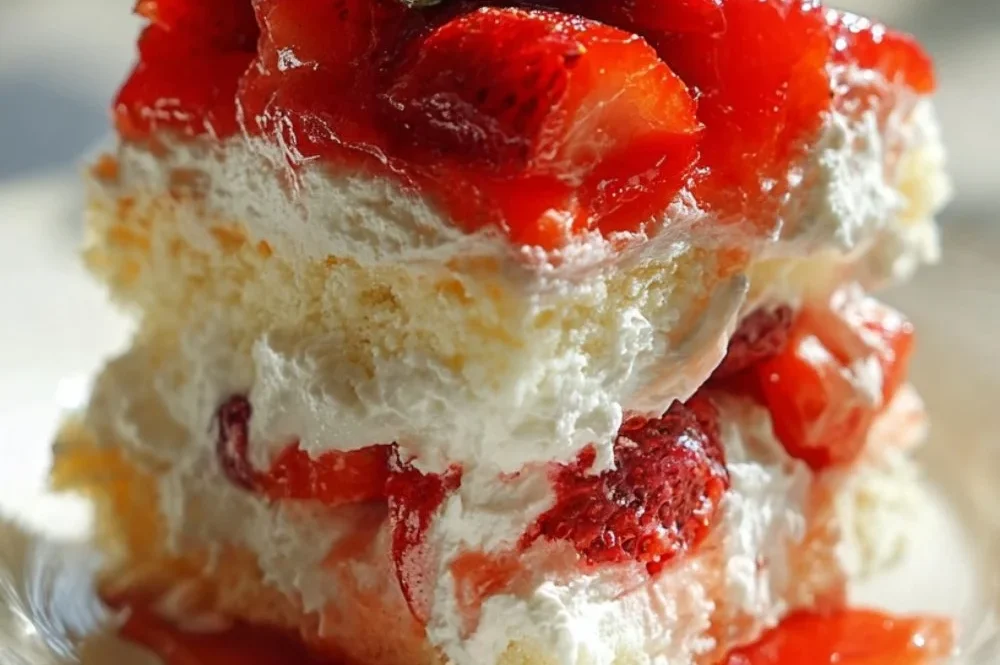
Topping with cherry pie filling is a theatrical flourish. The shiny red orbs catch the light, their syrup a bright counterpoint to the cake’s pale interior. Slicing reveals a cross-section: pale sponge, a glossy vanilla seam, and a cloud above, punctuated with ruby and berry. Each bite is a study in contrasts—airy crumb, cool cream, and the concentrated sweetness of preserved fruit. Traditional technique here is less about complicated maneuvers and more about timing and respect: cool the cake fully, set the pudding firmly, and whip the cream to peaks that hold their dignity without curdling into grain. In homes where this cake is tradition, these steps are as much a part of memory as measure.
How different regions prepare their version
Travel a few hundred miles and you’ll find polite variations like dialects. In the Midwest, the cake often arrives at potlucks with a glossy blanket of cherry pie filling—its canned convenience beloved and nostalgic. In New England, cooks sometimes fold local berries into the pudding or scatter maple walnuts on top, integrating the regional syrupy heritage. Down in the South, sliced peaches or a smear of lemon curd might nod to abundant orchards and a preference for tang. On the West Coast, fresh, sun-warmed strawberries are preferred, their perfume bright and immediate.
These variants are less about altering the core than about local translation. The cake’s structure tolerates and even welcomes substitutions of fruits and nuts, because what mattered to the original makers was the ritual of sharing. Families who migrated west over the decades adapted the recipe to what their new markets offered: canned cherries when the snow made markets thin, fresh berries when summer arrived—and with each substitution, a new memory layer formed.
Traditional ways this dish is shared or served
Heaven on Earth Cake is almost always a communal dessert. It belongs on long tables where conversation arcs and returns. At church socials, it is cut into rectangles and passed along with coffee; at family reunions, it sits next to bowls of potato salad and casseroles, a sweet punctuation to a savory chorus. Because it keeps well in the refrigerator, it becomes a fixture of summer barbecues and bake sales; because it can be made in a single pan, it fits the communal etiquette of sharing.
Serving is an act of attention. Hosts often slice it into generous squares, sometimes garnishing a single portion with an extra fresh strawberry or a sprinkle of chopped nuts—small, deliberate gestures that make guests feel seen. In some families, the topmost layer of fruit is the arbiters of who gets the first slice: the person who arrives first might claim the brightest cherries, or the youngest child might be awarded the corner piece. These customs, small and affectionate, are as important as the recipe itself.
Storing the dish without losing its cultural essence
Preservation is part practicality, part ritual. Keep the cake chilled to maintain the integrity of the pudding and whipped cream, and the fruit will remain jewel-like rather than syrupy. Stored in an airtight container, it will hold for a couple of days—longer if your refrigerator is more cavernous than crowded—though many would say that part of its charm is in the immediacy of eating it within a day or two, when textures are at their freshest.
When families ship pieces to relatives or bring the cake to gatherings, they wrap it with the same care they would a letter: waxed paper, a snug lid, and sometimes a handwritten note. These gestures transform storage into storytelling—an implicit promise that the taste of home can travel. Even in modern times of Tupperware and temperature control, the cake’s cultural essence is preserved most of all by the intent behind it: to feed, to remember, and to gather.
Cultural questions people often ask
People often ask whether this cake is “homemade” enough to pass as heirloom and the answer is invariably yes. Heirloom is not only the provenance of ingredients but the stories they carry. Others wonder about substitutions—can you use different fruits, low-fat cream, or homemade pudding? The recipe is forgiving, and many families tinker according to diet, season, and taste, but the core idea remains: layers of comfort and a surface that invites sharing.
Another common question is why this cake evokes such strong nostalgia. It isn’t just the flavor; it’s the social context. Cakes that sit on community tables are memory magnets: birthdays, farewells, barbecues, quiet Sunday suppers. The Heaven on Earth Cake, with its accessible list of ingredients and its gentle sweetness, is the culinary equivalent of a well-worn story told by an elder—predictable in structure but infinitely rich in its associations.
A closing note on food, memory & travel
Food is the most polite kind of memory: it offers itself without demanding. As travelers and as keepers of family tables, we carry and adapt recipes, folding in new places like spices into a pot. Heaven on Earth Cake is balm and bridge—comfort arranged in layers—one that has migrated with families and been translated by local markets. Its simplicity is its strength, allowing it to become a vessel for nostalgia, for welcome, and for the small rites of gathering.
If you bake it, do so with the understanding that you are participating in a living tradition. Spoon the cherries with care, inhale the vanilla, slide a fork that finds every layer. Share it not just because it tastes good, but because sharing itself is what has made this recipe endure. Food and travel teach us that places live in the mouth as much as in the eye, and with each shared slice of Heaven on Earth Cake, a little more of the world’s warmth is carried home.
Conclusion
If you would like to see one classic presentation of this beloved dessert, consider the detailed family-style rendition at Heaven on Earth Cake – The Country Cook, which captures the communal spirit of the dish. For another variation that celebrates bright fruit and simple assembly, the post at Heaven on Earth Cake – Onion Rings and Things offers useful inspiration. And for a take that leans into the cake’s role in family gatherings, this version at Heaven on Earth Cake – Together as Family highlights how recipes become heirlooms.
Heaven on Earth Cake
Ingredients
Method
- Preheat the oven according to the cake mix instructions. Grease and flour a 9×13 inch baking pan.
- In a large bowl, combine the vanilla cake mix, eggs, vegetable oil, and water. Mix until well combined.
- Pour the batter into the prepared baking pan and bake according to package instructions until a toothpick comes out clean. Let cool.
- In another bowl, prepare the instant vanilla pudding according to package instructions and refrigerate until set.
- In a separate bowl, whip the heavy cream to soft peaks and gradually add the powdered sugar, continuing to whip until stiff peaks form.
- Once the cake is cool, spread the vanilla pudding over the top of the cake.
- Spread the whipped cream over the pudding layer.
- Top with cherry pie filling, sliced strawberries, and nuts if desired.
- Chill in the refrigerator for at least 1 hour before serving.