Coconut Truffles
Introduction
There are dishes that arrive in a suitcase, and dishes that arrive in a memory. Coconut Truffles belong to the second kind: a small, luminous confection that opens like a photograph when you bite into it — the smell of warm shredded coconut, the sweet, almost caramel hush of condensed milk, the sudden clean snap of chocolate. I first met these in a seaside kitchen, the window open to a market of tarps and voices, where an elderly woman named Rosa made them with the kind of patient generosity you learn in coastal towns where food and hospitality are synonyms.
Sofia is not just a place to begin; it is a name that fits the friendly, intimate ritual of rolling, dipping, and sharing. The air around the table smelled of salt, sun, and coconut, and the truffles were little orbs of comfort that traveled easily — in the pocket of a shirt for a ferry ride, or boxed between napkins for a gift to a new friend. As I travel, I find versions of these in living rooms and cafés across continents, their recipes whispering of migrations, trade winds, and the slow reweaving of local traditions into new shapes. This is an ode to those whispered recipes — small, portable, and fiercely human.
The origin story & regional influence behind this dish
Coconut Truffles sit at the crossroads of two histories: the deep, ancient story of coconut palms and the relatively recent European romance with chocolate. Coconut itself is a traveller’s plant. Austronesian navigators carried coconut and cassava across oceans, planting groves that would root themselves into the daily life of islands from the Pacific to the Indian Ocean. Wherever the coconut landed, so did a thousand ways to transform it — boiling, drying, grating, caramelizing.
Chocolate, in contrast, is a story of discovery and adaptation. The concept of the “truffle” as a rich, spherical chocolate confection took shape in 20th-century Europe, yet when combined with coconut and condensed milk it becomes something else: a hybrid that speaks of colonial supply chains (cocoa and sugar), global trade (condensed milk traveling to places with little fresh dairy), and the quick ingenuity of home cooks who adapt what they have into something ceremonious.
The particular recipe you see — shredded coconut bound with condensed milk and dipped in melted chocolate — is a culinary child of convenience and celebration. It’s a way for people who love sweet, tactile treats to make something elegant without a pastry chef’s tools. The regional influences are many: the Brazilian beijinho, the Filipino bukayo, Caribbean cocadas, and European chocolate truffles all share affinities in texture, form, or sweetness. Each lends a voice to the simple truffle you cradle in your palm.
How to make Coconut Truffles
Ingredients :
3 cups coconut flakes ((sweetened or unsweetened)), 1/2 cup condensed milk, 12 ounces semi-sweet chocolate chips (melted), 2 tablespoons unsweetened shredded coconut (to sprinkle on top ((optional)))
Directions :
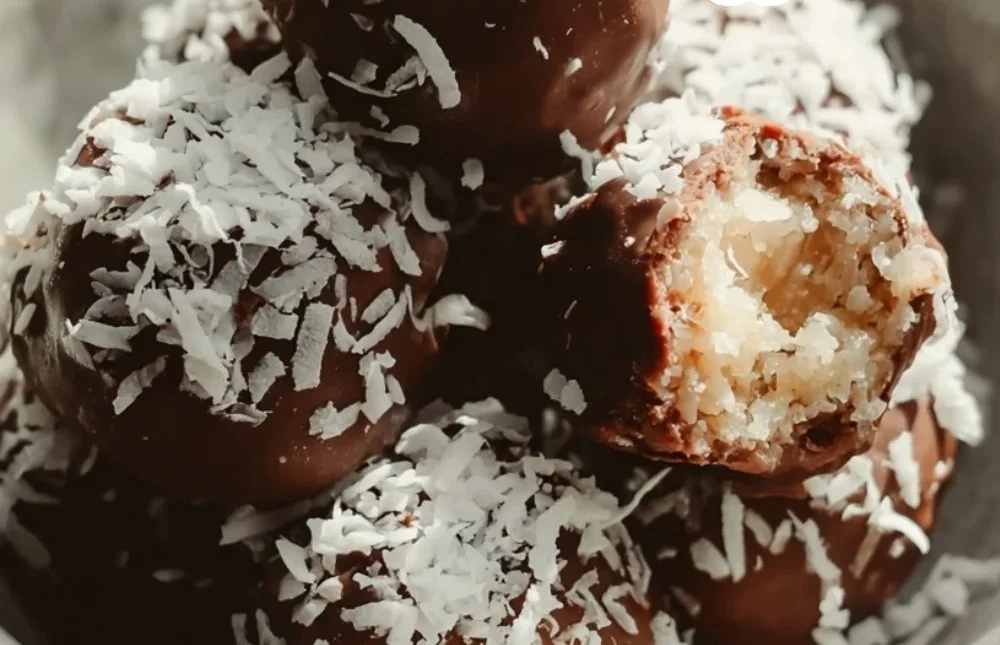
In a mixing bowl, mix together 3 cups shredded coconut and 1/2 cup condensed milk., Then, using a 1 tbsp cookie scoop or a regular spoon, scoop the mixture and roll it into the balls. Transfer to a baking sheet with parchment paper and refrigerate for 30 minutes to 1 hour., Melt 12 oz chocolate chips. Dip the coconut balls into the melted chocolate and place them back on a baking sheet with parchment paper., Sprinkle the tops with a little bit of shredded coconut and refrigerate again for about 30 minutes or until the chocolate it set.
Ingredients through a cultural & historical lens
To read ingredients is to read migration. Coconut flakes — whether sweetened or not — signal the palm-lined places of the world: the Philippines, Indonesia, the Caribbean, South India. Shredded coconut has been used for centuries in both savory and sweet contexts, its fibrous, oily flesh lending a coastal signature. Condensed milk, by contrast, is the emblem of the industrial era in food. Invented and popularized in the 19th century as a way to preserve milk without refrigeration, condensed milk became an indispensable pantry item in places where fresh milk is rare, expensive, or perishable — and thus it became woven into countless desserts across Latin America and Asia.
Semi-sweet chocolate chips are a modern convenience, a product of the chocolate industry’s push to make baking and melting approachable for home cooks. Their presence in this recipe marks a globalized pantry: cocoa beans grown in tropical soils, refined and tempered into chips somewhere in a factory far from the seaside kitchen where you might roll these truffles. Finally, the optional sprinkle of unsweetened shredded coconut is not merely decoration; it is a nod to texture and tradition — a dusting that recalls coconut-laden markets and the practiced fingers that bring finishing touches to confections before they are boxed and taken to a neighbor’s house.
Cooking the dish: sensory notes & traditional techniques
Making Coconut Truffles is less about technical precision and more about rhythm. You mix coconut and condensed milk and feel the way the dry, feathery flakes take on sheen and weight. There is an aroma that arrives almost immediately: the buttery, toasted note of coconut meeting the treacly, milky sweetness of condensed milk. When you form the balls, your hands remember seasons and kitchens. There is a certain intimacy to rolling: the warmth of a palm compressing a mound into a sphere, the tiny imperfections that make each truffle a portrait of the maker.
Dipping them into melted chocolate transforms the texture. The liquid chocolate wraps each ball like a dark coat; when it sets, the first bite is a contrast — a brittle shell followed by tender, almost creamy coconut. The refrigerator’s coolness plays a role: it sets the chocolate, firms the interior, and carries the scent of sea air from open windows in coastal kitchens, or the faint perfume of incense in some households. Traditional techniques vary — some cultures toast the coconut first to deepen the aroma, others use fresh grated coconut and simmer it with milk and sugar until it thickens — but the essence remains of a hand-made, tactile process that honors the senses more than exact measurements.
How different regions prepare their version
Walk from São Paulo to Manila and you will find cousins of this truffle with distinct accents. In Brazil, the beijinho is a beloved sweet at birthdays: condensed milk and coconut cooked into a fudgy mass, rolled and often adorned with a clove or coated with granulated sugar. The truffle in this recipe resembles that tradition but borrows the European habit of enrobing treats in chocolate. In the Philippines, bukayo is a chewy, caramelized coconut confection, often used as a topping or snack, while in the Caribbean, cocadas take on many forms — from syrupy, spoon-tender delights to drier, biscuit-like cookies, often flavored with lime or ginger.
Some regions favor toasted coconut to introduce a smoky depth; others add zest, spice, or rum for festive warmth. Europeans might see these as playful reinterpretations of a chocolate truffle, while Latin American and Southeast Asian cooks recognize the familiar condensed milk-coconut base. The variations are a map of cultural barter: how one household’s pantry staples meet another’s holiday rituals and personal taste.
Traditional ways this dish is shared or served
Coconut Truffles are communal by design. They arrive on dessert plates at birthdays and weddings, nestle into boxes for neighbors, and sit beside cups of strong coffee at afternoon gatherings. In many cultures, sweets like this are a language of hospitality: offering a handful is a way to take part in someone’s day. They are unpretentious gifts for a host, hand-tucked into waxed-paper squares for travelers, or clustered on a silver tray during festivals.
Presentation is often simple and loving: arranged on doilies, placed in paper candy cups, or tucked into banana leaves for a rustic touch. Pairings matter: in humid islands, truffles cut the heavy humidity with a cool, sweet bite; in cooler climates, their ribbon of chocolate feels almost like a tiny, comforting warmth. The ritual of offering — the exchange of a truffle across a kitchen table, the shared silence as people taste — is where the candy becomes a conduit for stories and memory.
Storing the dish without losing its cultural essence
Storage for a confection that embodies travel requires some thought. In cool climates, a tightly sealed container at room temperature may preserve texture, but in warmer places refrigeration is a necessity. The ritual of storing is itself cultural: in some households, sweets are kept in glass jars on the counter as a daily indulgence; in others, they are tucked into the cool dark of a refrigerator reserved for sacred or special items. What matters is not mere preservation but maintaining the gesture — wrapping in paper, marking occasion with a tied string, or leaving them out briefly at the center of a family table.
When transporting truffles as gifts, think like a traveler: cushion them in parchment, avoid stacking, and let them breathe to prevent condensation. If you must refrigerate them before travel, allow them to return slowly to ambient temperature to avoid moisture forming on the chocolate. These are practical steps, but they also honor the cultural essence: the care with which a homemade sweet is prepared and delivered.
Cultural questions people often ask
Is this recipe authentic to any one place? The honest answer is that it is authentic to many places. Its elements — coconut, condensed milk, chocolate — are ingredients that have been adopted and adapted by households across the globe. Authenticity in sweets often lies not in exact origin but in how a family or community claims a recipe as part of its ritual life.
Can one substitute ingredients to make it local? Yes, but substitutions change the story. Using fresh coconut instead of flakes, or local sweeteners instead of condensed milk, rewrites the recipe’s provenance. That is neither good nor bad; it is the very nature of how food travels. People also ask whether these can be vegan or allergy-friendly. They can be reimagined, but such transformations create new narratives rather than uphold the exact tradition described here.
Why is condensed milk so common in these sweets? Because it is a practical, shelf-stable way to add milkiness and sweetness in climates or periods where fresh milk was not readily available. Its presence in so many recipes is a trace of history — industrial, colonial, and domestic — that shaped modern pantries.
A closing note on food, memory & travel
I have eaten Coconut Truffles in bustling ferry terminals and quiet mountain inns, in hotel lobbies and private kitchens. In each place, the same little sphere conjured different memories: a childhood birthday, the lull of a grandmother’s knitting, the sudden intimacy of strangers sharing stories over tea. Food is the simplest map we have to other lives; a recipe becomes a passport when it travels between hands and hearts.
These truffles are more than sugar and coconut and chocolate: they are a way that people reach across climate, class, and language to say, “I remember, and I give this to you.” They are proof that small sweets can hold expansive geographies. When you make them, hold the bowl as you would hold a conversation. Let each roll carry with it a memory, a laugh, a farewell, and an invitation. In that way, every batch is a journey and every bite a return.
Conclusion
For a straightforward three-ingredient variant and a sense of how home cooks embrace simplicity, see Coconut Truffles – Veronika’s Kitchen. If you’re curious how coconut plays with white chocolate in a different, elegant register, this interpretation is beautifully presented at White Chocolate Truffles (W/ Coconut) – Pretty. Simple. Sweet. For those who favor darker, more bittersweet shells that highlight the coconut interior, explore the perspective shared by Dark Chocolate Coconut Truffles – Nourish and Fete.
Coconut Truffles
Ingredients
Method
- In a mixing bowl, mix together the coconut flakes and condensed milk until well combined.
- Using a cookie scoop or a regular spoon, scoop the mixture and roll it into small balls.
- Transfer the balls to a baking sheet lined with parchment paper and refrigerate for 30 minutes to 1 hour.
- Melt the semi-sweet chocolate chips in a microwave or double boiler.
- Dip each coconut ball into the melted chocolate, ensuring it is fully coated.
- Place the chocolate-coated truffles back on the baking sheet.
- Sprinkle the tops with shredded coconut, if desired, and refrigerate again for about 30 minutes or until the chocolate is set.