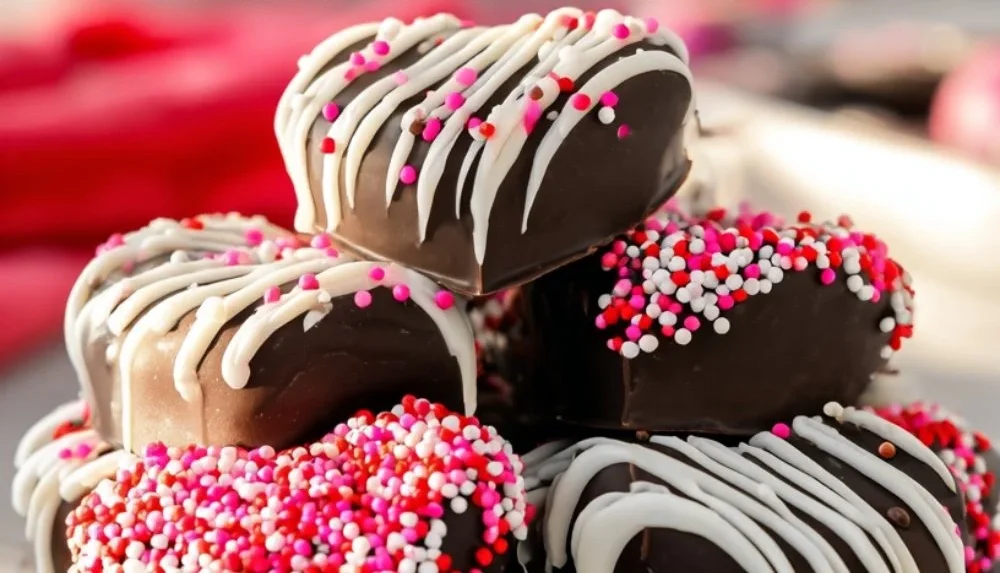
Heart-shaped Chocolate-covered Oreo Ball Truffles
Introduction
From the window of a small pâtisserie on a narrow street in a Croatian town, I first understood how a simple confection could be a passport. The proprietor, a woman named Sofia, wrapped tiny heart-shaped truffles in tissue paper and tucked them into boxes stamped with a local baker’s insignia; each one carried a sweetness that felt like home. Those chocolate-covered Oreo truffles — little hearts of familiar flavor cloaked in glossy chocolate — traveled with me, in the way scents do, folding memory into taste. They reminded me of the American Midwest’s convivial kitchens, of seaside cafés in Lisbon where couples shared miniature desserts, and of the gifts exchanged beneath winter market lights in Prague. One afternoon, while sampling a pink-sprinkled heart over a cup of strong coffee, I thought of how a recipe with such few ingredients could stitch together so many places.
These Heart-shaped Chocolate-covered Oreo Ball Truffles are at once intimate and universal. They are the kind of confection that appears on Valentine’s tables, at neighborhood bake sales, and in the sharing tray during a Sunday afternoon coffee hour. If you’re curious about cousins in other kitchens, you might enjoy a playful riff I found on similar treats like the Easter Egg Oreo cookie balls, where the same impulse to reshape comfort into celebratory forms reveals itself across seasons.
The origin story & regional influence behind this dish
The Oreo, introduced in the United States in 1912, is a product of mass food culture — a cookie whose black-and-white simplicity made it an icon. The transformation of crushed cookies and cream cheese into truffles is a distinctly modern, home-kitchen innovation: a no-bake, improvised confection born of convenience, affection, and the desire to elevate a store-bought element into something homemade. This practice—taking ubiquitous packaged ingredients and rendering them into ceremonial sweets—has parallels everywhere. In Britain, leftover cake becomes truffles; in Latin America, dulce de leche is blended with biscuit crumbs to make brigadeiro-like spheres; in Japan, packaged mochi might be repurposed into new textures. The Heart-shaped Chocolate-covered Oreo Ball Truffles are a contemporary folk practice, an example of culinary bricolage where the pantry meets celebration.
Regionally, the truffle’s form takes cues from local aesthetics. In the United States, the cookie-and-cream pairing tends toward playful pastel sprinkles and heart-shaped molds for Valentine’s Day; in parts of Europe, the same mixture might be rolled into bite-sized spheres and dusted with cocoa, presenting a more subdued palette. In places where chocolate-making carries a deep artisanal lineage—such as Belgium or Switzerland—the truffles may be enrobed in couverture and finished with a precise temper, yet at their heart remains the same act: transforming the familiar into a small, ceremonious bite.
How to make Heart-shaped Chocolate-covered Oreo Ball Truffles
Making these truffles is an exercise in intimacy more than technical prowess. It requires only the rhythm of hands and a sense of ceremony: the crush of dark cookies releasing a faint, bittersweet cocoa perfume; the pliant richness of cream cheese knitting crumbs into a dough; the soft pressure of palms giving shape to a heart. When dipped into glossy chocolate, they take on a solemn, celebratory gravity, and while the chocolate cools, the room fills with the scent of cocoa and sugar, an aroma that reads like an embrace.
These are not instructions as much as a poem to movement: to press, to roll, to dress the little hearts in chocolate finery. The charm lies not in complexity but in the ritual — children shaping hearts at a kitchen table, lovers exchanging one another’s first confectionary attempts, neighbors bringing small boxes as a gesture of thanks. Below you will find the precise ingredients and directions as they are traditionally prepared.
Ingredients :
OREO cookies, cream cheese, chocolate (for coating), sprinkles
Directions :
- Crush the OREO cookies in a bowl and mix with cream cheese until well combined., 2. Shape the mixture into heart-shaped balls., 3. Melt the chocolate and dip each ball into the melted chocolate to coat., 4. Place the coated truffles on a parchment-lined baking sheet., 5. Before the chocolate sets, sprinkle with sprinkles for decoration., 6. Chill in the refrigerator until the chocolate hardens., 7. Serve for a Valentine’s Day party.
Ingredients through a cultural & historical lens
When you name the elements — Oreo cookies, cream cheese, chocolate, sprinkles — you are naming layers of food history. The Oreo represents industrial-scale baking, a product engineered for shelf life and consistency; cream cheese, with roots in American and European dairy practices, stands for home-churned comfort; chocolate is a global story, its beans traded across oceans and transformed into a luxury that, over the centuries, has become both everyday and ceremonial; sprinkles are a language of celebration, the confetti of confection. Put together, they map a story of globalization: manufactured goods merged with local dairy, finished with festive adornment.
Every ingredient carries social meaning. In immigrant kitchens, store-bought cookies have historically been repurposed into treats when access to traditional ingredients was limited. In rural kitchens, cream cheese might be replaced by fresh ricotta when refrigeration was scarce, showing how the basic idea adapts to availability. Sprinkles—small, colorful, and joyful—signal a cakewalk through childhood memories, birthday parties, and the particular kind of gaiety associated with holidays like Valentine’s Day.
Cooking the dish: sensory notes & traditional techniques
The sensory experience is immediate and humble. Crush the Oreos and the room smells faintly of cocoa and sugar, a scent that tells of childhood cereal boxes and late-night snacks. The cream cheese adds a cool, lactic softness, smoothing the crumb into a collagenous, malleable paste. When you press a mound between your palms into a heart, the texture is cool and slightly tacky, like kneading a very fine dough. The chocolate pour is the operatic moment: a glossy ribbon covers the heart and drinks into its crevices, and when you lift it, the sheen catches the light like a lacquered pebble.
Traditionally, these truffles are not fussy. They are chilled to set rather than tempered with the painstaking precision of a chocolatier, which gives them an affectionate, home-made surface: sometimes slightly matte, sometimes gleaming, often imperfect in a way that announces its maker. Families train their hands on the shapes — some flatten the heart’s top with the edge of a spoon, others use a simple cookie cutter to press form — and those techniques become handed down, subtle gestures that are never written but taught over a plate of warm cookies and chatter.
How different regions prepare their version
Across regions, the same impulse produces different textures and presentations. In parts of Latin America, the addition of ground nuts or a dusting of cinnamon on the exterior nods to local flavor profiles, while in South Asia a sprinkle of crushed pistachio or rose petal adds floral and nutty notes. In the American South, you might find these truffles rolled in crushed pecans, giving them a toasted edge tied to the region’s nut-loving palate. In contrast, Scandinavian versions might favor a darker chocolate and a minimal garnish, reflecting a cultural preference for restrained sweetness.
For a playful transatlantic example, some bakers pair this Oreo-cream base with elements from other desserts — a chocolate drizzle that echoes the glaze used on certain European tarts or a dusting of freeze-dried raspberry powder that evokes the bright notes of a Parisian patisserie. The recipe’s simplicity invites experimentation, which is why it spreads and morphs, a treat that travels easily. If you enjoy thinking through such permutations, a nearby riff on fruit-and-chocolate combinations like chocolate-covered cherry magic bars reveals how one sweet idea adapts to local produce and seasonal celebrations.
Traditional ways this dish is shared or served
These heart truffles belong to the language of gifting. They appear in small boxes tied with ribbon, in tin cans passed from mother to daughter, and on communal platters at tea tables. In many households, the act of making them is as important as the eating: a parent teaching a child how to shape a heart becomes a rite, an occasion for stories about the family’s past Valentine’s Day rituals or the way a grandmother once imprinted a tiny design with a fork. In some towns, they are exchanged as tokens of affection on Saint Valentine’s Day; in others, they are a quiet thank-you after a winter dinner party.
They also bridge generations. Elder relatives recall the first time store-bought cookies were transformed into something celebratory; younger makers document their versions on social media, photographing the glossy dip and the delicate sprinkle of confetti. This exchange, between analogue memory and digital sharing, is itself a regional story about how small confections circulate differently in different places.
For a contrast in presentation styles, many home bakers pair these truffles with more elaborate treats at gatherings, offering them alongside items like chocolate-covered strawberry brownies to create a table that tells a story of abundance and variety.
Storing the dish without losing its cultural essence
How you store these truffles speaks to preserving both texture and memory. Refrigeration is practical: it hardens the coating and stabilizes the cream cheese center. But some traditions warn against over-chilling, preferring a slightly softer center that recalls the warmth of the hands that shaped them. Wrapped in wax paper, nestled into boxes, and kept away from the sharp scents of the refrigerator, they retain the gentle aroma of cocoa and dairy.
If you must transport them—a gift to a friend on a train or a picnic shared beneath ancient ruins—pack them in a lined tin with layers of tissue to prevent rubbing. The goal is to preserve the truffle’s intimacy: not just its flavor but the feeling of unwrapping a small, handcrafted gift. In many cultures, the journey of the confection is part of its meaning; a truffle that has been carried home by foot or bus holds the memory of that transit in its surface, a dent from a bump that becomes a part of the story.
Cultural questions people often ask
People often wonder whether a confection built on a modern packaged cookie can be “authentic.” The answer lives in how we define authenticity: as strict lineage, or as lived practice. These truffles are authentic in the sense that they are meaningful in daily life—passed around at parties, taught in kitchens, and tailored by hands to local tastes. Others ask whether such treats diminish culinary tradition. I would say they do the opposite: they testify that tradition is not static but porous, enriched by exchange.
Questions about health, substitutions, and suitable occasions arise too. While the recipe is indulgent, its portability and ease mean it’s often adapted for larger gatherings and charitable bake sales. People ask how to make them less sweet or suitable for various dietary needs; those conversations, too, are cultural, reflecting local attitudes toward sugar, hospitality, and celebration.
A closing note on food, memory & travel
In Sofia’s small shop the truffles tasted of patience and human scale: the kind of dessert that knows how to be small enough for one mouth and generous enough to say, “I was made for you.” As I travel, I collect such small things — recipes that fold into luggage as neatly as scarves. They become stories I tell, not as immutable facts but as invitations to participate.
These Heart-shaped Chocolate-covered Oreo Ball Truffles are a reminder that culinary practices travel as easily as people: a cookie invented in one country becomes a heart-shaped token in many others. Every time someone shapes a heart between their palms, they reenact a ritual that is at once rooted and wandering. In every bite there is a map: of trade routes that brought chocolate across oceans, of kitchen tables where hands learned a simple movement, of holidays and the human desire to mark them with sweetness.
Conclusion
For a straightforward, no-fuss how-to you can compare with the technique I described, see this approachable guide to No-Bake Oreo Heart Truffles | Moribyan, which emphasizes simplicity and presentation. If you’re curious about another family-friendly version that celebrates shape and ease, the write-up for Heart OREO Balls – A Pumpkin And A Princess offers a warm, domestic perspective. And for inspiration on styling your Valentine’s table with glossy, heart-shaped truffles, the collection at Oreo Truffle Valentine’s Hearts | Valentine’s Day Chocolate-Dipped … provides plenty of visual ideas and variations.
In the end, these small heart truffles are less a recipe than a habit: a way of folding comfort into ceremony, of sending a piece of domestic affection across distances. Wherever you shape them, they will carry the patina of your hands, the echoes of conversations, and the layered histories of the ingredients themselves.
Heart-shaped Chocolate-covered Oreo Ball Truffles
Ingredients
Method
- Crush the OREO cookies in a bowl and mix with cream cheese until well combined.
- Shape the mixture into heart-shaped balls.
- Melt the chocolate and dip each ball into the melted chocolate to coat.
- Place the coated truffles on a parchment-lined baking sheet.
- Before the chocolate sets, sprinkle with sprinkles for decoration.
- Chill in the refrigerator until the chocolate hardens.
- Serve for a Valentine's Day party.