Easter Bunny Chow
Introduction
There are recipes that travel like luggage—simple things folded into the corners of a suitcase, arriving with a scent that can unlock whole afternoons of memory. Easter Bunny Chow is one of those portable comforts: a handful of cereal and chocolate that has become a ritual across backyards, church basements, and kitchen counters from suburban cul-de-sacs to apartments where the windows fog in springtime. I first met this confection in a farmhouse kitchen outside of Lancaster, Pennsylvania, where a neighbor named Sofia ladled the mixture into a tin bowl and handed me a paper napkin with a conspiratorial smile. “For the children,” she said, though her fingertips bore the faint, satisfied smudges of powdered sugar that told a different truth—that adults were the early risers of this tradition, too.
Sofia taught me to watch the way the chocolate glossed the cereal, how the pastel candies, like small painted eggs, rattled in the bowl and made their own music. Later, traveling through other regions, I found versions with different names and small, private variations on the same theme. If you like exploring festival treats that cross generations, you might enjoy a tangentially related recipe for Easter cake mix cookie bars that plays the same notes of sweetness and nostalgia: Easter cake mix cookie bars. That shared tendency to mingle convenience with ceremony—boxed cake mixes, cereal, simple melting—reveals how modern life shapes the ritual foods we give to one another.
The origin story & regional influence behind this dish
Easter Bunny Chow is a child of mid-20th-century American practicality and post-war abundance. Cereal companies had already remade breakfast into a cultural commodity, and home cooks, ever inventive, turned what was meant for morning into a canvas for celebration. The precise origin is diffuse—this is comfort food that was assembled rather than invented by a single chef—but its genealogy is clear when you trace the ingredients back to the grocery shelves of the 1950s and 60s. Rice cereal, chocolate, peanut butter, and powdered sugar represent staples that were affordable and shelf-stable, perfect for the era’s housewives and kitchen parties.
Regional inflections crept in as families carried the recipe with them. In parts of the Midwest, where communal potlucks are almost a civic duty, Bunny Chow became a centerpiece at church picnics, often arriving in a large Tupperware bowl, its pastel candies echoing the paper napkins. In the South, a peanuty richness might be deepened—a nod to the region’s reverence for peanuts—while coastal variations sometimes nudge the candy palette toward tropical hues. Traveling through Appalachia, I found a grandmother who added toasted pecans to her batch, claiming they made the mixture “sing” at the family table. The dish is a map of migration and family preference; it tells us where communities have been and how they prefer their sweetness.
How to make Easter Bunny Chow
Ingredients :
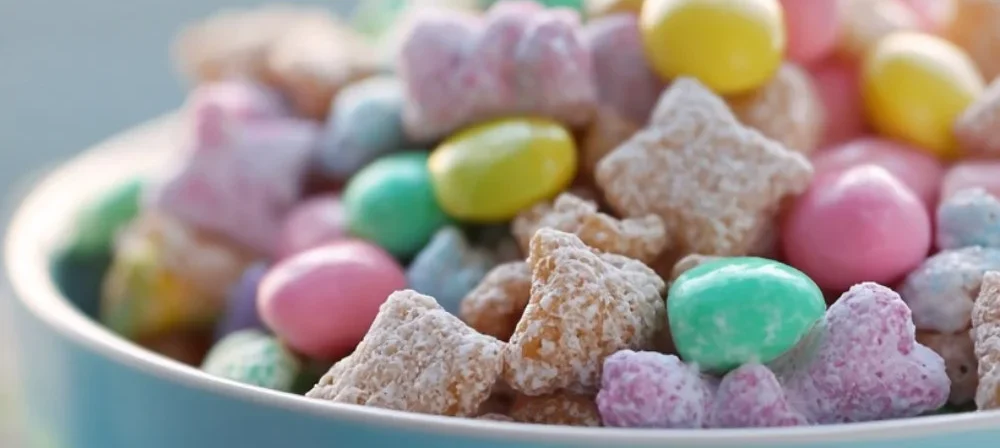
4 cups Rice Chex cereal, 1 cup chocolate chips, 1/2 cup peanut butter, 1/4 cup butter, 1 teaspoon vanilla extract, 2 cups powdered sugar, Pastel colored candy (like M&M’s or sprinkles)
Directions :
- In a large microwave-safe bowl, combine chocolate chips, peanut butter, and butter. Microwave on high for 1 minute, stir, and continue to heat in 30-second intervals until melted and smooth., 2. Stir in vanilla extract., 3. Add Rice Chex cereal to the chocolate mixture and stir gently until all pieces are coated., 4. Place the mixture in a large resealable bag, add powdered sugar, and shake until evenly coated., 5. Spread the mixture onto a baking sheet to cool., 6. Once cooled, mix in pastel colored candy and serve in a bowl.
Those instructions are as much a cultural script as they are a recipe: the microwave for speed, the resealable bag for easy sharing, the pastel candies to make the plate festive. They preserve the humble elegance of the dish—accessible, forgiving, and designed to be made with hands that might also be holding a child, a neighbor’s gossip, or a weary suitcase.
Ingredients through a cultural & historical lens
Each ingredient in Bunny Chow carries a quiet sociocultural biography. Rice Chex cereal—light, airy, and designed for mass consumption—represents the democratization of breakfast. Chocolate chips, once a luxury, became ubiquitous after Ruth Wakefield’s invention of the chocolate chip cookie popularized the morsel. Peanut butter, with its roots in both Indigenous and African American culinary traditions, became a pantry staple that symbolized nourishment and economy. Powdered sugar acts as a white coat that transforms texture and appearance, suggesting frost or the bloom of spring. Finally, the pastel candies are modern-day talismans: they signal celebration and, in their painted shells, echo the eggs that are the ancient symbol of rebirth in spring festivals across cultures.
Viewed this way, Bunny Chow is a confluence of industrial food systems and personal ritual. It’s the recipe that flourished when communities needed something quick that still felt special—when parents wanted to create a moment of joy without elaborate techniques. It is at once a convenience food and a carefully curated object of care.
Cooking the dish: sensory notes & traditional techniques
Making Bunny Chow is sensory choreography. The first scent is molten chocolate, warm and slightly bitter, which when stirred becomes velvety and sweet with the addition of peanut butter. The aroma fills a kitchen the way a bell announces a gathering—faintly nostalgic, immediately convivial. As the cereal is folded in, the mixture changes texture from slick gloss to crinkled, sugared clusters. Shaking the powdered sugar in a sealed bag is a small theatrical act: the bag becomes a snow globe, the sugar dusting each piece like early morning frost.
Traditional techniques are minimal but meaningful. Using a resealable bag, for instance, is not only practical; it is emblematic of a communal approach to cooking—something made to be shaken, passed, and shared. Spreading the mixture on a baking sheet to cool is a ritual pause, allowing the hand to rest and the conversation to swell. In some kitchens, an adult will reserve a small taste while the rest cools, citing “quality control” with a wink. These gestures, more than measurements, give the dish its character.
How different regions prepare their version
Across regions, Bunny Chow keeps its bones but adopts local flourishes. In the Midwest, you might find it obsessively festive—extra sprinkles, pastel-colored marshmallows, and an emphasis on volume, as if the size of the bowl announces the depth of hospitality. In New England, cooks sometimes swap chips for chopped chocolate bars, favoring a less uniform melt and a more rustic texture. The South endorses nuttier finishes—chopped peanuts or pecans scattered on top—while the West Coast might riff with dark chocolate and artisanal peanut butter for a sophisticated, less cloying take.
Internationally, there are cousins to Bunny Chow that reveal analogous impulses: the British have party mixes that combine cereal, chocolate, and biscuits; Australian “puppy chow” is nearly identical, though its name and candy palette differ. In every region, the same principle applies—make something quick, shareable, and playful—and the variations tell an anthropological tale about taste, resource availability, and the aesthetics of celebration.
Traditional ways this dish is shared or served
This is a food that insists on being communal. In the Midwest church halls where I have watched potlucks unfold, Bunny Chow arrives in wide-rimmed bowls and is nudged from one platter to another so every child can take a handful. In urban apartments, the mixture is portioned into paper cones for street-side Easter egg hunts. Mothers and grandmothers often tuck servings into sandwich bags and tie them with ribbon, turning the snack into a portable blessing for school parties or neighborhood exchanges. For a family picnic in Vermont, I watched it poured into paper cones and passed from hand to hand as the light softened; in a Miami block party, it served as a sweet counterpoint to savory skewers.
A local variation of communal serving I encountered involved layering Bunny Chow in a glass trifle bowl, alternating with whipped cream and berries, turning a simple snack into a celebratory centerpiece. In smaller gatherings, it is customary to set out a small bowl with a tiny spoon—an invitation to linger and talk. For a related idea of communal snacking at gatherings, some hosts pair Bunny Chow with finger-friendly dips—an approach that reminded me of a bright, citrusy Easter dip that complements the treat’s sweetness with tang.
Storing the dish without losing its cultural essence
Preservation here is practical and ceremonial. Bunny Chow keeps well in an airtight container for several days; refrigeration is unnecessary and even detrimental, as it can dull the candy’s crunch and the chocolate’s mouthfeel. Many families have a “do not touch until after church” rule on Easter morning, a gentle communal constraint that helps the dish retain its ceremonial role. When gifting, people often use waxed paper cones or small mason jars—wrappings that are part of the social language of giving.
To retain cultural essence, think beyond shelf life: include a handwritten note, a pastel ribbon, or a miniature tradition—such as “take only one hand”—that reconnects the snack to the moment. These small acts turn storage into a kind of slow ritual, ensuring the treat continues to function not just as food but as a vessel for memory.
Cultural questions people often ask
Why pastel candies? The colors echo eggs and springtime; they are visual shorthand for rebirth, renewal, and celebration, turning a simple bowl into a holiday symbol. Why the powdered sugar? It offers a snowy contrast—visually festive and texturally crisp—recalling older confectionery traditions of dusted sweets. Is Bunny Chow an American invention? Largely yes in its modern form, but it sits within an older global tradition of communal sweets assembled from shelf-stable ingredients for festivals and communal gatherings.
People also ask whether the recipe is “proper” or whether it loses cultural value when adapted. The answer is lived in kitchens: adaptations are part of the tradition. Each tweak—nut additions, chocolate swaps, the choice of candies—adds a chapter to a recipe’s story rather than erasing it. It is a living food, meant to adapt as families move, as palates change, and as memories accumulate.
A closing note on food, memory & travel
Food is a map of where we have been and who we love. Every time I watch someone make Bunny Chow, I think of Sofia and the tin bowl she offered me on a cloudy afternoon, and of the many kitchens where this mixture has been a small ritual of care. There is a simplicity to it that belies its power: it is easy to make, but hard to forget once it has been present at a child’s first Easter egg hunt, at a neighbor’s welcome party, or at a kitchen table where stories and sugar intermix.
Travel changes how we see such recipes. You bring them home, you adapt them, and they arrive somewhere new with a new gloss. The cultural riches of Bunny Chow are not in its novelty but in its ordinary elasticity—how it can hold a thousand versions of the same celebration. In that light, making this dish is an act of storytelling: stirring, shaking, and doling out a handful of sweetness that says, clearly and gently, you are welcome here.
Conclusion
For a well-loved, step-by-step version that many cooks return to each spring, see PennyWiseMama’s best Easter Bunny Chow recipe for inspiration. If you’re curious about another popular family take on this treat, Typically Simple’s Easter Bunny Chow recipe offers a thoughtfully presented variation. For a blog that explores creative takes and presentation ideas, the Butternut Bakery’s Easter Bunny Chow post is a lovely place to linger.
Easter Bunny Chow
Ingredients
Method
- In a large microwave-safe bowl, combine chocolate chips, peanut butter, and butter.
- Microwave on high for 1 minute, stir, and continue to heat in 30-second intervals until melted and smooth.
- Stir in vanilla extract.
- Add Rice Chex cereal to the chocolate mixture and stir gently until all pieces are coated.
- Place the mixture in a large resealable bag, add powdered sugar, and shake until evenly coated.
- Spread the mixture onto a baking sheet to cool.
- Once cooled, mix in pastel colored candy and serve in a bowl.