Mochi Brownies
Introduction
There are recipes that arrive like postcards from other lives, folded into the luggage of a return flight or tucked between the pages of a borrowed cookbook. Mochi brownies entered my life the same way—at a kitchen table in a city that smelled of rain and soy, where a friend from Okinawa slid a warm square across the table and said simply, “This is what home tastes like now.” The name stays with me: Mochi Brownies—two words together that hold an entire history of migration, adaptation, and the compassionate improvisation of cooks who make do with what they have. In that moment, the dense, elastic bite of sweet rice flour met the nostalgic cocoa of a Western brownie and created a new kind of comfort.
If you love the playful contrast of textures—crispy crust, tender crumb, then a chewy, almost gelatinous middle—this recipe will feel like meeting an old friend’s face after years apart. It is a dish that travels well in memory: one bite and you can be back under fluorescent bakery lights in Honolulu, or at a small festival where elders sit cross-legged handing out plates, or on a breezy ferry between islands, sharing a tin of treats. For an unexpected companion on this journey, consider how other brownies play with bright citrus and dense chocolate in their own ways, as in a lemon-browned sibling I once met in a seaside town—different geography, same impulse to bend a classic to new soils.
The origin story & regional influence behind this dish
Mochi itself—the pounded, glutinous rice cake—has a history as tactile as any living tradition. In Japan it is ceremonial and daily, a food of harvest, New Year, weddings, and street corners; the pounding of mochi is communal, a ritual of rhythm and muscle that brings people together. But to speak of mochi only as that round, white cake is to miss the diaspora of practices and flour-based adaptations that have spread across East Asia and the Pacific. Sweet rice flour—mokiko, mochiko—travels more easily than a mortar and pestle, and with it the chewy, sticky texture that has found its way into pancakes, dumplings, and, more recently, brownies.
The mochi brownie is a child of contact and creativity. It likely owes its existence to post-war culinary experiments, to immigrant bakers adapting familiar textures to new ingredients, to home cooks in Hawai‘i and the West Coast who fold Japanese pantry staples into American desserts. In Honolulu’s mixed-heritage neighborhoods, you might taste a version that leans more toward dense, fudgy chew; in Tokyo’s little cafes you might find a refined, less-sweet take with a dusting of kinako. Wherever it is made, the mochi brownie tells two stories at once: the continuity of a rice-culture tradition and the restless curiosity of those who cross oceans and cuisines.
How to make Mochi Brownies
Ingredients :
1 cup sweet rice flour (mochi flour), 1 cup granulated sugar, 1/2 cup unsweetened cocoa powder, 1/4 teaspoon salt, 1/4 cup vegetable oil, 1/2 cup water, 1 teaspoon vanilla extract, 1/2 cup chocolate chips (optional)
Directions :
- Preheat your oven to 350°F (175°C) and grease a baking pan., 2. In a large bowl, whisk together the sweet rice flour, sugar, cocoa powder, and salt., 3. In a separate bowl, mix the vegetable oil, water, and vanilla extract., 4. Combine the wet ingredients with the dry ingredients and stir until well mixed., 5. Fold in the chocolate chips if using., 6. Pour the batter into the prepared pan and spread it evenly., 7. Bake for 30-35 minutes or until a toothpick inserted in the center comes out mostly clean., 8. Allow to cool before cutting into squares and serving.
The method is refreshingly elementary—no need for electric mixers or sorcery—yet within its plainness lies a kind of alchemy. The sweet rice flour, when hydrated and heated, yields its characteristic chew; the oil keeps the crumb supple. In kitchens where tradition meets thrift, cooks will often use what they have on hand—simple utensils, a modest oven—and the result honors both resourcefulness and memory. If you want to trace a family recipe, ask whether the sugar was ever replaced with brown sugar, or if the chocolate chips are a later American amendment; such small adaptations map the journeys of people and taste.
Ingredients through a cultural & historical lens
Each line of the ingredients list reads like a thread in a larger tapestry of exchange. Sweet rice flour is the anchor here—its molecular character different from wheat, giving the final square that elastic bite that evokes mochi. Historically, glutinous rice has been revered across East Asia for its stickiness, a quality linguistically and ritually tied to cohesion and togetherness; to share something sticky is to share a piece of oneself. Cocoa powder and chocolate chips bring colonial histories and global commodity chains to the plate: cacao’s path from tropical groves to European markets and then into American pantries is part of the shadow behind many modern desserts.
Oil as the fat speaks of convenience and adaptability—a neutral, affordable medium that crosses culinary boundaries. Vanilla, once a perfume of elite tables, now rests in a teaspoon like a wink from a past era when spices signaled connection to distant lands. Sugar, whose presence in so many celebratory foods marks both abundance and complex histories of labor, sits at the center: sweetness as both pleasure and historical witness. When you assemble these ingredients, you bring together crop histories, trade routes, and the choices of countless cooks who have had to reconstruct familiar textures with unfamiliar staples.
For a comparative note, bakers who wander between recipes sometimes think of a brownie’s citrus counterparts; just as a bright lemon brownie plays light and shade, the mochi brownie balances the buoyant stick of rice with the earthy, grounding force of chocolate.
Cooking the dish: sensory notes & traditional techniques
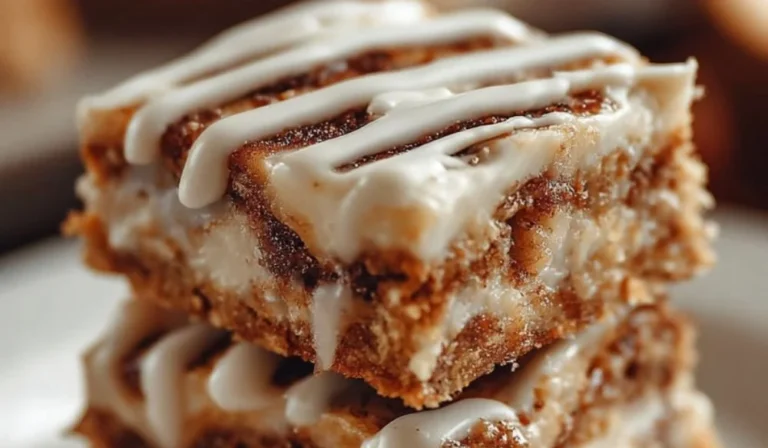
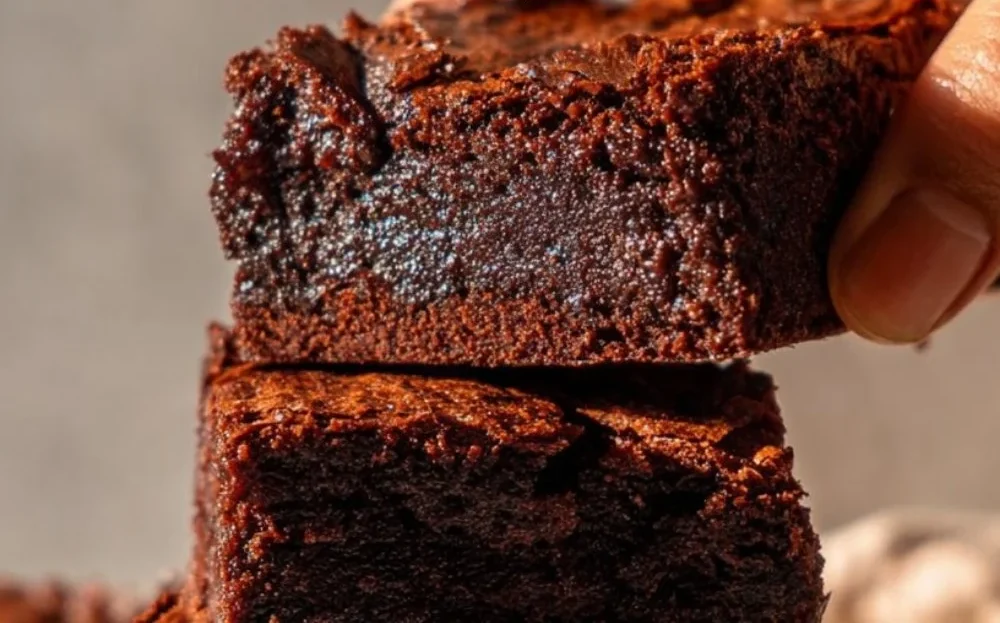
Making mochi brownies is a sensory act. The dry cocoa, when whisked with sweet rice flour, smells of warm earth and dry heat; mixing in water and oil changes the aroma to something buttery and promising. As batter spreads into the pan it glistens—quiet, like a pond under clouded light—and the oven transforms that sheen into a dark, crackled top that offers a brittle welcome to a tender interior. The first cut is always a test: the edges yield with a gentle resistance, the center gives with a pleasing chew.
Traditional mochi-making is rhythmic and communal; while mochi brownies do not require rhythmic pounding, they inherit a social function. They are made for sharing—cut into squares and handed around a living room, brought as gifts on morning commutes, tucked into bentos or the lunchboxes of those who grew up with the chew of rice under their teeth. The technique here—mix, pour, bake—is almost ceremonial in its simplicity. In the kitchens of elders, the measure of success is not the gloss of a ganache or the precision of a crust, but the way the brownie makes people lean together, closing the space between them with a shared bite.
How different regions prepare their version
Across different regions, the mochi brownie mutates in affectionate ways. In Hawai‘i, where Japanese, Filipino, Portuguese, and Native Hawaiian influences mingle on plates and in language, you might find versions flecked with macadamia nuts, dorayaki-inspired fillings, or a Hawaiian-style coffee glaze. On the Japanese mainland, cafes sometimes pare sweetness back and emphasize a taut chew, perhaps dusting the top with matcha or kinako to speak of heritage. On the U.S. West Coast, bakers often riff boldly—adding peanut butter swirls, salted caramel drizzles, or a layer of azuki bean paste—adapting the square to local palates.
In communities across the Pacific, mochi brownies become an expression of identity: a way to assert cultural memory while participating in broader dessert cultures. They are testimonies of adaptability—how staple flours can be woven into borrowed forms—and of the hospitable refusal to remain pure. Regional variations sing the song of place: islands give you sun-cured flavors, cities offer cosmopolitan twists, and small towns keep the recipe close to the hearth.
Traditional ways this dish is shared or served
Mochi brownies inhabit many tables: birthday parties where children admire their chew rather than their sweetness, tea-time spreads where they sit beside light sencha, office potlucks where colleagues pass around a tin stamped with a note of thanks. They are common gifts for housewarmings, baked in disposable pans and presented with a ribbon—a simple, edible benediction. In some families, these brownies are the dessert of consolation, brought to someone nursing a cold or returning from the hospital: soft, easy to eat, imbued with the care of whoever took the time to make them.
In festivals and markets, you might spot them sold in neat rows atop wicker trays, often warmed and wrapped in wax paper. The act of serving is often casual and intimate: no formal slicing, but rather the gentle tearing and offering that keeps the gesture human. There is also a quiet pedagogy around them—mothers or grandmothers who teach the recipe by hand, guiding the stir and the pour while telling stories about the island or the old country. In such moments, food becomes a conduit for language, memory, and belonging.
Storing the dish without losing its cultural essence
Storing mochi brownies is an exercise in preservation of texture as much as memory. Ideally, they are allowed to cool and then kept in a simple tin or glass container at room temperature for a day or two—this maintains the chew without drying the edges. Refrigeration will firm them up and is useful in warm climates, but beware: the cold can blunt the tenderness, so allow squares to come to room temperature before serving to revive their giving center.
In many households, leftovers become gifts. Tucked into small boxes with a handwritten note, they travel across neighborhoods, passed door to door like a small, edible conversation. Even the act of reheating—briefly in a low oven or a skillet—becomes a kind of ritual, a way to recall the original warmth of the tray fresh from the oven. Storage, then, is not merely pragmatic; it is another layer of the story, a continuation of the care embedded in the baking.
Cultural questions people often ask
People often ask whether mochi brownies are “authentic,” as if authenticity were a single point on a map. The answer is that authenticity is layered: the chewy quality is faithful to the textural tradition of glutinous rice, while the marriage with cocoa is an innovation born of encounter. Others wonder if they should call them brownies at all. Naming is an act of translation—some call them mochi brownies, others sticky rice brownies, and still others use entirely local names. Each name carries its own claim and affection.
Another frequent question concerns the texture: why the chew? It is the nature of sweet rice flour. Some ask about the social function: are these celebratory? Often, yes—but they are also everyday. They bridge monumental festivals and small acts of kindness. Finally, travelers often wonder where to taste the best version. The truth is, the best mochi brownie is often the one eaten in good company, on a noisy morning, or given by a hand that has learned a recipe from someone they love.
Conclusion
A mochi brownie is more than a recipe; it is a map of movement, a flavor that carries the grain of a homeland and the cocoa of a different story. To taste one is to feel the tug of migration and the comfort of adaptation, to stand at a kitchen counter where two worlds have been folded together with a wooden spoon. If you’d like to see a contemporary take on chewy mochi brownies with step-by-step photos, I recommend this thoughtful version from a well-loved blog: Chewy Mochi Brownies – Snixy Kitchen. For another home-baker’s perspective and serving ideas that show how flexible this dessert can be across kitchens, this write-up offers useful reflections: Mochi Brownies — Fix Feast Flair.
Make a pan, share it, and listen to the stories that spill out between bites—about islands and cities, about hands that learned recipes from their mothers and mothers who learned from their mothers. In that listening, a simple square becomes a small, radiant archive of belonging.
Mochi Brownies
Ingredients
Method
- Preheat your oven to 350°F (175°C) and grease a baking pan.
- In a large bowl, whisk together the sweet rice flour, sugar, cocoa powder, and salt.
- In a separate bowl, mix the vegetable oil, water, and vanilla extract.
- Combine the wet ingredients with the dry ingredients and stir until well mixed.
- Fold in the chocolate chips if using.
- Pour the batter into the prepared pan and spread it evenly.
- Bake for 30-35 minutes or until a toothpick inserted in the center comes out mostly clean.
- Allow to cool before cutting into squares and serving.