Baklava Pistachio Cheesecake
Introduction
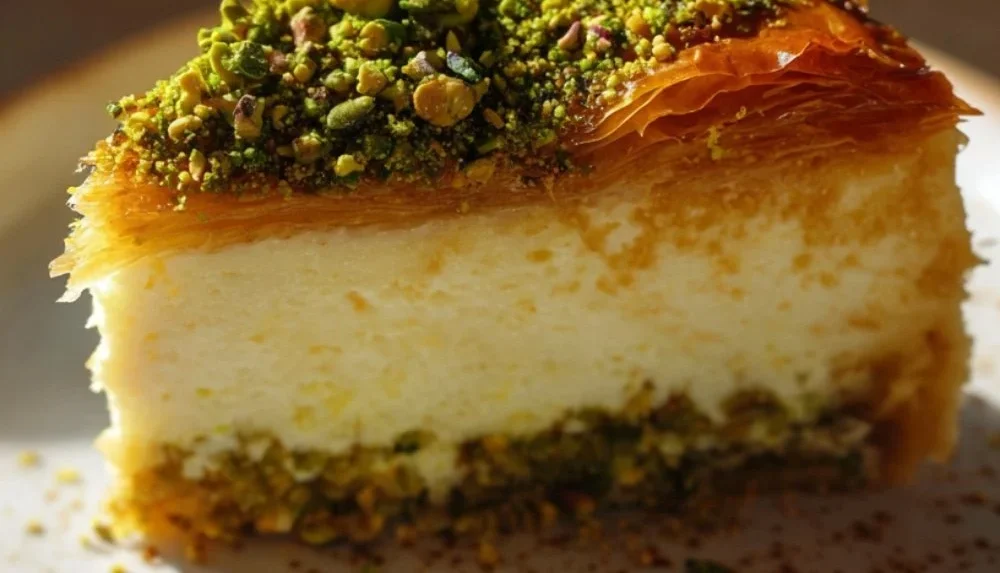
I first encountered Baklava Pistachio Cheesecake in a teahouse tucked between a mosaic of narrow streets and the slow wash of a river. The air was thick with cardamom and simmering lemon syrup; somewhere a kettle sang. A city like Sofia, where east meets west in stone and song, teaches you that food is never merely nourishment. It is a map—folded, stained, and creased by the hands of those who travel, trade, and remember. That day, a slice arrived like a small, improbable monument: a creamy slab of cheesecake studded with honeyed, caramelized filo and shards of pistachio, a dessert that held the fluorescent hush of modern patisserie and the warm, nutty lineage of centuries-old tables.
This is a recipe that tastes like border crossings. It tastes like a grandmother pulling filo paper with deliberate patience, and like an American baker whisking cream cheese in a bowl under electric light. It tastes like the green of pistachios from Anatolia or Iran, the gold of honey harvested under a low sun, and the fragile, whisper-thin crunch of phyllo that carries memory as readily as sesame carries scent. To write about Baklava Pistachio Cheesecake is to tell several stories at once: of trade routes and teapots, of immigrant kitchens where new traditions are born, and of how flavor can act as a repository for longing.
The origin story & regional influence behind this dish
Baklava itself is a map stitched with recipes: a layered pastry with roots that scholars and grandmothers alike trace to the Ottoman kitchen, to the palaces where pastry chefs folded sheets of dough into dizzying patterns. Pistachios — particularly those from Gaziantep in southeastern Turkey — have been prized for their sweet, resinous richness for centuries. Honey has long been the ceremonial sweetener across the eastern Mediterranean and the Levant. Cheesecake, by contrast, speaks the language of the West: ancient Greco-Roman texts mention forms of curdled cheese, and the creamy American-style cheesecake is a relatively recent evolution, born of industrialized dairying and the ease of cream cheese.
Put these elements together and you have a conversation across time and place. Baklava Pistachio Cheesecake is likely a contemporary creation of diasporic kitchens and inventive pastry chefs who wanted to honor both the crisp, honeyed legacy of baklava and the lush, velvety comfort of cheesecake. It is a hybrid that would feel at home in a seaside patisserie in Athens, a cookbook in Boston, or a family table in Beirut. Each iteration is an act of cultural translation: filo becomes an architectural roof over a custardy interior; pistachio becomes both texture and color; honey becomes the bridge that unites brittle history with modern indulgence.
How to make Baklava Pistachio Cheesecake
This is a dessert that asks for patience and generosity of spirit more than for technical bravado. It is built in layers of memory and material: a nut-flecked crust, a slow and trusting cheesecake center, and an audacious crown of honey-brushed baklava. Making it is like assembling a small archive of flavors — each layer a chapter, each bite a line of prose.
Ingredients :
3/4 cup (170 grams) unsalted butter, softened, 3/4 cup (95 grams) powdered sugar, 1/4 teaspoon salt, 1 3/4 cups (220 grams) all-purpose flour, 1 cup (120 grams) chopped pistachios, 14 oz (400 grams) store-bought filo (phyllo) dough, 1 cup (120 grams) finely chopped pistachios, 1/3 cup (75 grams) butter, melted and cooled, 3 tablespoons (45 grams) white sugar, 1 teaspoon lemon juice, 1/4 cup (30 grams) water, 1/4 cup (50 grams) honey, 24 ounces (675 grams) cream cheese, 1/3 cup (125 grams) honey, 2 large eggs, 1 egg yolk, 1/2 cup (120 grams) sour cream, 15-20% fat, 1/4 teaspoon salt
Directions :
Preheat the oven to 350°F (175°C)., For the crust, blend softened butter, powdered sugar, and salt until creamy. Gradually mix in flour and chopped pistachios, then press into a greased 9-inch springform pan., Bake the crust for 10-12 minutes until lightly golden., For the baklava topping, layer filo sheets on a baking sheet, brushing each with melted butter. Sprinkle with chopped pistachios mixed with sugar; drizzle with lemon juice, water, and honey before baking for about 20 minutes until golden., For the filling, beat cream cheese until smooth; add honey, eggs, egg yolk, sour cream, and salt until combined., Pour filling over cooled crust and top with pieces of baklava. Bake for 40-45 minutes until set., Cool completely at room temperature before refrigerating for at least four hours.
Ingredients through a cultural & historical lens
Look at this ingredient list and you see borders erased by flavor. Pistachios, once a prized export along caravan routes, tell of arid lands where green kernels are coaxed from sunburned trees; to see them small and vivid on a cake is to hold a sun-washed orchard in your hand. Filo, the featherlight pastry, is the result of centuries of practice in stretching dough paper-thin enough to catch light; it is a technique taught from mother to daughter in places where patience is as important as flour. Honey is more than sweetener here; it is incense — a floral history that carries thyme and orange blossom depending on the season and the place where bees have foraged.
Cream cheese and sour cream speak of cooler climates and dairy economies that made such textures possible; they are the voice of urban bakeries and refrigerated cabinets. The butter and sugar in the crust ground tradition into a new dialect — something that would not have been imagined in a centuries-old Ottoman palace nor in a rural Anatolian kitchen, but which makes sense on a modern table where multiple culinary heritages convene.
Cooking the dish: sensory notes & traditional techniques
This dessert is about contrasts: the brittle, honeyed crack of baklava atop the dense, yielding silence of cheesecake. When it comes from the oven, there is a split-second when the kitchen smells like both a honey shop and a dairy stall. The filo will crackle under the fork, thin as old paper, while the interior gives way like a cloud compressed into velvet. The pistachios punctuate each forkful with their mild, smoky bitterness, their green a kind of punctuation against the ivory of the cheese.
Traditional technique matters not for the electric beat of a mixer but for how filo is handled: brushed with melted butter, layered in a manner that respects its fragility, and baked only until it achieves a honeyed translucence. The honey-lime drizzle on the topping is a memory of soaked baklava, where syrup is poured hot to mingle with hot pastry and creates a coat that bruises the layers with sweetness. In some homes, the baklava shards are allowed to rest in the syrup overnight, an act akin to letting stories steep: flavors intersect and soften, edges mellow into each other.
How different regions prepare their version
Across the eastern Mediterranean and the Balkans, baklava itself wears many costumes: in some corners it is compact and diamond-shaped, heavily spiced with clove and cinnamon; in others it is a simple stack of nuts and honey. In Greece, baklava may be heavier on butter and include cinnamon; in Turkey, pistachios from Gaziantep are emblematic and sometimes substituted with walnuts elsewhere. When cheesecake enters the conversation, it brings regional asymmetry: an American version leans into cream cheese and custard richness, while a Mediterranean adaptation might favor labneh or strained yogurt for a tangier finish.
A Lebanese kitchen might fold rosewater into the syrup; an Armenian table might favor walnuts in the crust. In a modern European patisserie, pastry chefs might caramelize the filo for added crunch or infuse the honey with citrus peel. In the United States, baklava cheesecake became a kind of hybrid emblem in neighborhoods where immigrant families settled side-by-side with local bakers, each borrowing the other’s tools and tastes.
Traditional ways this dish is shared or served
Baklava and cheesecake occupy ceremonial spaces. Baklava is a classic offering at weddings, religious festivals, and hospitality: a tray presented to guests is a sign of abundance and welcome. Cheesecake, often a celebratory dessert, marks birthdays and communal gatherings. Together, Baklava Pistachio Cheesecake feels like the kind of dessert that might appear at a multicultural family celebration — the kind where uncles with mismatched spoons reach across a table laden with rakı, Turkish coffee, and espresso; where children sneak a second slice as elders reminisce about homes left behind.
It is served with tea in the late afternoon or with dark coffee after a long dinner. In colder months, a slice alongside a small glass of spiced wine or sweet tea can serve as a warm, consoling punctuation to a communal meal. Presentation matters: the baklava shards on top are intentionally irregular, as if to say that beauty in these kitchens often comes from improvisation rather than precision.
Storing the dish without losing its cultural essence
Storage is always an act of negotiation between texture and tradition. Refrigeration preserves the cheesecake’s custardy heart, but it can conspire with moisture to soften the filo. Many households solve this by keeping the baklava topping separate until serving, crumbling it over each slice like fresh news of a journey. Others accept the softened top as its own kind of beauty — an invitation to experience baklava in a new register, where the honey becomes more integrated with the cheese.
To store this dessert is to decide what aspect you wish to preserve: the crunch of a single, fresh-baked piece of filo, or the melding of honey and cream that happens after time has worked its slow alchemy. Both approaches are cultural statements — the first honors immediate, crunchy pleasure; the second respects the layered intimacy of flavors aged together.
Cultural questions people often ask
Is baklava Turkish or Greek? The answer is rarely simple. Baklava’s history is shared across the region, and claims of origin are entwined with national narratives and family lore. Which pistachio is best? Connoisseurs will praise Gaziantep pistachios for their fragrance, but good nuts come from many soils; what matters is freshness. Is this dessert “authentic”? Authenticity is a moving target; dishes are living things, changing as people move and adapt. Does honey make it healthier? Honey carries medicinal and symbolic weight in many cultures, but sweetness remains sweetness — the point here is pleasure and ritual as much as sustenance.
A closing note on food, memory & travel
Meals are languages we use to speak across distances. A slice of Baklava Pistachio Cheesecake can be a passport back to a grandmother’s kitchen, a memory of a city you passed through one rainy evening, or an experiment that honors multiple homelands. Travel taught me that dishes like this are less about defining borders than about narrating journeys: how flavors migrate, how people adapt, how new rituals form from the overlap of old ones. To taste it is to taste the negotiation of past and present, and to be reminded that every bite is a small act of translation.
Conclusion
For readers who enjoy tracing recipes across kitchens and continents, a well-crafted modern take on this fusion can be found in a thoughtful recipe shared by a contemporary baker at Baklava Cheesecake | Buttermilk by Sam. If you prefer to watch the method and sense the rhythms of assembly, a visual demonstration of a similar Pistachio Honey Baklava Cheesecake offers useful technique and inspiration at Pistachio Honey Baklava Cheesecake (video) – Tatyanas Everyday ….
Food remembers in ways we do not always understand; it carries the echo of markets, the cadence of hands folding dough, and the quiet rituals of hospitality. Baklava Pistachio Cheesecake sits at that intersection — a dessert that sings with history while inviting you, warmly and insistently, to taste.
Baklava Pistachio Cheesecake
Ingredients
Method
- Preheat the oven to 350°F (175°C).
- For the crust, blend softened butter, powdered sugar, and salt until creamy.
- Gradually mix in the flour and chopped pistachios, then press into a greased 9-inch springform pan.
- Bake the crust for 10-12 minutes until lightly golden.
- Layer filo sheets on a baking sheet, brushing each with melted butter.
- Sprinkle with chopped pistachios mixed with sugar; drizzle with lemon juice, water, and honey.
- Bake for about 20 minutes until golden.
- Beat the cream cheese until smooth.
- Add honey, eggs, egg yolk, sour cream, and salt until combined.
- Pour filling over cooled crust and top with pieces of baklava.
- Bake for 40-45 minutes until set.
- Cool completely at room temperature before refrigerating for at least four hours.