Grinch Mini Cheesecakes
Introduction
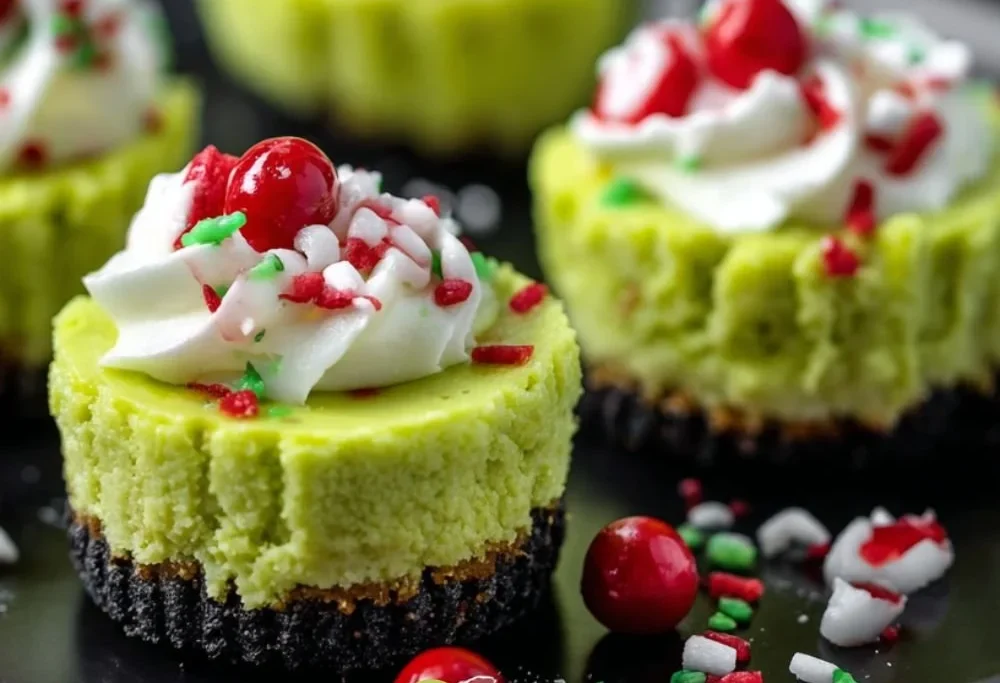
There are recipes that arrive as if carried on the wind from childhood kitchens, and then there are ones that appear like a mischievous holiday sprite — bright, small, and impossible not to smile at. Grinch Mini Cheesecakes belong unmistakably to that second category. They look like a confectionary wink: velvet-green, gently domed, and made to sit like tiny ornaments on a festive platter. As a traveler and a writer who keeps a passport full of crumbs, I have watched desserts such as these migrate from kitchens into ritual, from recipes into stories. The Grinch Mini Cheesecake is less about culinary innovation and more about cultural choreography — a playful adaptation of the classic American cheesecake, reimagined through the lens of holiday iconography and the collective need for sweetness in cold months.
My own first encounter with a Grinch-coloured treat came not in a bustling New York bakery but at a small holiday market in Ljubljana. A vendor, who had emigrated from the Midwest, offered samples on a paper napkin — a small green cake whose tang of cream cheese cut clean through the sugar. In a moment between the smell of roasting chestnuts and the distant hum of folk singers, I understood why such a dessert travels. It carries with it stories: of family laughter, of modest ovens and miniature tins, of celebrations that insist on being bright in the short days. These little cheesecakes are both a culinary echo and an iconography of warmth.
The origin story & regional influence behind this dish
Cheesecake has a lineage that stretches back to ancient Greece, but its American iterations — dense, creamy, often baked on a crumb base — are the result of immigrant kitchens and regional reinvention. The Grinch Mini Cheesecake, by contrast, is an example of modern culinary storytelling. It borrows the comforting, familiar base of graham cracker crusts and the silky tang of cream cheese filling, then overlays a seasonal narrative: the green hue and playful name nod to Dr. Seuss’s Grinch, a character who has become part of North American Christmas lore.
This dessert is less a product of a discrete place and more of a cultural moment: the mid- to late-20th-century explosion of holiday commercialization when characters and themes migrated into party fare. But within that commercialization sit regional fingerprints. In the American South, where pecans and sorghum are king, miniature cheesecakes might be crowned with candied nuts; in the Midwest, they might arrive as potluck stars, cooled in large communal refrigerators after being baked in church basements. In coastal cities you find them garnished with citrus zest and local honey, while in places with storied baking traditions — think Vienna or Naples — the craftsmanship becomes the focus: immaculate crusts, a faint jiggle in the set, and a restrained sweetness.
The Grinch Mini Cheesecake, then, is a cultural hybrid. It borrows the mechanics of cheesecake from American domestic traditions and dresses them in a visual vocabulary drawn from popular culture. Through that synthesis, it becomes an artifact of modern holiday rituals: small, shareable, and photogenic.
How to make Grinch Mini Cheesecakes
The procedure for these tiny confections is straightforward, and that simplicity is part of their cultural appeal. They are the sort of dessert that invites participation: children can press crumbs into liners, grandparents can smooth the batter, and friends can debate how much green is too much. The making is not an act of high culinary theater but of communal ease — an accessible ritual that creates memory simply by virtue of being shared.
Ingredients :
8 oz cream cheese, softened, 1/2 cup sugar, 1 teaspoon vanilla extract, 1 cup whipped cream, Green food coloring, Graham cracker crumbs (for crust), Mini muffin liners
Directions :
- Preheat the oven to 350°F (175°C) and line a mini muffin tin with liners., 2. In a mixing bowl, beat the cream cheese, sugar, and vanilla extract until smooth., 3. Add whipped cream and a few drops of green food coloring, mixing until you achieve the desired shade of green., 4. In each mini muffin liner, add a spoonful of graham cracker crumbs to form a base., 5. Fill the liners with the cheesecake mixture and smooth the tops., 6. Bake for about 15 minutes or until the cheesecakes are set., 7. Allow to cool, then refrigerate for at least 2 hours before serving., 8. Optional: Top with whipped cream and festive decorations for added flair.
Ingredients through a cultural & historical lens
Look closely at the ingredient list and you see a story of modern convenience and global trade. Cream cheese, which defines the texture and tang of these cheesecakes, is itself a product of refrigerated modernity and industrial dairy processes. Sugar, once a luxury commodity tied to colonial histories, now anchors countless holiday desserts worldwide. Vanilla, the aromatic whisper of the list, threads through colonial history, cross-cultural cultivation, and global commerce.
Graham cracker crumbs betray a very American lineage: the graham cracker is named after a 19th-century American clergyman and health reformer, Sylvester Graham, and its use as a crust became a staple of domestic American baking in the 20th century. Mini muffin liners, whipped cream, and food coloring are artifacts of a century in which baking became as much about presentation and convenience as about sustenance — the disposable paper cuplets are a result of mass-produced party culture.
Yet these pragmatic ingredients acquire tenderness when placed in ritual. The graham crumb, once pressed into miniature wells, becomes the anchor of a child’s proud offering. The green dye, used sparingly, transforms the familiar into the fanciful. In this way, the recipe becomes a map of modern life: ingredients sourced from disparate places, combined in a small kitchen, and turned into something that signifies celebration.
Cooking the dish: sensory notes & traditional techniques
A Grinch Mini Cheesecake is an exercise in contrasts. The first imprint is visual: a glossy, serenely green dome set against a russet crumb. Lift it to your nose and you will find a duet of scents: the warm, biscuity hum of graham crumbs and the clean, sweet-tart perfume of cream cheese and vanilla. Texturally, the bite is at once soft and structured — the crust should yield with a muted crumble while the filling gives as a spoon slides through, leaving a satiny trail.
Traditional techniques are modest here, but they matter. Softening the cream cheese to room temperature, rather than rushing with heat, preserves its creaminess and avoids graininess — a lesson in patience that households have passed down for decades. Gently folding whipped cream into the beaten cheese is a method borrowed from classical patisserie: aeration gives lift without heaviness. Baking until “set” — not dry, not wobbly — is learned by the eye and the feel of generations who judge doneness by the gentle tremor of a cheesecake’s center.
These small techniques, practical and tactile, are as much a part of the dessert’s tradition as its holiday color. They are the moments when a recipe shifts from instruction into lineage: how Aunt Rosa learned to fold, how a neighbor taught you the right pressure to press crumbs into the tin. That is the heart of culinary tradition.
How different regions prepare their version
If you follow the Grinch Mini Cheesecake across borders and coastlines, you begin to see how local tastes press their character onto this portable dessert. In Latin American kitchens, a splash of lime zest or a crown of dulce de leche might transform its profile. In parts of Europe where mascarpone is more familiar than cream cheese, the texture becomes silkier and the sweetness more restrained. In Japan, where presentation and minimalism are prized, you might find tiny cheesecakes topped with a single candied yuzu peel and arranged with geometric precision.
In the Philippines, where pandan is beloved, the green hue might come from pandan extract instead of artificial coloring, adding a fragrant, grassy note. In Scandinavian countries the green might be less literal and more tinted by pistachios or matcha, offering botanical complexity. Each iteration holds true to the central idea — small, creamy cakes that can be shared — but the local palate steers garnish, color, and nuance.
These variations show how food travels not by erasing local culture but by being remade within it. The Grinch Mini Cheesecake is a culinary passenger that adapts, taking on the flavors and aesthetics of the places that host it.
Traditional ways this dish is shared or served
In many American households, mini cheesecakes make their most frequent appearance at holiday gatherings, potlucks, and school parties. Their size is civic: perfectly portioned to pass between conversations, to sit on a saucer beside a cup of coffee, to be offered as a token of hospitality. They are frequently strewn on dessert tables among cookies, tarts, and fruitcake, their green a visual anchor for seasonal color schemes.
Tradition also governs the manner of their service. A cluster of these on a tiered stand invites communal sampling; a single one, boxed and wrapped with a ribbon, becomes a portable gift. There is ritual in the garnish: a dollop of whipped cream crowned with a red candy — the contrasting red-green a playful nod to the Grinch narrative of transformation. In community events such as school bake sales, they are sold by the dozen, each a small unit of cheer purchased to sustain fundraisers and friendships.
In many cultures, small sweets like these function as currency of care. Bringing a tray to a neighbor signifies inclusion; passing one across a table is an act of shared joy. In that sense, their role is as important as their taste.
Storing the dish without losing its cultural essence
Storing these mini cheesecakes is a practical lesson in preserving both texture and sentiment. Refrigeration is essential — the dairy base demands cool care — and a tightly sealed container keeps humidity at bay and prevents flavor transfer. Yet beyond the technical, storage holds memory: placing them on the middle shelf of a family fridge amidst jars of pickles and leftovers is a small ritual that situates the dessert within daily life rather than as an isolated spectacle.
For gifting, packaging matters: in my travels I’ve seen them nestled in tins, paper-lined boxes, and even in repurposed wooden crates. Each style tells you something about the giver — thrift, elegance, a love of the rustic. The way they are stored and presented communicates cultural values as much as the recipe does.
Cultural questions people often ask
People often ask whether the green color is necessary. The answer, culturally speaking, is both yes and no: the green is the visual joke, the nod to a modern myth; yet the essence of the dessert — its cream-cheese soul and buttery crumb — remains unchanged without it. Another frequent question concerns indulgence: how sweet is too sweet? That, too, is a matter of local palate. Some cultures prefer a subdued sugar profile, balancing tang and sweetness; others coat their holidays in confectionery abandon. Finally, people wonder whether such a playful dessert can be considered “traditional.” Traditions, I believe, are living things. A dessert becomes traditional when communities adopt it, adapt it, and pass it on.
A closing note on food, memory & travel
Food is the most portable element of any culture. A tiny green cheesecake tucked into a paper liner can travel farther than most photographs; it carries with it the warmth of ovens, the cadence of family kitchens, the textures of local ingredients, and the playful stories of modern icons. As someone who has followed food across borders, I have seen how a simple recipe can stitch together afternoons in a Slovenian market, a church basement in Ohio, and a minimalist café in Tokyo. Each time I bite into a mini cheesecake — Grinch-green or otherwise — I taste the intersection of place and people, the way a recipe absorbs the fingerprints of those who make it.
In the end, making and sharing these little cakes is an act of cultural translation. Someone chooses a color, countless hands press crumbs, and a community tastes memory. That process is what transforms an ingredient list into a litany of belonging.
Conclusion
If you want to follow the recipe as a practical guide and see a visual step-by-step, you can find a trusted source at Grinch Mini Cheesecakes | Baking You Happier.
Grinch Mini Cheesecakes
Ingredients
Method
- Preheat the oven to 350°F (175°C) and line a mini muffin tin with liners.
- In a mixing bowl, beat the cream cheese, sugar, and vanilla extract until smooth.
- Add whipped cream and a few drops of green food coloring, mixing until you achieve the desired shade of green.
- In each mini muffin liner, add a spoonful of graham cracker crumbs to form a base.
- Fill the liners with the cheesecake mixture and smooth the tops.
- Bake for about 15 minutes or until the cheesecakes are set.
- Allow to cool, then refrigerate for at least 2 hours before serving.
- Optional: Top with whipped cream and festive decorations for added flair.