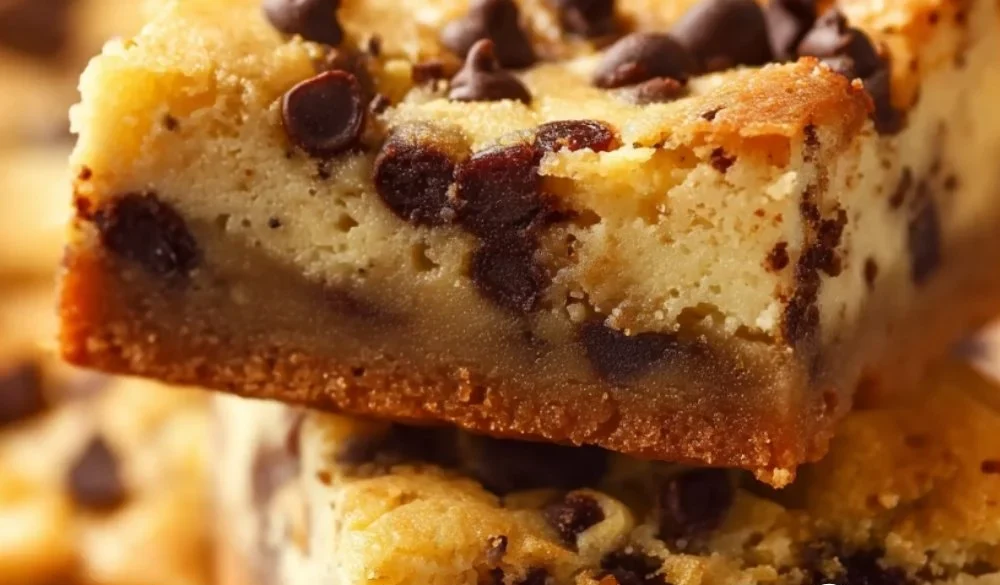
Chocolate Chip Cookie Cheesecake Bars
Introduction
This Chocolate Chip Cookie Cheesecake Bars recipe is a study in contrast: a buttery cookie matrix that frames a lightly sweetened, tangy cream cheese layer. The construction is straightforward, yet achieving optimal texture requires attention to fat temperature, mixing technique, and bake timing. The dough’s composition—high butter content with both granulated and brown sugar—creates a pliant, flavorful crust that browns to a rich, nutty hue while the cream cheese layer remains smooth and set without cracking. For bakers evaluating related bar techniques and proportion scaling, consider a comparison with a simpler prepared-base recipe such as cake mix cookie bars, which highlights how base density and moisture management alter final mouthfeel.
The culinary logic behind this dish
The interplay between cookie dough and cream cheese is an exercise in balancing structure and moisture. The cookie dough functions as both a structural shell and a flavor vehicle: butter and sugars contribute tenderness, chew, and caramelized aromatics; flour and baking soda supply the necessary framework and controlled lift. The cream cheese filling supplies acidity and a silky texture that contrasts with the cookie’s crumb. Because cream cheese contains both water and fat, the barrier layers are critical—pressing half the dough as an even base prevents seepage, while crumbled topping provides visual texture and prevents a soggy surface by allowing trapped steam to escape during the bake. Comparing layered development to nut-forward or flavor-contrasting bars such as the pistachio cookie bars clarifies how ingredient function dictates assembly order and bake profile.
How to make Chocolate Chip Cookie Cheesecake Bars
Ingredients :
1 cup unsalted butter, softened, 1 cup brown sugar, packed, 1/2 cup granulated sugar, 2 large eggs, 2 teaspoons vanilla extract, 3 cups all-purpose flour, 1 teaspoon baking soda, 1/2 teaspoon salt, 1 cup chocolate chips, 8 oz cream cheese, softened, 1/2 cup powdered sugar
Directions :
- Preheat the oven to 350°F (175°C) and grease a 9×13-inch baking pan., 2. In a large bowl, cream together the butter, brown sugar, and granulated sugar until smooth., 3. Beat in the eggs one at a time, then stir in the vanilla., 4. In another bowl, combine the flour, baking soda, and salt. Gradually blend the dry ingredients into the creamed mixture., 5. Stir in the chocolate chips., 6. Press half of the cookie dough into the bottom of the prepared baking pan., 7. In a separate bowl, beat the softened cream cheese and powdered sugar until smooth. Spread the cream cheese mixture over the cookie layer in the pan., 8. Crumble the remaining cookie dough over the cream cheese layer., 9. Bake for 30-35 minutes, or until the edges are golden brown., 10. Allow to cool completely before cutting into bars.
Follow the directions precisely to preserve the intended textural contrast: do not overmix once flour is added, and ensure the cream cheese is at room temperature before beating.
Ingredient analysis through a chef’s lens
Butter: The recipe calls for softened unsalted butter, which serves as both lubricant and flavor carrier. Proper softening (cool but yielding) enables efficient creaming with sugars, creating micro-air pockets that yield tender crumb and controlled rise.
Sugars: The combination of brown and granulated sugar is deliberate. Brown sugar contributes moisture and molasses notes, deepening the caramelization during bake and keeping the base slightly moist. Granulated sugar promotes spread and crisping at the edges. The resulting Maillard and caramelization reactions build aroma and color.
Eggs and vanilla: Eggs provide emulsion and structure. Beating them in one at a time ensures stable incorporation and promotes a silky matrix. Vanilla is the aromatic bridge, rounding the sharpness of cream cheese and enhancing chocolate perception.
Flour, baking soda, salt: All-purpose flour at three cups provides the necessary bulk; baking soda gives a controlled lift and promotes browning through alkalinity; salt balances and amplifies sweetness, suppressing flatness.
Chocolate chips: Added last to prevent chocolate bloom from overworking and to ensure distribution without altering dough elasticity.
Cream cheese and powdered sugar: Cream cheese is the defining layer—its fat and moisture content create a velvety interior. Powdered sugar integrates smoothly, avoiding graininess and providing the precise sweetness to balance the cookie’s caramel notes.
Kitchen workflow & technique breakdown
Set up a mise en place before starting: measure and arrange butter, sugars, eggs, vanilla, dry ingredients, and chips. Softening cream cheese concurrently while bringing butter to the right softness accelerates workflow. Use a stand mixer fitted with a paddle for consistent creaming; it provides controlled aeration compared with a hand mixer. When creaming butter and sugars, aim for a glossy, pale texture—this indicates sugar has been properly integrated and air has been incorporated. After adding eggs, scrape the bowl to ensure even emulsification.
When combining dry and wet components, use low speed or fold by hand until just combined; overworking develops gluten and stiffens the dough. Pressing the base into the pan requires an even thickness—use a bench scraper or the back of a measuring cup to compress the dough uniformly to avoid thin spots that will brown too quickly. The remaining dough should be crumbled rather than spread; this modular placement allows steam to vent and limits direct contact between the wet filling and the air, preventing sogginess. For reference on pressing and crumble technique applicable across bar recipes, consult a similar approach in sugar cookie bars.
Texture control, heat management & timing
Temperature is the principal variable controlling crumb and filling set. The oven at 350°F provides a balance between adequate browning and sufficient internal baking without overcooking the cream cheese. Edge browning—a golden-brown perimeter—signals caramelization of sugars and that the cookie matrix has set. Bake 30–35 minutes, but begin visual and tactile checks around 28 minutes: the center should appear set but slightly soft; it will continue to firm as residual heat dissipates.
Cooling is essential. Allowing the pan to cool completely ensures the cream cheese layer stabilizes; cutting while warm will yield tearing and a loose texture. If time allows, refrigerate the fully cooled pan for an hour to sharpen slice lines and make cleaner bars. Heat management also extends to ingredient temperatures: cream cheese at true room temperature integrates smoothly; cold cream cheese will increase mixing time and can result in lumps.
Professional variations
Without altering ingredient quantities or steps, adjust technique to produce distinct experiences:
- For a more browned, crisp base, rotate the pan midway through baking to mitigate hot spots and encourage uniform caramelization.
- To emphasize the cream cheese layer’s tang, substitute part of the powdered sugar with an equal weight of lemon zest (grated) in the mixing step—note: this is a technique suggestion; do not alter the recipe as provided.
- To enhance chocolate distribution, briefly toss chips in a tablespoon of flour before folding in; this prevents sinking and yields evenly dispersed morsels.
- For a glossy, slightly aerated filling, whip the cream cheese until smooth but avoid incorporating excess air, which can create fissures during baking.
These variations rely on execution rather than ingredient substitution; the original formulation already balances moisture and structure.
Finishing touches & plating philosophy
Presentation should reflect textural contrast. After full cooling and optional refrigeration, trim the edges for a neat rectangle, then cut into bars using a hot, dry chef’s knife wiped between cuts to achieve clean edges and avoid dragging crumbs across the cut surface. For plating, align bars on a neutral plate to emphasize color contrasts—the deep golden-brown cookie against the pale cream cheese. Garnish sparingly: a light dusting of powdered sugar or a few strategically placed chocolate chips highlights components without obscuring the bar’s architecture. Serve at room temperature to allow the filling’s silkiness to register fully on the palate.
Maintaining quality after cooking
Storage impacts texture. Refrigeration preserves the cream cheese layer and prevents bacterial growth; however, cold temperatures can firm the butter matrix, muting the cookie’s chew. Store in an airtight container in the refrigerator for up to five days; allow bars to return to near-room temperature before serving to recover textural nuances. For longer storage, freeze individual portions flash-wrapped in plastic and foil; thaw in the refrigerator, then rest at room temperature for 30–45 minutes before serving. Avoid stacking warm bars to reduce condensation that would soften the cookie layer.
Questions from home cooks (chef answers)
Q: How do I prevent the cream cheese layer from becoming runny?
A: Ensure the cream cheese is well-beaten but not over-whipped; full incorporation with powdered sugar creates a stable emulsion. Baking to the point where the edges are set but the center is slightly soft prevents overcooking, which can cause separation.
Q: Why is half the dough used for the base and half crumbled on top?
A: A compressed base creates an even structural platform that supports the filling, while crumbled dough on top offers variable exposure to heat, allowing for localized browning and steam release. This combination preserves a textural contrast that a single uniform layer cannot.
Q: My edges browned fast but the center was underbaked—what went wrong?
A: This indicates uneven heat or a pan that conducts heat too aggressively. Use a light-colored, heavy-duty pan to moderate browning or tent foil loosely over the pan halfway through baking to protect the edges while the center finishes.
Q: Can I prepare this ahead?
A: Yes. Assemble and bake as directed, then refrigerate. Chilling overnight often enhances sliceability and flavor melding.
Final chef notes
Precision in the fundamentals—ingredient temperature, controlled mixing, and timing—determines success with layered bars. The methodical assembly of a structured cookie base, a stabilized cream cheese filling, and a ventilated crumble topping produces consistent texture and flavor. Maintain discipline during mixing and browning checks; err toward slightly underbaked centers that finish during cooling rather than overbaked, dry interiors. For technique cross-references on timing strategies for quick bake items, review methods used in similar recipes such as chewy maple cinnamon cookies.
Conclusion
For further reading and alternative tested versions of this recipe, consult the practical home-cook adaptation on Mom On Timeout’s Chocolate Chip Cookie Cheesecake Bars, a variation with step-by-step photos available on Handle the Heat’s Chocolate Chip Cookie Cheesecake Bars, and an additional perspective at Kroll’s Korner Chocolate Chip Cookie Cheesecake Bars.