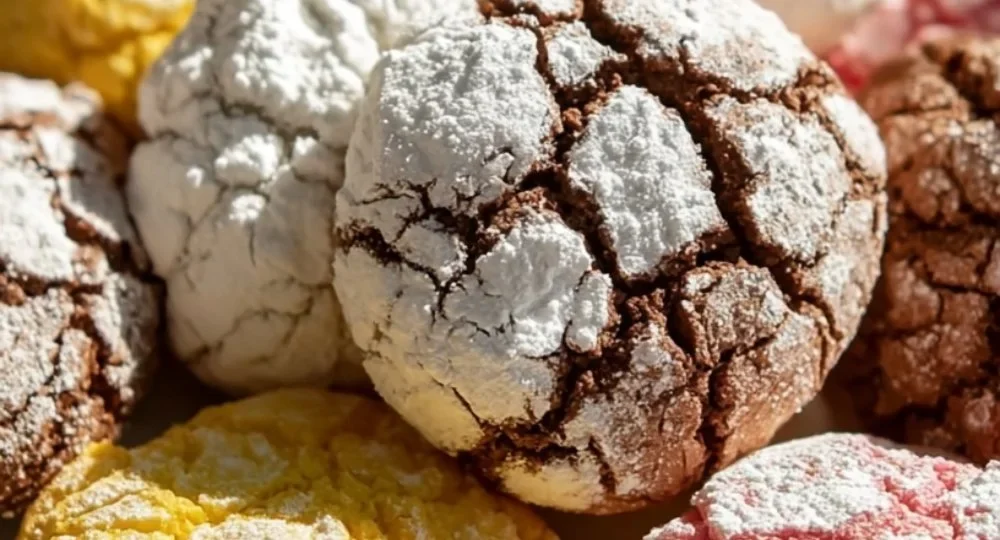
3-Ingredient Cool Whip Crinkle Cookies (Fluffy, Easy Holiday Cookie Hack)
Introduction
As a concise and efficient formula for producing tender, crinkled cookies, the 3-Ingredient Cool Whip Crinkle Cookies are an instructive exercise in ingredient substitution and texture manipulation. The recipe’s economy—one boxed cake mix, thawed whipped topping, and an egg—creates a dough that relies on manufactured emulsifiers, starches, and aeration rather than extended creaming or complex lamination. For an immediate reference on handling tender cookie doughs and preserving chew while encouraging surface cracking, consult the construction principles demonstrated in this chewy maple-cinnamon cookie method which shares workflow efficiencies transferable to these cookies.
This introduction establishes the technical expectations for the process: control moisture, limit gluten development, manage surface tension, and use thermal ramping to generate the signature crinkles.
The culinary logic behind this dish
At first glance the formula defies a classical pastry ratio: there is no butter creaming, no separate liquid phase beyond the egg, and the primary dry component is a pre-formulated cake mix. Cake mixes contain flour treated with leavening agents, sugar, emulsifiers, and stabilizers; these ingredients supply structure, sweetness, and controlled gas production. Cool Whip, or any whipped topping, contributes trapped air, stabilizers (for texture retention), and additional sugar/fat matrices depending on the formulation. The egg provides protein for coagulation and binding.
The culinary logic is to exploit these manufactured components to achieve a cookie that is both tender and aerated. Rapid oven expansion of trapped air in the whipped topping and leavening in the cake mix puffs the cookie; simultaneously, the gluten-forming capacity is limited by the lack of water and by the short mixing time, resulting in a delicate crumb rather than a chewy, brawny one. Controlled refrigeration of the dough firms it enough to produce uniform expanse rather than uncontrolled spread. Understanding that interplay—leavening kinetics, fat dispersion, and starch gelatinization—allows the baker to predict texture outcomes and make small, informed adjustments in timing and heat management.
How to make 3-Ingredient Cool Whip Crinkle Cookies (Fluffy, Easy Holiday Cookie Hack)
This section explains the how with an emphasis on why each step matters. The exact ingredient set and directions follow in their native form thereafter; read them, then refer back to this procedural rationale.
Begin by preheating to a stable 350°F (175°C). The oven temperature here is deliberate: it is high enough to set edges and allow the interior to expand and coagulate within a 12–15 minute window, but not so high as to brown rapidly and mask the crinkle pattern. Combining the cake mix, Cool Whip, and egg requires only a spatula because mechanical overworking would develop unwanted gluten and collapse the aerated network provided by the whipped topping. Refrigeration is a practical step to firm the dough and reduce spread; the chilled dough retains surface tension so that as interior gases expand, the exterior fractures into the characteristic cracks. Rolling in powdered sugar is both decorative and functional: the sugar layer dries slightly in the oven, enhancing visible crack contrast and adding a thin textural skin.
Ingredients :
1 box Cake Mix (any flavor – white, vanilla, red velvet, or chocolate), 1 (8 oz) container Whipped Topping (Cool Whip), thawed, 1 large Egg, Powdered Sugar (optional, for rolling)
Directions :
Preheat your oven to 350°F (175°C). Line a large baking sheet with parchment paper or a silicone baking mat., In a large bowl, combine the cake mix, thawed Cool Whip, and egg. Stir with a spatula until a thick, sticky dough forms. No mixer needed!, Refrigerate the dough for 30–60 minutes. This helps firm it up for easier handling and rolling., Scoop 1-inch portions (about 1 tablespoon) and roll each ball generously in powdered sugar. Place on the prepared baking sheet, spaced 2 inches apart., Bake for 12–15 minutes, until edges are set and tops are puffed with visible cracks. Cool on a wire rack before serving.
Ingredient analysis through a chef’s lens
Analyzing each component clarifies expected behavior during mixing and baking. The cake mix’s flour is often pre-treated (bleached or unbleached depending on brand) and combined with a measured amount of baking powder/soda. Those leaveners determine gas volume during thermal expansion. The sugar present in the mix and any additional sugar in the whipped topping influences Maillard and caramelization thresholds, but because the formulation lacks free butter, browning is modest—this preserves color while emphasizing interior tenderness.
The whipped topping provides an emulsion of water, hydrogenated or partially hydrogenated vegetable oils, stabilizers, and air. The trapped air expands in the oven to create volume; stabilizers ensure the structure persists long enough to set. Because whipped topping is more aqueous than butter, the dough’s hydration is different from traditional cookie doughs—yet there is just enough liquid to allow starch gelatinization and protein coagulation without excess spread. The egg contributes moisture, protein, and emulsification; it bridges fat and aqueous phases and provides structural setting through coagulation.
Powdered sugar is optional but recommended for visual contrast and a delicate sugar crust. It also absorbs surface moisture, aiding in the rapid formation of a thin dry skin that will fracture into crinkles as the cookie expands.
Kitchen workflow & technique breakdown
Consistent results arise from a disciplined workflow. Start with mise en place: thaw Cool Whip in the refrigerator until fully soft but still cold—this ensures the air isn’t lost prematurely. Preheat the oven early so the deck temperature is stable when the first tray goes in. Prepare parchment or silicone liners to avoid adhesion and to facilitate rapid post-bake cooling.
Mixing should be done gently and just until homogeneous. Overmixing will remove the trapped air in the whipped topping and develop gluten in the cake mix—both deleterious. Scrape the bowl sides to incorporate dry pockets without extended folding. Chill the dough for the prescribed 30–60 minutes; this time window is crucial: too little chilling yields excessive spread and smudged crinkles; too long and the dough will become stiff, inhibiting expansion and reducing crack formation.
Portioning at 1-inch balls (about one tablespoon) yields uniform bake rates. Use a scoop to ensure consistency, then roll quickly in powdered sugar. Arrange spacing at 2 inches to allow lateral expansion without collision. Bake in the center rack to balance top and bottom heat; rotate trays midway if your oven has inconsistent heat.
For advanced workflow integration into a busy kitchen, the dough can be held chilled on sheet pans and baked in batches with cooled pans replaced by preheated ones for thermal consistency.
Texture control, heat management & timing
The final cookie’s texture is governed by the balance of heat input and internal moisture. At 350°F, the exterior sets quickly while the center remains slightly tender—this is the desired texture: a delicate crumb with a puffy, slightly cakey interior. Baking 12–15 minutes allows sufficient time for starch gelatinization and egg coagulation without over-drying.
If you prefer a softer center, err toward the lower end of the time range and pull cookies once the edges are set but the center still looks slightly glossy. For a slightly firmer, more uniformly set cookie, extend to the upper limit. Heat management includes preheating thoroughly, avoiding opening the oven door during the first 8–10 minutes (the initial oven rise phase), and using a calibrated thermometer for accuracy.
The powdered sugar surface affects the timing: it insulates the top marginally and encourages a thin crust that fractures. Watch for puffing and the development of visible cracks rather than color change—these are the visual cues to doneness in this formula.
Professional variations
Though the base recipe prohibits ingredient substitution for this exercise, there are technique-based variations suitable for professional contexts. Flavor modulation can come from the choice of cake mix—chocolate produces a denser color and a perception of greater richness, while vanilla and white mixes highlight subtler inclusions (zest, extracts). For a seasonal pivot, chill the dough longer and roll in flavored powdered sugar or finely chopped toasted nuts after partial cooling to add texture contrast.
Another professional tactic is to portion the dough, chill on trays, then freeze solid and store. Frozen balls can be rolled in powdered sugar and baked from frozen with an additional 1–2 minutes in the oven; thermal mass and delayed expansion create a slightly different crack pattern and can be useful for staging in production kitchens.
For kitchens focused on throughput, baking multiple trays concurrently requires uniform tray preheating and rotating positions to mitigate hot spots.
Finishing touches & plating philosophy
Finishing is minimalist: a sift of powdered sugar or a controlled dusting to emphasize the crack network and provide a touch of sweetness per bite. For plated presentation, group in odd numbers (three or five) on a neutral plate or a slate tile to showcase the texture. Use a small offset spatula to transfer cookies gently; their tender structure benefits from minimal handling. If serving as part of a composed dessert, pair with a complementary textural element—such as a crisp tuile or a chilled ganache—to balance the cookie’s tender interior.
When displaying for retail or holiday presentation, consider stacking in clear, food-safe containers with a sheet of parchment between layers to avoid surface abrasion.
Maintaining quality after cooking
Retention of texture post-bake depends on storage conditions. Because the cookies are tender and contain stabilized water from the whipped topping, they are susceptible to humidity-driven softening. Store in an airtight container at room temperature with a small desiccant packet or a piece of dry bread to maintain a balance of moisture if you prefer crispness at the edges. For longer storage, freeze fully cooled cookies in single layers on a tray, then transfer to a sealed container; thaw at room temperature when needed.
Re-crisping can be achieved with a brief return to a 300°F oven for 3–4 minutes; this drives off superficial moisture and refreshes the surface skin without drying the interior unduly. Conversely, microwaving will soften them rapidly and is not recommended for texture maintenance.
For planning in a professional setting, scale timing and chilling proportionally, and use the following quick reference on production: portion → chill 30–60 minutes → bake → cool 10 minutes on sheet → transfer to wire rack. For additional staging strategies and compact recipe assembly techniques, review our guidance on quick recipe scaling strategies.
Questions from home cooks (chef answers)
Q: Why does the recipe call for chilling the dough for 30–60 minutes?
A: Chilling firms the dough, reducing spread and allowing surface tension to form. The chilled surface resists immediate flow, so as interior gases expand the surface will fracture, creating the crinkle pattern. It also consolidates the fat and stabilizers in the whipped topping, improving handling.
Q: My cookies didn’t crack—what went wrong?
A: Common causes are overmixing (which collapses aeration), insufficient chilling (which allows excessive spread), or baking at too low a temperature (which lets the cookie expand slowly without surface fracture). Ensure gentle mixing, a chilled dough, and a reliably hot oven.
Q: How do I prevent a raw center?
A: Maintain ball size, space cookies appropriately, and bake to the recommended 12–15 minutes. If centers are persistently underdone, increase bake time by one-minute increments, or reduce ball size slightly to ensure even heat penetration.
Q: Can I make the dough ahead of time?
A: Yes. Chilled dough can be held for 24–48 hours tightly wrapped; for longer storage, freeze balls individually then bake from frozen with a slight extension in time.
For broader ideas on efficient weeknight preparations and time-saving cooking principles, examine methods from our collection of efficient kitchen workflows used in easy dinner recipes, which translate readily to sweet-baking production.
Final chef notes
This recipe exemplifies modern convenience baking: it leverages industrial ingredient functionality to produce a reliable, tender cookie with minimal technique. The critical controls are gentle handling, temperature discipline (both for chilling the dough and the oven), and consistent portioning. The result, when executed with attention to those variables, is a cookie with a refined crumb and a visually arresting crinkle top that belies the simplicity of its components.
Conclusion
For additional perspectives on this style of cookie and similar three-ingredient approaches, see the original method as presented by 3 Ingredient Cool Whip Cookies – The Soccer Mom Blog and a variation focusing on cake mix integration at Cool Whip Cookies with Cake Mix | Tastes of Lizzy T.
3-Ingredient Cool Whip Crinkle Cookies
Ingredients
Method
- Preheat your oven to 350°F (175°C). Line a large baking sheet with parchment paper or a silicone baking mat.
- In a large bowl, combine the cake mix, thawed Cool Whip, and egg. Stir with a spatula until a thick, sticky dough forms. No mixer needed!
- Refrigerate the dough for 30–60 minutes to help firm it up for easier handling and rolling.
- Scoop 1-inch portions (about 1 tablespoon) and roll each ball generously in powdered sugar. Place on the prepared baking sheet, spaced 2 inches apart.
- Bake for 12–15 minutes, until edges are set and tops are puffed with visible cracks.
- Cool on a wire rack before serving.