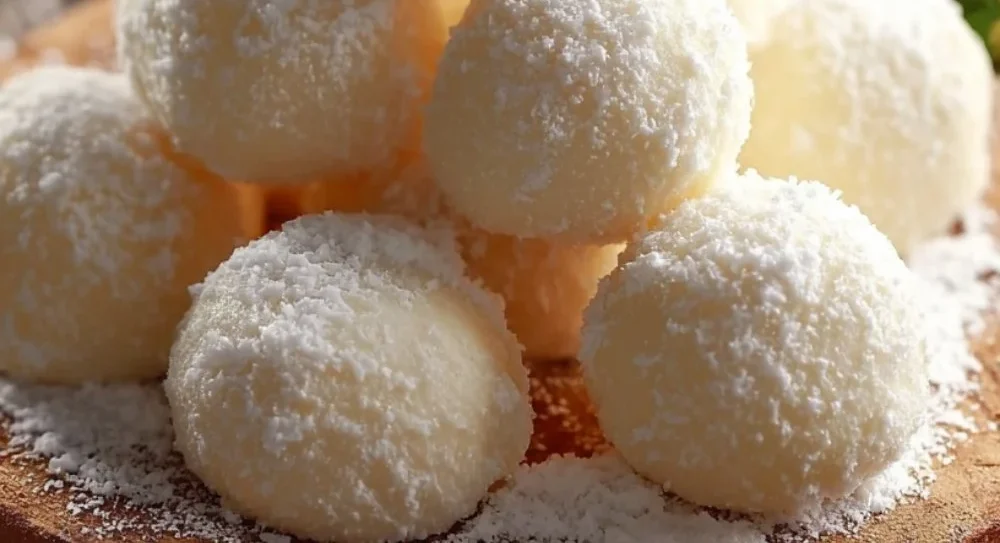
Sweetened Condensed Milk Snowballs
Introduction
There are moments in travel when a small, familiar sweetness can feel like a compass. I remember stepping off a train in a city that smelled of diesel and orange blossom, and a woman at a corner stall pressed a tiny snowball into my palm as if it were a secret. It was cool to the touch, slightly yielding, and the coconut whispered against my teeth like a wave. That taste—rich, milky, and delicate—opened a map of memory that led me back to kitchens in three continents. These Sweetened Condensed Milk Snowballs are not merely little cookies; they are handheld stories, compact as postcards, that speak of migration, thrift, celebration, and the small economies of sweetness that cross borders.
As a writer who traces the intersections of place and palate, I find that such recipes travel in the pockets of people—mothers teaching daughters on afternoons thick with laughter, aunts packing tins for weddings, bakers improvising with the pantry’s modest offerings. The snowballs are shaped by the simplicity of their ingredients and the warmth of the tables that produce them. They are a kind of culinary Esperanto, speaking to anyone who has ever wanted to wrap comfort into a bite.
The origin story & regional influence behind this dish
The history of sweetened condensed milk itself reads like a chronicle of adaptation. Invented in the 19th century as a way to preserve milk for long voyages and frontier settlements, condensed milk became a pantry staple in places where fresh milk was intermittent. It traveled on ships and trains, hitchhiking into regional cuisines and domestic rituals. The “snowball” motif—compact, round, and coated or filled with texture—appears in many cultures, but when combined with condensed milk and coconut it takes on a particular diaspora.
In Latin America, versions of condensed-milk confections can be traced to influences from European dulce de leche traditions and indigenous techniques for preserving dairy and sugar. In the Caribbean, coconut is a native rhythm, and its marriage with condensed milk feels inevitable—an island duet. In parts of Europe, especially Eastern Europe and the Mediterranean, adaptations of milk-based sweets absorbed local dried fruits, nuts, or dessicated coconut as colonial trade made exotic ingredients more available. In the United States and Australia, condensed milk became shorthand for economical indulgence: a can of shelf-stable richness that turns scarcity into celebration.
The snowball cookie, then, is a palimpsest: each family writing its version on the same basic script. It is both humbler cousin and joyful rival to more elaborate pastries. Its regional influence is less about culinary hierarchy and more about uses—festive trays at weddings, modest plates for afternoon tea, or the boxed gift passed between neighbors during holidays. Its universality lies in its accessibility: everyone recognizes the grammar of flour, butter, sugar, and that silky condensed milk, and everyone makes it speak with their own accent.
How to make Sweetened Condensed Milk Snowballs
Ingredients :
2 cups all-purpose flour, 1 cup sweetened condensed milk, 1 cup unsweetened shredded coconut, 1/2 cup powdered sugar, 1/2 cup butter, softened, 1 teaspoon vanilla extract, 1/4 teaspoon salt
Directions :
- Preheat your oven to 350°F (175°C)., 2. In a large bowl, cream together the softened butter and powdered sugar until light and fluffy., 3. Stir in the sweetened condensed milk and vanilla extract., 4. Gradually mix in the flour and salt., 5. Fold in the shredded coconut until well combined., 6. Roll the mixture into small balls and place them on a baking sheet lined with parchment paper., 7. Bake for 10-12 minutes or until lightly golden., 8. Allow to cool slightly before serving. Enjoy your Sweetened Condensed Milk Snowballs!
If you follow this sequence at a modest kitchen table, watching afternoon sun tilt across the counter, you are participating in a ritual more than a recipe. The act of pressing these little balls together—pinching, rolling, setting them in tidy rows on a sheet—feels like a domestic choreography handed down across plates and languages.
Ingredients through a cultural & historical lens
Each ingredient in the snowball speaks of trade routes, economies, and domestic choices. All-purpose flour is the neutral stage on which migration plays out: wheat was traded and cultivated, became a global staple, and found its way into both festival cakes and everyday biscuits. Butter and powdered sugar, symbols of dairy and refined sweetening, reflect a household’s ability to indulge—small luxuries that mark special occasions.
Sweetened condensed milk is the star in this story. It is a product of industrial ingenuity and necessity—preserved milk that liberated households from the constraints of fresh dairy. It is also a comfort loaded with nostalgia; a can evokes childhood kitchens where mothers measured warmth with teaspoons of condensed milk stirred into coffee and porridge. In many parts of the world, the introduction of condensed milk altered dessert-making overnight, allowing creamy textures to appear even in poor seasons.
Shredded coconut brings an aroma of faraway coastlines. Coconut’s presence in the recipe is a reminder of colonial commodity flows: palms yielding fruit that became oil, milk, and a dried panoply used in both savory and sweet preparations. In islands and tropical regions, coconut also carries spiritual and social significance—used in ceremonies, wrapped in leaves for offerings, or simply a lunchtime companion.
Vanilla extract and a pinch of salt are the whisperers: vanilla elevates and rounds, a botanical thread connecting the snowballs to tropical orchids and far-off plantations; the salt, though modest, is the counterpoint that makes the sweetness sing.
Cooking the dish: sensory notes & traditional techniques
Making snowballs is primarily a sensory language. The creaming of butter and powdered sugar produces an airy texture and a pale, glossy sheen that promises tenderness. When the condensed milk arrives, it brings a syrupy perfume—molasses-like, sweet, and milk-slick—that softens the mixture into a pliable dough. Flour hushes this richness, smoothing the mixture into a compact, cool mass you can roll between palms. Coconut adds a dry, fragrant resistance; its ridged texture becomes the toothsome surprise within the soft middle.
In traditional kitchens, these actions are rarely rushed. Elders will tell you that the dough is “ready when it feels right”—a tactile judgment that resists precise timing. Rolling is often communal: children gather, pressing dough into spheres, some too big, some too small, each irregularity a memory in itself. Baking is brief, a matter of golden edges rather than deep color, leaving the centers tender. The aroma as they come out of the oven is an immediate invocation: browned butter and sugar, with coconut’s sweet hay notes and condensed milk’s creaminess.
Technique, therefore, is less about mechanical precision and more about intimacy with texture and aroma. The cultural technique is patience, the willingness to let a kitchen synch with hands and table, to let conversation and music mark the minutes in the oven.
How different regions prepare their version
Across regions, the snowball adapts. In the Caribbean, where coconut is abundant and life moves to the cadence of the sea, shredded coconut is often toasted gently before being folded in, lending smoky depth that contrasts the condensed milk’s sweetness. In some Latin American homes, a hint of citrus zest—lime or orange—will be grated into the dough, brightening the richness as if sunlight were stirred in.
In parts of Eastern Europe or the Levant where coconut is less traditional, variations may include finely chopped nuts or a dusting of powdered sugar to resemble fresh snow—a visual cue that migrates with the name ‘snowball.’ In Australia and parts of Southeast Asia, condensed milk often finds playful partners like desiccated coconut and condensed fruit slices; sometimes the balls are dipped in chocolate for a marriage of textures.
Street vendors in cities will sometimes press the snowball into a toasted coconut coating, creating a crisp outer shell around a soft heart. Home cooks, meanwhile, will vary the size to suit occasions—smaller for tea, larger for gift tins. These regional choices are not culinary one-ups but conversations between environment and memory: what grows nearby, what travelers bring back, what an economy allows.
Traditional ways this dish is shared or served
The snowball’s smallness makes it inherently shareable. In many cultures it is part of the “tray of little things” set out for guests—a practice of hospitality that values plentiful variety over singular extravagance. It is a cookie that travels well in tins, making it a favored contribution to holiday exchanges or a neighbor’s knock on the door. Bridal tables often feature such small sweets because they are unassuming yet indulgent; they invite conversation rather than interrupt it.
In village kitchens, snowballs may appear during harvest celebrations, as a simple offering of abundance. In urban apartments, they become tokens of comfort—packaged in waxed paper and passed between friends as a balm against the city’s distance. Their presence at religious festivals, family gatherings, and school bake sales speaks to their versatility. They are not strictly ceremonial, but their recurrence at life’s small ceremonies gives them a quiet ceremoniality: comfort for births, consolation at funerals, sweetness for rites of passage.
Storing the dish without losing its cultural essence
Preserving snowballs is an act of memory management. Tins with tight lids are traditional because they promise protection against humidity and the aromas of kitchens where they nest. Room temperature storage is usually sufficient—humidity being the real enemy, as it can soften the coconut’s pleasing texture. In tropical climates, brief refrigeration may be used, but many elders will warn against cold that dulls flavor.
Part of storing these cookies is also about ritual: the choosing of a tin, the labeling of gifts, the layering of parchment between rows. When passed between households, the manner of packing becomes part of the gift—the folded napkin, the tied string, the handwritten note. Even the act of reheating slightly on a low oven to return them to tenderness becomes a ceremony of revival, an invocation of fresh-baked warmth.
Cultural questions people often ask
People often wonder: Are these snowballs traditional to one country? The answer is no single place owns them. They are a mosaic, appearing in many kitchens shaped by local ingredients and histories. Another common question: Why condensed milk? Practically, it’s about preservation and richness; emotionally, it is about the flavor of memory. People also ask about variations for dietary needs. While substitutions can be made, each change alters the memory the cookie carries. For many, maintaining the original ingredients is part of honoring the recipe’s lineage.
Visitors to a new city often ask where to find authentic versions. The truth is that authenticity is personal—found in the hands that roll them and the stories that surround them. A tin from a grandmother in Buenos Aires can feel as authentic, perhaps more so, than a polished café version.
A closing note on food, memory & travel
Travel teaches you that food is never just sustenance. It is a map, a language, and a ledger of human movement. Sweetened Condensed Milk Snowballs, with their modest list of pantry items, are a testament to how resourcefulness becomes ritual. They remind us that simple things—milk reduced to a sweet, a handful of coconut, flour and butter—can hold generations of taste and tenderness.
When I eat one in a train station, at a family table, or in a market stall under a fan’s steady pulse, I taste the patience of hands and the economy of joy. They are humble in appearance but generous in memory. If you take this recipe into your own kitchen, let it be more than a set of instructions: let it be a chance to remember, to pass on, and to make new stories for others to taste.
Conclusion
For further inspiration and variations on this nostalgic treat, recipes and personal accounts can be found at Sweetened Condensed Milk Snowballs – Lord Byron’s Kitchen, at a home-baker’s take on texture and technique at Sweetened Condensed Milk Snowballs – That Oven Feelin, and a regional perspective with notes on presentation at Sweetened Condesed Milk Snowball Cookies recipe – Spices N …. Each link is a small doorway into the many kitchens where these snowballs have been rolled, baked, and shared.
Sweetened Condensed Milk Snowballs
Ingredients
Method
- Preheat your oven to 350°F (175°C).
- In a large bowl, cream together the softened butter and powdered sugar until light and fluffy.
- Stir in the sweetened condensed milk and vanilla extract.
- Gradually mix in the flour and salt.
- Fold in the shredded coconut until well combined.
- Roll the mixture into small balls and place them on a baking sheet lined with parchment paper.
- Bake for 10-12 minutes or until lightly golden.
- Allow to cool slightly before serving.