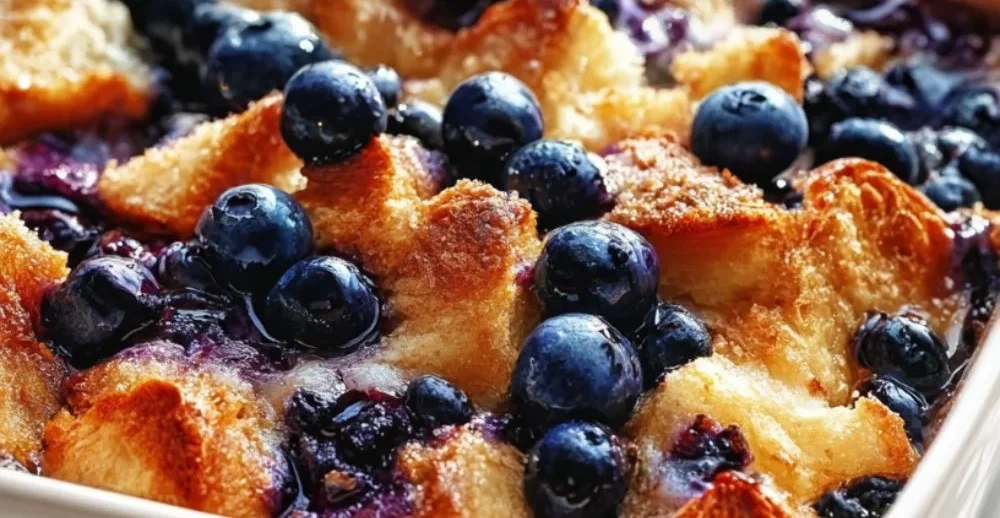
Quick Blueberry French Toast Casserole
Introduction
The first thing I learned about a dish like Quick Blueberry French Toast Casserole is that it arrives in a house like sunlight — slowly, insistently, and with the smell of maple and cinnamon already laid out in the air. I carry recipes with me like passports: small, folded, stained by olive oil and tea, each one a map back to a place where I heard laughter and tasted something that made time feel right. This casserole is one of those maps. It is familiar everywhere and intimate in a way only breakfast can be: a shared ritual after a long night, a leisurely Sunday, or a small domestic feast when friends arrive unannounced.
On a damp morning in a New England inn, I first woke to the warm perfume of browned bread and blueberries bubbling at the edge of a dish. Later, in a Montreal kitchen warmed by an old wood stove, I watched a woman press day-old bread into custard with the deliberation of someone comforting a family. The recipe is fast, generous, and forgiving — qualities that have made it travel well across borders and cultures. If you want more ideas for simple, comforting morning dishes to pair with such moments, explore this collection of quick easy recipes, which often accompany stories of place as much as they accompany plates.
The origin story & regional influence behind this dish
The bones of this casserole are older than the name “French toast.” Across Europe there are renditions of repurposed bread bathed in milk and egg — from the German Arme Ritter to the Portuguese rabanadas — and each one carries the logic of thrift, warmth, and sweetness. Where the French name perhaps gives a veneer of continental flair, the casserole’s modern life belongs to the practical, communal kitchens of North America. There it met the wild, ripe generosity of native blueberries and the amber consolation of maple syrup.
Blueberries themselves are a story of place: wild, small and concentrated with flavor in northern forests, they were gathered by Indigenous peoples long before settlers adopted them into preserves and pies. Maple syrup, similarly, is a liquid memory of early spring and the deep knowledge of people who tapped trees and turned sap into a shimmering sweetness. When bread — often a loaf rescued from yesterday’s table — meets custard and fruit under heat, the result is both humble and celebratory: a breakfast that tastes like hearth and harvest at once. If you are curious how such dishes fit into swift, modern mornings across regions, see this useful list of quick easy recipes that share the same spirit of efficient, soulful cooking.
How to make Quick Blueberry French Toast Casserole
Ingredients : 1 loaf of bread, cubed, 2 cups fresh blueberries, 6 large eggs, 2 cups milk, 1/2 cup maple syrup, 1 teaspoon vanilla extract, 1 teaspoon ground cinnamon, Pinch of salt, Butter for greasing
Directions :
- Preheat your oven to 350°F (175°C) and grease a baking dish with butter.
- In a large bowl, whisk together the eggs, milk, maple syrup, vanilla extract, cinnamon, and salt.
- Layer the cubed bread in the prepared baking dish and sprinkle with blueberries.
- Pour the egg mixture evenly over the bread and blueberries, pressing down gently to ensure the bread absorbs the mixture.
- Let it sit for about 15 minutes to soak.
- Bake in the preheated oven for 35-40 minutes or until the top is golden and a knife inserted in the center comes out clean.
- Let it cool slightly, then serve warm with additional maple syrup if desired.
There is beauty in the recipe’s economy: a handful of ingredients, a single baking dish, and a short vigil while the kitchen fills with scent. The process asks only for patience and the small ceremony of pressing bread into egg, which is itself an act of kindness.
Ingredients through a cultural & historical lens
Each ingredient in this casserole carries a lineage. Bread is the most democratic of foods — a loaf can be city-bought brioche, a country boule, or a dense whole-grain bread handed down from a neighbor. In many cultures, stale bread is never waste; it becomes a canvas for new life. Eggs and milk, the elements of custard, speak of domesticated animals and seasonal routines: hens laying in cycles and dairy produced in barns where late afternoons smell of hay and hay-warmed udders.
Maple syrup is the map of a landscape: the sap that wells in thaw and freezes, turned by technique into a syrup that tastes of wood smoke and mineral. In the northeastern corner of the continent it is as essential as salt. Blueberries bind the dish to the forest. Whether harvested wild or sold in neat punnets at markets, they bring a tart sweetness that balances the comfort of custard. Vanilla and cinnamon — spices that traveled across oceans on merchant ships — hint at colonial trade routes and the global conversations in flavor that formed modern breakfast tables.
Cooking the dish: sensory notes & traditional techniques
There is a quiet alchemy when custard meets old bread. The eggs thicken and set, the bread swells and tenderizes; the top browns into a skin that gives with a soft crackle, revealing a moist, velvet heart. The aroma is crucial: maple syrup sings through cinnamon and warm milk, while blueberries pop and release aromatic juices that perfume the oven. In older households, this casserole might be finished under a broiler for an extra caramelized top; in other kitchens, a scattering of sugar before baking yields a delicate crust. In Quebec, cooks sometimes add a splash of cream or a scatter of brown sugar to tilt the flavor toward indulgence; in Michigan or Maine, where blueberries are a local pride, the fruit is used liberally, the berries left whole to burst like small, sweet lanterns.
Traditional technique is less about precise timing and more about rhythm: allowing bread to soak until it sighs under the custard, trusting the oven’s steady warmth, and resisting the temptation to cut into the dish too soon. Serving it warm, in slices that steam in the plate’s hollows, with extra maple amber running down, is a ritual that transforms kitchen heat into comfort.
How different regions prepare their version
Regional variations read like postcards from a country. In the American Northeast, the casserole is a manger for maple and wild blueberries, often served in weekend inns where families gather after church. In the Midwest, cooks sometimes fold in a handful of toasted pecans or swap in brown sugar for a caramel edge. Southern versions might incorporate a splash of bourbon or a scattering of peaches when blueberries are out of season, tying the dish into a land of warm afternoons and front-porch conversations. In Britain and parts of Northern Europe, the idea of bread-and-custard appears as baked puddings and bread-and-butter puddings, where raisins and a more pronounced custard are customary.
Travel further, and you find cousins rather than copies: custardy baked breads in Scandinavia, the rice puddings of the Mediterranean, and the egg-sweetened breads in Latin America. Each adaptation tells the same human story — of making abundance from thrift and finding sweetness in what is at hand.
Traditional ways this dish is shared or served
This casserole lives best in company. It is often cut into generous squares, placed in the center of a weathered table, and shared with hands that reach, slice, and pass. At family reunions it becomes the reliable constant amid the changing parade of dishes: the child who refuses oatmeal will eat a bite of warm custard, an aged aunt will fold a napkin around her fork and close her eyes at the first taste. At bed-and-breakfasts, it arrives steaming with jam and butter, a welcome that smells of hospitality.
There is also a quiet, solitary way to savor it — late at night with a cup of strong tea, when the house is still and the mind unspools. People bring ritual to its serving: a thread of cream, a scattering of powdered sugar, a few extra blueberries placed like coins on its surface. In many communities, the casserole becomes part of holiday mornings — an accessible, shareable symbol of comfort that takes little time and yields a great deal of conviviality.
Storing the dish without losing its cultural essence
A casserole like this keeps the imprint of its making: it remembers the oven and the hand that pressed the bread down. To store it is to preserve a memory while accepting change. Kept in the refrigerator, it will reheat well, regaining warmth and aroma in a low oven or a gently coaxing stovetop skillet. Microwaves will do the work quickly, but the texture changes — the contrast between crust and custard softens. For those who prize tradition, reheating under brief oven heat restores the singing crust and the blueberry perfume.
If you must transport it — to a potluck or a picnic — cover it so steam does not condense and collapse the top. Many households make the casserole the night before, allowing it to sit overnight so flavors deepen; this is both practical and ancestral, echoing how families have long prepared foods ahead for the rhythms of work and worship. The casserole’s cultural essence is less in its temperature than in the story of it: who made it, who ate it, and the small gestures that frame its serving.
Cultural questions people often ask
Is this French? Only in name. The dish borrows its moniker from European traditions but has been remade in North American kitchens with fruit and maple. Why blueberries? They are local to large parts of North America and carry an identity of place — wild and tart, they balance the richness of custard. Can it be made ahead? Yes, and many cooks prefer overnight soaking; the act of waiting is part of the ritual. Is it a breakfast or dessert? It refuses to be pinned down; it is breakfast’s dessert and dessert’s breakfast, a bridge between the day’s end and beginning.
People also ask about substitutions: historically, such dishes evolved because cooks used what was available. Grain, fruit, and sweetener shifted with trade, migration, and seasons. The casserole lives in that lineage of adaptation — it is both specific and universal, a recipe that invites improvisation while rewarding tradition.
A closing note on food, memory & travel
Every kitchen has a geography of memory. Plates like Quick Blueberry French Toast Casserole are topographic maps of afternoons and conversations; they chart the places where people have stood, the hands that stirred, and the seasons when certain fruits were at their most generous. When I travel, I look for those maps — for the breakfast served by a woman who learned to coax sweetness out of last week’s bread, for the roadside diner that brightens a damp morning with a pan of bubbling berries. These are the scenes that lodge in the mind: steam on a window, a child reaching for a corner piece, the way a simple spoonful can stop a conversation and make everyone listen.
Food moves with people, carrying pieces of identity and creating new tapestries as it meets new ingredients and kitchens. This casserole is a small testament to that movement, a reminder that comfort foods are often the most cosmopolitan. They speak of migrations, of trade, of local harvests and global tastes, and they invite us to sit, to remember, and to tell a story over a warm plate.
Conclusion
If you would like to compare variations and see another beloved version of this recipe, take a look at this thoughtful rendition: Blueberry French Toast Casserole – Sally’s Baking.
Quick Blueberry French Toast Casserole
Ingredients
Method
- Preheat your oven to 350°F (175°C) and grease a baking dish with butter.
- In a large bowl, whisk together the eggs, milk, maple syrup, vanilla extract, cinnamon, and salt.
- Layer the cubed bread in the prepared baking dish and sprinkle with blueberries.
- Pour the egg mixture evenly over the bread and blueberries, pressing down gently to ensure the bread absorbs the mixture.
- Let it sit for about 15 minutes to soak.
- Bake in the preheated oven for 35-40 minutes or until the top is golden and a knife inserted in the center comes out clean.
- Let it cool slightly, then serve warm with additional maple syrup if desired.