No Bake Oreo Cheesecake Cups
Introduction
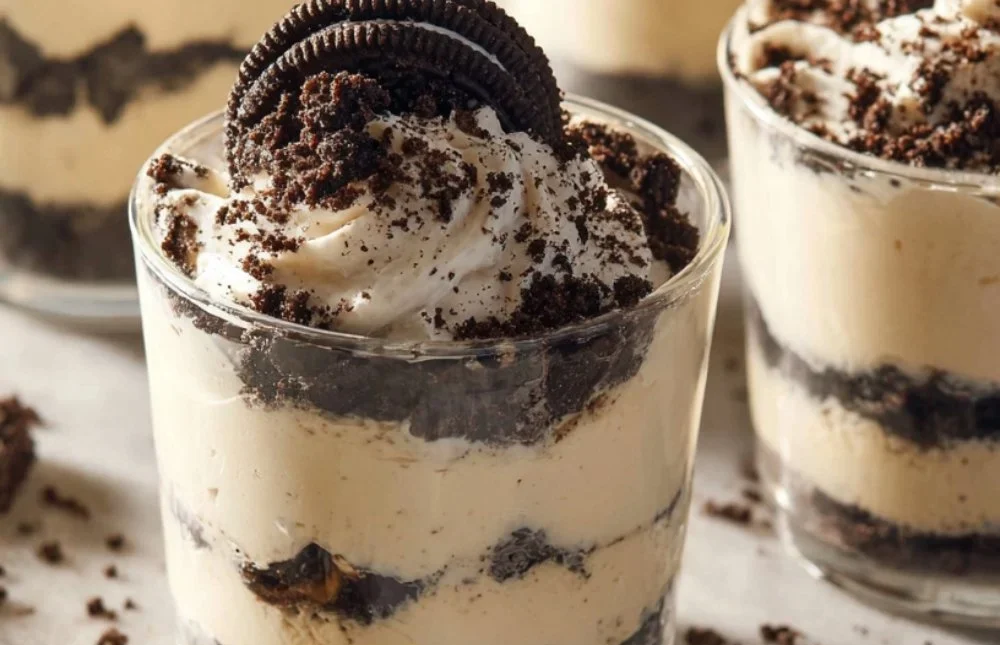
No-bake desserts demand precision despite their apparent simplicity. The No Bake Oreo Cheesecake Cups synthesize two complementary structures: a dense, cocoa-stained cookie crumb and a light, aerated cream-cheese matrix. The result is a layered experience in which mouthfeel and temperature govern perception as much as flavor. Executed correctly, these cups balance the bitter roast notes of the Oreo cookie with the lactic tang and fat richness of cream cheese, modulated by powdered sugar and vanilla, and softened by the air and coolness of whipped cream. This recipe is compact, efficient, and relies on technique rather than thermal transformation; mastering it refines skills in emulsification, aeration, folding, and cold-set stabilization.
The culinary logic behind this dish
The architecture of these cups is straightforward: a particulate base provides friction and crunch while the filling offers creaminess and lift. The Oreo base contributes a high proportion of fat, sugar, and cocoa solids, creating both flavor contrast and structural integrity when compacted. Cream cheese supplies dairy fat and casein networks that trap water and air; powdered sugar acts not only as sweetener but as a drying agent that stabilizes the protein matrix, and vanilla adjusts aromatic perception. Whipped cream introduces lightness through dispersed fat globules and entrained air; folding it into the cream cheese blend reduces overall density without breaking the protein network. Chilling is the final structural step—it allows the fat to firm and the casein network to set, giving the cups a spoonable yet stable texture. Because there is no heat, control of temperature and mechanical action during preparation directly determines outcome.
How to make No Bake Oreo Cheesecake Cups
Technique determines the difference between a cohesive cup and one that separates or becomes grainy. Begin with temperature control: the cream cheese should be softened to a point where it yields under gentle pressure but is not warm. This ensures smooth incorporation of powdered sugar and avoids a thin emulsion. Crushing cookies can be done to two textures: fine for a compact, sliceable base and slightly coarse for textural contrast; both are valid but demand different packing pressures in the cups. When combining cream cheese, powdered sugar, and vanilla, mix only to a satin-smooth consistency—overworking will beat air into the casein network, later risking collapse. Incorporate whipped cream using a series of gentle, deliberate folds: slide the spatula down the side, cut through the center, and lift to bring bottom to top; rotate the bowl between folds. Layering should be perpendicular in texture—press a crumb layer firmly, deposit filling with a small offset to maintain a clean stratification, and repeat. Final chilling is essential: an hour is the minimum to allow fat and protein to firm; longer improves slicing and mouthfeel. Each of these choices—temperatures, particle size, folding pace, and cold time—addresses a specific physical property of the components.
Ingredients :
1 package Oreo cookies, 2 cups cream cheese, softened, 1 cup powdered sugar, 1 teaspoon vanilla extract, 2 cups whipped cream
In this form the ingredient list is intentionally reductive: each element has a precise functional role. The package of Oreo cookies provides both the crunchy matrix and the bitter/sweet counterpoint. The cream cheese is the primary binder and source of dairy tang and fat. Powdered sugar integrates tidily into the cream cheese without the graininess that granulated sugar can leave; its cornstarch content also contributes slight stabilizing effect. Vanilla is aromatic seasoning, sharpening perceived sweetness and adding depth. Whipped cream introduces aeration and a softer fat phase, transforming a dense cream-cheese base into a lighter mousse-like filling.
Directions :
- Crush the Oreo cookies and set aside.
- In a mixing bowl, combine the softened cream cheese, powdered sugar, and vanilla extract until smooth.
- Gently fold in the whipped cream until well combined.
- In serving cups, layer the crushed Oreo cookies at the bottom, followed by the cheesecake mixture.
- Repeat the layers until the cups are filled.
- Top with additional crushed Oreos or whipped cream.
- Refrigerate for at least 1 hour before serving.
These directions are intentionally minimal; the following sections unpack why each instruction matters and how to execute them with professional consistency.
Ingredient analysis through a chef’s lens
Oreo cookies are composite particles: cocoa solids, sugar crystals, vegetable fats, and a sweet filling. When crushed, the filling acts as a secondary binder, which aids cohesion in the base. Fine crumbs pack more densely, creating a firmer foundation that resists spoon pressure; coarser fragments provide audible crunch and quicker moisture migration from the filling. Cream cheese is a dispersion of fat in a protein-stabilized matrix; its firmness depends on temperature and fat ratio. Powdered sugar includes cornstarch, which reduces hygroscopicity and helps thicken the mixture without additional cooking. Vanilla extract contributes volatile odorants that complement the cocoa aromatics of the cookie. Whipped cream is an emulsion of fat droplets and air; its stability hinges on fat percentage and whipping level—medium peaks give structure without stiffness, while over-whipped cream becomes grainy and separates upon folding.
Kitchen workflow & technique breakdown
Set up a disciplined workflow. Stage the components: crush cookies first and reserve; measure and chill the serving cups; soften cream cheese to room-but-cool temperature; have powdered sugar sifted and close at hand; whip cream just short of firm peaks and hold it chilled. Use a wide, shallow mixing bowl for folding to minimize mixing time. Tools matter: a food processor yields uniform crumbs, while a rolling pin in a zip-top bag offers variable textures; a rubber spatula protects the aeration in the whipped cream; an electric mixer expedites smoothing the cream cheese but stop as soon as satin texture is achieved. Work in short, purposeful cycles—combine, fold, layer, chill. This reduces the time the components spend at temperatures that compromise stability.
Texture control, heat management & timing
Temperature governs texture in a no-bake system. If cream cheese is too cold, it will resist incorporation and leave lumps; too warm, and it will create a loose emulsion that weeps. Aim for a tactile softness: press gently and it should yield without feeling glossy or oily. Whipped cream should be cold and at medium peaks; this maximizes air retention without stiffness that makes folding difficult. The folding technique must preserve the whipped cream’s air while ensuring homogeneity; typically 6–10 gentle folds suffice. Chilling for at least an hour allows fats to firm and moisture to equilibrate between layers; shorter times will yield a softer, less stable cup. For best texture, hold refrigerated until service and allow a few minutes at service temperature for flavors to bloom—cold mutes sweetness and aroma, so brief warming enhances perception.
Professional variations
Variations can enhance presentation and texture without altering the core ingredients. Alter the crumb grading to produce a dual-texture cup—place a compacted fine crumb layer at the base and a coarse crumb layer midway for contrast. Use different glassware to change the perceived portion size and layering visual; narrow glasses emphasize stratification while shallow ramekins increase surface area-to-volume, affecting chill rate. For a cleaner profile, pipe the cheesecake mixture using a large plain tip to control layer thickness and create precise interfaces. If you require a firmer set for transport, increase chilling time and consider single-serve cups with tighter lids to prevent humidity exchange—this adjusts logistics rather than formula.
Finishing touches & plating philosophy
Finishing should reinforce the contrasting elements. A restrained sprinkle of crushed Oreos provides textural punctuation and reinforces the visual cue of flavor. Whipped cream rosettes made from the reserve whipped cream lend a glossy, airy cap and are functionally the same ingredient as the interior aeration. When plating, consider negative space and the utensil: shallow spoons allow an integrated bite of crumb and filling, while tall spoons emphasize texture contrast. Serve chilled on a clean, dry tray; avoid over-garnishing which blunts the simple, purposeful flavor pairing.
Maintaining quality after cooking
Storage is refrigeration only. These cups are a refrigerated, not frozen, product: freezing alters the whipped cream’s microstructure and produces textural collapse on thaw. Keep covered to prevent absorption of refrigerator odors and to control surface drying—plastic lids or airtight containers are preferred. Consume within 48–72 hours for optimal textural integrity; over time, moisture migration from the filling will soften the crumbs, and the whipped cream will lose its aeration. If planning advance service, assemble the bases and filling separately and combine within a few hours of service to maintain crispness—this is a logistical modification, not a recipe change.
Questions from home cooks (chef answers)
Q: Why is my filling runny?
A: Runny filling results from overly warm cream cheese or under-whipped cream. Ensure cream cheese is softened but cool; whip cream to medium peaks and fold gently but thoroughly to avoid localized pockets of liquid.
Q: How can I prevent the crust from becoming soggy?
A: Pack the crumb base firmly to minimize exposed surface area and chill promptly. Coarser crumbs and a denser pack reduce capillary wicking from the filling.
Q: Can I make these ahead for a party?
A: Yes, up to 48–72 hours refrigerated. For maximum crispness, assemble and chill no more than 6–12 hours ahead if you prefer a pronounced crunch; for convenient service, you may assemble earlier, accepting a softer base.
Q: What’s the correct folding technique?
A: Use a wide spatula. Slide it down the bowl’s side, scoop under the mass, lift through the center, then rotate the bowl. Minimize strokes—each fold should be decisive.
Final chef notes
This No Bake Oreo Cheesecake Cups recipe is a study in balancing structural contrasts: controlled particle size, precise temperature, and measured mechanical action. Its success depends on respecting ingredient function—cream cheese as binder, powdered sugar as both sweetener and stabilizer, whipped cream as aeration—and on disciplined technique. When executed with attention to these variables, the cups exhibit a clean cocoa note, a bright dairy tang, and a layered texture that rewards both spoon and palate. The method scales efficiently and adapts to professional plating contexts without compromising clarity of flavor or structural logic.
Conclusion
For a tested recipe reference and a visual guide to assembly, consult the version at Best Friends For Frosting — No Bake OREO Cheesecake Cups, which complements the technical approach described here. For an alternate presentation and additional step-by-step photos, see Lemons & Zest — 5 Ingredient No-Bake Oreo Cheesecake Cups.
No Bake Oreo Cheesecake Cups
Ingredients
Method
- Crush the Oreo cookies and set aside.
- In a mixing bowl, combine the softened cream cheese, powdered sugar, and vanilla extract until smooth.
- Gently fold in the whipped cream until well combined.
- In serving cups, layer the crushed Oreo cookies at the bottom.
- Follow with the cheesecake mixture.
- Repeat the layers until the cups are filled.
- Top with additional crushed Oreos or whipped cream.
- Refrigerate for at least 1 hour before serving.