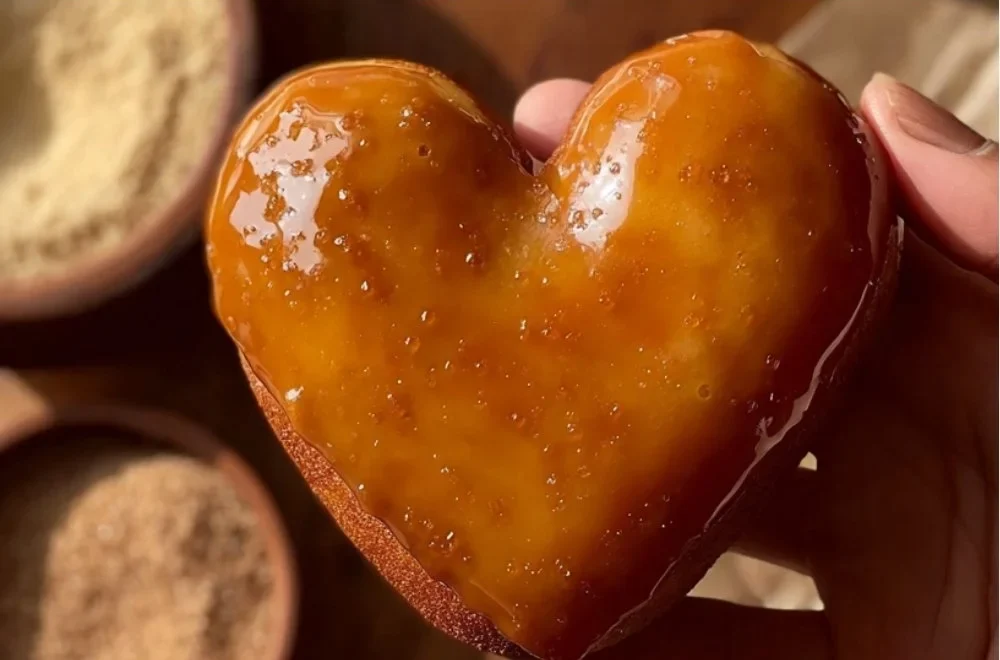
Crème Brûlée Heart Donuts
Introduction
In the quiet hours before a city wakes, when the tram wires hum and the bakeries of a neighborhood begin to exhale warm yeast and sugar into the cold air, a particular combination of textures and aromas can feel like a small act of belonging. I remember the first time I tasted something like these Crème Brûlée Heart Donuts in a corner café that could have been in Paris, yet smelled faintly of cardamom like an Ottoman kitchen and looked as deliberate as an artisan’s love letter. The dough glowed with a honeyed warmth; the custard, fragrant with vanilla, held the hush of a rural dairy morning; the caramelized sugar snapped with a private, celebratory crack.
As a traveler who follows food like a seam through a continent, I find that recipes like this one sit between worlds — they are both a nod to classical French restraint and an affectionate embrace of the global ritual of fried dough. In Sofia, on a frost-still morning, the heart-shaped donuts felt like a city’s way of giving itself permission to indulge. The pastry cases of cafés and market stalls around the world have long offered up their versions of sweet indulgence; these heart-shaped, custard-filled rounds are simply the latest chapter in a story of exchange, adaptation, and communal pleasure.
This introduction is a small map: of scent and texture, of where a spoonful of warm custard meets a shard of caramel under a sky that remembers empires. It’s also an invitation — to imagine the places these flavors might have come from, and the small domestic rituals that turned them into comfort.
The origin story & regional influence behind this dish
Crème brûlée, with its taut shell of caramel and its soft, slow-set custard, reads like French table manners — at once precise and quietly ostentatious. Yet its deeper family tree reaches across borders: custard as a concept appears in medieval Anglo-Norman kitchens, Iberian convents where egg yolks were preserved by nuns, and in the custard tarts of Portugal and Spain. Each culture tempered the same fundamental idea — eggs, cream, sugar — into something that fit local tastes and rhythms.
Fried dough, by contrast, is one of humankind’s simplest, most democratic inventions. From the beignets of New Orleans and the pączki of Poland to the sufganiyot of Jewish tradition and the churros of Spain, societies have independently discovered that frying enriched dough transforms everyday ingredients into ritual food. The donut here is not just a pastry; it is a practice: shared at markets, given as gifts on festivals, slipped into a child’s hand at dawn.
So when a crisp bronze shell of caramel meets a pillowy heart-shaped donut, you are witnessing a culinary conversation between the French flair for surface tension and the global affection for fried treats. The heart shape itself is modern, perhaps commercial, yet it taps into age-old customs of gifting sweets to mark affection, holidays, or rites of passage. Regions that prize communal eating will serve such pastries at weddings or morning gatherings, while cosmopolitan streets will sell them as an artful snack to passersby who seek novelty and nostalgia in equal measure.
How to make Crème Brûlée Heart Donuts
This recipe is a choreography of two traditions — the cool, composed custard and the impulsive grace of fried dough. Below are the exact ingredients and directions for assembling this particular iteration. I leave them untouched, as a document of technique and measure, a photograph of an idea you can reproduce in your own kitchen.
Ingredients :
3 2/3 cups all-purpose flour, 1 1/4 cups whole milk (warmed), 1 1/2 teaspoons instant yeast, 1/3 cup granulated sugar, 1 teaspoon salt, 1 large egg (at room temperature), 6 tablespoons unsalted butter (softened), Vegetable oil (for frying), 1 2/3 cups whole milk (for custard), 2 teaspoons vanilla extract, 1 vanilla bean (seeds scraped), 1/4 teaspoon salt (for custard), 1/4 cup cornstarch, 1/2 cup sugar (for custard), 4 egg yolks, 2 tablespoons unsalted butter (for custard), 1 cup granulated sugar (for brulee), 1/4 cup water (for brulee)
Directions :
- Make the Custard: In a mixing bowl, whisk together cornstarch, sugar, and salt. Add egg yolks and beat until light in color. In a pot over medium heat, combine 1 2/3 cups milk, vanilla extract, and scraped vanilla bean. Heat until edges start to bubble. Slowly add warm milk to the egg mixture, whisking constantly to prevent curdling. Return mixture to pot and cook over medium-low heat until thickened. Remove from heat, stir in 2 tablespoons butter, and chill in the fridge., 2. Make the Dough: In a large mixing bowl, combine warm milk, yeast, sugar, salt, and egg. Mix until smooth. Add softened butter and flour, knead until dough forms. Let rise for 1 hour 30 minutes to 2 hours., 3. Shape and Fry: Roll out dough and cut into heart-shaped donuts. Let rise for 30 minutes. Fry donuts in heated oil until golden brown. Drain on paper towels., 4. Fill: Fill a piping bag with chilled custard. Make a hole in each donut and pipe in custard., 5. Brulee: In a pan over medium heat, boil sugar and water until golden brown. Dip one side of each filled donut in the caramelized sugar. Let excess drip off and set on a wire rack. Enjoy your freshly made Crème Brûlée Heart Donuts!
Ingredients through a cultural & historical lens
Every ingredient here carries a quiet lineage. Flour is a map of trade routes, from the grain fields of central plains to the mills that crowned towns with their wooden sails. Milk — warmed for the dough and more lavishly used in the custard — tells of dairy traditions, of mountain pastures and small family herds that supplied cream for special occasions. The vanilla bean is an emblem of colonial exchange: native to Mesoamerica, carried to Madagascar and Réunion for global cultivation, then ground into a pod whose sweet perfume now defines luxury in a single scrape of seeds.
Sugar, present in multiple roles — for the dough, for the custard, and for the brulee — is perhaps the most political ingredient. Its history is entangled with the rise of global commerce, plantation economies, and shifting tastes. Yet in local kitchens it has been domesticated into something generous: a means to preserve, to celebrate, to sweeten the bitter parts of life. Butter and eggs are markers of seasonality and prosperity; where eggs were once hoarded for sale, their yolks now signal an indulgent moment. Cornstarch, a more modern addition, speaks to the ingenuity of cooks who asked for a silkier, more stable custard without the potential grittiness of less processed thickeners.
Viewed together, this list is not merely a shopping list; it is a compact history of flavors, economies, and migrations. The heart-shaped result is newer than its components, but it rests on centuries of technique and appetite.
Cooking the dish: sensory notes & traditional techniques
Cooking these donuts is an exercise in patience and attention to sensual detail rather than mechanical exactness. The dough, after its first rise, should feel like a palm that remembers warmth — resilient but forgiving. Rolling it out under a dusting of flour releases a faint yeasty perfume that promises a softer crumb. When dropped into hot oil, the dough should sizzle with an immediate, slightly sharp note that softens into a browned, nutty aroma as the crust forms.
The custard, when cooked slowly and with gentle whisking, becomes a quiet, glossy thing: pale gold, smelling of warm milk and vanilla bean, with a texture that yields to the tongue like a secret. The moment of caramelizing — making the brûlée — is theatrical and intimate. Sugar and water transform under heat into a deep amber; the smell is of toasted sugar and a whisper of smoke. When that caramel kisses the custard-filled donut, it lends a brittle counterpoint to the custard’s velvet, the sound of the sugar snapping under the teeth and the softened, yielding bite within.
Traditional techniques here are not technological feats but rituals: the slow warming of milk, the careful tempering of eggs with hot liquid to avoid curdling, the patience of proofing dough. In many households these steps are shared — a grandmother watching the custard set, a child cutting out hearts, neighbors smelling the fryer from the street and wandering in with stories. It is in these small human interactions that technique becomes tradition.
How different regions prepare their version
Traveling through Europe, the Middle East, and the Americas, you notice the same impulse manifesting differently. In Paris, a chef might reinterpret this dish with a brûléed top done via a torch, pairing it with a crisp apple compote or a flourish of fleur de sel. In Istanbul, you might find a version using tahini or a hint of mastic in the custard; in Poland, the heart shape recalls pączki, traditionally filled with rose hip or plum preserves and eaten on Fat Thursday. In Japan, the custard might be lighter, almost souffle-like, with the dough itself less sweet and the brulee more restrained.
Street vendors in Buenos Aires could dust the fried hearts in powdered sugar and drizzle them with dulce de leche before adding a caramelized finish; in New Orleans, a beignet-like approach might avoid filling altogether in favor of a brûléed custard on the side. Each region keeps the core pleasures — warm fried dough, sweet custard, caramel crack — but inflects the flavor with its own pantry and history.
Traditional ways this dish is shared or served
Heart-shaped pastries are often tied to occasions of emotion: Valentine’s celebrations, anniversaries, or simply an impromptu apology. In markets, a vendor may hand a warm heart to a passing couple; in homes, a tray might be placed at the center of a table during a small family celebration. In communal festivals where fried dough is customary, such as Carnival or harvest fairs, these filled hearts can appear as a fanciful, modern addition — a bridge between ritual and contemporary indulgence.
Serving is both practical and ceremonial. A sugar-dusted napkin for the street, a delicate porcelain plate for the parlor. Some households will dip the donuts in the caramel only on one side, presenting them like gilded coins; others will torch the sugar at the table, the small blue flame becoming part of a domestic theater. The act of sharing — tearing a donut in half, letting someone taste the warm custard at its center — is how many people remember a place.
Storing the dish without losing its cultural essence
These donuts are at their most honest when freshly made: the contrast between crisp caramel and soft custard is immediate and ephemeral. If you must store them, keep the custard chilled and fill the donuts shortly before serving; filled donuts will soften more quickly. An airtight container in the refrigerator will preserve the custard for a day or two, but the caramel will lose its snap and the fried shell will gradually become tender.
Yet storage is more than a technical problem — it is a cultural choice. In societies that prize immediacy, such pastries are made to be consumed the same day, an act of presentness. In homes where food is prepared ahead for guests, unfilled shells may be kept and finished at the moment of serving, preserving both texture and the social ritual of completion.
Cultural questions people often ask
Is this dessert French or global? Both. People ask whether the heart shape cheapens the classic crème brûlée — often, purists bristle — but others see it as a playful evolution. Why caramelize with sugar and water instead of torching sugar? The pan method gives a different depth of flavor and a slightly thicker caramel that adheres to the dough in a distinct way. Can this be adapted for festivals with dietary restrictions? Yes, cultures always adapt pastries to fit fasting rules, religious calendars, and ingredient availability; you will find eggless, dairy-free, or differently sweetened versions where necessary.
Ultimately, these questions are about belonging: who gets to claim a recipe, how culinary forms migrate, and what it means when a technique moves from a formal dining room to a street stall. Food is often a way of negotiating identity, and pastries like these are fertile ground for negotiation.
A closing note on food, memory & travel
I have eaten variations of this donut at late-night markets and at sunlit bakeries, and each time the pastry has been less a fixed dish than a mirror reflecting the place and people who made it. In one town a woman told me that offering a brûléed donut to a guest was a way of showing devotion; in another, a baker wrapped them in waxed paper and called them “little comforts” for workers leaving early shifts. Food, always, is a kind of mapping: of seasons, migrations, and human attention.
These Crème Brûlée Heart Donuts remind us that culinary traditions are living things. They ask to be tasted not only for sweetness but for the histories and hands they carry. To eat one is to participate in a ritual that is at once private and public — a small, warm fidelity to memory and to the ever-shifting geography of taste.
Conclusion
For a plated sense of what these pastries look like and to see a visual interpretation of the recipe, you can view a presentation of Crème Brûlée Heart Donuts at Creme Brûlée Heart Donuts | Moribyan.
Crème Brûlée Heart Donuts
Ingredients
Method
- In a mixing bowl, whisk together cornstarch, sugar, and salt. Add egg yolks and beat until light in color.
- In a pot over medium heat, combine 1 2/3 cups milk, vanilla extract, and scraped vanilla bean. Heat until edges start to bubble.
- Slowly add warm milk to the egg mixture, whisking constantly to prevent curdling.
- Return mixture to pot and cook over medium-low heat until thickened.
- Remove from heat, stir in 2 tablespoons butter, and chill in the fridge.
- In a large mixing bowl, combine warm milk, yeast, sugar, salt, and egg. Mix until smooth.
- Add softened butter and flour, knead until dough forms.
- Let rise for 1 hour 30 minutes to 2 hours.
- Roll out dough and cut into heart-shaped donuts.
- Let rise for another 30 minutes.
- Fry donuts in heated oil until golden brown. Drain on paper towels.
- Fill a piping bag with chilled custard.
- Make a hole in each donut and pipe in custard.
- In a pan over medium heat, boil sugar and water until golden brown.
- Dip one side of each filled donut in the caramelized sugar. Let excess drip off and set on a wire rack.
- Enjoy your freshly made Crème Brûlée Heart Donuts!