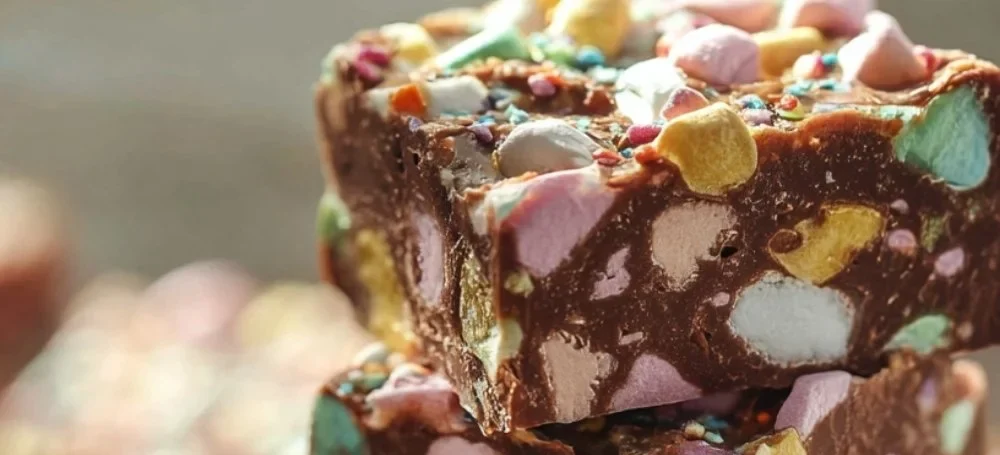
Chocolate Confetti Squares
Introduction
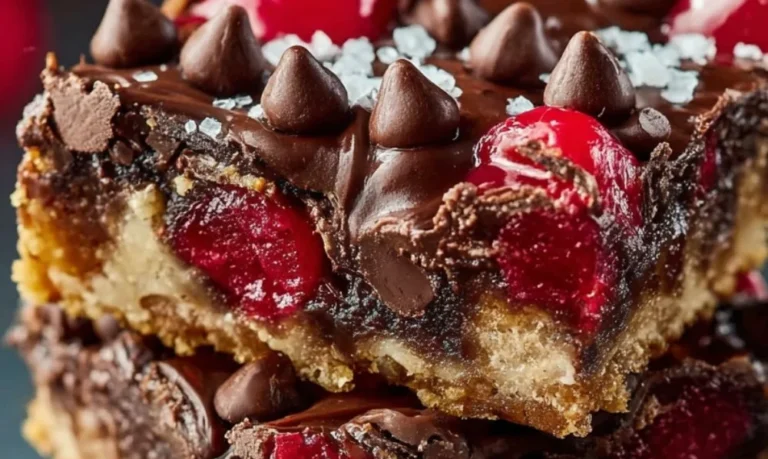
Chocolate Confetti Squares are a compact study in contrast: the glossy density of melted chocolate, the malleable richness of peanut butter, the butter’s silk, and the sudden buoyancy of fruity marshmallows. This preparation is efficient and deliberate—each ingredient contributes a defined functional role beyond flavor. The chocolate provides structure and snap as it cools; peanut butter supplies emulsification and body; butter rounds flavor and moderates setting; vanilla lifts aromatic top notes; and the marshmallows introduce trapped air and a burst of color. Approached with professional technique, this recipe yields a composed confection whose success depends on controlled heat, deliberate folding, and timing of the set. For comparative technique and textural references consult a closely related bar preparation like the chocolate-covered cherry magic bars, which share similar layering and structural logic.
The culinary logic behind this dish
At its core, Chocolate Confetti Squares are a composed refrigerated confection, not a baked item. The structure develops primarily through fat crystallization and the mechanical entrapment of air and sugar within the marshmallows. Melting chocolate with peanut butter creates a stable emulsion: cacao solids and cocoa butter are loosened into a fluid state, and peanut butter—containing both oil and proteins—helps bind that matrix by introducing lecithin-like emulsification and additional fat. Butter and vanilla, added off heat, ensure the temperature is low enough to preserve aromatics and to allow the butter to incorporate without separating. The marshmallows function as inclusions with high sugar and aeration; they do not contribute to structural firmness but instead provide chew and color contrast. Understanding these roles clarifies why the sequential order of steps is necessary and why refrigeration, rather than baking, is specified for setting.
How to make Chocolate Confetti Squares
Ingredients :
2 cups chocolate chips, 1 cup peanut butter, 4 cups fruity marshmallows, 1/2 cup butter, 1 teaspoon vanilla extract
Directions :
- In a large saucepan, melt the chocolate chips and peanut butter together over low heat, stirring until smooth., 2. Remove from heat and stir in the butter and vanilla extract until combined., 3. Fold in the fruity marshmallows until evenly coated., 4. Pour the mixture into a greased 9×9 inch baking pan and spread it evenly., 5. Refrigerate for 1-2 hours until set., 6. Once set, cut into squares and enjoy!
This procedure is intentionally succinct. It emphasizes heat control and rapid transitions from melt to set. Begin with a low, consistent heat and a heavy-bottomed saucepan to prevent localized overheat that can scorch chocolate and separate the coconut or peanut oils within peanut butter. Stirring continuously with a heat-resistant spatula encourages even melting and a smooth emulsion. Removing from the heat before adding butter and vanilla prevents volatilization of aromatics and avoids tempering issues in the chocolate matrix. Folding the marshmallows must be gentle to preserve their shape and aeration while ensuring even distribution. Spreading into a uniformly greased 9×9 pan guarantees an even thickness for consistent set times and clean portioning.
Ingredient analysis through a chef’s lens
Each ingredient is chosen for both function and flavor. Chocolate chips supply tempered cocoa solids and saturated cocoa butter; because chips are formulated to retain shape, they may require slightly extended low-heat melting compared to couverture, but they deliver reliable sweetness and body. Peanut butter is the sole nut fat—its oil integrates with melted chocolate to reduce viscosity and add savory depth; choose a smooth, well-mixed peanut butter for predictable consistency. Fruity marshmallows are not merely decorative; their sugar and gelatin matrix contributes localized chew and pockets of color that punctuate each bite. Butter introduces milk fat and water; added off-heat it emulsifies into the warm chocolate, improving mouthfeel and sheen. Vanilla is a volatile aromatic that should be added after heating to preserve its top-note complexity. The proportions are calibrated to balance firmness and chew: too little chocolate or too much butter softens the set; too many marshmallows compromise cohesion.
One may study similar desserts to refine texture expectations; for instance, the density-to-crumb balance in chocolate-covered strawberry brownies provides insight into how inclusions alter mouthfeel.
Kitchen workflow & technique breakdown
Efficient workflow reduces temperature fluctuations and ensures quality. Set up mise en place: measure chocolate chips and peanut butter into the saucepan-ready container; have butter and vanilla in a small bowl at hand; grease the pan and line with parchment where possible to expedite removal; portion marshmallows into an accessible bowl for rapid folding. Heat strategy: maintain a low, steady flame and stir continuously from the center outward to avoid hotspots. Use a wide, shallow saucepan rather than a tall one to maximize surface area and speed melting. When the mixture reaches a uniform glossy viscosity, remove immediately—residual heat will carry operation forward. Rapid incorporation of butter and vanilla off the heat prevents breakdown of the emulsion and preserves aromatic clarity.
Distribute internal stresses by spreading the mix evenly; use an offset spatula pressed lightly and smoothed in one direction to avoid air pockets and to create uniform thickness. Rapid refrigeration in a shallow container accelerates set while preventing grainy fat bloom that can occur if the mixture cools unevenly.
Referencing composition techniques from airy confections such as mini Easter cheesecakes with chocolate eggs helps calibrate expectations for pan preparation and portioning.
Texture control, heat management & timing
Texture is a function of fat crystallization and the physical state of inclusions. Control heat to preserve cocoa butter’s desirable crystalline forms; avoid overheating beyond the point where chocolate becomes thin and dull, because re-crystallization on cooling will be slower and may yield a softer set. Timing is crucial: melt just until smooth, then remove, and incorporate butter and vanilla to allow the butter to distribute without separating. Folding marshmallows too early—when the matrix is excessively hot—will cause them to partially melt and lose their characteristic chew. Fold when the mixture is warm but not scalding; residual heat should be sufficient to coat without collapse.
Refrigeration time of 1–2 hours is a guideline; monitor the set by touch at the center—if the surface yields slightly but the interior resists, it is ready. Over-chilling increases brittleness; allow squares to temper briefly at room temperature (five to ten minutes) before serving to regain peak mouthfeel.
For additional inspiration on balancing inclusions and fat matrices in cold-set bars, examine methods used in viral chocolate date bark where incorporation and cooling strategies influence final texture.
Professional variations
Maintaining the listed ingredient set and measurements, minor technique-driven variations can elevate the result without altering the composition. Use a double boiler for gentle melting if your stovetop provides uneven heat. For increased shine and a snapier set, briefly cool the melted chocolate mixture to 30–32°C (86–90°F) before adding butter and vanilla—this encourages more stable fat crystallization. If you prefer larger texture contrast, reserve a portion of marshmallows to press lightly onto the surface after spreading so they remain more pronounced. For a glossier finish, smooth the surface with a plastic wrap sheet pressed lightly to avoid bloom during refrigeration. Do not alter the ingredient quantities; changes to ratios will directly affect set and texture.
Finishing touches & plating philosophy
Cutting squares cleanly requires attention to temperature and blade. Use a long, sharp knife warmed under hot water and wiped dry for each pass; this produces straight edges and prevents sticking. For professional presentation, line the base of each square with a small square of parchment and serve on neutral-toned crockery to emphasize the confetti colors. Consider consistent portion size—an even grid maximizes a uniform eating experience. When plating for service, allow the squares to sit five minutes at room temperature to release some butter softness, which enhances flavor release without compromising structure.
Maintaining quality after cooking
Storage dictates texture retention. Keep the squares refrigerated in an airtight container layered with parchment to prevent adhesion and moisture migration. Consistent cold storage maintains the intended fat crystalline structure and preserves marshmallow chew. Avoid freezing; ice crystals will disrupt the fat matrix and create a grainy mouthfeel upon thawing. If preparing in advance for an event, store up to four days under refrigeration and remove 10 minutes before service to recover optimal richness.
Questions from home cooks (chef answers)
Q: Why did my marshmallows melt into the mixture?
A: They were exposed to excessive heat. Allow the melted chocolate and peanut butter to cool slightly off heat before folding in marshmallows; the goal is to coat them, not to dissolve them. A warm, not hot, matrix preserves marshmallow structure.
Q: My squares are too soft after refrigeration—what went wrong?
A: Likely the chocolate-to-fat ratio was altered, or the mixture was not cooled properly to encourage cocoa butter crystallization. Use precisely the provided measurements and ensure the mixture has opportunity to set uniformly in a shallow pan. Rapid cooling from refrigeration is necessary but not prolonged cold storage prior to firming.
Q: How can I get smoother edges when cutting?
A: Wash and heat your knife between cuts and dry it thoroughly. A slight warming melts back any tacky surface and creates clean slices.
Q: Can I substitute the butter?
A: The recipe specifies butter for its milk fat contribution. Substituting will affect mouthfeel and set; do not change ingredients or quantities if you wish to replicate the original texture.
Final chef notes
Precision in temperature and sequence is the defining variable in this recipe. Respect the roles of each ingredient and control heat to preserve aromatics and structural components. Minimalist in execution, this recipe rewards methodical technique: a gentle melt, immediate emulsification, restrained folding, and even cooling produce squares with balanced richness, clean texture contrasts, and visual clarity. When presenting, allow slight tempering at room temperature to maximize flavor release. For further reading on comparable bar techniques and finished presentations, see the professional references in the conclusion.
Conclusion
For an external reference that complements technique and presentation for Chocolate Confetti Squares, consult the detailed write-up at Chocolate Confetti Squares – Just so Tasty, which illustrates a similar preparation and plating approach. Additional recipe perspectives and variations can be found at Chocolate Confetti Squares – Food Mamma, offering alternate visual cues and user-tested adjustments. For a comparative recipe that highlights serving suggestions and portioning techniques, review Chocolate Confetti Squares Recipe – Dinner, then Dessert.
Chocolate Confetti Squares
Ingredients
Method
- In a large saucepan, melt the chocolate chips and peanut butter together over low heat, stirring until smooth.
- Remove from heat and stir in the butter and vanilla extract until combined.
- Fold in the fruity marshmallows until evenly coated.
- Pour the mixture into a greased 9×9 inch baking pan and spread it evenly.
- Refrigerate for 1-2 hours until set.
- Once set, cut into squares and enjoy!