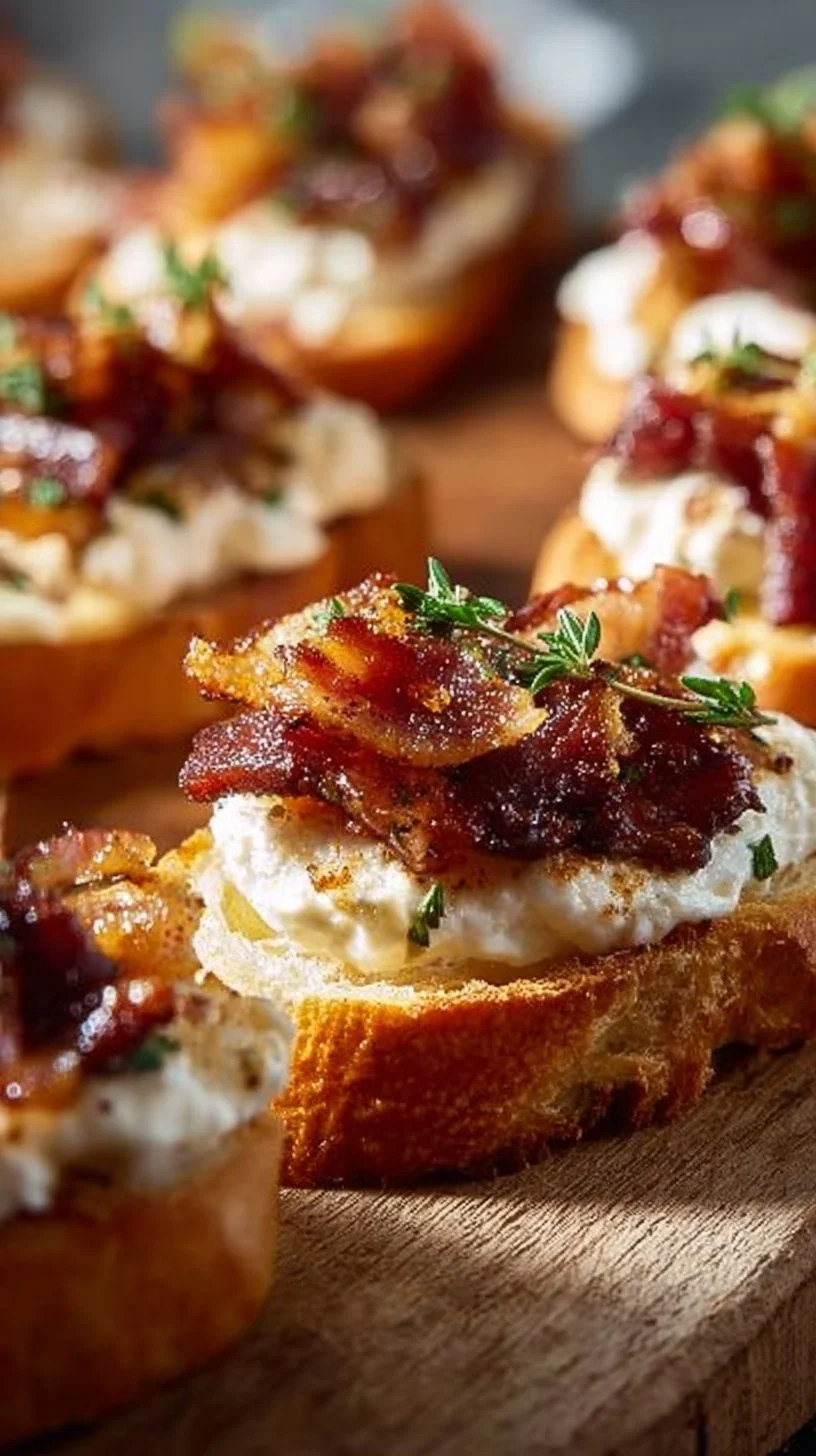
Million Dollar Bacon Crostini
Introduction
In a narrow kitchen in Sofia, where light slips through lace curtains and the air tastes faintly of coffee and history, a simple slice of bread can become an act of devotion. That is the feeling that rises when a Million Dollar Bacon Crostini slides from the oven: the sweet, smoky crunch of bacon against the cool tang of goat cheese, a drizzle of honey that glints like a late-afternoon sun on an old city tile. I learned to love these crostini not from a famous restaurant menu but at a friend’s table beneath a balcony overflowing with geraniums. It was a dish that felt both extravagant and intimate — the sort of bite you share with someone whose stories you are only beginning to know.
As a travel writer, I’ve watched food stitch together fragments of place, memory, and identity. These crostini do that work beautifully. In every crunch there is a whisper of markets and smokehouses, in every smear of goat cheese a memory of small farms and stubborn goats on Mediterranean hillsides. To me, they taste like evenings that fold into one another: a seaside town’s twilight, a mountain village’s hearth, a bustling capital’s late-night gathering. The recipe is straightforward, but the feeling it evokes is richly layered; it asks to be eaten slowly, with attention, and preferably with people whose laughter you will carry long after the crumbs are gone.
The origin story & regional influence behind this dish
Million Dollar Bacon Crostini, though named with the cheeky modernity of social media-era appetizers, is rooted in ancient instincts: preserve meat with salt and sugar, pair rich proteins with acidic dairy, and present small, shareable bites that encourage conversation. Crostini itself is Italian in origin — small, toasted slices of bread that were historically a rustic solution for creating portable plates at communal tables. In Tuscany, crostini were topped with liver, beans, or simple olive oil; elsewhere, across the Mediterranean and into Eastern Europe, toasted bread became a canvas for whatever abundance the region offered.
Bacon, cured pork, and sugar have their own global lineage. In the American South, brown sugar and spice on bacon echo the tradition of candied pork — a way of finishing salted meat that balances savory and sweet. In northern Europe, cured pork has been central to winter diets, while in the Middle East, a drizzle of honey over cheese is a classical finale. The Million Dollar Bacon Crostini is a transatlantic conversation: Italian toast meets American bacon innovation with a hint of honeyed Middle Eastern grace. It is an appetizer that could have been imagined in a Brooklyn loft, a Venetian bacaro, or a Sofia kitchen, and each place leaves its fingerprint on the final bite.
How to make Million Dollar Bacon Crostini
Making these crostini is less about technique than about ritual — the slow caramelization of bacon, the warm perfume that fills a small room, the way a loaf of bread seems to glow when sliced and toasted. Serve them at a table where stories arrive before dessert, where hands linger, and where the sound of clinking glasses becomes part of the recipe.
Ingredients :
2 packs thick-cut bacon, ½ cup brown sugar, 1 tbsp water, 1 tsp black pepper, ½ tsp cayenne pepper, ½ tsp red pepper flakes (optional, for extra heat), Optional twist: 1 tsp smoked paprika or maple syrup brushed on post-bake, 1 large baguette, sliced into 24 rounds, Olive oil (for brushing), Salt and pepper to taste, Optional twist: rub slices with garlic clove after toasting for extra flavor, 8 oz goat cheese log (or mix with a bit of cream cheese for a milder version), Maple syrup, honey, or hot honey (for drizzling), Optional garnish: chopped fresh thyme, chives, or candied pecans
Directions :
Preheat oven to 375°F (190°C). Line a baking sheet with foil and place a wire rack on top., Mix brown sugar, water, and spices in a bowl. Dredge bacon strips in the mixture and lay them on the rack., Bake for 25–30 minutes, flipping halfway, until crisp and caramelized. Let cool, then chop or break into bite-size pieces., Brush baguette slices with olive oil, season with salt and pepper, and toast in oven at 375°F for 8–10 minutes, flipping once, until golden., Spread goat cheese on each crostini, top with bacon pieces, and drizzle with maple syrup or hot honey., Finish with fresh herbs or a sprinkle of candied nuts for extra flair.
Ingredients through a cultural & historical lens
Each ingredient reads like a map. Thick-cut bacon carries the legacy of salt-curing, an ancient method to preserve meat before refrigeration. Brown sugar — molasses-rich and dark — traces routes of trade and empire, sweetening savory meats in ways that have comforted families for generations. Goat cheese, tangy and elemental, has shepherded human diets across the Mediterranean and into Eastern Europe; it is the terroir of small farms captured in a soft log. The baguette is a symbol of French bakery technique but also of the many ways societies elevate simple wheat into daily ritual.
Sprinkled through this list are optional twists: maple syrup that calls to mind cold Canadian forests and smoky sugar shacks; smoked paprika that evokes Spanish conservas and the sun-baked fields of La Mancha; garlic rubbed onto toast like a blessing across southern Europe. These small choices are how families make a recipe their own, layering migration stories, local produce, and personal memory. In every kitchen where this dish appears, the ingredients become bookmarks in a larger narrative about adaptation, resourcefulness, and celebration.
Cooking the dish: sensory notes & traditional techniques
The oven becomes a storyteller. As the bacon caramelizes, sugar melts and sears into crystalline patches on the meat, releasing aromas that are at once nostalgic and electrifying: burnt caramel, cured pork, warm smoke. That scent is an invitation — a promise that the first bite will be a small revelation. Toasted bread should be sun-dry and resilient, offering a crack that contrasts with the soft goat cheese. When you rub a toasted crostini with a halved garlic clove — a practice common in Catalan tapas and Sicilian antipasti — the bread becomes perfumed, the garlic’s sharpness tempered by the toast’s warmth.
Traditional techniques are modest: baking on a rack allows hot air to circulate and the bacon to crisp evenly, a detail that home cooks learned through trial and neighborly advice. Spreading goat cheese at room temperature gives it body and silkiness; in colder months, a spoonful softened with a splash of cream echoes centuries of cooks who would adapt dairy with the seasons. These tactile gestures — the scraping of sugar into a bowl, the careful brush of oil across bread — are as important as the timing. They keep the dish human.
How different regions prepare their version
Walk through Spain and you’ll find crostini cousins in montaditos and pintxos: small breads piled with jamón and manchego, where salty cured meats meet sweet peppers. In France, the marriage of cheese and jam on toast is a simple, elegant cousin. In New Orleans, candied bacon appears beside beignets at brunch, glistening with local syrups. In the Balkans and Eastern Mediterranean, you might find bread smeared with sheep’s cheese, topped with spiced meats or honey — a familiar texture with different accents.
In coastal regions, cooks swap goat cheese for ricotta or labneh, adding a tang that pairs with seafood-forward palates. In places where pork is less common for religious reasons, cooks substitute smoked fish or roasted vegetables, keeping the structure of a crunchy base, a creamy middle, and a sweet or spicy finish. Each region’s version is a respectful translation: the same language of contrasting textures and flavors, spoken with different accents and local vocabulary.
Traditional ways this dish is shared or served
Million Dollar Bacon Crostini thrives as a communal ritual. It appears at cocktail parties, seaside gatherings, and holiday spreads, where people graze and talk rather than sit in formal order. There is something democratic about crostini: every piece is modest, no one is left out of the pleasure. They are often served family-style on platters that travel from hand to hand, plates crowded with other small tastes — olives brined with lemon, roasted peppers, pickled onions — so conversations can drift like smoke.
In many cultures, small bites like these mark transitions: the pause between work and dinner, the start of a feast, the festive hour before a wedding meal. Hosts arrange them on wooden boards, their edges lined with herbs or nuts to signify care. Eating becomes an act of social maintenance; the crostini is not simply fuel but an excuse to slow down, share news, and pass along stories.
Storing the dish without losing its cultural essence
If there is one fortune-cookie truth about this recipe, it is that some elements are best enjoyed immediately. The bacon’s sugar crust will soften if stored in moisture, and the bread will surrender its crispness. But preserving the spirit is possible. Store the salted, caramelized bacon separately in a paper-lined container to keep it crisp; keep the goat cheese cold and the toasted bread at room temperature in a paper bag to retain snap. Assemble just before serving so warmth, texture, and aroma align.
Beyond technique, storing is about memory. Save a piece of the packaging from the market where you bought the goat cheese, a scrap of ribbon from the baguette’s bakery, or a note about the day you first made the recipe. These small archives preserve the dish’s story alongside the flavors. When you reheat the bacon briefly on a rack to revive its crunch, the kitchen will once again smell like that first evening you shared.
Cultural questions people often ask
Is it authentic? Authenticity is a slippery river. This dish is less about lineage than about lineage’s capacity to change. It borrows from many traditions, and that makes it honest — a contemporary folk creation.
Is it celebratory or everyday? Both. It can crown a holiday table or lend ordinary Tuesday a moment of ceremony. That dual nature is why it travels well across cultures.
Can it be vegetarian? Substitutions change the conversation but not necessarily the essence: roasted mushrooms or caramelized pears can offer the same sweet-savory interplay for those who avoid pork.
Why goat cheese? Goat cheese’s bright tang cuts through the bacon’s richness, acting as a palate cleanser between bites. In cultures where sheep or goat dairy dominates, it is the logical, ancient choice.
A closing note on food, memory & travel
Travel teaches that food is less a list of ingredients and more a ledger of human choices. A crostini becomes a map when you trace its textures back to a hillside farm, a smokehouse, a baker’s early morning labor. Each bite is an accumulation: of climate, of trade, of migration, and of tiny domestic decisions like whether to rub garlic on warm toast. For me, the Million Dollar Bacon Crostini is a lesson in intimacy — how grandeur can hide in the small, how extravagant names sometimes point to modest pleasures.
When I think of that table in Sofia, of the way the city’s mixed history folded into our conversation, the crostini are a shorthand for connection. We ate, we talked, we traded memories. We left with our pockets filled with the recipe’s afterimages: the glint of sugar on pork, the scent of warm bread, the taste of honey like an afterthought of sun. That is the true wealth of a recipe — not the price of its ingredients but the way it binds us to others and to the places we carry within us.
Conclusion
For a tested home version and step-by-step guidance, consider the recipe at Million Dollar Bacon Crostini – Hezzi-D’s Books and Cooks, which reflects the sweet-savory balance that makes this appetizer contagious. If you prefer a log-style party presentation with approachable notes, see the adaptation at Million Dollar Bacon Goat Cheese Appetizer Log – Snug & Cozy Life. For a creative twist pairing these candied bacon bites with spinach dip, explore the playful combination showcased at Spinach Dip Crostini with Million Dollar Bacon – Asili Glam.
Million Dollar Bacon Crostini
Ingredients
Method
- Preheat oven to 375°F (190°C). Line a baking sheet with foil and place a wire rack on top.
- Mix brown sugar, water, and spices in a bowl. Dredge bacon strips in the mixture and lay them on the rack.
- Bake for 25–30 minutes, flipping halfway, until crisp and caramelized. Let cool, then chop or break into bite-size pieces.
- Brush baguette slices with olive oil, season with salt and pepper, and toast in the oven at 375°F for 8–10 minutes, flipping once, until golden.
- Spread goat cheese on each crostini.
- Top with bacon pieces, and drizzle with maple syrup or hot honey.
- Finish with fresh herbs or a sprinkle of candied nuts for extra flair.