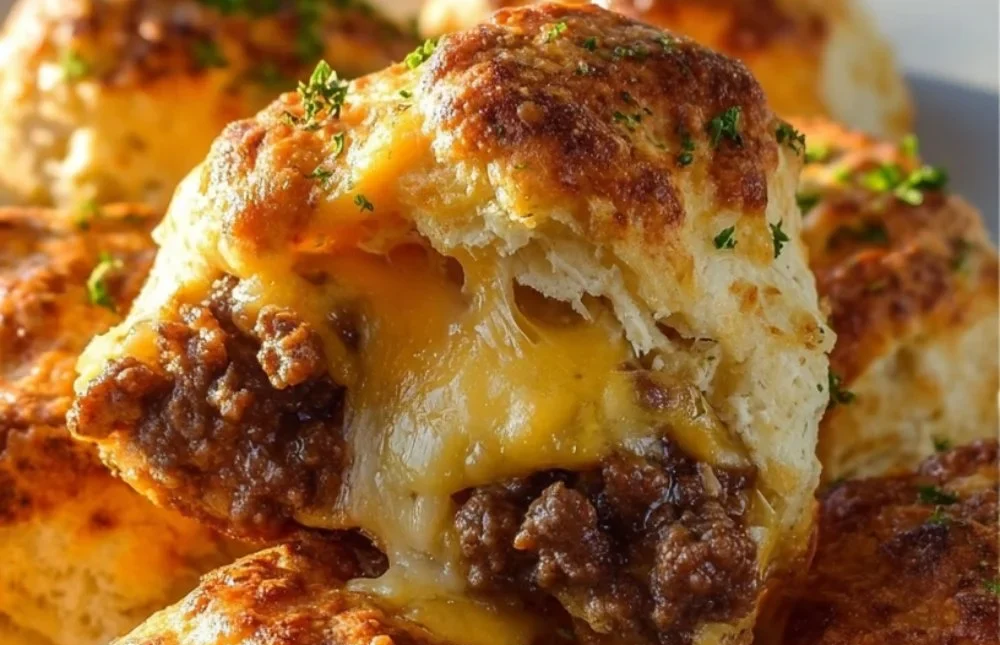
Cheesy Beef Biscuit Bombs
Introduction
I learned to love the small explosions of comfort that happen when a simple dough envelops a savory heart in a kitchen in which the map on the wall had more pins than the passport. The woman who taught me—Sofia—was not the city but a careful cook from a place that believed in generous hands and louder laughter. In her kitchen, the oven was a hearth of hospitality, and biscuit dough was currency: quick, forgiving, and beloved. She called these little parcels “bombs” with a grin, not out of menace but because the first bite detonated warm cheese and seasoned meat across the palate like a happy memory made edible.
That is the intimacy that Cheesy Beef Biscuit Bombs carry into any room: they arrive simple, unpretentious, and wholly inviting. They are not a single-origin artifact but an improvised hymn to the ways cultures negotiate hunger and joy—an American mashup that tastes like home no matter which home you bring it to.
The origin story & regional influence behind this dish
To trace the lineage of Cheesy Beef Biscuit Bombs is to travel through the kitchens of the American South and the melting pot of modern convenience. Biscuits—flaky, comforting rounds—are the North American descendant of the quick breads that English settlers adapted and perfected with local fats and buttermilk. Ground beef speaks to the Midwest and its ranching landscapes; cheddar cheese is both English in origin and American in its cultural migration, becoming a staple in chest-high fridges and family picnics.
This recipe sits at the intersection of Southern hospitality and mid-century American pragmatism: it borrows the biscuit’s communal history and marries it to the cheeseburger’s portable, satisfying appeal. In many American regions, potlucks and tailgates demanded dishes that could be made quickly, carried easily, and fed a crowd; the refrigerated biscuit can was practically invented for that hurried generosity. The result is a tiny, stuffed monument to a culture that prizes conviviality—where the best dishes are those you can hold, share, and eat without ceremony.
How to make Cheesy Beef Biscuit Bombs
Making these bombs is less about culinary virtuosity and more about ritual: gathering, filling, sealing. It is a family assembly line or a solo meditation—both conducive to stories told between folds of dough. The hands do the measuring of memories, pressing and pinching in the same movements that stitched generations together around tables. Below are the raw materials and the steps as Sofia taught me—unchanged, because recipes are stories and those sentences are part of the narrative.
Ingredients :
1 pound ground beef, 1 cup shredded cheddar cheese, 1/2 cup cream cheese, softened, 1 can refrigerated biscuit dough, 1/4 cup grated Parmesan cheese, 1 teaspoon garlic powder, 1/2 teaspoon onion powder, 1/4 teaspoon black pepper, 1 tablespoon melted butter
Directions :
Preheat your oven to 375°F (190°C). , In a large skillet, cook the ground beef over medium heat, stirring occasionally to break it apart. , Cook the beef until it is fully browned, about 6-8 minutes. , Drain any excess grease from the skillet and return the beef to the heat. , Stir in the garlic powder, onion powder, and black pepper, and cook for another 1-2 minutes until the spices are well combined with the beef. , Remove the skillet from the heat and allow the beef mixture to cool slightly. , In a mixing bowl, combine the cream cheese, shredded cheddar cheese, and grated Parmesan cheese. , Add the cooled beef mixture to the cheese mixture and stir until everything is evenly mixed. , Open the can of refrigerated biscuit dough and separate the biscuits. , Flatten each biscuit into a small round disc with your hands or a rolling pin. , Spoon a generous amount of the beef and cheese mixture into the center of each biscuit. , Carefully fold the edges of each biscuit around the filling and pinch them together to form a sealed ball. , Place each filled biscuit bomb onto a baking sheet lined with parchment paper or a silicone baking mat, making sure they are evenly spaced. , Brush the tops of the biscuit bombs with the melted butter for a golden, crispy finish. , Bake the biscuit bombs in the preheated oven for 12-15 minutes or until the biscuits are golden brown and cooked through. , Remove the biscuit bombs from the oven and allow them to cool for a few minutes before serving.
Ingredients through a cultural & historical lens
Look at each ingredient and you’ll see a lineage: ground beef is the story of pastures and working hands, the kind of meat that powered factory workers and farmers alike. Cheddar and Parmesan are echoes of trade routes and taste migrations—Parmesan carrying the old world’s tang, cheddar softened into the ubiquitous shreds sold in plastic bags across supermarkets. Cream cheese, with its smooth, spreadable profile, is a mid-20th-century invention of spreadable convenience; it entered home kitchens as a symbol of modern hospitality and has since become an ingredient that turns ordinary into indulgent.
Refrigerated biscuit dough is the modernist chapter in this story: the industrialization of baking, the promise of time saved, the small rebellion against starting from scratch. Garlic and onion powders speak to spice cupboards that bridge time zones—an accessible nod to savory aromatics without the fuss. Even the melted butter brushed atop each bomb is a cultural act: butter is both a flavor and a signifier of generosity, the final gilding that says “this is for guests.”
Cooking the dish: sensory notes & traditional techniques
To make Cheesy Beef Biscuit Bombs is to orchestrate a little symphony. The first sound is the sizzle of beef hitting a warm skillet, the kitchen filling with a roasted, meaty smell that primes the appetite. As the meat browns, nutty notes emerge from the Parmesan and the sharper, milky tang of cheddar begins to suggest the promise of melt. Cream cheese smooths everything into a velvety center, so the interior becomes a molten, savory core that contrasts with the crisped exterior.
There is a ritual in flattening dough—quiet and tactile—bringing hands into a kinship with the recipe. Pinching dough into a sealed orb is an intimate act of trust; it promises that whatever warmth is inside will stay there until the first bite. Baking transmutes the raw into the golden: the tops blister and caramelize, butter seeps into the edges, and the aroma that emanates is the one that signals arrival—golden, buttery, and impossible to resist.
Though the recipe is straightforward, the technique that often accompanies it in communal settings is traditional: families line up around a kitchen island, each person taking a role—one flattens, another piles filling, a third seals and places on the tray. There is a rhythm, a music of hands that is as much part of the dish as the ingredients.
How different regions prepare their version
Regional variations of this idea are where the recipe sings. In the American South, the biscuit might be made from scratch with buttermilk, whispering of lard and decades-old pans. In Texas, jalapeños or pepper jack may slip into the filling, and cumin or smoked paprika will hint of barbecue. In the Midwest, a denser cheddar and an emphasis on hearty, diner-style flavors prevail. Coastal cities might add a touch of herbs or serve the bombs with pickled slaw to cut through the richness.
Across the Atlantic, similar concepts—stuffed breads like British pasties or Italian panzerotti—show how different cultures solve the same craving for portable, stuffed comfort. In Eastern Europe, pirozhki are the beloved cousins: bread encasing meat or cheese, served warm from street vendors and family ovens alike. Each regional spin tells a small story about climate, local produce, and the kinds of communal gatherings that define a place.
Traditional ways this dish is shared or served
Cheesy Beef Biscuit Bombs thrive at gatherings that are loud and generous: potlucks, children’s birthday tables, tailgates, and the late-night counters of convenience. They are the hands-off appetizer at a party—something guests can hold while their mouths and hands do the social work. They also travel well in lunchboxes, wrapped in foil like a small, edible letter from home. In some families, they are a weekend tradition, assembled on a Saturday afternoon while radios recite weather and neighbors pass through.
Serving them is a ritual of its own: a tray passed around, napkins offered like gentle diplomacy, a jar of ketchup or a bowl of pickles set nearby as optional companions. The communal aspect—eating with fingers, sharing stories—reinforces the social function of the recipe as much as its culinary one.
Storing the dish without losing its cultural essence
Storage is about preserving not only texture but also the invitation to gather. These bombs travel well—refrigerated and reheated, they retain much of their soul. Wrapped individually, they keep the intimacy of a single-serve comfort and the memory of hands that shaped them. Freezing is a pragmatic choice in many homes: make a large batch, freeze on a tray, then tuck into a bag for the days when hospitality must be swift.
When reheating, there is a small ceremony in reviving the crisp exterior and molten interior—gentle heat, a brief time in the oven, and the aroma will again signal hearth and welcome. The real secret, culturally speaking, is the gesture: reheating and offering is as meaningful in some families as the initial baking.
Cultural questions people often ask
Is this Southern? Yes and no. It borrows from Southern biscuit traditions but is essentially a fusion: part cheeseburger, part hot-pocket, part picnic staple. Is it modern or traditional? It is both—a modern convenience built on traditional forms. Could it be vegetarian? Of course; the spirit is a filled biscuit, and many cultures swap proteins based on economy and availability.
People also ask who “owns” such a dish. The answer is always collective. Recipes like this belong to kitchens, to potlucks, to the hands that made them on rainy afternoons or before parades. They do not belong to a single origin story but to the network of family tables and community rituals that reproduce them.
A closing note on food, memory & travel
Travel teaches you that dishes matter less for their originality and more for the connections they create. Cheesy Beef Biscuit Bombs are not an artifact in a museum; they are a spoonful of migration, invention, and domestic generosity folded into dough. They remind me of kitchens where strangers became friends over a tray of warm things and where maps were smudged by flour and fingerprints. Food is a way we tell stories without speaking—an invitation, a comfort, an argument for togetherness.
When I travel, I search for those small parcels of meaning: a bun pressed in a market, a pastry passed between shepherds, a biscuit shared at dawn. Each one reframes the world in edible terms, and each one—like Sofia’s bombs—becomes part of the geography of the heart.
Conclusion
If you want to explore variations of this concept, try the family-friendly twist at Cheeseburger Biscuit Bombs – Kids Kubby, which emphasizes simple flavors for little hands; for a homecook’s narrative and tips, see the cozy write-up at Cheeseburger Biscuit Bombs – Genuinely Jana; and for another enthusiastic home-kitchen take that celebrates the indulgent spirit of these parcels, visit Cheeseburger Biscuit Bombs (Scrumptious!). Wherever you find them, these biscuit bombs will keep offering that small, explosive pleasure of warmth, flavor, and the memory of hands that made them.
Cheesy Beef Biscuit Bombs
Ingredients
Method
- Preheat your oven to 375°F (190°C).
- In a large skillet, cook the ground beef over medium heat, stirring occasionally to break it apart.
- Cook the beef until it is fully browned, about 6-8 minutes.
- Drain any excess grease from the skillet and return the beef to the heat.
- Stir in the garlic powder, onion powder, and black pepper, and cook for another 1-2 minutes until well combined.
- Remove the skillet from the heat and allow the beef mixture to cool slightly.
- In a mixing bowl, combine the cream cheese, shredded cheddar cheese, and grated Parmesan cheese.
- Add the cooled beef mixture to the cheese mixture and stir until evenly mixed.
- Open the can of refrigerated biscuit dough and separate the biscuits.
- Flatten each biscuit into a small round disc.
- Spoon a generous amount of the beef and cheese mixture into the center of each biscuit.
- Fold the edges of each biscuit around the filling and pinch them together to form a sealed ball.
- Place each filled biscuit bomb onto a baking sheet lined with parchment paper or a silicone mat, ensuring they are evenly spaced.
- Brush the tops of the biscuit bombs with melted butter.
- Bake the biscuit bombs in the preheated oven for 12-15 minutes or until golden brown.
- Remove from the oven and allow to cool for a few minutes before serving.