Easter Trifle Dessert
Introduction
On a spring morning in a coastal town where the sea smells of salt and fresh bread, the trifle arrives like a recollection — layered, luminous, and somehow inevitable. I learned to read this dessert like a map: each stratum of cake, pudding, fruit and cream is a village, a market stall, a conversation. Growing up between plazas and packing crates of citrus, I was taught that certain sweets are ways of telling a story aloud. The Easter Trifle Dessert is one of those stories — a tactile, shared narrative that appears at kitchens and communal tables across continents every year.
I remember a rainy Easter when an acquaintance in a London flat opened her fridge and revealed a trifle so monumental it could have housed a small choir. The scent of vanilla rose up and filled the room, and with each spoonful we traced homecomings and small domestic rituals. That trifle sat alongside other playful fusings of tradition and novelty — a cousin to the imaginative bite I later encountered in a street-food stall offering dessert tacos, where layers were more casual but the impulse to combine textures felt kin. As a traveler who writes about food, I find that trifles are the sort of dish that asks nothing of ceremony and everything of memory: they hold the past and present one spoonful at a time.
The origin story & regional influence behind this dish
The trifle’s origins are a braided tale, stitched from the kitchens of medieval England, the patisseries of modern Europe, and the pantry improvisations of immigrant families. The word itself — rooted in a sense of “trifle” as something small and pleasing — betrays its evolution. Early trifles were more custardy and wine-soaked, a testament to a time when fortified wines and preserved fruits marked feasts. Over centuries, the trifle shed some of its austerity and absorbed domestic innovations: sponge cakes replaced dense breads, creams softened into custards, and fresh fruit made seasonal appearances.
As the recipe traveled, it adapted. In Britain, trifle became official company for Boxing Day and Easter, a communal finale after roast and sermon. In the United States, the dish arrived with settlers and later with home cooks who loved a dessert that could be dressed up or down: showy for holidays, simple for weeknight endings. In Australia and South Africa, local berries and cream bring sun-washed, tart brightness; in parts of Latin America, layered desserts echo trifle’s scaffolding with dulce de leche and tropical fruit. Even within one country, regional influence leaves fingerprints: coastal kitchens favor citrus and fresh berries, inland homes rely on preserved fruits and heavier creams. The Easter Trifle Dessert is less a single recipe and more a framework for celebration — a mirror of landscape, season, and the human desire to mark passage.
How to make Easter Trifle Dessert
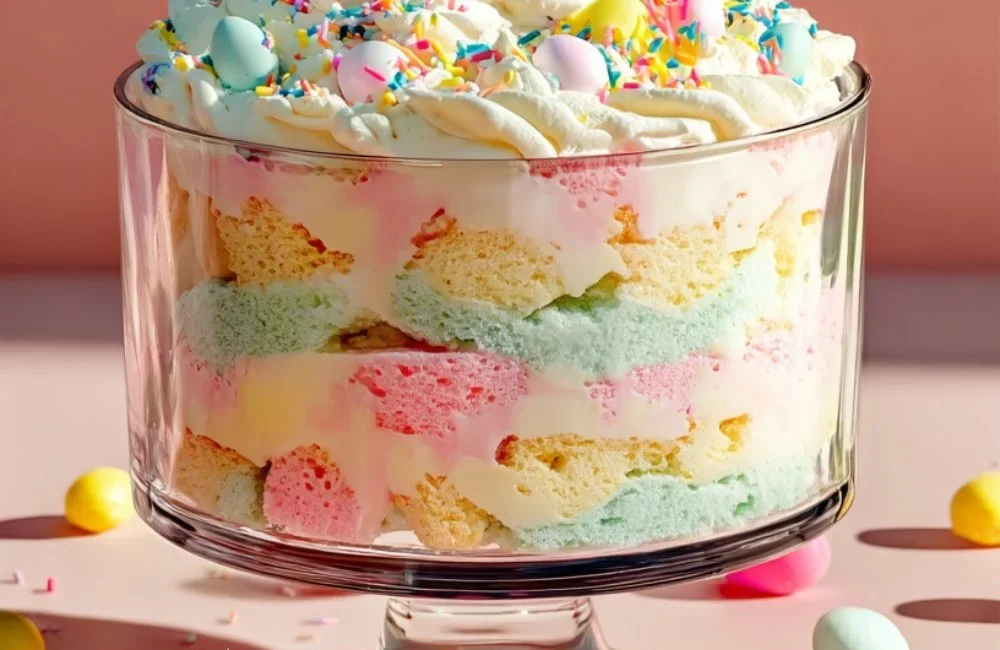
Making an Easter trifle is as much about assembling memories as it is about arranging ingredients. Imagine a shallow glass bowl like a small aquarium, where each layer floats in view: ladyfingers or sponge cake at the bottom, creamy vanilla pudding as a nourishing tide, then a scatter of bright strawberries and blueberries, all crowned by clouds of whipped cream. The ritual of layering is quiet and domestic — a child pressing cookies into the bowl, an elder smoothing pudding with a spoon, hands smudged with berry juice and laughter. This is not the place for clinical precision; elegance here is found in the generosity of layers and the convivial mess of spoons at the table.
The recipe is forgiving on technique but strict in sentiment: chilled before serving, so the flavors knit and the textures sing together. Doing this in a community kitchen, where multiple hands take turns, transforms the act into a small ceremony: someone cuts the cake, someone folds the cream, and someone else remembers how their grandmother always used a sprig of mint to finish. The result is more than dessert — it’s an archive of family, an edible photograph of the moment.
Ingredients :
Ladyfinger cookies or sponge cake, Vanilla pudding, Fresh strawberries, sliced, Fresh blueberries, Whipped cream, Mint leaves for garnish
Directions :
- In a large bowl, prepare the vanilla pudding according to package instructions. Let it cool.
- In a trifle dish or a large glass bowl, layer ladyfinger cookies or pieces of sponge cake at the bottom.
- Add a layer of vanilla pudding on top of the cookies.
- Layer fresh strawberries and blueberries on top of the pudding.
- Add a layer of whipped cream over the fruit.
- Repeat the layers until the dish is filled, ending with a layer of whipped cream.
- Garnish with mint leaves.
- Chill in the refrigerator for at least 2 hours before serving.
Ingredients through a cultural & historical lens
Each item in this list carries a lineage. Ladyfinger cookies — light, finger-shaped sponge biscuits — trace back to European tea-time traditions, where delicate confections were prized for their ability to absorb creams and liqueurs without collapsing. Sponge cake, meanwhile, speaks of homely ovens and hands that learned to coax air into batter without modern gadgets. Vanilla pudding is emblematic of mid-20th century home kitchens, when boxed mixes promised reliability and convenience; its presence in this recipe reflects the way home cooks adopted industrial products and turned them into heirlooms of taste.
Fresh strawberries and blueberries tell a seasonal story: they are the bright punctuation of spring, a promise of warmth after winter, and their color palette has made them synonymous with Easter’s pastel and jewel tones. Whipped cream, ethereal and immediate, is both a texture and an emotion — lightness that lifts the whole. Mint leaves, final and fragrant, speak of garden windowsills and the small, green things we cultivate to garnish life.
Seen together, these ingredients are a meeting of convenience and ritual, of store-bought shortcuts and garden-fresh gestures. They are also a lesson in how modern holidays repurpose both tradition and commerce, composing a dessert that is at once affordable and ceremonial.
Cooking the dish: sensory notes & traditional techniques
To make a trifle is to practice patience; the chilling period is where textures harmonize and flavors settle. When you open the refrigerator after those first two hours, the aroma is dominated by vanilla and brightened by berry acidity. The pudding, now cool and slightly condensed, holds firm against the porous texture of the ladyfingers or cake, which will have softened into a pudding-sponge hybrid — a contrast of tender chew and sumptuous cream.
Spoonfuls reveal an orchestra of textures: the quick snap of a blueberry, the velvet slide of pudding, the pie-like chew of soaked sponge, and the airy lift of whipped cream. In traditional kitchens, an elder might have encouraged a very deliberate layering technique, pressing each cookie gently to allow a subtle infusion of flavor. In other homes, a more rustic hand prevails, with broken cake pieces thrown in and pudding ladled without fuss. Both methods yield pleasure; the guiding principle in older households was always communal sharing — a large bowl in the center of the table, not individual cups.
In some families, a splash of sherry or fruit liqueur is added to the cake layer, harking back to ancestral practices of preserving fruit and flavor with alcohol. While this recipe is silent on spirits, the cultural technique remains a whispered option for those who like their trifles with an edge of history.
How different regions prepare their version
Across regions the trifle keeps its scaffold but alters its costume. In England, you might find a trifle that nods to the Victorian table — soaked sponge, brandy-soaked cherries, and custard thick enough to stand a spoon. In the United States, the trifle often leans towards the modern and playful: instant pudding mixes and fresh fruit create a bright, approachable dessert for large gatherings. In Australia, the widespread availability of strawberries in spring transforms the trifle into a sunlit confection, sometimes joined by passionfruit. In South Africa, local fruits and condensed milk play cameo roles, and in Latin American homes, you may find layers reminiscent of trifle but with dulce de leche and tropical fruit as the main players.
The ways in which regions adapt trifles reflect climate and harvest: where berries are abundant, they star; where citrus is king, lemon curd or zest will appear. Places with strong preserves traditions may prefer candied peels or marmalades folded in. In each case, the trifle becomes a ledger of what the land and season provide, and how households choose to celebrate.
One modern offshoot is the mini-trifle, individual servings served in glasses for ease at parties; another is the deconstructed trifle seen in restaurants, where chefs re-interpret layers into elegant, separate elements on a plate. Yet, whether in a village hall or a metropolitan restaurant, the cultural impulse is the same: to present a dessert that honors abundance and enables sharing.
Traditional ways this dish is shared or served
Easter trifles are social beasts. They are brought to potlucks, set on church hall tables, and presented at family gatherings after the main meal. The large, communal bowl plays an essential role: everyone serves themselves, and the act of spooning into the bowl is a nonverbal form of intimacy. In some homes, the trifle is reserved for children first — a joyful inversion of the typical adult-first rule — while in others, elders take the first portion as a blessing.
The trifle’s presentation is often ceremonial. Garnishes are not mere decoration but signifiers: a sprig of mint suggests freshness and new beginnings; a ring of berries around the rim is a wreath for spring. In contemporary family tables, the trifle sits amid casseroles and roasted meats, but it carries its own gravity. It is one of the dishes that invites stories: “This is how my aunt used to make it,” or “We always put extra strawberries on top.” These statements are recipes and memories woven together.
For those who enjoy exploring sweet parallels, the trifle can sit comfortably next to other Easter confections — for example, homemade bars that echo the season’s colors and textures; a family I visited paired their trifle with a tray of Easter cake mix cookie bars, a humble companion that kept children busy while adults lingered over long spoons and conversation.
Storing the dish without losing its cultural essence
Storage is practical but also symbolic. A trifle kept overnight will often taste better; resting allows the layers to commune. Cover the bowl gently so the whipped cream does not absorb refrigerator smells, and keep it cold — trifles are fragile, temperamental things in warm air. If you need to prepare in advance, assemble most of it but leave the final whipped cream crown until shortly before serving; this preserves the visual and textural contrast that makes a trifle feel celebratory.
If transport is necessary — to a picnic or community hall — choose a cooler with ice packs and a sturdy lid. The journey itself becomes part of the ritual: carrying the dessert across town is a way of delivering care. Families with long-standing traditions often have a specific, beloved container reserved for this role; handing over that bowl to the host is an act of trust and continuity.
Cultural questions people often ask
People frequently ask whether trifle is old-fashioned or how to modernize it. The answer is both: trifle is timeless because it adapts. Questions about alcohol in the layers reveal generational divides — some see sherry as essential, others as optional nostalgia. Others ask about substituting ingredients for dietary needs; communities creative with constraints have historically used substitutions without feeling that they had abandoned tradition, because the essence of the trifle is communal sharing more than a strict ingredient list.
Another common question concerns presentation: must a trifle be in a glass bowl? Glass matters because it makes the layers visible, turning the dessert into a landscape to be admired before it is eaten. Yet, any deep dish will do; what matters is the act of layering and the shared experience that follows.
A closing note on food, memory & travel
Travel teaches that food is a language of place and people, and the Easter trifle is a dialect rich with inflection. Each spoonful can translate landscape into flavor: seaside air into saline-bright berries, inland orchards into jammy sweetness, hearth warmth into sponge and cream. The trifle travels on the breath of conversations, in the hush after the dessert is set down, in the laughter that follows a shared forkful. It is a dessert that demands presence — not precise measures, but attentive assembling and generous serving.
If you travel with a trifle, you travel with a story you can share. If you are invited to one, you are offered more than dessert; you are invited into a household’s memory. For me, the trifle will always be a kind of map: a map to the rooms I’ve been welcomed into and the faces that have smiled across the bowl.
Conclusion
For a modern take and inspiration, see this Easter Trifle Dessert exploration at Easter Trifle Dessert – Bitz & Giggles, which offers inventive presentation ideas. If you prefer a homey, step-by-step family approach, consult the version at Easter Trifle Dessert – The Cookin Chicks for comforting variations. For a playful Cadbury egg–inspired riff with video guidance, consider this recipe collection at Best Easter Trifle Recipe (Cadbury Egg Dessert) + Video.
Easter Trifle Dessert
Ingredients
Method
- In a large bowl, prepare the vanilla pudding according to package instructions. Let it cool.
- In a trifle dish or a large glass bowl, layer ladyfinger cookies or pieces of sponge cake at the bottom.
- Add a layer of vanilla pudding on top of the cookies.
- Layer fresh strawberries and blueberries on top of the pudding.
- Add a layer of whipped cream over the fruit.
- Repeat the layers until the dish is filled, ending with a layer of whipped cream.
- Garnish with mint leaves.
- Chill in the refrigerator for at least 2 hours before serving.