Blackberry Pistachio Dream Bars
Introduction
There are places that taste like memory, and there are recipes that carry the geography of a thousand small journeys. I first met the blackberry and pistachio duet on a rain-softened afternoon in a coastal town where markets still smelled of sea and sugar. A woman named Sofia—after whom this introduction borrows its name—sold small squares of a nut-speckled bar from a stall that had been in her family for three generations. She wrapped each piece in waxed paper, and as she handed one to me she traced with her thumb the soft ripple of the crust and said, with the very deliberate tenderness of someone who keeps tradition like a secret, “Eat it while it’s still warm.” That warmth is the same warmth that lives in these bars: the green of pistachios like inland groves warmed by sun, the tart dark swell of blackberries gathered from hedgerows, and the soft, yielding comfort of a shortbread crust that crumbles like a small story.
Food is always a map of place and time. As you read, imagine markets with low awnings, the clack of cups in cafés, or the hush of a morning kitchen where hands move with ancient, well-practiced choreography. If you like the playful simplicity of bar cookies and want a different rhythm to your pantry, these bars sit between a tart and a cookie: portable, communal, and immediate. For a similar kind of bar simplicity reshaped by modern convenience, I have often thought of the way American bakers riff on boxed mixes—some playful experiments exist in recipes for cake mix cookie bars, which channel that same spirit of accessible, joyous baking.
The origin story & regional influence behind this dish
Blackberries are wild storytellers, growing where hedgerows meet field and river. They are as much a part of English-speaking countryside lore as they are of mountain paths in the Balkans and the Eastern Mediterranean. Pistachios, in contrast, carry a different lineage: small, sun-bronzed seeds that traveled from the Iranian plateau and Anatolia through trade routes and household kitchens, eventually finding their way into sweets and pastries around the Mediterranean and the Levant. To weave these two together into a single bar is a quietly modern act of culinary translation—a meeting of northern hedgerow and southern orchard.
The bar form itself owes much to American baking traditions, where slabs of dough and fillings are pressed into pans and portioned into handheld squares, ready for lunchboxes, train rides, and church socials. Yet when I talk to bakers in southern Italy or to women in Istanbul who fold walnuts into phyllo, I hear the same idea: a single tray of pastry made to be shared. The Blackberry Pistachio Dream Bars are thus a hybrid: their temperament is North American, their ingredients carry Mediterranean and wild-European histories, and their spirit is utterly communal. In some homes, a variation might be called a traybake or a slab cake; in others, simply a gift wrapped in paper and tied with string.
How to make Blackberry Pistachio Dream Bars
This recipe is deceptively simple—a few humble ingredients coaxed into a moment of delight. There’s comfort in the economy of the list, and poetry in the way blackberries yield their dark, jewel-like juice against a sandy, buttery base. Before you begin, picture the bowl as a stage and your hands as storytellers: press, fold, bat, and let the oven finish the narration. Below are the exact ingredients and directions that preserve the integrity of the recipe; I share them without alteration, as reverence for the original is part of the cultural respect each recipe deserves.
Ingredients :
1 cup unsalted butter (melted), 1 cup granulated sugar, 2 cups all-purpose flour, 2 cups fresh blackberries, 1 cup chopped pistachios, 2 large eggs
Directions :
Preheat your oven to 350°F (175°C) and grease your baking dish., In a bowl, mix melted butter, sugar, and flour until crumbly; press the mixture into the bottom of the prepared dish., In another bowl, whisk together eggs and sugar until fluffy; gently fold in blackberries and chopped pistachios., Pour the blackberry filling over the crust and bake for 25-30 minutes or until set., Allow to cool completely before cutting into squares.
Ingredients through a cultural & historical lens
Every ingredient here carries a story beyond its measurement. Butter—seen here melted for ease—has historically been a sign of pastoral life: churned in small homesteads, used as both sustenance and currency of hospitality. Sugar, once the luxury of the few, now sweetens commonplace rituals; the granular white here speaks to a modern pantry where refined sugar became a symbol of celebration and daily comfort. Flour, the bedrock of so many cultures’ baked goods, is the transformed grain: wheat ground in stone or steel, representing centuries of agriculture and labor.
Blackberries bring the wild: their tartness is a reminder of foraging walks along lanes and riverbanks, of baskets stained like frescoes from their juice. Pistachios bring sun and trade: their green flecks conjure patios in southern climes, the spice markets of old cities, and the hands of harvesters who pick them from gnarled trees. Eggs bind memory as much as they bind mixture—an agricultural constant in kitchens across continents. Together, this small roster of grocery staples becomes a palimpsest of migration, trade, and the slow exchange of tastes.
Cooking the dish: sensory notes & traditional techniques
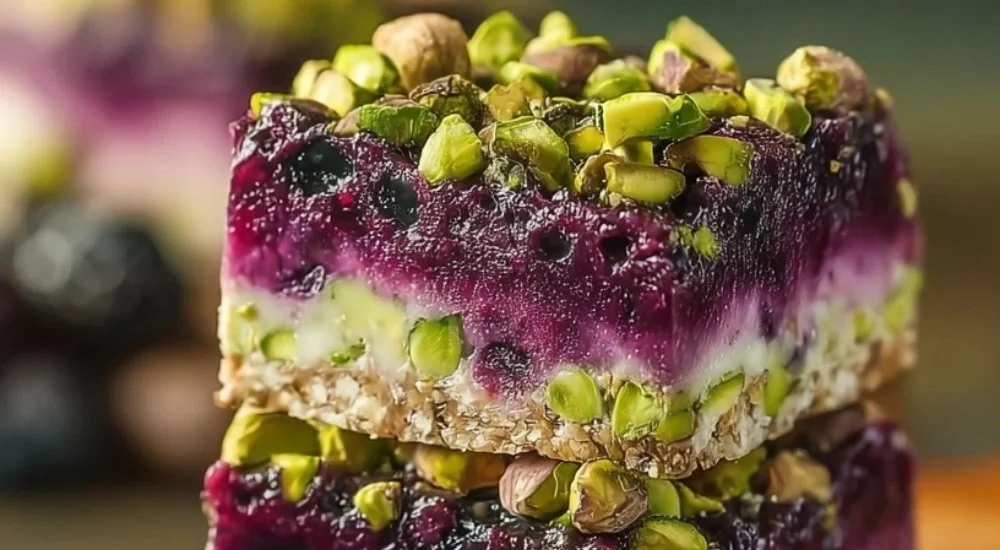
The first sensation is smell: as the butter and sugar kiss the air, you’ll sense something like a seaside bakery or a Sunday brunch—warm, slightly nutty, leaning into caramel. When the crust presses into the dish, there’s a tactile joy: it yields like fine sand made solid, a promise of crunch that will become tender when the filling’s juices settle into it.
As the oven does its alchemy, the blackberries release their acids and sugars; their scent shifts from bright and green to deep and wine-like. The pistachios offer a counterpoint—an herbaceous, almost resinous note that lifts the fruit’s darker perfume. When you cut into the cooled bars, the crust should fracture softly under the knife, releasing a whisper of sugar dust, while the filling pulls with a slightly sticky insistence, flecked with green and black. Traditional techniques that echo here are simple and humane: mixing by hand, folding gently so the berries remain intact, and letting the bars cool fully so they hold their shape—each seemingly small choice is steeped in the kind of patient care passed down across generations.
For those looking for a kinship in form, one can find a similar tenderness in regional innovations where bakers press and layer flavors into trays—there is a kinship that extends even to modern home-baked plays like easy baked donut bars, which reinterpret textures and conviviality for contemporary tables.
How different regions prepare their version
Travel teaches you the many ways a simple idea can mutate. In parts of southern Europe, the pistachio might be ground into a paste and folded into the batter, turning the bar into something closer to a dense, nutty slice that echoes pistachio kalács or marzipan. In northern climates where blackberries climb hedgerows in abundance, some bakers macerate the berries with a little lemon zest and sugar before folding them into eggs, which brightens their tartness. In the Levant, one might encounter a dusting of orange blossom sugar or a finish of toasted sesame for contrast. In the American Midwest, oats or a streusel are sometimes added to the crust, making the bar heartier and more breakfast-friendly.
Each regional tweak tells a story of what was available and what was loved: a splash of lemon from a backyard tree, a handful of nuts saved from last autumn’s harvest, a spoonful of rosewater saved for festivals. These small signatures are the fingerprints of place.
Traditional ways this dish is shared or served
Where I’ve watched these bars exchanged, they are seldom solitary affairs. They arrive on plates at afternoon teas, wrapped in wax paper at farmers’ markets, or stacked on trays at family gatherings. In some towns, a baker will cut them into squares and arrange them like little courtyards on a platter, allowing guests to select a corner or a middle. They travel well, which makes them perfect for potlucks and pilgrimages—people tuck them into baskets beside jars of preserves for long train rides or hikes.
There is a ritual to serving: a tea poured from a chipped pot, hands that insist on one more for the road, and a conversation that always returns to the weather of the berry season or the luck of a good harvest. The bar becomes a social object, a way of saying, “I thought of you,” with the simplicity of a shared sweetness.
Storing the dish without losing its cultural essence
To preserve these bars is to preserve their story. Wrap them in cloth or greaseproof paper, not to mask them but to keep their aromas as part of the bundle. At room temperature they remain soft and fragrant for a couple of days; refrigerated, they firm up and keep for longer—this is practical, but remember that cold mutes the aromatics, so allow them to return toward room temperature before serving to recover their character.
Freezing is a sensible travel trick: frozen, they can be a keepsake for seasons when blackberries are absent. Thaw slowly and let the bar breathe. The cultural essence—its memory of hands, of markets, of the smell of beyond—resides in how you share them as much as in how you store them. A wrapped square handed to a neighbor retains its stories even after a winter thaw.
Cultural questions people often ask
What makes these bars different from a tart or a crumble? They belong to the portable spectrum of desserts—less fussy than a tart, more composed than a crumble, and perfectly at ease in the palm of a hand. Why pistachios, and not almonds or walnuts? Pistachios narrate a particular lineage: their warmth and color bring a Mediterranean sun to the hedgerow tang of blackberries. Can you substitute frozen berries? Yes, though many will tell you frozen berries carry a different texture, and the smell of fresh blackberries is part of the charm that connects a bar to the season it was born in.
People also ask about the name—why “dream”? Perhaps because these bars are a quiet, unassuming dream: nutty, bright, and intimate, like a memory you wake up to in a different country and carry home in your suitcase.
A closing note on food, memory & travel
There is a certain humility to a bar: it doesn’t demand ceremony, but it invites company. Making these bars is like walking through different regions without leaving the kitchen; you carry the hedgerow taste of blackberries and the sun-tinted whisper of pistachios into the domestic present. In kitchens across cities and villages, people fold similar impulses—preserve what is good, share what is abundant, and make sweetness portable.
To travel with food is to collect small, human stories—the woman named Sofia who wrapped her bars in paper, a friend who once stitched pistachio kernels into a cake in a mountain village, a child who learned to fold dough on a rainy afternoon. These snacks are not only sustenance; they are memory made edible. The Blackberry Pistachio Dream Bars are a lesson in how humble ingredients can become an emissary for place, telling stories of trade, harvest, and gentle domestic ritual.
Conclusion
If you want a modern reference that riffs on berry-and-nut bars while exploring different textures, consider how other cooks have approached similar combinations—some delightful variations can be found in resources like Blackberry Pistachio Dream Bars, which reflect the same impulse to marry fruit and noble nuts, and in riffs such as Blackberry Pistachio Oat Crumble Bars – Spices in My DNA that experiment with crumb and crust in different cultural registers. These links can guide you toward new iterations while you keep the original spirit of the recipe alive: simple, shared, and rooted in place.
Blackberry Pistachio Dream Bars
Ingredients
Method
- Preheat your oven to 350°F (175°C) and grease your baking dish.
- In a bowl, mix melted butter, sugar, and flour until crumbly; press the mixture into the bottom of the prepared dish.
- In another bowl, whisk together eggs and sugar until fluffy; gently fold in blackberries and chopped pistachios.
- Pour the blackberry filling over the crust and bake for 25-30 minutes or until set.
- Allow to cool completely before cutting into squares.