Ooey Gooey Butter Cake
Introduction
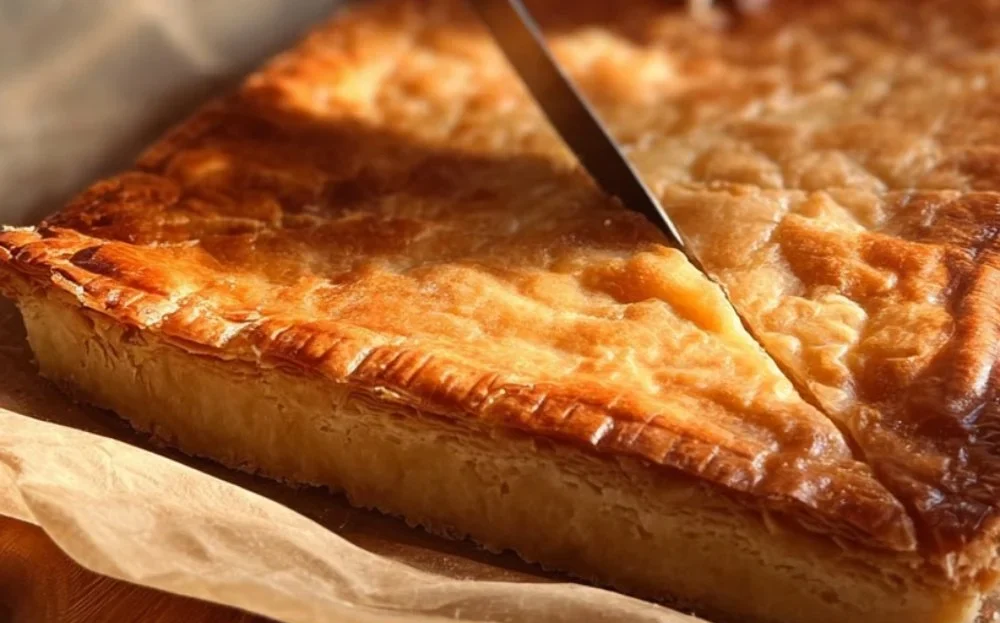
The Ooey Gooey Butter Cake is a compact study in contrasting textures: a crisp, golden top and edges that yield to a dense, creamy, almost lava-like interior. As a practicing chef, I approach this dessert as a compact exercise in controlling emulsion stability, egg coagulation, and starch development to produce a stable, moist center while allowing the exterior to caramelize and develop color. The technique is straightforward, but the refinement comes from precise temperature control, methodical mixing, and attention to timing—factors that determine whether the cake presents as a clean-sliced bar or a collapsed, overly dense pudding.
This text will analyze the recipe with technical clarity, explain the culinary logic behind every key action, and provide a workflow and troubleshooting guide to reproduce the ideal balance of tender cake and glossy, viscous interior. The focus is on sensory cues—aroma, color, resistance under a knife—and on why the steps in the supplied method produce this distinctive result.
The culinary logic behind this dish
At its core the Ooey Gooey Butter Cake juxtaposes two systems: a structured cake crumb formed by flour, egg proteins, and fat; and a fat- and sugar-rich custard-like layer dominated by cream cheese, eggs, and sugar. The cake component relies on limited gluten development and leavening from baking powder to yield a tender scaffold. The custard component depends on controlled coagulation of egg proteins and the emulsifying behavior of cream cheese to stay soft rather than set into a firm, dry curd.
Sensory results emerge from predictable chemical events. Sugar delays starch gelatinization and elevates browning through Maillard and caramelization reactions, creating the characteristic golden-brown crust and sweet, slightly toasty notes. Butter and cream cheese supply both fat and flavor; fat retards gluten formation for tenderness and carries aroma compounds that create a rich mouthfeel. Eggs provide structure via protein coagulation; the trick is to reach coagulation without overcooking, which demands predictable oven heat and accurate bake time.
The recipe’s ingredient ratios intentionally favor moisture and fat, so the end product is meant to be slightly underbaked in the center relative to conventional cakes. Understanding the interplay of temperature, time, and ingredient function allows a cook to hit that perfect, glossy interior without compromising food safety or presentation.
How to make Ooey Gooey Butter Cake
This section translates technique into actionable focus points while preserving the exact recipe procedure. Follow the directions verbatim, but attend to the textural and thermal signals described below at each stage.
- Preheat and pan preparation: Preheating to 350°F creates a predictable environment in which heat penetrates from the pan edges inward. Greasing a 9×13 inch dish ensures even contact and assists with heat transfer at the interface, promoting an even crust.
- Creaming phase: Creaming butter and sugar incorporates air and creates a fine network of fat-coated bubbles. These trapped air cells contribute lift and tenderness; mixing until light and fluffy aims to reach a stable emulsion without causing overheating that would destabilize the butter.
- Dry and wet integration: Incorporating flour, baking powder, and salt into the creamed mixture must be done until just combined to limit gluten formation. Adding eggs one at a time ensures gradual emulsification of liquid into fat, preventing separation.
- Cream cheese integration: Beating cream cheese smooth removes lumps and reestablishes a homogeneous matrix. Slow combination with the batter avoids overmixing which would create excess gluten and a tough crumb, and also ensures the custard layer maintains a smooth mouthfeel.
- Baking: Spreading the batter evenly ensures uniform heat penetration. The 30–35 minute range targets a colored exterior and set edges while retaining a glossy interior. Cooling completely in the pan allows residual heat to finish coagulation gently without overshooting into dryness.
- Finishing: A light dusting of powdered sugar draws attention to color contrast and contributes a delicate surface sweetness.
Execute the steps exactly as written in the provided directions block below for ingredient fidelity and proper timing.
Ingredients :
1/2 cup butter, softened, 1 cup sugar, 1 cup flour, 1 teaspoon baking powder, 1/4 teaspoon salt, 4 large eggs, 8 ounces cream cheese, softened, 1 teaspoon vanilla extract, 1 tablespoon powdered sugar (for dusting)
Directions :
- Preheat your oven to 350°F (175°C) and grease a 9×13 inch baking dish., 2. In a large bowl, cream together the butter and sugar until light and fluffy., 3. Mix in the flour, baking powder, and salt until well combined., 4. Add the eggs one at a time, mixing well after each addition., 5. In another bowl, beat the cream cheese until smooth and add the vanilla extract., 6. Slowly combine the cream cheese mixture with the batter until everything is well blended., 7. Pour the batter into the prepared baking dish and spread evenly., 8. Bake for about 30-35 minutes or until the top is golden brown., 9. Let it cool completely in the pan., 10. Dust with powdered sugar before serving.
Ingredient analysis through a chef’s lens
- Butter (1/2 cup, softened): Provides flavor, melts during baking to create a tender crumb and contributes to the crisping of the top and edges where fat and sugar meet heat. Using softened (not melted) butter ensures a stable emulsion during creaming.
- Sugar (1 cup): Functions as sweetener, tenderizer, and browning agent. Sugar competes with flour for water, moderating gluten formation, while promoting color and a delicate crust through caramelization.
- Flour (1 cup): Supplies starch and limited gluten-forming protein. The single cup here maintains a high fat-to-flour ratio to produce a dense yet tender base.
- Baking powder (1 teaspoon): Introduces chemical leavening to lift the batter slightly; small amounts are used to avoid an open crumb that would undermine the gooey center.
- Salt (1/4 teaspoon): Enhances flavor clarity and balances sweetness, while also influencing gluten behavior.
- Eggs (4 large): Provide liquid, fat (yolks), and proteins that coagulate during baking to stabilize both cake and custard elements. Adding them individually promotes a stable emulsion.
- Cream cheese (8 ounces, softened): The defining element. It supplies acidity, fat, and casein proteins that, when beaten, create a smooth, creamy phase that will set to a custardy consistency at the correct internal temperature.
- Vanilla extract (1 teaspoon): Elevates aromatic complexity and rounds the flavor profile.
- Powdered sugar (1 tablespoon for dusting): A finishing element that provides visual contrast and a fine sweetness without altering texture.
Each ingredient is present to balance structure and moisture; altering quantities will shift the texture from ooey to either liquid or cakey.
Kitchen workflow & technique breakdown
Plan mise en place before beginning: soften butter and cream cheese to a similar temperature (room temp but not warm) to ensure even emulsification. Separate bowls help manage stages: one for creamed butter-sugar, one for dry ingredients, one for the cream cheese mixture. A handheld or stand mixer with a paddle attachment provides reproducible aeration during creaming; use low speed when incorporating dry ingredients and eggs to prevent overworking gluten.
Grease the 9×13 pan immediately before pouring to avoid batter sitting in a bare metal pan that can overcook edges. Position the oven rack in the center to maintain even top color and avoid overly rapid edge browning. If your oven has hot spots, rotate the pan once at halfway time—only if rotation can be done without jostling the pan.
Temperature management extends to ingredient temperatures: cold cream cheese creates lumps; overly warm butter makes the creaming phase greasy. Aim for a butter that gives slight resistance when pressed and a cream cheese that deforms smoothly under a spoon.
Texture control, heat management & timing
The critical challenge is balancing a golden exterior and a viscous interior. The recommended 30–35 minute bake window puts the center at a point where egg proteins have coagulated enough to hold together but have not fully cross-linked into a dry curd. The top should be golden brown—an active visual signal—and the center should show slight jiggle when you gently shake the pan.
Use these tactile and visual cues:
- Top color: even medium-golden indicates Maillard and caramelization are underway.
- Edge firming: edges should pull slightly away from the pan and feel set.
- Center movement: a uniform, slow jiggle is acceptable; rapid liquid or a fully firm center means under- or over-baking respectively.
- Internal temperature: if you use a probe, target roughly 175–185°F (79–85°C) in the center for a custard that’s safe and still glossy.
Overbaking dries the custard and masks the contrast; underbaking may leave a liquid center. Cooling completely in the pan completes gentle carryover coagulation and minimizes collapse.
Professional variations
Within the constraints of maintaining the supplied recipe, consider technique-level variations rather than ingredient substitutions:
- Pan material: a light-colored aluminum pan conducts heat quickly and can produce a crisper edge; a glass or ceramic dish will bake slightly slower and preserve moisture longer. Adjust timing by a few minutes accordingly.
- Temperature profiling: if your oven runs hot, reduce to 325°F and extend bake time, watching color closely; conversely, increase heat slightly for faster browning if a deeply caramelized top is desired—again, monitor center doneness.
- Presentation formats: bake in smaller pans for thicker bars, but expect longer bake times and a different crust-to-center ratio.
These professional adjustments respect the recipe’s ingredient list while altering thermal dynamics to achieve tailored results.
Finishing touches & plating philosophy
A restrained finish preserves the dessert’s core identity. Powdered sugar, used sparingly, highlights color contrast without introducing moisture. For service, cut bars with a thin, warmed knife to achieve clean edges; wipe the blade between cuts to prevent dragging the mull of cream cheese across slices. Serve at room temperature or slightly chilled—room temperature accentuates the gooey texture and flavor volatility, while slight chilling firms the center for neater portions.
Plate with restraint: a small smear of neutral cream (whipped to soft peaks) or a warm fruit compote provides contrast in acidity and temperature, but avoid syrups that would excessively wet the crust. Consider texture contrasts—crisp biscotti or toasted nuts—to offset the cake’s density.
Maintaining quality after cooking
Storage: because of the dairy content, cool completely before covering and refrigerate in an airtight container for up to 4–5 days. Refrigeration firms the center; allow portions to return to room temperature for 20–30 minutes before serving to recover gloss and soften the crumb.
Reheating: for a fresh sensation, rewarm single portions in a 325°F oven for 6–8 minutes or a microwave on medium in short bursts until slightly warmed—avoid overheating. If you plan to freeze, cut into portions, wrap tightly, and freeze up to 2 months; thaw in the refrigerator overnight and bring to room temperature before serving.
Avoid prolonged exposure to air to prevent crust softening and moisture loss. If the sugar topping absorbs moisture and becomes dull, re-dust with powdered sugar just prior to service.
Questions from home cooks (chef answers)
Q: The center appears too liquid after the recommended bake time—what did I do wrong?
A: Oven variability and pan conductivity are the primary factors. Confirm your oven temperature with a thermometer. If the center is still overly loose, extend bake time in 3–5 minute increments, watching the top color; a slight jiggle is acceptable, but the batter should not be pourable.
Q: The top cracked or separated from the batter—why?
A: Rapid oven heat or over-creaming can cause the top to set and separate. Ensure you creamed butter and sugar until light but not foamy and that eggs were incorporated slowly. Also verify that the oven temperature is consistent and that the pan is centered.
Q: My cream cheese has lumps after mixing—can I fix it?
A: Yes. Transfer the mixture to a bowl and beat on medium speed until smooth, or pass the cream cheese first through a fine-mesh sieve if needed before combining. Using fully softened cream cheese prevents this issue.
Q: How much should this recipe rise?
A: Expect modest rise from the baking powder and aeration during creaming. The goal is a slight lift—too much rise will produce a dryer interior.
Q: Can I make this ahead?
A: Yes. Bake, cool completely, cover, and refrigerate up to 48 hours before serving; bring to room temperature before serving to recover texture.
Final chef notes
Execute the fundamental controls: ingredient temperature, proper creaming, and accurate oven heat. Respect the recipe’s ratios and procedural order; the interplay of fat, egg, and flour is intentionally calibrated. Do not rush cooling—carryover coagulation is part of the set and finish. A light, methodical approach yields the signature contrast: a golden, slightly crisp exterior with a dense, glossy, spoonable interior.
Conclusion
For an authoritative reference on the origin and traditional formulation that inspired this version, consult the original recipe source: Original Gooey Butter Cake Recipe | Paula Deen.
Ooey Gooey Butter Cake
Ingredients
Method
- Preheat your oven to 350°F (175°C) and grease a 9x13 inch baking dish.
- In a large bowl, cream together the butter and sugar until light and fluffy.
- Mix in the flour, baking powder, and salt until well combined.
- Add the eggs one at a time, mixing well after each addition.
- In another bowl, beat the cream cheese until smooth and add the vanilla extract.
- Slowly combine the cream cheese mixture with the batter until everything is well blended.
- Pour the batter into the prepared baking dish and spread evenly.
- Bake for about 30-35 minutes or until the top is golden brown.
- Let it cool completely in the pan.
- Dust with powdered sugar before serving.