Lemon Cream Snowball Cookies – Melt-in-Your-Mouth Holiday Magic
Introduction
The Lemon Cream Snowball Cookies – Melt-in-Your-Mouth Holiday Magic is an exercise in balance: butter-rich shortbread structure married to a tang-forward cream cheese-lemon filling, finished with a soft powdered-sugar halo. Precision in temperature, ingredient sequencing, and portion control transforms these components from mere baked goods into a composed pastry. For reference on related dough hydration and handling techniques, consult chewy maple-cinnamon cookie technique, which provides complementary insights into low-moisture, high-fat cookie doughs that behave similarly in the oven.
The culinary logic behind this dish
This recipe leverages two complementary textures and flavor functions. The dough is essentially a shortbread: high in fat, low in moisture, with minimal sugar to avoid caramelization-driven chew. Its role is structural and textural — to provide a tender, melt-in-the-mouth casing. The cream cheese-lemon filling is concentrated acid and sugar to cut the richness and introduce brightness that persists after finishing-sugar dulls the palate. Zest and lemon juice are used separately to capture volatile oils (zest) and citric acidity (juice); both are necessary because the oil-soluble aromatics in the zest provide immediate lemon perfume while the juice contributes persistent tartness that lifts fat perception.
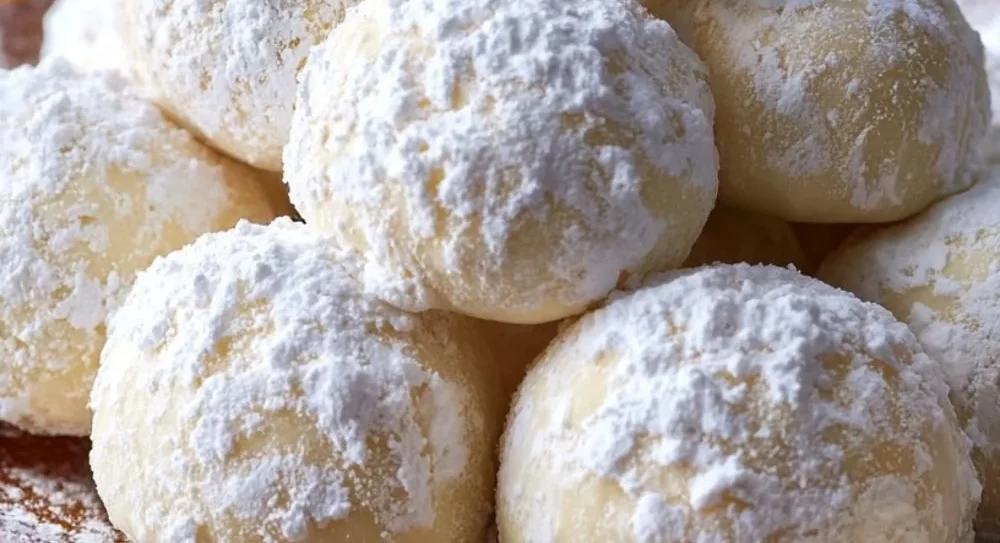
Baking at 350°F (175°C) produces gentle oven spring without excessive browning; the goal is set-and-dry exterior with a tender interior. The double coating in powdered sugar controls surface moisture exchange and creates the signature snowball appearance while adding a delicate textural contrast — a fine, powdery exterior against a soft, crumbly interior.
How to make Lemon Cream Snowball Cookies – Melt-in-Your-Mouth Holiday Magic
Technique is paramount: temperature control, portion consistency, and timing. Begin by preparing the filling because its chill time stabilizes fat and tightens texture, making it easier to encase accurately. Cream cheese and butter must be smooth and at the same temperature for a homogenous emulsion when sugar is incorporated; otherwise, you risk separation or a granular mouthfeel. In the dough, do not over-develop gluten — mix only until dry ingredients are integrated. Overworking will produce a tougher bite.
Portioning with a tablespoon and measuring filling to ½ teaspoon ensures consistent bake times and uniform geometry; this keeps heat transfer predictable across a sheet and prevents underbaked centers. Arranging dough balls spaced for minimal lateral spread will preserve spherical form, and a brief cool-down before the first sugar roll lets residual steam release without smearing the powdered surface.
For additional technique comparison to other cookie systems where fat and sugar ratios dictate spread and texture, consider the dough-handling strategies described in maple-cinnamon cookie dough handling.
Ingredients :
1 cup unsalted butter, softened, ½ cup powdered sugar, 1 tsp vanilla extract, 2 cups all-purpose flour, ¼ tsp salt, 2 tsp lemon zest, 4 oz cream cheese, 2 tbsp butter, 1½ cups powdered sugar, 2 tbsp lemon juice, ½ tsp lemon zest, Pinch of salt, Extra powdered sugar for coating
Directions :
Beat cream cheese and butter; add sugar, lemon juice, and zest. Chill filling for 30 minutes., Cream butter and sugar; add vanilla and zest. Mix in flour and salt., Flatten a tablespoon of dough, add ½ tsp filling, and roll into a ball., Place on lined baking sheet and bake at 350°F (175°C) for 12–14 minutes., d=”instruction-step-5″>5. Cool 5 minutes, roll in powdered sugar, cool fully, then roll again.
Ingredient analysis through a chef’s lens
- Butter: Unsalted, softened butter controls salt and water content. Butter temperature affects aeration; too soft yields greasy dough, too cold resists creaming and creates uneven aeration pockets.
- Powdered sugar in the dough: Uses finer particles and cornstarch (in many commercial varieties) to yield a silkier crumb and less granular mouthfeel than granulated sugar, also aiding the short, tender texture.
- Vanilla extract and lemon zest: Vanilla provides depth and perception of sweetness; lemon zest contributes volatile oils that amplify citrus aromatics without adding acidity that could destabilize the dough structure.
- Flour and salt: All-purpose flour gives a moderate protein level; the minimal salt sharpens flavors. Measure flour accurately — spoon and level — to avoid a dry, flour-heavy crumb.
- Cream cheese filling: The filling is an emulsion of dairy fat, sugar, and acid. Powdered sugar integrates smoothly and reduces grittiness. Chilling tightens the matrix, making it easier to portion and reducing melt during baking.
- Lemon juice and zest in filling: Juice provides acidity to balance fat; zest supplies high-impact aromatic oils. Together they prevent the filling from tasting cloying.
Kitchen workflow & technique breakdown
Workflow determines efficiency and product quality. Begin mise en place: soften butter and cream cheese to the same temperature, zest lemons, measure dry ingredients into bowls, and prepare parchment-lined baking sheets. Stage tasks to use chill time effectively: while the filling chills for 30 minutes, prepare and portion dough. Preheat oven only after dough is portioned to avoid prolonged warm bench time which increases spread. Use a tablespoon measure and a calibrated mini scoop for the filling; consistency here reduces variation in baking and final texture.
Use a paddle attachment or a sturdy whisk for creaming — mix until light but not aerated into a mousse. For the dough, mix at low speed just to combine to minimize gluten development. Maintain two baking sheets rotating between racks if baking multiple batches to keep oven temperature stable. For an in-depth look at batch management and bench timing with similar enriched doughs, review heat management approaches in batch timing for chewy cookies.
Texture control, heat management & timing
The shortbread dough requires controlled heat application. Bake at 350°F (175°C) to achieve a set exterior without browning; any higher, and you risk crisp edges and a crumbly, dry center. The 12–14 minute window targets a pale surface and slight set at the base. Remove sheets promptly — carryover heat will continue to dry the cookies slightly. Cooling five minutes before the first sugar roll prevents crushing of hot, fragile surfaces while allowing residual steam to escape so the powdered sugar adheres as a dry layer rather than a paste.
Temperature control extends to ingredient handling: keep the filling chilled until assembly and do not allow dough to over-warm during filling insertion. If dough becomes too soft, refrigerate for 10–15 minutes to regain body. If the filling becomes too soft during assembly, return to the refrigerator to prevent leakage. These micro-adjustments are key to preserving spherical geometry and achieving the characteristic melt-in-mouth crumb.
Professional variations
In a professional context, small modifications yield different sensory outcomes while preserving the core logic:
- Browned-butter shortbread: Clarify or brown the butter before use to add nutty aromatics. Reduce baking heat slightly to compensate for increased browning tendency.
- Citrus blend: Replace part of the lemon zest with lime or Meyer lemon zest for nuanced aromatic layers; maintain lemon juice proportion to avoid destabilizing the filling.
- Nut inclusion: Finely ground toasted nuts folded into the dough change fat absorption and texture; reduce flour by the weight of nut meal and adjust bake time minimally.
- Alternative sweeteners: Using superfine sugar instead of powdered sugar in the dough will increase tenderness and change surface sheen. When experimenting, perform small-scale trials to recalibrate bake time and mouthfeel.
For procedural parallels and adaptation strategies across similar shortbread systems, see practical examples at cookie adaptation strategies.
Finishing touches & plating philosophy
Finishing is structural and visual. The double roll in powdered sugar serves three functions: it seals minor surface cracks, increases perceived sweetness at first bite, and creates a luminous, snow-like finish appropriate for holiday presentation. The first roll when the cookie is warm allows a thin sugar film to adhere; the second after full cooling creates a thicker, stable coating that resists humidity for short-term display.
Plating should emphasize contrast: place cookies on a matte white platter to highlight the powdered surface and avoid reflective backgrounds that diminish textural cues. For professional service, space cookies to avoid sugar transfer and present in groups of odd numbers for visual rhythm. Garnish sparingly—one micro-lift of additional lemon zest atop a few cookies creates aromatic focus without overpowering the powdered-sugar visual.
Maintaining quality after cooking
Storage is governed by moisture migration. The powdered coating attracts ambient moisture and can become tacky; store cookies in a single layer in an airtight container with a desiccant packet or a folded paper towel to absorb excess humidity for short-term storage (1–2 days). For longer storage (up to 5 days), separate layers with parchment and keep refrigerated; bring to room temperature before serving to regain optimal texture. Freeze uncoated cookies individually on a tray, then transfer to a sealed bag; cool before the first sugar roll, and finish-coat after thawing to maintain a fresh appearance and avoid sugar clumping.
Avoid stacking warm cookies and minimize freezer-to-counter condensation by thawing in an airtight container to reduce surface moisture that dissolves powdered sugar.
Questions from home cooks (chef answers)
Q: Why use powdered sugar instead of granulated or caster sugar in the dough?
A: Powdered sugar contains cornstarch and finer particles, yielding a smoother crumb and reducing hygroscopic sweetness that would attract moisture. It enhances the short, tender structure.
Q: My filling leaked during baking. What went wrong?
A: Leakage indicates the filling was too soft or over-portioning. Chill the filling until firm and use precisely ½ teaspoon per cookie. Ensure the dough encasement is sealed with no thin spots.
Q: The cookies spread too much and lost spherical shape. How to prevent?
A: Common causes are over-soft dough, high oven temperature, or excess flattening during shaping. Chill dough briefly if too soft and measure portions consistently. Bake on a preheated sheet, middle rack, and avoid overcrowding.
Q: The powdered sugar turned wet and clumpy after storage. How to avoid?
A: Moisture is the culprit. Store in an airtight environment with humidity control (desiccant/paper towel) and avoid refrigeration without separation; coat only after cookies are fully cooled to prevent steam dissolving the sugar.
Final chef notes
Precision in ingredient temperatures, portion control, and timing are non-negotiable for consistent execution. The interplay of fat and acid defines the eating experience: butter and cream cheese provide richness, lemon zest and juice provide lift. Approach this recipe as a study in restrained technique — small adjustments in temperature or portion alter texture perceptibly. For the highest-quality result, calibrate oven temperature with an oven thermometer, measure ingredients by weight for repeatability, and respect chill times.
Conclusion
For a nut-free perspective on lemon snowball variants and plating ideas, review this focused recipe for inspiration at Lemon Snowball Cookies • nut free recipe!. To explore a textural and ingredient breakdown that informs shortbread adaptations, examine the professional approach in How to make the BEST Pecan Snowball Cookies – The Speckled …. For a softer, chewier lemon cookie comparison and technique notes on achieving tender chew with citrus, consult Soft Lemon Cookies | Wholefully.
Lemon Cream Snowball Cookies
Ingredients
Method
- Beat cream cheese and 2 tablespoons of butter until smooth.
- Add 1.5 cups of powdered sugar, lemon juice, and lemon zest. Mix until well combined.
- Chill the filling for 30 minutes.
- Cream 1 cup of butter with 0.5 cup of powdered sugar until light and fluffy.
- Add vanilla and lemon zest, mixing until combined.
- Gradually mix in the flour and 0.25 teaspoon of salt until just incorporated.
- Flatten a tablespoon of dough, add 0.5 teaspoon of the chilled filling, and roll into a ball.
- Place on a lined baking sheet, ensuring they are spaced out to allow for baking expansion.
- Preheat the oven to 350°F (175°C).
- Bake cookies for 12-14 minutes until set but not browned.
- Cool for 5 minutes on the baking sheet before rolling in powdered sugar.
- Allow to cool fully, then roll again in powdered sugar before serving.