Lunch Lady Peanut Butter Bars
Introduction
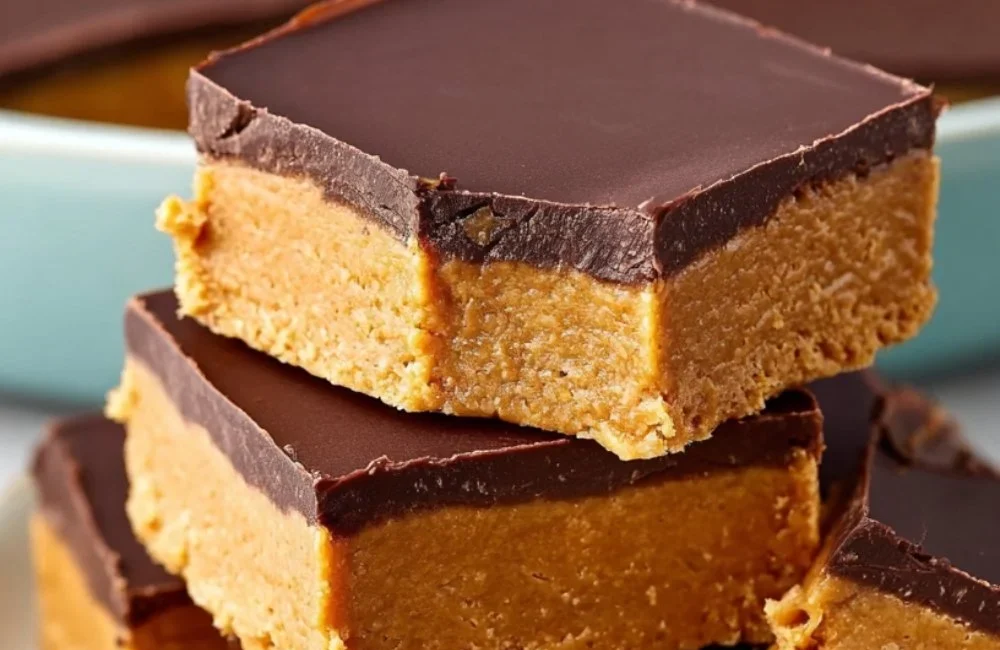
Lunch Lady Peanut Butter Bars are a textbook exercise in restrained technique and purposeful layering. The recipe relies on three elemental components — a dry, crumbly base bound with fat and sugar; a glossy chocolate-peanut topping; and rigid cold-setting to produce clean bars. As a professional chef, I evaluate this preparation on how well each layer performs its structural and sensory roles: the base must provide snap and mouth-coating peanut flavor without oiliness; the topping must be fluid enough to spread yet stable enough to produce a smooth sheen; and the cold-set must be timed to preserve texture contrast. This article examines those elements with precise technique, explaining why each step matters and how to control flavor, texture, and timing for consistent results.
The culinary logic behind this dish
At a fundamental level the Lunch Lady Peanut Butter Bars are a no-bake construction that depends on simple physical principles: particle adhesion, emulsion stability, and thermal setting. Graham cracker crumbs are dry particles that require a binding matrix — in this recipe, creamy peanut butter, powdered sugar, and melted butter — to form a coherent base. The powdered sugar contributes both sweetness and a drier, sand-like texture that reduces oil migration from the peanut butter. Melted butter adds fat and plasticity, allowing the crumb matrix to compact and hold shape when pressed. The chocolate-peanut topping uses melted chocolate chips combined with additional peanut butter to create an emulsion that sets glossy when cooled. Refrigeration solidifies both the butter in the base and the cocoa butter in the chocolate, locking the structure. Each ingredient functions with intent; understanding those roles is the basis for predictable results.
How to make Lunch Lady Peanut Butter Bars
This preparation is intentionally straightforward; success depends on attention to execution rather than complication. The goal during assembly is to form a dense, even base and a uniform topping with minimal agitation that could introduce graininess or air. When combining crumbs and fats, work quickly but deliberately: you want the butter to coat the crumbs evenly without melting the peanut butter into a puddle. Press the base firmly and evenly to eliminate voids and create a surface that will accept the topping without sinking. For the chocolate layer, the microwave method is efficient, but observe melt temperature closely — chocolate melts smoothly between 104–113°F (40–45°C) and will seize if overheated. Stirring the peanut butter into the melted chocolate at a slightly lower temperature helps form a glossy emulsion without breaking. Finally, chill long enough for both layers to firm to the same plane so bars slice cleanly with minimal smear.
Ingredients :
1 cup graham cracker crumbs, 1 cup creamy peanut butter, 1 cup powdered sugar, 1/2 cup butter, melted, 1 cup chocolate chips, 1/4 cup creamy peanut butter (for topping)
Directions :
- In a mixing bowl, combine graham cracker crumbs, peanut butter, powdered sugar, and melted butter until well mixed. Press the mixture into the bottom of a greased 9×9 inch pan., 2. In a microwave-safe bowl, melt the chocolate chips. Stir in the additional peanut butter until smooth., 3. Pour the chocolate peanut butter mixture over the graham cracker base and spread evenly., 4. Refrigerate for at least 2 hours to set., 5. Cut into bars and serve.
Ingredient analysis through a chef’s lens
Graham cracker crumbs: a neutral, lightly sweet substrate with enough texture to provide bite. Particle size matters: finely processed crumbs pack more densely and require slightly less binder, while coarser crumbs yield more pronounced crumb structure.
Creamy peanut butter: supplies flavor, protein, and fat. The creamy variety ensures homogeneity; natural peanut butter with separated oil will change mouthfeel and may cause phase separation in the base.
Powdered sugar: functions as a dryer and stabilizer. Its fine crystals absorb free oil and reduce tackiness; it also contributes to the firm, sliceable quality of the base.
Melted butter: adds fat and plasticity; when cooled it re-solidifies to bind crumbs. Use unsalted if you want precise control over seasoning.
Chocolate chips: in this context they are both vehicle and structural fat. Chips contain cocoa butter and emulsifiers that produce a smooth set chocolate when melted properly.
Additional peanut butter for topping: incorporated into the melted chocolate to harmonize flavor and soften the chocolate set, creating a slightly more pliable topping that is less brittle than pure tempered chocolate.
Understanding these roles allows targeted adjustments (without altering the recipe) for specific textural outcomes, such as creating a firmer base or a softer topping.
Kitchen workflow & technique breakdown
Efficiency and sequence preserve texture here. Work in two distinct phases: base assembly and topping assembly. Prepare your 9×9 pan first — grease lightly so the base releases cleanly. Measure and have ingredients at hand. Pulse the graham crackers to a consistent crumb size before starting to ensure uniform packing.
Phase 1: Combine crumbs, peanut butter, powdered sugar, and melted butter while the butter is still warm but not hot. Warm butter spreads and wets particles; if it’s too hot it can partially melt the peanut butter causing an oily, unstable matrix. Use a spatula to fold until homogenous, then transfer to the pan. Use either the back of a spoon, a flat-bottomed measuring cup, or a bench scraper to press the mixture evenly, applying firm pressure to eliminate air pockets.
Phase 2: Melt chocolate chips in short bursts (15–20 seconds) at 50% power in a microwave or over a double boiler. The microwave offers speed; the double boiler gives better temperature control. Remove from heat while a few unmelted bits remain and stir until smooth. Incorporate the 1/4 cup peanut butter off-heat to maintain emulsion and avoid tempering issues. Pour and spread with a small offset spatula for a thin, even layer.
Arrange your workspace to minimize time between steps; chocolate will begin to cool and thicken rapidly, so spread it promptly after combining.
Texture control, heat management & timing
Texture results from controlling temperature and moisture. For the base, the ideal endpoint is a compact, slightly crumbly matrix that holds together when sliced but offers a clean break. If the butter-to-crumb ratio is too high locally, the base will be greasy and soft; too low, and it will be dry and brittle. Uniform mixing and firm pressing mitigate these faults.
For the topping, heat management is critical. Chocolate should be heated gently to avoid crossing the threshold where cocoa solids separate from fats and the chocolate becomes grainy or dull. The melt-stir-rest approach — heat to just above the melting point, remove and stir to finish melting, then incorporate peanut butter at a slightly lower temperature — yields a glossy emulsion. After spreading, the refrigerator accelerates setting; allow at least two hours as specified so the entire mass reaches consistent temperature and rigidity. Cutting before the layers are fully chilled will smear the topping and compress the base; waiting ensures clean edges and preserved layer definition.
Professional variations
While the recipe must remain unchanged, chefs often apply technique-driven variations to refine execution without altering ingredients. For instance:
- Toast the graham cracker crumbs briefly in a 350°F oven for 4–6 minutes to deepen flavor and reduce moisture; allow to cool before combining with other cold ingredients to maintain expected consistency.
- Use a bench scraper wrapped in plastic to compact the base into the pan more evenly than hand pressing, achieving a consistently dense foundation.
- Temper the chocolate chips if you prefer a firmer snap to the topping; this is an entirely technical step that changes setting characteristics without altering ingredient list.
- Apply the topping in two thinner layers, allowing a brief chill between pours to minimize sinking and produce a uniform sheen.
Each technique focuses on structural control or flavor concentration rather than ingredient substitution.
Finishing touches & plating philosophy
Presentation for these bars is about geometry and restraint. After a full chill, score the surface with a warm, dry knife — warming the blade under hot water and wiping it clean before each cut reduces drag and produces razor-sharp edges. Cut in a single, decisive motion rather than sawing to avoid chipping the chocolate layer.
For serving, consider scale and proportion: small bars emphasize richness and allow the eater to experience contrasting textures in one bite. Arrange bars on an unadorned platter or bakery parchment to highlight clean lines; avoid sauces or garnishes that compete with the robust peanut and chocolate profile. If pairing, a lightly acidic component such as a citrus-macerated berry on the side can cut richness, but keep the plating functional and focused on texture contrast.
Maintaining quality after cooking
Storage controls shelf life and texture retention. Refrigeration preserves structure but can cause condensation when bars are returned to room temperature; store in an airtight container with parchment layers to prevent sticking and moisture transfer. For best texture, bring to cool room temperature (15–20 minutes out of the fridge) before serving — this softens slightly without losing definition.
If you need longer storage, freeze the bars individually wrapped in parchment and foil, then place in a sealed container. Thaw in the refrigerator to avoid surface condensation. Avoid prolonged exposure to ambient heat, which promotes oil migration from the peanut butter into the chocolate topping and the base, causing softening and bloom.
Questions from home cooks (chef answers)
Q: Why is my base oily or too soft?
A: Oiling is usually due to warm or unevenly distributed peanut butter or excess melted butter. Ensure the butter is warm, not hot, and mix until just combined. Press the base firmly to compact it; compaction mitigates perceived oiliness by reducing free surface area.
Q: My chocolate topping is grainy after melting. How to prevent it?
A: Overheating causes chocolate to seize. Heat in short bursts and remove while a few pieces remain, then stir off-heat to finish melting. Incorporating peanut butter while the chocolate is slightly below peak melt temperature helps form a stable emulsion. If graininess develops, add a small amount of neutral oil (a few drops) off-heat and stir briskly to smooth, although this technically alters mouthfeel.
Q: The topping cracked when cutting. How can I avoid that?
A: Allow full cold-set before cutting and warm the knife between cuts. A warmed, wiped knife reduces shear and prevents cracking. If the topping is excessively brittle, allow bars to sit at room temperature for a few minutes to let the chocolate become slightly more pliable before slicing.
Q: Can I use crunchy peanut butter?
A: The recipe specifies creamy peanut butter. Crunchy will introduce textural variation and larger particles that can interfere with uniform compaction of the base and the smoothness of the topping. Use only if you intend that change in mouthfeel.
Final chef notes
This recipe exemplifies how simple ingredients can produce a refined finished product when executed with attention to temperature, emulsion, and structural compaction. The mechanics are straightforward, but the margins for texture and sheen are technical: consistent crumb size, careful heat control during melting, and disciplined chilling are the variables that determine success. Respect the rhythm of the process — mix, press, melt, pour, chill — and you will obtain reproducible bars that present cleanly and perform well in commercial or home production.
Conclusion
For further reference on variations and step-by-step photograph guides, consult a reliable recipe resource such as No-Bake Lunch Lady Peanut Butter Bars – Moore or Less Cooking, review another tested version at Lunch Lady Peanut Butter Bars – CenterCutCook, or compare technique notes and serving suggestions with the home-cook oriented write-up at Lunch Lady Peanut Butter Bars Recipe – Six Sisters’ Stuff.