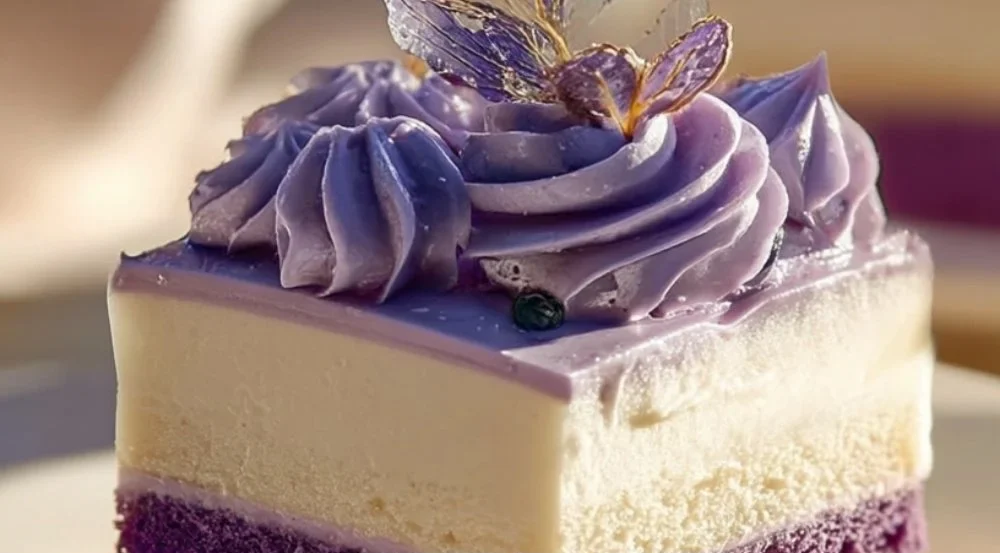
Purple Three Milks Cake
Introduction
I first tasted Purple Three Milks Cake in a seaside kitchen in the Philippines, where the late afternoon light turned the world a soft lavender and the air tasted faintly of sea salt and frying garlic. Sofia, a grandmother with a laugh like the clap of waves, set a chilled slab of cake on the table and told me, with the economy of someone who has fed half a barrio, that sweets are for remembering. She sliced through the spongy purple layer and the dollop of whipped cream gleamed like a little cloud. The smell was a gentle, exotic lullaby—sugared milk carried with the delicate, nutty perfume of ube—and every mouthful felt like a place: a sari-sari store, a Sunday mass, a child’s birthday song. That first bite became a map I could read with my senses.
As a travel writer I have come to understand that certain foods are less recipes than languages: they say where you’ve been, who made you, and what the land tastes like in a particular season. Purple Three Milks Cake—often called Ube Tres Leches Cake—speaks in a dialect composed of two migrations: the Spanish and the Filipino, the pastoral and the tropical. It is both a sweetness of colonized kitchens and a reclamation; it is a dessert that folds together history and harvest, technique and heart.
The origin story & regional influence behind this dish
The story of three-milk cakes travels across oceans: tres leches is widely considered to have traveled with Spanish colonial influence and Latin American adaptation, a sponge soaked in a triumvirate of milks to create something both indulgent and humble. In the Philippines, that practice met the island’s indigenous tastes and produce and became something else—brighter, more purple, and infused with the yam’s gentle earthiness.
Ube, the purple yam, has been cultivated in the Philippines for centuries, its deep violet hue woven into festivals and memories. When local cooks began folding ube halaya—a boiled, mashed, sweetened jam—into cakes, they made the foreign familiar. Evaporated and condensed milk, imported by way of trade and later industrial canned food markets, brought new textures and a modern convenience. When those three milks met the velvety purple of ube, the result was a dessert that felt quintessentially Filipino: exuberant, communal, and drenched in stories.
This cake’s lineage is thus plural: a Latin American technique, Philippine produce, and a post-colonial pantry that has always been experimental. It is a dish that sits comfortably between celebration and everyday comfort, a testament to how places make borrowed things their own.
How to make Purple Three Milks Cake
Making this cake at home is an act of hospitality. It asks only for patience and a quiet hour to prepare, then a willingness to wait as the milky mixture seeps into the crumb and becomes a memory. The method is simple but ceremonial—the beating of butter and sugar, the gentle folding in of ube, the patient poking of holes that will allow the milk to enter and transform the cake. It is as much about care as it is about ingredients.
Below are the exact ingredients and directions used in the recipe I learned from Sofia and countless Filipino kitchens. I offer them here without alteration, as recipes like these are less instruction than inheritance.
Ingredients :
1 cup all-purpose flour, 1 1/2 tsp baking powder, 1/4 tsp salt, 1/2 cup unsalted butter, softened, 1 cup sugar, 3 large eggs, 1 tsp vanilla extract, 1 cup ube halaya (ube jam or purple yam), 1 cup evaporated milk, 1 cup sweetened condensed milk, 1 cup whole milk, 1 cup heavy cream, 2 tbsp powdered sugar, 1 tsp vanilla extract for whipping cream
Directions :
- Preheat the oven to 350°F (175°C). Grease and flour a 9×13 inch baking pan., 2. In a bowl, mix flour, baking powder, and salt. Set aside., 3. In a large bowl, beat butter and sugar until light and fluffy. Add eggs one at a time, mixing well. Stir in vanilla and ube halaya., 4. Gradually add the flour mixture, mixing until just combined. Pour batter into the prepared pan and smooth the top., 5. Bake for 25-30 minutes, or until a toothpick comes out clean. Allow to cool completely., 6. In a bowl, whisk together evaporated milk, sweetened condensed milk, and whole milk., 7. Poke holes all over the cooled cake with a skewer. Pour the milk mixture over the cake and let it soak., 8. For the topping, whip the heavy cream with powdered sugar and vanilla until stiff peaks form. Spread over the soaked cake., 9. Chill for at least 2 hours before serving. Enjoy your Ube Tres Leches Cake!
Ingredients through a cultural & historical lens
Each item on the ingredient list is a small story. Flour and sugar tell of commercial mills and of traders who shaped diets across hemispheres. Eggs and butter speak of kitchen economies and the extra attention accorded to celebratory baking. The three milks—evaporated, condensed, and whole—reveal the 20th-century pantry, a time when canned milks became symbols of modernity and were embraced in colonial and post-colonial kitchens for their longevity and richness.
And then there is ube halaya: the luminous heart. Ube is not simply a flavor; it is chromatic memory. Its purple promises are visible in Filipino markets and in the trimmings of festive clothing, in the glinting slices at weddings and the humble pockets sold by street vendors. To add ube to a tres leches cake is to perform a cultural translation: to say, in sugary, velvety terms, that this borrowed form now speaks an island language.
Cooking the dish: sensory notes & traditional techniques
The alchemy of this dessert is tactile and olfactory. The cake’s crumb should be tender—springy to the touch and receptive. When you poke the cake to invite the milk, you can feel the sponge yield and then swell as the liquid settles. The scent as you pour the milky mixture is a lullaby: condensed milk brings a caramel warmth, evaporated milk offers depth, and whole milk adds a pastoral freshness. Folded into the batter, ube offers an earth-sweet perfume that is floral and nutty at once.
Traditional technique is less about complicated steps and more about timing and respect: letting the cake cool completely prevents the milk from pooling awkwardly; chilling for a few hours allows the mixture to set into the crumb like a quiet memory settling into a sofa. The whipped cream topping functions as a cool, cloud-like counterpoint to the dense, soaked layer beneath—a final gesture that softens and prettifies, making the cake both humble and ceremonious.
How different regions prepare their version
Across the archipelago and beyond, variations of the purple three milks cake bloom like different dialects of the same song. In some parts of the Philippines, cooks will fold in grated coconut or use coconut milk to edge the flavor closer to the island’s coastal kitchens. In urban bakeries, the cake may be elevated with a crown of macapuno or a swirl of ube halaya on top, creating a visual homage to its violet roots.
In Latin America, tres leches is often perfumed with cinnamon and served with a dusting of spice; in Mexico, it is common at celebrations where condense milk and caramel flavors mingle with citrus. The Filipino adaptation replaces those spices with tropical vibrancy: the ube’s purple is a clarion call to local palates and to the omnipresent love of sweet, creamy textures. In diaspora communities—from Los Angeles to Toronto—bakers merge traditions, sometimes adding a layer of leche flan or pairing the cake with a strong, black coffee to temper the milk-sweetness.
Traditional ways this dish is shared or served
This cake is most often a communal thing. It appears at birthdays, taught in the rhythm of kitchen choreography passed from parent to child. At fiestas it sits on long tables under tarps, next to fried foods and savory stews, a cool respite from the day’s heat. In homes, it is a method of marking an ordinary afternoon as worth savoring: a piece for a neighbor, a slice laid out for a visitor, a cake saved for the person who returned from a long trip.
Sharing this cake is a social ritual. People gather around the table, pausing to admire the brilliant interior, commenting on the intensity of the purple and the balance of milk. It is served chilled, often with a simple fork and a side of conversation—tales of kin, remembrances of distant towns, and the small domestic news that stitches communities together.
Storing the dish without losing its cultural essence
Storing a milky cake requires tenderness. Refrigeration is part of its character: the chill keeps its texture and the whipped cream pristine. Covered tightly, it will keep for a few days, during which its flavors deepen; the ube often seems to mellow and the milks integrate further into the crumb. Yet the cake is best shared soon—like many symbolic foods, it is at its most meaningful when offered fresh, when the act of eating is also the act of being together.
Transporting it—say, to a family reunion—carries its own ritual. People will secure the pan, often with a layer of plastic wrap, and the cake travels like a small deputation of home. The journey is part of its meaning: food moved across city lines or oceans becomes a tangible reminder of origin, a slice of place.
Cultural questions people often ask
Is tres leches Filipino? The honest answer is both yes and no: its technique and name have Latin roots, but when ube is folded into the batter, the cake becomes distinctly Filipino. People ask whether the purple color is natural; in the best versions, it is—the ube itself gives that hue, not artificial coloring. Others ask if this is a modern invention; its components have long histories, but the particular fusion—of Latin technique with native tuber—feels like a 20th-century conversation between pantry and palate.
Another frequent question: is it for special occasions? In many homes, yes; but there is also an everyday version—smaller cakes, simpler whips of cream—meant to soothe an ordinary afternoon. The cake’s adaptability is part of its charm: it can be both extravagant and intimate.
A closing note on food, memory & travel
Eating Purple Three Milks Cake is to participate in a layered geography. There is first the place of origin—the fields where ube was dug, the markets where its purple velvet is sold—and then the domestic geography: the kitchen air, the hands that stirred, the songs hummed while waiting for the cake to cool. Travel teaches us to look for such edible markers, for dishes that carry whole towns inside their flavors. They are compact maps of belonging.
When I taste that lavender slice, I do not only recall Sofia’s kitchen but the broader human habit of making new things from what is available: of turning a Cartesian list of ingredients into a narrative you can cut and serve. The cake is a bridge between histories, a sweet negotiation between the imported and the indigenous. At the table, it asks only that we listen—to the crackle of whipped cream as the knife passes through, to the soft sigh of sponge meeting milk—and remember where we have been and who is waiting at our table.
Conclusion
If you want to explore more renditions and background on Ube Tres Leches Cake, this recipe roundup offers a thoughtful take on the classic fusion: Ube Tres Leches Cake | Ash Baber. For another detailed home-baker perspective and variations, see this version that highlights technique and presentation: Ube Tres Leches Cake.
Purple Three Milks Cake
Ingredients
Method
- Preheat the oven to 350°F (175°C). Grease and flour a 9x13 inch baking pan.
- In a bowl, mix flour, baking powder, and salt. Set aside.
- In a large bowl, beat butter and sugar until light and fluffy. Add eggs one at a time, mixing well. Stir in vanilla and ube halaya.
- Gradually add the flour mixture, mixing until just combined. Pour batter into the prepared pan and smooth the top.
- Bake for 25-30 minutes, or until a toothpick comes out clean. Allow to cool completely.
- In a bowl, whisk together evaporated milk, sweetened condensed milk, and whole milk.
- Poke holes all over the cooled cake with a skewer. Pour the milk mixture over the cake and let it soak.
- For the topping, whip the heavy cream with powdered sugar and vanilla until stiff peaks form. Spread over the soaked cake.
- Chill for at least 2 hours before serving. Enjoy your Ube Tres Leches Cake!