Dessert Tacos
Introduction
Dessert Tacos are an exercise in balancing simplicity with technique: delicate tortillas transformed into portable platforms for a creamy, sweet filling and bright, acid-balanced fruit. The construction is straightforward, but achieving the optimal texture — a pliable tortilla that holds a silky cream cheese filling without becoming soggy — requires attention to temperature, fat content, and timing. For a systematic approach to finishing and serving composed sweets, consult this broader comprehensive dessert recipes collection that outlines comparable tempering and assembly methods applied to other small-format treats.
In this piece I will treat Dessert Tacos as a small-plate, composed dessert, focusing on technique, texture control, and efficient timing so that each taco is consistent in flavor and mouthfeel. Expect precise guidance on tempering cream cheese, warming and shaping tortillas, controlling moisture transfer from fruit, and finishing elements like sauces and whipped cream that influence perception of sweetness and richness.
The culinary logic behind this dish
Dessert Tacos rely on contrasts: the neutral, slightly toasty tortilla; the dense, tangy cream cheese filling; and the vibrant, acidic berries. Each element must be tuned so the sum is balanced rather than cloying. Cream cheese supplies fat and a mild tang that cuts sugar; powdered sugar dissolves quickly into the cream cheese, avoiding grainy texture. Vanilla provides aromatic lift; berries contribute bright acidity and textural variance. A drizzle of chocolate or caramel introduces a secondary sweetness and a line of bitter or toasted-flavor contrast depending on the sauce chosen.
From a technical standpoint, two primary hazards determine success: textural collapse due to moisture migration and structural failure due to over-softened shells. Moisture migration happens as berries release juice; uncontrolled, that juice will wet the tortilla and render the shell limp. Structural failure occurs if the tortilla is not warmed sufficiently to become pliable or is heated unevenly, producing cracks under folding. Managing these risks requires sequencing — tempering and applying the filling onto a warm but not hot tortilla, placing fruit last, and serving immediately — and component adjustments that control water activity and surface tension.
For contextual technique transfer, review how small-format baked goods are protected from moisture in other recipes — for example, the layering and assembly methods used in small fruit-topped cookies and tartlets in the pineapple upside-down cookies technique guide — then adopt the same protective logic here.
How to make Dessert Tacos
Ingredients :
8 small flour or corn tortillas, 1 cup cream cheese, softened, 1/2 cup powdered sugar, 1 teaspoon vanilla extract, 1 cup mixed berries (strawberries, blueberries, raspberries), 1/4 cup whipped cream (optional), Chocolate sauce or caramel for drizzling (optional)
Directions :
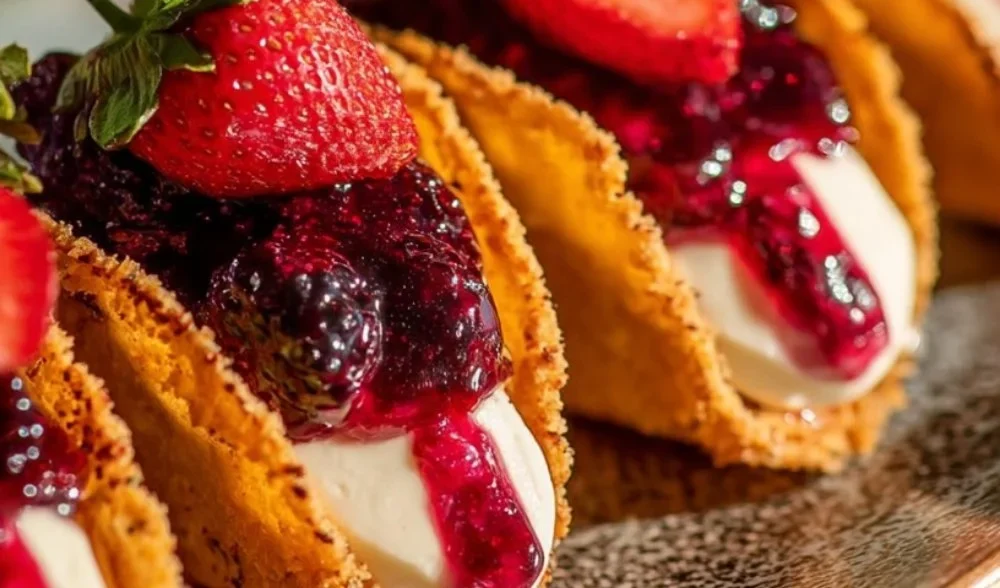
- In a mixing bowl, beat the cream cheese, powdered sugar, and vanilla extract together until smooth., 2. Warm the tortillas slightly on a skillet or in a microwave to make them pliable., 3. Spread a layer of the cream cheese mixture onto each tortilla., 4. Top with mixed berries and a dollop of whipped cream if desired., 5. Fold the tortillas into taco shapes., 6. Drizzle with chocolate or caramel sauce if using., 7. Serve immediately and enjoy your Dessert Tacos!
The directions above are precise and intentionally minimal. Several execution notes will improve outcomes without altering the recipe: the cream cheese should be softened to room temperature but not warm; this allows efficient aeration without separation. When warming tortillas on a skillet, use a dry pan over medium-low heat and rotate frequently for even pliability. If using the microwave, warm in 10–12 second bursts under a damp towel to conserve moisture and prevent local overheating.
When spreading the cream cheese mixture, aim for an even layer approximately 2–3 tablespoons per tortilla depending on tortilla diameter. This quantity balances mouthfeel and prevents the filling from overwhelming the shell. Place the berries last to limit juice contact time with the tortilla; if large strawberries are used, slice them to maintain uniform bite size. The final fold should be made immediately before service to retain the crispness and structural integrity of the shell.
Ingredient analysis through a chef’s lens
Each ingredient contributes functional properties as much as flavor. Tortillas provide structure: flour tortillas are slightly richer and more pliable due to gluten and fat; corn tortillas are drier and more texturally pronounced. Choosing between them alters mouthfeel and folding technique: flour tortillas tolerate slightly thicker fillings; corn tortillas require more precise warming to avoid cracking.
Cream cheese delivers emulsion stability and fat that carries flavor. Powdered sugar has a critical functional advantage over granulated sugar: the cornstarch in powdered sugar stabilizes the cream cheese, reduces water separation, and dissolves seamlessly for a satin finish. Vanilla extract adds volatile aromatics that read as sweetness and complexity; even at one teaspoon it significantly enhances perceived sweetness, allowing for less added sugar in the filling.
Berries are the variable element. Strawberries have substantial water content and large cells that macerate; raspberries and blueberries release juice more gradually. To limit moisture migration, select berries at peak ripeness but firm, and consider gently tossing larger berries in a light coat of cornstarch or powdered sugar immediately before assembly to absorb free juice. Whipped cream functions as both texture and insulating layer; a small dollop placed between cream cheese and berries can slow juice transfer and add a light mouthfeel contrast.
Kitchen workflow & technique breakdown
Set up an assembly line to maintain temperature control and speed. Station 1: softened cream cheese mixture in a bowl with a spreader. Station 2: warmed tortillas on a towel-covered tray to retain heat and prevent steam accumulation. Station 3: berries, drained and blotted. Station 4: final garnishes (whipped cream, sauces).
Tempo is crucial: aim to assemble each taco in under 45 seconds from the first contact of the filling to the fold. This minimizes time for berry juice to seep into the tortilla. Warm the tortillas in small batches so each one is used while still pliable; a tortilla left on a tray for more than two minutes will cool and stiffen, increasing the chance of cracking when folded. Use a small offset spatula to spread the cream cheese evenly and thinly; thick hunks concentrate moisture and can push berries out of the shell when folded.
If you scale production, precool the filling slightly to improve spreadability and stability. Fillings with a chilled fat phase hold a better shape and prevent slippage when the taco is handled.
Texture control, heat management & timing
Texture control is the interplay of shell pliability, filling viscosity, and fruit juiciness. Heat management concerns the tortilla warming technique: short, even heat to achieve pliability without toasting. Overheating produces localized drying that promotes cracks when folding; underheating results in stiffness. For skillet warming, rotate tortillas every 10–15 seconds and remove when they yield but before they char.
Filling viscosity matters: the cream cheese mixture should be smooth and slightly thick — enough to cling when spread but not so dense that it clumps. If the mixture is too loose, it will flow and increase the risk of soaking the tortilla. If it feels too soft, chill it five to ten minutes and re-whip lightly to regain body. Always blot berries briefly on paper towel to remove surface moisture just before placing them on the filling.
Timing: assemble and serve immediately. Serve within five minutes of completing the last taco for optimal textural contrast. If hold time is necessary (for service of a small plated course), stagger assembly: fill shells with a thin layer of cream cheese, then nap with a barrier of whipped cream, and add berries at the last second.
Professional variations
Yield professional layers of complexity without changing the base recipe: lightly toast the tortillas to introduce Maillard complexity before warming, or brush a thin wash of melted butter and granulated sugar and torch briefly to add a caramelized note. For increased aromatic depth, fold a small amount of citrus zest into the cream cheese mixture — lemon or orange — which raises brightness and reduces perceived sweetness.
For an elevated sauce, heat chocolate with a small fraction of cream and a pinch of sea salt for a ganache-style drizzle, or reduce a caramel with a splash of bourbon for complexity. For textural contrast add a spiced crumble — a quick nut crumble or toasted oats — sprinkled sparingly on the cream cheese before placing berries; this must be used judiciously to avoid wrecking the shell’s structural integrity.
Note: none of these variations require changing the listed ingredients or directions; they are optional finishing techniques that align with the existing framework.
Finishing touches & plating philosophy
Plating should emphasize neatness and clarity of flavor. Arrange tacos in a staggered line or small fan to show interior layers. Use a thin stream of sauce to create directional movement on the plate; avoid puddling sauce beneath the taco which will invite sogginess. A small quenelle of whipped cream on the plate can act as both garnish and functional barrier to protect the shell if the plate will be held briefly.
Garnish with micro-mint or citrus zest sparingly for contrast; keep garnishes small so they do not overpower the modest proportions of the taco. Temperature at service should be room for the tortillas and chilled for the filling to create a contrast that reads as refined and intentional.
Maintaining quality after cooking
Dessert Tacos are best consumed immediately; however, if a short hold is necessary, follow these rules: store the cream cheese filling under refrigeration and keep tortillas at room temperature wrapped in a cloth to preserve pliability. Assemble only a portion of the tacos and add berries and the final fold at service time. If assembled and refrigerated, the tortillas will absorb moisture and become limp; rewarming is not recommended after refrigeration as it will unevenly reintroduce heat and moisture.
For a buffet or service line, set up an assembly station near the pass and stagger assembly in short batches to ensure freshness. If transport is necessary, place tacos in a single layer with wax paper between them and keep them cool to preserve filling stability.
Questions from home cooks (chef answers)
Q: How soft should the cream cheese be?
A: Softened to room temperature — yielding to gentle pressure but not warm. It should hold shape yet be easily beatable. If it is too cold, it will be lumpy; too warm and it will be oily and lose structure.
Q: Can I substitute mascarpone?
A: Mascarpone will produce a richer, looser filling. Reduce added sugar slightly if using mascarpone; also chill briefly after mixing to tighten the emulsion.
Q: How can I prevent tortillas from cracking?
A: Warm them evenly and just enough to become pliable. Use a towel to keep them warm and handle minimally. If using corn tortillas, steam lightly for a few seconds wrapped in a damp towel before warming on a skillet.
Q: What’s the best way to keep berries from making the shell soggy?
A: Drain and blot berries, add them last, and apply a thin insulating layer of whipped cream or an additional thin line of cream cheese between berry contact points and the tortilla.
Final chef notes
This recipe exemplifies how a simple ingredient list benefits from disciplined technique. Control temperature, limit moisture transfer, and sequence assembly to maximize texture and flavor clarity. The restraint in sweetness from using a measured 1/2 cup powdered sugar against a full cup of cream cheese allows the berries’ acidity to register rather than being masked; small refinements — even as minimal as blotting berries or warming tortillas correctly — have outsized effects on the final dish.
Consistent results come from repetition and micro-adjustment: note how your local tortillas react to heat, tune the cream cheese softness to your kitchen temperature, and prepare mise en place so that the final assembly is swift. When executed precisely, Dessert Tacos present an elegant, modern small-plate dessert with clean lines and well-calibrated contrasts.
Conclusion
For a clear visual reference and a slightly different take on the assembled dessert taco concept, consult the original Dessert Tacos technique page for plating and ingredient ratios at Dessert Tacos, and for a no-bake cheesecake variation that explores similar cream-based fillings, see the Cheesecake Dessert Tacos resource at Cheesecake Dessert Tacos (No Bake Cheesecake).