Oreo Fudge
Introduction
There are certain sweets that arrive not simply as food but as souvenirs you can press into your palm: small, dense, sweet squares that hold the heft of a journey, a season, a grandmother’s laugh. Oreo Fudge is one of those confections. It feels like an afternoon spent leaning on a sun-warmed balcony in a small city that could be anywhere and nowhere all at once — a cosmopolitan whisper of milk and cocoa, the bright churn of cookie crunch folded into the creamy hush of white chocolate. For me, arriving in a new place usually involves finding its simplest, most honest desserts. They tell you how people live, what they celebrate, how they bridge time between harvest and holiday. Oreo Fudge’s charm is its universal accessibility: three humble components that, together, make something nostalgic and modern, local and global.
Walk through any neighborhood market in Sofia and you will see treats that are mains of comfort — baklava and banitsa, sweetened shepherd’s cheese and honeyed nuts — and among them, an imported notion that has been adapted, set down and made dear: the idea that a packaged cookie can be the kernel of a new traditional delight. Here, Oreo Fudge sits beside jarred preserves and hand-rolled pastries, a kind of cultural shortcut and a celebration of memory. I write as someone who follows food into rooms where strangers become friends across a shared plate. Oreo Fudge is small and portable and generous — perfect for passing around at gatherings where stories are currency and flavor is memory.
The origin story & regional influence behind this dish
If we trace the tale of Oreo Fudge, we are really tracing two threads braided together: the story of the Oreo cookie, born in the labs of early 20th-century America, and the ancient, wandering genealogy of fudge-like sweets — confections made by boiling sugar and milk into something caressing and dense. Oreos themselves traveled the world with the consumer goods networks of the 20th century, becoming a global shorthand for “cookie,” often adopted and reinvented by regional bakers. Fudge, meanwhile, carries a more domestic, portable lineage. It is the language of holiday tins and school fundraisers, of kitchens warmed by radios and the hum of family.
Regional influence is subtle but present. In Eastern Europe, where dairy-rich sweets are beloved and confectionery is often made with condensed milk and white cheeses, the embrace of sweetened condensed milk in recipes feels familiar and reassuring. In the Americas, mixing a ubiquitous mass-produced cookie into homemade sweets speaks to a culture of innovation — improvisation with what’s on the pantry shelf. In the Mediterranean and the Balkans, where sharing small sweets after coffee is ritual, the dense, sliceable nature of Oreo Fudge aligns with convivial habits: easy to portion, easy to pass, a modern companion to the time-honored ritual of lifts of cup and exchanges of news.
How to make Oreo Fudge
Ingredients :
Oreo cookies, sweetened condensed milk, white chocolate chips
Directions :
- Crush the Oreo cookies into chunky pieces., 2. In a saucepan, melt the white chocolate chips over low heat., 3. Stir in the sweetened condensed milk until smooth., 4. Remove from heat and fold in the crushed Oreos., 5. Pour the mixture into a lined square baking dish and spread evenly., 6. Refrigerate for at least 2 hours until firm., 7. Cut into squares and serve.
This is a recipe that asks for no grand kitchen equipment, only gentle attention. The ritual of making it is as telling as the finished squares: crushing the cookies is tactile communion with texture; melting the white chocolate is a slow, intimate patience; folding in the crushed Oreos becomes a meditative pattern of mixing difference into unity. Each step is a small act of translation, where a commercial product is invited into the warm, slow domesticity of a homemade sweet.
Ingredients through a cultural & historical lens
Consider each ingredient as a character with a history. The Oreo cookie, first introduced in 1912, has become an icon — its two dark wafers with cream center carry the visual shorthand of “cookie” across continents. But it is more than branding; Oreos have been adapted into local variations everywhere from Indonesia to Mexico, and their presence in a fudge recipe is an example of how global commodities are domesticated. They become memory facilitators: the cookie you dunk in milk as a child reappears later, broken into a glossy, creamy bar that tastes like both past and present.
Sweetened condensed milk has its own story: a product born of preservation, a way to keep milk without refrigeration. In many places it stands in for a local condensed dairy tradition; in Latin America and Asia it is a backbone of candies and desserts, and in Eastern Europe it often echoes the density of creams and curds. Because it is both sugary and dairy-rich, it acts as a bridge between crunchy and creamy, between the dry and the lush.
White chocolate chips are the final mediator: they melt into a satin base that embraces cookie fragments. Though white chocolate is a modern invention, its pale sweetness complements local tastes where delicate, floral sugars are prized. Together these three items narrate a story of modern trade and communal kitchens: imported goods turned into local ritual.
Cooking the dish: sensory notes & traditional techniques
Making Oreo Fudge is less about flame and more about sensation. The smell of white chocolate melting is like the hush after rain: sweet, milky, slightly perfumed with vanilla. As the chips soften, there’s a glossy sheen that promises satiny texture. Mixing in condensed milk deepens the aroma: a slow, caramel undertone emerges as the sugar and milk become luminous. Fold in the cookies and the scent shifts — now a darker, more complex note of cocoa and familiar biscuit.
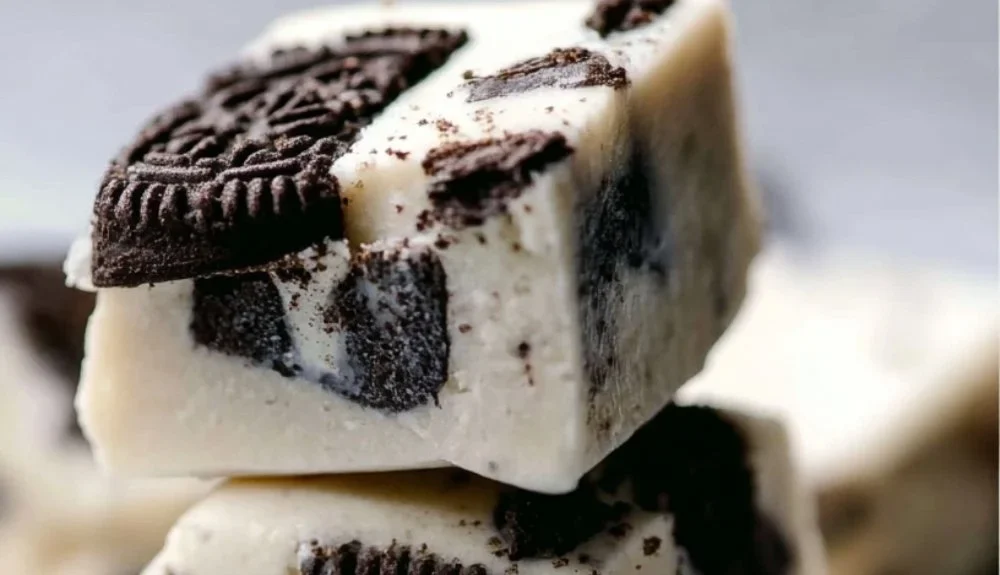
The texture is the real conversation. Each square is dense, nearly chewy, with sudden, celebratory fractures where cookie pieces assert themselves. It is not a timid dessert; it asks to be bitten, to be appreciated for the interplay between the forgiving cream and the crisped, cynical crunch. Traditional technique here is minimal: loving, measured stirring over low heat, patience to allow the fudge to set. In many homes, this moment — leaving something to cool while talking or washing dishes — becomes as ritual as the stirring itself. The act of refrigerating and then cutting small squares is meant for social sharing; slices are tiny gifts, not solitary indulgences.
How different regions prepare their version
Across kitchens and continents, Oreo Fudge is a canvas for local inflection. In Latin America, cooks sometimes press toasted nuts into the top, echoing the region’s love of roasted textures and adding a salt-sweet counterpoint. In parts of Asia where matcha is beloved, a green tea powder might be sifted into melted white chocolate for a gentle vegetal note that cuts the sugar. In Eastern Europe, you might find the fudge trimmed into tiny diamonds and served alongside fruit preserves, the acidity of the jam playing against the sweet, milky square.
North American versions often lean toward playful elaboration: white chocolate shades to milk or dark, layers of different cookies, or a finishing sprinkle of flaky sea salt. In Mediterranean climes, the fudge might be accompanied by coffee that is dense and bitter, honoring the tradition of balancing sweet and stern. These regional twists tell you more about local palettes and communal customs than they do about the recipe itself; the basic method remains, but the accents change, offering a map of taste across the globe.
Traditional ways this dish is shared or served
Oreo Fudge’s portability informs how it is served. It is cut into small squares and placed on plates for weddings, birthday buffets, or as part of a coffee table spread. In countries where sharing food is a declaration of hospitality, these small squares become currency of welcome: offered with a smile, accepted with sincere gratitude. In family kitchens, they are tucked into lunchboxes, wrapped in wax paper for teachers or neighbors. During holiday seasons they ride in tin boxes between houses, a modern continuation of exchanging sweets that spans cultures.
Serving accompaniments reveal cultural practices: in some houses it will be offered with a small glass of milk for children, in others with strong, black coffee for adults. Presentation can be simple — a paper doily, a small plate — or ceremonial: placed next to a plate of dried fruits and nuts as part of an afternoon tea. The ritual of passing the plate, the pause when someone reaches for a piece, the commentary on how chewy or crumbly it is — these are the stories the dish collects.
Storing the dish without losing its cultural essence
Preservation is both practical and symbolic. Oreo Fudge keeps well in the refrigerator, wrapped in parchment or stored in an airtight container, for a week or more. But beyond the physical method, there is a cultural ethic to storing sweets: they are often packed with intention. A mother might tuck a few squares into a child’s bag with a note. An older neighbor might leave a generous slab at a doorstep as an unspoken invocation of community. Refrigeration is modern, but the practice of protecting a treat for someone else is timeless.
If you bring fudge along as a gift, present it in a container that respects the act of giving — a small tin, a recycled jam jar, a wrapped stack tied with string. The way you store and present it prolongs the story: it is not only about keeping the texture but about carrying the warmth of the kitchen into other hands.
Cultural questions people often ask
People often ask if this is “authentic” or “traditional.” The answer is that food authenticity is layered. Oreo Fudge is a hybrid — an invention that sits comfortably among family recipes precisely because it adapts and becomes familiar. Others ask whether it is “too modern” for certain festivals; many find that its simplicity is a virtue, fitting into celebrations where variety matters more than lineage.
Another common question concerns substitutions and adaptations: can you use dark chocolate instead of white? Can you replace Oreos with local biscuits? Yes — but remember that each substitution tells a new story. The choice of ingredient signals a different cultural alliance, a different set of memories. The most important questions are the quiet ones: who will you share this with, and what memory are you hoping to build?
A closing note on food, memory & travel
Food is a form of mapmaking. With each bite, we chart where we have been and who we have met. Oreo Fudge, in its modesty, is an invitation to write small maps: to recall a kitchen counter with a radio on low, to remember a child’s sticky fingers, to mark an afternoon visit with an older friend. Travel teaches that the most portable parts of a culture are the ones that fit in the palm — the sweets, the gestures, the small customs of hospitality. When I find a plate of fudge in a new city, it feels like a handshake across time.
Conclusion
If you want to try a version of this dessert or see one recipe’s exact measurements and presentation, you can consult Pioneer Woman’s Oreo Fudge recipe for a familiar interpretation that many cooks have used as a starting point in their own kitchens.
Oreo Fudge
Ingredients
Method
- Crush the Oreo cookies into chunky pieces.
- In a saucepan, melt the white chocolate chips over low heat.
- Stir in the sweetened condensed milk until smooth.
- Remove from heat and fold in the crushed Oreos.
- Pour the mixture into a lined square baking dish and spread evenly.
- Refrigerate for at least 2 hours until firm.
- Cut into squares and serve.