Strawberry Mousse Without Gelatin Or Whipped Cream
Introduction
There are kitchens that smell like homes, and then there are kitchens that smell like a place: sun-warmed fruit, the quiet hum of a market street, a wooden table softened by years of meals. I first met this strawberry mousse without gelatin or whipped cream in a coastal town where the mornings were so bright the fishermen wrapped their nets in song and the women at the market stacked strawberries like little red suns. Sofia — not the city but a woman with that name, who moved from a mountain village to the sea — served it to me in a chipped porcelain bowl beneath an awning that kept the afternoon from melting away. She called it a summer thinking, a memory in a spoon, and as I tasted the cool, airy sweetness I felt suddenly located: in the memory of a place and in the lineage of recipes that make travel less about arriving and more about remembering.
Sofia’s version used only what her climate offered: ripe berries, a tin of chilled coconut cream from a neighbor who brought tropical gifts from a relative abroad, lemon from her balcony tree, and the modest sugar that had been kept for guests. No gelatin, no heavy cream — just the airy lift of whipped coconut and the bright clarity of strawberry. It was both humble and uncanny: a simple preparation that somehow contained whole seasons in its texture and a map of trade routes in its flavor. I left that afternoon with my hands stained faintly pink and a promise to translate the feeling of that bowl across cultures and kitchens.
The origin story & regional influence behind this dish
Mousse, in its earliest literary forms, is French by name — “mousse” meaning foam — and was conceived as a luxurious study of texture: light, airy, and often rich. Yet food travels and reinvents itself, and the concept of a light, aerated dessert filled with fruit or cream exists in many corners of the world. The version without gelatin or whipped dairy is a story of crossroads: of European culinary technique meeting tropical pantry, of colonial trade spreading sugar and vanilla, and of local improvisation when refrigeration, dairy, or manufactured gelling agents were scarce.
Strawberries themselves traveled a long road to become summer’s emblem. Wild strawberries were foraged and treasured long before commercial varieties were bred, and the modern strawberry owes its existence to cross-continental horticulture and the exchange of plants from the Americas to Europe. The sweetness in this mousse — sugar — carries its own history, a complicated arc from cane fields to kitchen bowls. Coconut cream, the non-dairy stand-in, speaks of tropical ecosystems and the way islands and coastal regions have long used the coconut as a versatile, sustaining ingredient. Vanilla and lemon are accents with their own global narratives: vanilla from orchids tended by patient hands, lemon with its Mediterranean brightness.
This mousse is, then, a small palimpsest of regions: French technique; Mediterranean citrus; tropical coconut; and strawberries that connect fields across hemispheres. In each place it is made, it tells a slightly different story, but everywhere it speaks of seasonality, hospitality, and the human will to make something light and memorable from what is at hand.
How to make Strawberry Mousse Without Gelatin Or Whipped Cream
Ingredients : 2 cups fresh strawberries, pureed, 1/4 cup sugar (adjust to taste), 1 cup coconut cream (chilled), 1/2 teaspoon vanilla extract, 1 tablespoon lemon juice
Directions :
- In a mixing bowl, combine the strawberry puree and sugar. Stir until the sugar is dissolved., 2. In another bowl, whisk the chilled coconut cream until it becomes light and fluffy., 3. Gently fold the strawberry mixture into the whipped coconut cream., 4. Add vanilla extract and lemon juice, folding gently until fully combined., 5. Spoon the mousse into serving dishes and refrigerate for at least 1-2 hours before serving.
The method reads like a short poem: puree, sweeten, lift, fold, and rest. It asks little of a cook’s arsenal and much of their feel — the delicate patience to fold without flattening, the patience to let the mousse cool and set in its own quiet way. In Sofia’s kitchen the folding was done with two wooden spoons, the stoic clack of porcelain against table, and neighbors who peered in to taste a spoonful. The instruction to chill is as much about texture as it is about ritual: refrigerating becomes a pause, a small social interval between preparation and the act of sharing.
Ingredients through a cultural & historical lens
Each ingredient in this mousse carries the weight of geography and history. The strawberry, in the pureed form, is seasonality made visible: a concentrated perfume of sunlight and soil. In northern European traditions strawberries often mark midsummer; in temperate climates a bowl of them means a gathering has begun. Sugar, an ingredient with an often painful past, is also a symbol of hospitality in many cultures; its refinement and use in desserts maps historical trade and labor.
Coconut cream is the most telling substitution here: where classic mousse might rely on dairy, the coconut offers fat and body with a flavor that suggests warm shores. Coconut has been central to island cuisines across the Indian Ocean and the Pacific, and its use in a dessert like this is a gentle reminder that local adaptation is not merely convenience but artistry. Vanilla, which whispers floral warmth into the mousse, has a story of pollination and tending that’s tended to be intimate and slow — a luxury flavor transformed into commonplace through trade. Lemon juice cuts the sweetness, a bright balancing node that harkens to Mediterranean kitchens where citrus is used like punctuation.
Together, these elements map a world: each spoonful is a tiny compendium of climatic zones and cultural practices, a reminder that even the simplest desserts are woven from global threads.
Cooking the dish: sensory notes & traditional techniques
Cooking here is less about precision and more about care. The sensory experience begins at the puree: the scent of strawberries releasing into the air, a green, floral top note that can make a room feel like a field. Sugar dissolving into the puree is almost invisible, but you can feel the change on the tongue — the sharpness of the fruit softened, the texture silkier. Whipping the chilled coconut cream is a tactile moment: the tropical fatty notes bloom, and the cream takes on an airy presence that feels almost impossible for a non-dairy ingredient; it becomes a cloud for the fruit.
Folding is the technique with the most human story. In many households the act of folding is done by someone who watches for the mood of the batter, who knows when to stop. It is gentle, conversational, a back-and-forth that reminds me of elders who teach through touch: fold as if you are helping a child into a coat. The addition of vanilla and lemon is a final instruction from the room: a little of the world’s perfume and a sun-shot of acid. And then the refrigeration — the cool hush where the mousse comes together — becomes the kitchen’s moment of repose.
How different regions prepare their version
Across Europe, strawberries are often paired with cream, and in France and Italy you might find a mousse made with whipped cream or mascarpone, richer and heavier than the coconut version. In parts of Asia, the interplay of fruit and coconut is natural; you might find mousses or puddings where coconut milk is simmered with pandan leaves or sweetened with palm sugar, yielding a darker, caramelized sweetness. In Latin America, fruit creams sometimes incorporate condensed milk, creating a denser, luxuriously sweet texture. In Japan, fruit desserts are often delicate and restrained, highlighting the fruit’s clarity with minimal sweetness and a focus on presentation.
What remains constant is the impulse to make fruit light and celebrating. Each region places its signature on the dish: the choice of sweetener, the fat that gives body, and the way it is served — in a porcelain cup, a recycled jar, or a lacquered bowl. The mousse without gelatin or dairy is a testimony to adaptation: people choose ingredients that are available, and in doing so create versions that are both familiar and new.
Traditional ways this dish is shared or served
This mousse is at home at many kinds of gatherings. It is a welcome offering at summer lunches, a gentle dessert after heavy meals, and a favored treat for children who prize its softness. In coastal towns, it might appear after a long afternoon’s fishing, the coolness of the mousse a relief against sun-warmed throats. In village homes, it can be a celebratory dessert served at small weddings, birthdays, or funerals — occasions where sweetness acts as solace and social glue.
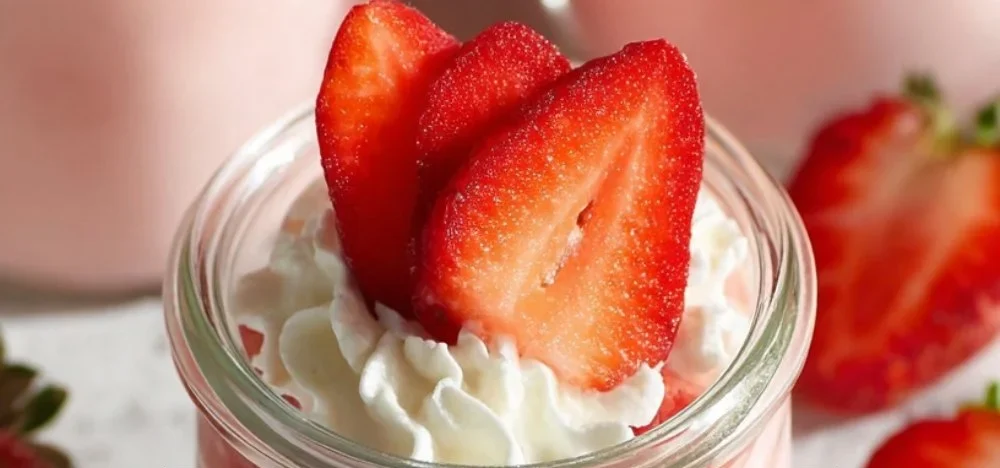
Presentation matters as much as recipe: small glasses or repurposed jam jars give the mousse an intimacy; a sprig of mint or a single halved strawberry becomes a signpost of attention. In Sofia’s place it was always served with the radio on low, neighbors bringing crusty bread and olives, the mousse placed like a jewel in the middle of a communal table. Sharing it felt like exchanging weather and stories — each spoonful a punctuation in conversation.
Storing the dish without losing its cultural essence
Preservation is both practical and philosophical. To store this mousse is to keep its memory intact: cover it gently to avoid absorbing refrigerator smells, and respect the time it has spent cooling. In climates where refrigeration is a later luxury, people have historically used cool cellars, stone jars, or the noble shade of a fig tree to keep desserts at a steady temperature. The aim is to protect aroma more than to preserve texture: strawberries are delicate, and their perfume fades when exposed to air.
When you re-open a container of mousse, do it like opening a letter: expect a small rush of scent and a moment in which the dessert reintroduces itself. If the mousse has been left too long, the texture may relax and the strawberry’s brightness may dim, but it will still hold the memory of the meal. Storing food is part of its storytelling — how long we keep something, and how we retrieve it, speaks to our relationship with the past.
Cultural questions people often ask
Is this mousse vegan? Often yes, if the coconut cream is plant-based and no gelatin is used, though the answer depends on the sugar processing in some regions. Is it authentic? Authenticity is slippery; recipes mean different things to different people. This mousse is authentic to the impulse of making light fruit desserts with available ingredients. Why coconut cream instead of dairy? In many parts of the world dairy is scarce or heavy; coconut offers a local, flavorful alternative that carries its own cultural resonance. Can the sweetness be adjusted? Absolutely — sweetness is a matter of climate and taste. In cooler climates, berries taste sweeter naturally; in warmer places, a touch more sugar may be welcome. The questions are always a doorway into deeper stories of place and preference.
A closing note on food, memory & travel
Food is the language that translates place into memory. This strawberry mousse without gelatin or whipped cream is less about technique than about provenance and presence. It is a dish that asks you to attend: to taste the season, to honor the substitutions made out of necessity or preference, and to recognize that generosity is often simplest when it is most local. On my travels, bowls like this have been my companions — quiet, honest, and eloquent in their modesty. They remind me that culinary routes are human routes: people carrying seeds, recipes, and tastes across seas and mountain passes, reshaping them in new kitchens, and offering them at tables both humble and grand.
At the end of a meal, when conversation settles and plates are passed to be cleared, food becomes memory. The mousse that Sofia taught me is a small archive of mornings and markets, of borrowed coconuts and lemon trees on balconies, of the way one woman decided that a foam of fruit and cream could say everything she wanted to welcome a friend. Travel gives you maps; food gives you the means to enter those maps and rest there for a while.
Conclusion
For a gentle exploration of similar gelatin-free strawberry mousses and variations from home cooks, I have often returned to recipes that celebrate fruit and simple ingredients like the write-up on Strawberry Mousse (Without Gelatin) – Aromatic Essence, which sketches approachable techniques for fruit-forward desserts. For an Italian perspective that highlights seasonal berries and light preparations, the essay and recipe on Easy Fresh Strawberry Mousse Recipe – An Italian in my Kitchen is a lovely companion. And for another home-cook’s take on a no-gelatin strawberry mousse that emphasizes clarity of flavor, see the thoughtful notes at Strawberry Mousse | No Gelatin – My Food Story.
Strawberry Mousse
Ingredients
Method
- In a mixing bowl, combine the strawberry puree and sugar. Stir until the sugar is dissolved.
- In another bowl, whisk the chilled coconut cream until it becomes light and fluffy.
- Gently fold the strawberry mixture into the whipped coconut cream.
- Add the vanilla extract and lemon juice, folding gently until fully combined.
- Spoon the mousse into serving dishes and refrigerate for at least 1-2 hours before serving.