Gingerbread Tiramisu
Introduction
Gingerbread Tiramisu presents a disciplined intersection of two distinct pastry traditions: the spiced biscuit heritage of gingerbread and the layered, emulsified cream technique of classic tiramisù. As a professional chef, approaching this composition requires attention to the chemistry of emulsions, the hygroscopic behavior of baked goods, and the balance between aromatic spice and the dairy fat matrix. The outcome should be a dessert that reads as cohesive — each spoonful revealing integrated flavors, controlled sweetness, and a measured contrast of textures: a tender, coffee-moistened cookie and a stable, aerated mascarpone cream.
The recipe provided is deliberately concise. It relies on precise ingredient relationships and straightforward assembly, but the technique is where texture and flavor maturity are secured. Proper execution transforms the components into an architecture of taste: the coffee’s volatile aromatics lift the ginger and cinnamon; sugar and fat modulate spice perception; and cold aging allows hydration and flavor melding without collapse. The following sections dissect the culinary logic and give practical direction for a repeatable, restaurant-quality result.
The culinary logic behind this dish
This variant of tiramisù substitutes ladyfingers with gingerbread cookies and spices the mascarpone matrix, which necessitates deliberate adjustments in technique to maintain structural integrity and flavor clarity. Gingerbread cookies tend to be denser and more hygroscopic than savoiardi; they absorb liquid differently and can become pasty if oversaturated. That characteristic dictates controlled soaking and layer thickness to preserve a gentle chew rather than a soggy mass.
Spices — ground ginger, cinnamon, and nutmeg — are volatile and can become muted or harsh if misapplied. Gelling them into a buffered dairy fat (mascarpone and cream) softens their edge, distributes them evenly, and allows their essential oils to integrate slowly during refrigeration. Sugar acts not only as a sweetener but as a stabilizer for the whipped cream, increasing viscosity and shelf life of the emulsion. Coffee provides acidity and bitterness to counterbalance sweetness and spice; its temperature and concentration influence absorption and final aroma profile.
Finally, timing — rest and cold maturation — is crucial. Short resting leads to heterogenous texture and underdeveloped meld; overly long rest risks grainy cream or a collapsed structure if stabilizers are not correctly used. The logic is to create equilibrium: moisture transfer, flavor diffusion, and structural stability coalesce during a controlled chilling period.
How to make Gingerbread Tiramisu
This recipe follows the classic tiramisù assembly but adapts for spice and biscuit structure. Execute each step with intention: maintain steady cream aeration, monitor cookie soak, and build uniform layers to ensure even hydration and consistent mouthfeel across the serving.
Ingredients :
1 cup mascarpone cheese, 1 cup heavy cream, 1/2 cup sugar, 1 teaspoon vanilla extract, 1 teaspoon ground ginger, 1 teaspoon ground cinnamon, 1/4 teaspoon ground nutmeg, 1 cup gingerbread cookies (store-bought or homemade), 1/2 cup brewed coffee, cooled, Cocoa powder for dusting, Chocolate shavings for garnish
Directions :
- In a large bowl, whisk together the mascarpone cheese, heavy cream, sugar, vanilla extract, ginger, cinnamon, and nutmeg until smooth and creamy., 2. Dip each gingerbread cookie in the brewed coffee, ensuring they are soaked but not soggy., 3. In a serving dish or individual cups, layer the soaked cookies at the bottom., 4. Spread a layer of the mascarpone cream mixture over the cookies., 5. Repeat the layering process until you’ve used all the cookies and cream, finishing with the mascarpone layer on top., 6. Dust the top with cocoa powder and add chocolate shavings for garnish., 7. Refrigerate for at least 4 hours or overnight before serving. Enjoy your festive dessert!
Ingredient analysis through a chef’s lens
Mascarpone cheese: a high-fat, soft cheese whose creaminess and neutral lactic tang form the structural backbone of the tiramisù. Its fat content stabilizes the emulsion and carries volatile spice oils. Use full-fat mascarpone kept cold to maintain body during whipping.
Heavy cream: provides aeration when whipped and lightens the dense mascarpone. Whipping degree controls texture — under-whipped yields a heavy, clotted cream; over-whipped risks breakage and graininess. The interfacial tension between whipped cream and mascarpone creates a stable, yet supple, filling.
Sugar: at 1/2 cup, sugar functions beyond sweetness — it modifies freezing point, helps retain moisture, and increases emulsion stability. Caster sugar is preferred for rapid dissolution; if granulated is used, ensure it dissolves fully to avoid a gritty mouthfeel.
Vanilla and spices (ginger, cinnamon, nutmeg): spices should be ground fresh and measured precisely — they contribute essential oils that interact with the coffee and dairy. Vanilla provides background sweetness and rounds spice edges. Even distribution is critical; mix spices thoroughly into the dairy base for homogeneity.
Gingerbread cookies: Their composition (molasses, butter, flour ratio) and density define soak time. Home-baked gingerbread can vary; store-bought typically offers consistency. The cookie matrix must hold shape after coffee immersion—aim for a pliant, moist texture without collapsing.
Brewed coffee: cooled to room temperature to prevent heat damage to the mascarpone emulsion during assembly. Coffee strength affects tannins and acidity; use a medium to strong brew, but avoid concentrated espresso without testing, as it can overpower and over-wet the cookie.
Cocoa powder and chocolate shavings: both finalize the palate with dry bitterness and textural contrast. Unsweetened cocoa creates a finishing dry note that balances the sweet, spiced cream; chocolate shavings add a glossy, slightly firm counterpoint.
Kitchen workflow & technique breakdown
Mise en place is essential. Chill the mascarpone and heavy cream until just below 40°F (4–5°C) to ensure optimal whipping and emulsion formation. Set out all measured spices in small bowls. Brew and cool the coffee in advance; warm or hot coffee will collapse the whipped structure and loosen the mascarpone.
Start by combining mascarpone, sugar, vanilla, and spices in a chilled mixing bowl. Gently fold in the whipped cream rather than vigorously whisking; folding preserves aeration and prevents broken emulsions. For the coffee dip, use a shallow dish to control immersion time; lay the cookie flat and submerge for a clear, seconds-based rhythm rather than a prolonged soak, then transfer immediately to a tray to prevent cross-saturation.
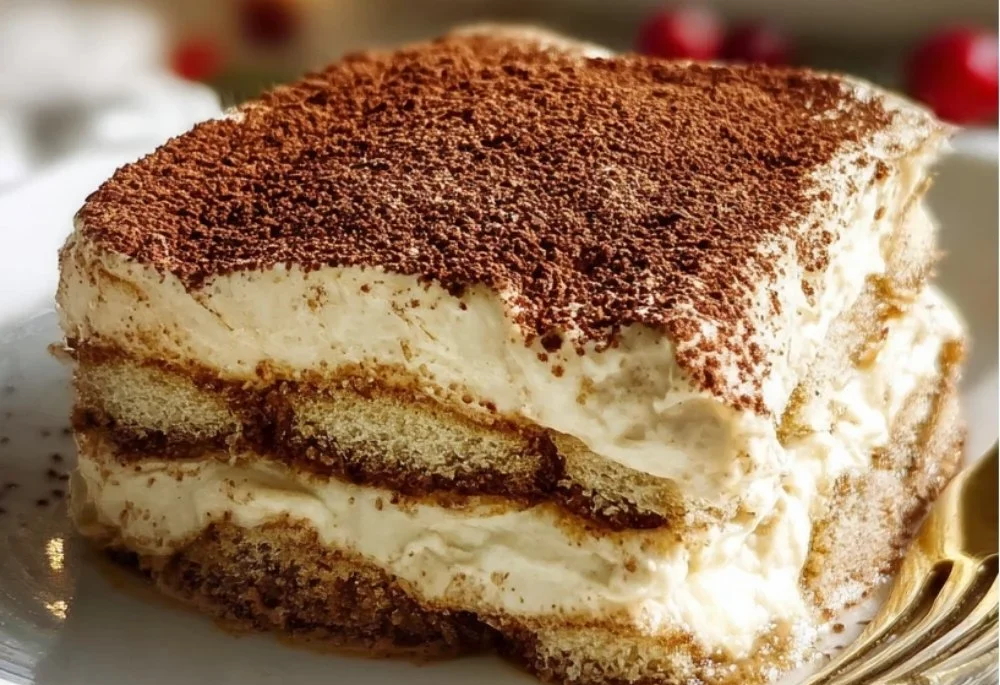
Assemble in a dish with straight sides for even layering. Use an offset spatula to spread the cream with minimal deflation. Work quickly but deliberately: maintaining cool components and minimal handling preserves texture. Clean edges between layers for neat presentation.
Texture control, heat management & timing
Texture control centers on two variables: the whipped cream’s firmness and the cookie’s absorption. For cream, whip to soft peaks; this yields a lightness that supports the mascarpone without deflating under the weight of the cookie layers. Over-whipping yields rigidity and can split the emulsion when folded. If a more stable finish is required for longer service, incorporate a small percentage of gelatin (not in this recipe) or use stabilized whipped cream techniques, but adhere to the provided recipe.
Heat management: work in a cool environment and keep bowls chilled. Mascarpone becomes runny if warmed; that can lead to separation when mixed with whipped cream. Coffee must be fully cooled — lukewarm liquid starts to fatigue the emulsion immediately upon contact.
Timing: a minimum of 4 hours chilling is required to allow moisture migration and flavor integration. Overnight (8–12 hours) is acceptable and encourages a fully married flavor profile and a cohesive, spoonable texture. However, extended storage beyond 48 hours may degrade textural contrast as cookie structure breaks down.
Professional variations
- Layer refinement: alternate thin layers of cream and finely crushed gingerbread folded into a fraction of the cream to introduce textural interruptions without risking sogginess.
- Alcohol integration: a small amount of dark rum or spiced liqueur may be brushed into the coffee for added complexity; dose conservatively to preserve balance with spices.
- Spice bloom: briefly warm spices with a small portion of the cream before cooling and incorporating to bloom essential oils; ensure the cream is cooled to prevent destabilizing the whole mixture.
- Chocolate accent: replace some cocoa dusting with a light layer of tempered chocolate shards for a firmer bite on the surface.
Note: Do not alter ingredient quantities in the canonical recipe when preparing to test replication fidelity.
Finishing touches & plating philosophy
Presentation should emphasize clean lines and restrained garnishes to highlight the dessert’s layered nature. Dust the cocoa evenly using a fine-mesh sieve to avoid clumping and to create a uniform, matte surface that contrasts with glossy chocolate shavings. Chocolate shavings should be created from a cold, high-quality chocolate bar using a thermometer-cooled peeler to produce thin, delicate curls rather than thick chips.
Portion control matters: serve in pre-chilled plates or in individual glasses to maintain temperature and structure. When plating from a large dish, use a hot, dry knife passed between slices for clean cuts — heat lightly and wipe between cuts to avoid tearing. Maintain a balance: the garnish should provide contrast without dominating the spice and coffee interplay.
Maintaining quality after cooking
Store the tiramisù refrigerated at 36–40°F (2–4°C). Consume within 48 hours for optimal texture contrast; beyond that, moisture migration will soften the gingerbread to near-paste and the cream may lose its aeration. If transporting, keep chilled in an insulated carrier and avoid vibrations that accelerate structural breakdown.
If you need to prepare components ahead, assemble up to 12 hours in advance for best results. Alternatively, pre-make bases and cream separately: cookies can be stored airtight; cream should be assembled and kept cold, then layered within an hour of service to maintain peak texture.
Questions from home cooks (chef answers)
Q: How wet should the cookies be after dipping? A: The objective is a controlled hydration: cookies should be pliant and saturated but retain discrete structure. Aim for a 1–2 second full immersion in the coffee for typical store-bought gingerbread; adjust in proportion to cookie thickness. Transfer immediately and lay flat to drain briefly — puddled coffee accelerates collapse.
Q: My cream separated when I mixed mascarpone with whipped cream. Why? A: That indicates either the mascarpone was too warm or the whipped cream was over-whipped. Work with cold ingredients, and fold whipped cream into mascarpone using gentle strokes, lifting from the bottom to maintain aeration. If separation occurs, chill the mixture briefly and then re-fold gently; do not use high-shear beating.
Q: Can I use espresso instead of brewed coffee? A: You can, but espresso concentrates tannin and acidity; dilute to match the volume and tasting profile of the brewed coffee given here. Always cool completely before contact.
Q: The spices seem muted after chilling. How can I intensify them without changing quantities? A: Bloom spices by warming a small portion of the cream with the ground spices until aromatic, then cool completely and proceed with mixing. This brings essential oils to the surface and enhances perceived spice without altering the recipe.
Q: How long can it sit in the freezer? A: Freezing alters texture dramatically; ice crystals rupture the cream matrix. If absolutely necessary, freeze for short periods with airtight protection, but thawing will produce a softer, wetter texture and diluted flavor.
Final chef notes
This Gingerbread Tiramisu is an exercise in restraint and balance. Observe temperatures, control hydration, and be precise with aeration. The harmony between the coffee’s acidity, the spice oils, and the dairy fat is fragile but rewarding when managed intentionally. Preserve the architecture during assembly and rest the finished product long enough for flavors to equilibrate; the result is a composed dessert that reads as unified rather than a sum of disparate parts.
Conclusion
For reference and additional interpretations, consult these three external resources to compare technique and presentation: Gingerbread Tiramisu – Butternut Bakery, Christmas Gingerbread Tiramisu – Burrata and Bubbles, and Gingerbread Tiramisu – Cook Republic. These examples provide useful variations in soaking technique, spice balance, and plating that can inform refinements while remaining aligned with the core principles outlined above.
Gingerbread Tiramisu
Ingredients
Method
- In a large bowl, whisk together the mascarpone cheese, heavy cream, sugar, vanilla extract, ginger, cinnamon, and nutmeg until smooth and creamy.
- Dip each gingerbread cookie in the brewed coffee, ensuring they are soaked but not soggy.
- In a serving dish or individual cups, layer the soaked cookies at the bottom.
- Spread a layer of the mascarpone cream mixture over the cookies.
- Repeat the layering process until you've used all the cookies and cream, finishing with the mascarpone layer on top.
- Dust the top with cocoa powder and add chocolate shavings for garnish.
- Refrigerate for at least 4 hours or overnight before serving.
- Enjoy your festive dessert!