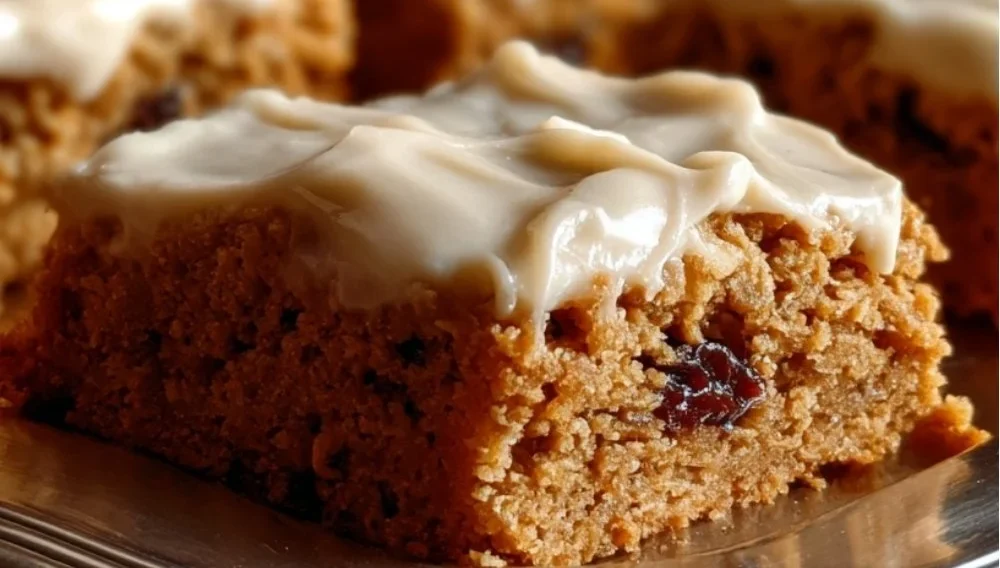
Easy Oatmeal Raisin Cookie Bars
Introduction
The Easy Oatmeal Raisin Cookie Bars are a classical, utility-focused dessert that emphasizes starch structure, caramelization and chew through a restrained ingredient list. My approach treats this formula as a study in balance: dry to fat ratio, sugar types and their hygroscopic properties, and the interplay between oats and wheat for mouthfeel. In professional terms, the result should be a uniform matrix that is golden and tender at the crumb, with focused chew from the oats and suspended pockets of sweetness from the raisins. For comparative technique on converting cookie dough concepts into slab-style bars, review the differences demonstrated in a reliable cake-bar conversion such as the cake mix cookie bars, which illuminates scale, thickness, and bake-time adjustments crucial to bar geometry.
This article examines the recipe with technical clarity: why each step matters, how to control texture and color, how timing and heat affect chew and caramelization, and how to maintain quality after baking. The aim is to give a precise, chef-oriented blueprint that preserves the original recipe while expanding on execution and sensory outcomes.
The culinary logic behind this dish
At its core this recipe is a hybrid between a cookie and a quick bread: it uses creamed butter and sugar and a single egg to provide leavening, structure and moisture. Rolled oats supply both texture and fat-absorbing fiber; they blunt gluten development and contribute a slow-release chew that contrasts with the short tender crumb created by the butter and minimal egg. Brown sugar adds molasses—introducing acidity, moisture retention, and enhanced Maillard reaction—resulting in deeper color and richer flavor than white sugar alone.
Baking in a shallow pan instead of forming individual cookies compresses the surface area-to-volume ratio and concentrates browning reactions on the exposed top and edges. The result is a finished product that is uniformly set through the slab with pronounced edge caramelization. The presence of baking soda, at 1/2 teaspoon for the given volume, is not intended to aggressively leaven but to ensure mild lift and to raise pH slightly, which both quickens browning and softens the crumb by weakening gluten bonds. Salt is minimal but critical for flavor clarity and to temper the sweetness of the sugars and raisins.
The precision of creaming, the order of ingredient incorporation, and the distribution of the oats versus flour all direct final mouthfeel. Each manipulation controls gluten formation, sugar dissolution and fat coating—key variables for a successful bar.
How to make Easy Oatmeal Raisin Cookie Bars
Prepare mise en place first: measure and preheat the oven accurately to 350°F (175°C), bring the butter to a softened but cool state (about 65–70°F / 18–21°C) so it will trap air without collapsing, and sift or whisk the dry ingredients to ensure even leavening. For the raisins, if you prefer them plump and integrated rather than as chewy islands, soak briefly in hot water, tea, or a liqueur, then drain; if left dry they provide a denser, chewier contrast. Follow these exact recipe directives before executing:
Directions :
- Preheat the oven to 350°F (175°C). Grease a baking dish., 2. In a large bowl, cream together the softened butter, brown sugar, and granulated sugar until smooth., 3. Beat in the egg and vanilla extract., 4. In another bowl, mix together the rolled oats, flour, baking soda, and salt., 5. Gradually add the dry mixture to the wet mixture and stir until combined., 6. Fold in the raisins., 7. Spread the mixture evenly in the prepared baking dish., 8. Bake for 25-30 minutes, or until golden brown., 9. Allow to cool before cutting into bars.
Each of those steps is deliberately sequenced to control texture and distribution: creaming first creates a homogenous lipid-sugar matrix that will emulsify the egg uniformly when added; combining dry ingredients separately prevents localized overmixing and ensures the soda is evenly dispersed for consistent color and lift. Folding in raisins at the end prevents tearing of the matrix and prevents the raisins from releasing too much moisture early in the bake.
Ingredients :
1 cup rolled oats, 1 cup all-purpose flour, 1/2 cup brown sugar, 1/2 cup granulated sugar, 1/2 cup butter, softened, 1/2 cup raisins, 1/2 teaspoon vanilla extract, 1/2 teaspoon baking soda, 1/4 teaspoon salt, 1 egg
This list should be followed exactly to maintain the established balance of dry and wet components. The combined 1.5 cups of sugars create both sweetness and color potential. Butter at 1/2 cup is the sole fat source; its temperature is crucial, as noted. The single egg provides emulsification and modest structure; do not increase egg count lightly, as that will firm the bars and reduce the desired chew.
Ingredient analysis through a chef’s lens
Rolled oats: Their particle size—larger than quick oats—preserves chew and suspension in the matrix. Oats absorb moisture and interrupt gluten strands, which reduces toughness. Toasting a portion of the oats briefly in a dry pan before mixing can develop an almond-like aroma and deepen color without altering hydration substantially.
All-purpose flour: Serves as the primary structural protein. Given the oat content, the formula inherently reduces gluten development; however, mixing technique still matters. Combine gently to avoid over-developing gluten from the flour.
Brown sugar: The molasses component contains acids and invert sugars that retain moisture and encourage Maillard reactions. It also contributes to a softer, tackier crumb. Granulated sugar encourages surface browning and crisping at the edges. The 1:1 sugar split balances chew and edge crispness.
Butter: Fat coats flour proteins to limit gluten formation and provides richness and mouthfeel. Properly softened butter will trap air when creamed, contributing a mild lift. Avoid melted butter; it will yield a denser, squarer bar.
Raisins: Concentrated pockets of sugar and acidity; their water activity differs from the crumb, so folding them in at the end limits their moisture migration. If using plumped raisins, account for added moisture in bake time and texture.
Baking soda and salt: Baking soda subtly increases browning and adjusts pH for flavor; salt enhances overall perception and balances the sweetness.
Kitchen workflow & technique breakdown
Efficient workflow reduces variability. Begin by setting the oven and preparing the pan—greasing uniformly prevents adhesion and gives predictable edge caramelization. Cream butter and sugars until the mixture is aerated and visually homogeneous: you should see a slight color lightening and the mixture should feel glossy and less granular; this step both dissolves some sugar and distributes fat. Add the egg and vanilla, mixing only until incorporated—overbeating at this stage can create an emulsion that traps too much air, which may collapse during baking and create a gummy interior.
When combining dry ingredients, whisk to distribute the soda and salt. Folding the dry into the wet should be done with a flexible spatula in three additions: this reduces the risk of overmixing and ensures even oat distribution. Scrape the bowl frequently. When spreading into the pan, press evenly but do not compact; a light, uniform surface allows steam to escape predictably and promotes even baking. Use an offset spatula to level without compressing.
Bake monitoring: ovens vary; start checking at 22 minutes if your oven runs hot. Look for a uniform golden brown top and edges, with slightly darker corners. A thin knife near the center should come out clean or with only a few moist crumbs—if it is wet with batter, extend baking in two-minute increments.
For reference on converting slab techniques and spacing considerations in slab desserts, consult approaches used in similar bar-format recipes such as the easy baked donut bars which emphasize pan depth and bake time relationships.
Texture control, heat management & timing
Texture arises from controlling water migration, heat exposure and sugar caramelization. Oven temperature at 350°F provides moderate radiant heat, promoting surface browning without overcooking the interior. If you increase temperature, the exterior will color before the center sets, yielding a raw interior. If your oven cooks unevenly, rotate the pan halfway through baking to promote even browning.
Timing is tied to pan depth. A deeper pan increases mass and requires longer, lower-temperature baking to prevent overbrowned edges. For the given ingredient volumes expect 25–30 minutes in a standard 8×8 or similar. Resist cutting immediately: the internal crumb will continue to set as it cools; slicing prematurely compresses the crumb and can release steam, producing a gummy texture. Cooling also allows fats to resolidify, improving slice integrity.
If you want a chewier bar, bias toward the lower end of the bake time and allow bars to cool fully; for a crisper, more cookie-like edge, extend by a few minutes, watching color rather than relying solely on time.
Professional variations
Maintain the ingredient proportions when testing variations. To increase complexity without changing hydration, consider one or two of the following, applied sparingly:
- Replace 1/4 cup of oats with toasted coconut for aromatic complexity.
- Swap half the raisins for chopped dried apple or chopped dates to shift acidity and textural contrast.
- Stir in a teaspoon of ground cinnamon or a 1/8 teaspoon of ground cardamom for spice lift; do not introduce additional liquid.
These are technique-focused modifications; they change flavor but not the structural balance.
If you are interested in nut-forward reinterpretations that retain slab behaviour, review texture conversion strategies used in compositions like the pistachio dream cookie bars for ideas on nut inclusion and roast timing.
Finishing touches & plating philosophy
Finishing is functional and visual: a light dusting of fine sugar over the top immediately post-bake will adhere to the still-warm surface and add a faint glaze; alternatively, a thin run of melted chocolate across cut bars creates contrast and seals in residual moisture. When plating for service, cut bars to uniform size and consider composition: a small stack of two with a micro-herb (e.g., a micro-mint leaf) is unnecessary for home service but can provide visual scale in a professional setting. Keep presentation minimal—the bars should read as rustic and intentional.
Temperature at service affects perception: slightly warm (served within 20–30 minutes of cooling) accentuates aroma and makes the fat seem silkier; completely chilled bars will firm the texture and accentuate chew.
Maintaining quality after cooking
Storage governs texture retention. For short-term freshness (up to 48 hours), hold bars at room temperature in an airtight container with a loose paper towel layer to buffer moisture if you prefer a crisper edge. For longer storage, refrigerate in an airtight container; the cold will firm fats and produce a denser mouthfeel—allow bars to return to near room temperature before serving for optimal aroma. To revive slightly stale bars, a 4–6 minute reheat at 300°F will restore some softness and revive oat aroma.
Freeze flat in single layers between sheets of parchment for up to three months. Thaw overnight in the refrigerator, then bring to room temperature; a brief 8–10 minute warm-up in a 325°F oven will refresh surface qualities.
Questions from home cooks (chef answers)
Q: Why did my bars turn out flat and greasy?
A: Likely causes are over-creaming melted butter or using butter that was too warm, which collapses the air matrix and pools fat. Also, underbaking in a high-hydration environment can give a greasy mouthfeel. Use properly softened butter and observe bake color rather than relying solely on time.
Q: Why are my bars crumbly rather than cohesive?
A: Under-creaming or insufficient mixing of the egg can cause poor emulsification; also, over-measuring flour by packing the cup will increase gluten formation and dryness. Spoon and level flour, and ensure the egg is fully incorporated.
Q: Can I use quick oats instead of rolled oats?
A: Quick oats will alter texture, producing a softer, less distinct chew. If you must substitute, reduce mixing and consider toasting to reintroduce textural interest.
Q: How can I prevent the raisins from sinking?
A: Toss raisins lightly with a tablespoon of flour before folding in; this creates a dry coating that slows moisture migration and suspension during baking.
Final chef notes
The elegance of Easy Oatmeal Raisin Cookie Bars is their reliance on controlled, simple technique. Precision in butter temperature, gentle yet thorough mixing, and attention to color during baking will yield consistent results. Preserve the balance of sugars and oats as provided; small technique changes have larger effects than minor ingredient deviations. Execute with measured confidence: this formula rewards discipline.
Conclusion
For additional variations and tested formulations of oatmeal-based slab cookies, see the community-tested Oatmeal Raisin Bar Cookies Recipe – Food.com which provides comparative baking notes. For a different take with step-by-step photography and alternate finishing ideas, consult Oatmeal Raisin Cookie Bars – i am baker, which complements the technical considerations covered here.
Easy Oatmeal Raisin Cookie Bars
Ingredients
Method
- Preheat the oven to 350°F (175°C). Grease a baking dish.
- In a large bowl, cream together the softened butter, brown sugar, and granulated sugar until smooth.
- Beat in the egg and vanilla extract.
- In another bowl, mix together the rolled oats, flour, baking soda, and salt.
- Gradually add the dry mixture to the wet mixture and stir until combined.
- Fold in the raisins.
- Spread the mixture evenly in the prepared baking dish.
- Bake for 25-30 minutes, or until golden brown.
- Allow to cool before cutting into bars.