White Chocolate Easter Bark
Introduction
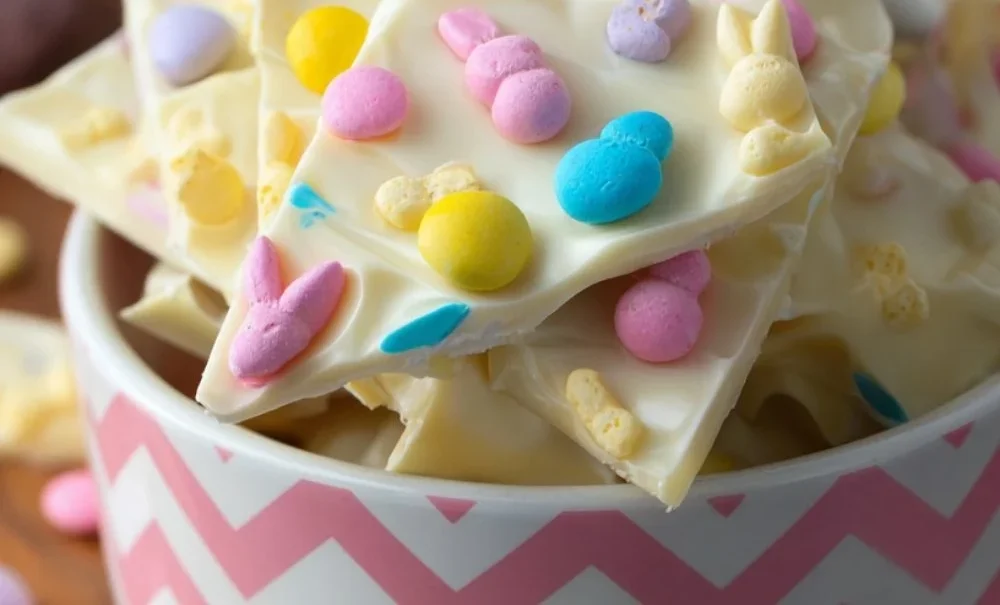
I first met this little confection on a sunlit table in a house above a narrow cobbled street, where laughter rose from an open window and floral curtains moved like sighs. Someone called it “Easter bark” and it was as simple and immediate as the name suggested: a sheet of white chocolate studded with bright, jewel-like candies and the remnants of last season’s dried fruits and nuts. In that moment the confection felt like a map — a map not of roads but of gatherings: children with sticky fingers, elders with stories curled in the corners of their mouths, and the silent archive of kitchen rituals that travel with families when they move from one country to another. The gentle, almost floral sweetness of the white chocolate anchored the memory; the candies offered bursts of color like village flags on a holiday.
If you have ever paired an extravagantly playful treat with the measured calm of a family table, you will find echoes of this in other small festive sweets, such as mini Easter cheesecakes with chocolate eggs, where the familiar meets the ceremonial and every bite feels like a commemorative act. I call this introduction SOFIA because names matter: they hold personalities and places, and the name in my memory was the person who handed me a piece of that bark with a wink and the soft warning that one would not be enough.
The origin story & regional influence behind this dish
Bark is, in its essence, a modern folk confection — improvised, festive, quick to make, and utterly adaptable. Its lineage is less about a single point of origin and more about a constellation of domestic practices: the age-old habit of pressing sweet things into a slab and sharing them. In Europe, the tradition of melting chocolate to decorate cakes or to create handheld sweets runs alongside seasonal rituals. In North America, bark became a household symbol of holidays, a canvas for celebration where candy remnants, nuts, and seasonal colors are pressed into warm chocolate and then shared.
White Chocolate Easter Bark, specifically, carries the dual imprint of Easter’s symbolism and the late-20th-century rise of white chocolate as a festive staple. Easter, across Christian and many secular communities, is a festival of return and light, and the pale, luminous surface of white chocolate often becomes a visual language for that season: soft as dawn, brilliant with pastel confetti. In coastal towns and inland villages alike, people have adapted the bark to local products — candied citrus peels where oranges abound, pistachios and rose petals in places influenced by Middle Eastern trade, or simple candy-coated eggs in bakeries whose shelves glimmer with imported confections.
More than geography, the dish records movement and memory. Migrant kitchens took the idea and made it their own: in cities where ingredients were scarce, dried fruit took center stage; where food markets overflowed with nuts and spices, those elements became part of the bark’s voice. The result is a confection that reads like a travelogue — each shard a chapter.
How to make White Chocolate Easter Bark
To make this bark is to perform an act both deliberate and forgiving. The ritual is short, which is perhaps why it has become so beloved: slow enough to feel attentive, swift enough to fit into the cadence of a busy house preparing for a holiday. One warms the chocolate, spreads it, and decorates — gestures that echo the larger gestures of hospitality that define Easter tables: open hands, shared plates, the small choreographies that tell friends and family they belong.
The act of pressing candies into the warm chocolate is an expression of improvisation and care. Children often take part, choosing colors and arrangements, their fingers leaving little prints around the edges that become part of the confection’s charm. There is delight in the way the glossy white surface receives the storm of colors and textures: smooth, then studded, then broken into pieces that collect in a bowl like scattered fortunes. The bark asks nothing of the baker in terms of skill, but asks for attention and an awareness of the moment — whether that moment is a sleepy morning or an evening of housefuls.
Ingredients :
1 pound white chocolate, 1 cup colorful Easter candies (like candy-coated chocolate eggs or jelly beans), 1/2 cup chopped nuts (optional), 1/2 cup dried fruit (optional)
Directions :
- Line a baking sheet with parchment paper., 2. Melt the white chocolate in a microwave-safe bowl, stirring every 30 seconds until smooth., 3. Pour the melted chocolate onto the prepared baking sheet and spread it into an even layer., 4. Sprinkle the colorful Easter candies, nuts, and dried fruit on top of the melted chocolate., 5. Refrigerate for about 30 minutes or until the chocolate is set., 6. Break into pieces and enjoy!
Ingredients through a cultural & historical lens
There is an anthropology in every ingredient. White chocolate, unlike its darker cousins, did not evolve from local cacao traditions; it is the product of modern confectionery, an object of luxury turned familiar. Its milky sweetness often points to industrial production and global trade routes — cacao derivatives, dairy, and sugar converging in a factory before arriving at market stalls. Yet when that white slab arrives in a kitchen, it becomes a site of reinvention.
Candy-coated eggs, with their pastel shells, trace their form to the egg itself — the universal symbol of rebirth. The act of coating a small chocolate sphere in colored sugar suggests a layering of meaning: the egg as symbol becomes the candy as signifier of celebration. Nuts and dried fruits bring older narratives: almonds were gifts in Roman rituals and later in Mediterranean weddings; dried apricots carried on caravan routes became tokens of hospitality. Together on a plate they fold history into the present, a small anthology of tastes that carry stories from harvest to holiday table.
Optional nuts and dried fruits are also the cultural adapters of this dish. In Eastern Europe one might see walnuts and candied orange peel; in parts of the Mediterranean, roasted pistachios and dried figs make an appearance. Each variant speaks of what was accessible, what was prized, and what was worth preserving.
Cooking the dish: sensory notes & traditional techniques
The sensory life of this bark is immediate. Melted white chocolate breathes a warm, creamy aroma that hovers between caramel and vanilla; it suggests kitchens full of sunlight and the slow work of stirring. When poured onto parchment, it spreads into a glossy plain like a winter river, reflective and cool. The candies land with a soft pat, their sugar shells chiming in bright colors against the white expanse.
Breaking the set chocolate produces a sound that belongs to domestic joy — a clean snap, then an irregular scattering as pieces are handed around. The textures are a conversation: the soft melt of chocolate, the crisp sugar shell of a candy, the chew of dried fruit, the satisfying crunch of a nut. In many households, the making is as important as the eating; elders will instruct with stories rather than technique — how a mother used to hide the last pieces, or how a small relative insisted on placing the very last jelly bean.
Traditional techniques are minimal but evocative: using a wooden spoon warmed by hand to stir the chocolate, spreading it with a palette knife inherited from a grandmother, or allowing the sheet to cool by a window where the breeze carries the scent of lilacs. These small rituals tie a simple recipe to a lineage.
How different regions prepare their version
Across regions the bark tells new stories. In Scandinavia, you might find it pared with cardamom-scented dried apple strips, lending the white chocolate a green, aromatic edge that recalls winter markets. In the Levant, rosewater-soaked dried apricots and pistachios transform the slab into something lavish and aromatic. In Latin American households, where dark chocolate is the touchstone, white chocolate appears less often, but where it’s embraced it gathers local add-ins like candied citrus or toasted coconut.
Urban kitchens reimagine it with modern aesthetics: micro herbs, edible flowers, or even smoked salt flakes, while rural homes prefer what the fields and pantries offer. There is a democratic quality: the same recipe welcomes the gold-leafed extravagance of a pastry chef and the pragmatic frugality of a mother who uses what she has on hand. For a contrast in texture and intent, one can compare this to variations like the viral chocolate date bark, which uses dense dried fruit to anchor the chocolate and speaks of different regional palettes and preserved-food traditions.
Traditional ways this dish is shared or served
Bark is never merely plated; it is presented. In many homes it becomes a participant in the ritual of visiting: a plate offered at the door, a treat for children who come bearing small bunches of flowers, or an accompaniment to coffee cups that steam in the afternoon light. On holiday mornings, a bowl of broken pieces sits beside casseroles and boiled eggs, offered as a sweet punctuation to savory dishes.
Because it is so easily portioned, bark functions as a communal sweet: people take a shard and continue a conversation. In some regions, recipes are given names tied to the giver — “Maria’s bark” — and the style becomes an extension of personality. Bakers tuck pieces into gift boxes or nestle them among other confections on a communal table, and the visual effect of the glittering candies against the white chocolate elevates it into an object of celebration.
Storing the dish without losing its cultural essence
Storing bark is a practical matter that also carries memory. In tightly packed tins, sheeted between parchment, the shards keep their stories intact. Refrigeration keeps white chocolate from blooming in warm climates but risks dulling the aromatic top notes; many households choose a cool pantry for a day or two and the fridge for longer. The real risk is not physical degradation but forgetting: a slab wrapped and placed aside can lose its place in the ritual, so families often store it where it will be seen and taken.
When gifted, bark is wrapped in translucent paper or placed in small boxes, the decoration visible through the wrap — an invitation to open, an announcement of generosity. Even the way it is stored tells a story: a tin labeled and carried across borders, a box left by the window, the last piece hidden in a jar and discovered months later like a seed from a past season.
Cultural questions people often ask
People ask why white chocolate, when cocoa-rich dark bars are the cultural norm in so many places. The answer is that white chocolate is a kind of soft architecture, a blank wall upon which color, memory, and ritual paint themselves. Others ask if the candies dilute the “authenticity” of a confection. Authenticity, in this context, is not a fixed point but a conversation; the candies are markers of time and availability, of childhood and spectacle.
Questions also arise about substitutions: what if one cannot find the exact candy or dried fruit? The tradition of bark has always included substitution — local ingredients step into the role of distant ones, and the meaning remains because the gesture remains: sharing a festive, beautiful sweet. People wonder about formality: is bark casual or worthy of a table? It depends on how it is presented. A bark arranged on a family platter for a holiday has a different gravity than a hastily broken slab handed to a neighbor, and both are true to its spirit.
A closing note on food, memory & travel
Food remembers a place long after a person has left it; it stores migrations and maps them onto taste. White Chocolate Easter Bark is simple enough to be a child’s first confection and complex enough to carry traces of a family’s movement across continents. In each shard there is an archive of hands — the hands that stirred, the hands that pressed, the hands that broke and offered. Eating it is an act of reading, and with every bite we translate gestures into memory.
Conclusion
If you wish to try a variety of simple, festive preparations that celebrate the same spirit of seasonal sharing, you may enjoy this easy white chocolate Easter bark recipe which shows a minimal and cheerful approach to the treat. For a domestic, all-American take filled with bright colors and household warmth, see the thoughtful presentation at White Chocolate Easter Bark – The Gracious Wife. And for another rustic, easy-to-make variation that emphasizes accessibility and joyful messiness, consider the recipe for Easy White Chocolate Easter Bark Recipe which captures the playful, communal heart of the dish.
White Chocolate Easter Bark
Ingredients
Method
- Line a baking sheet with parchment paper.
- Melt the white chocolate in a microwave-safe bowl, stirring every 30 seconds until smooth.
- Pour the melted chocolate onto the prepared baking sheet and spread it into an even layer.
- Sprinkle the colorful Easter candies, nuts, and dried fruit on top of the melted chocolate.
- Refrigerate for about 30 minutes or until the chocolate is set.
- Break into pieces and enjoy!