Heart-Shaped Macarons
Introduction
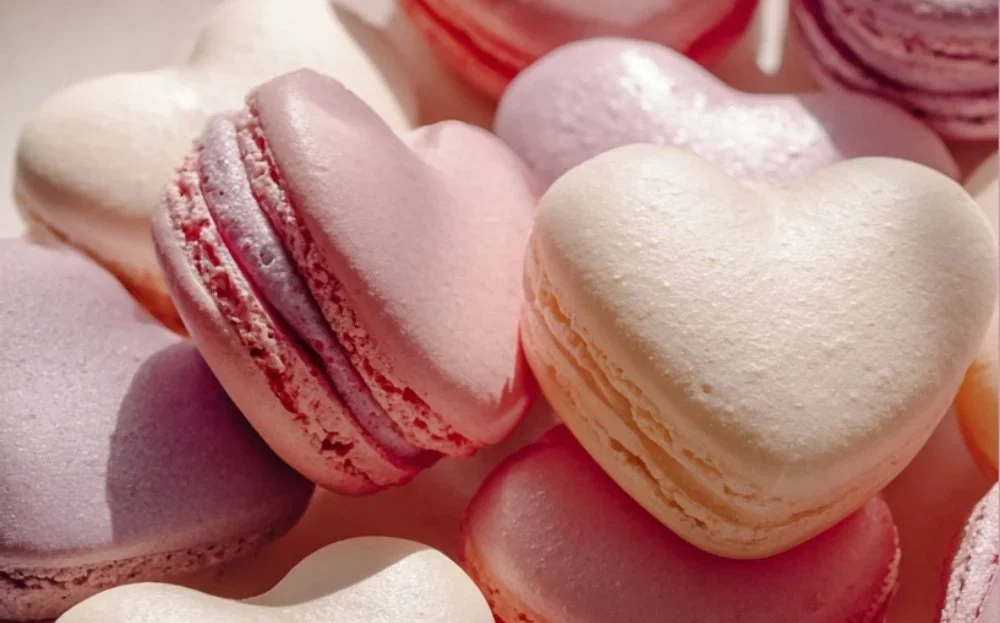
Heart-shaped macarons are an exercise in structural precision and delicate flavor balance. The macaron shell is a deceptively simple architecture: a crisp, thin exterior membrane, a tender interior, and a ruffled “foot” where the batter lifts during steam expansion. Shaping them as hearts requires the same technical control as round shells but adds a requirement for consistent piping and oven behavior to preserve the silhouette. This recipe pairs classic French macaron technique with a straightforward vanilla buttercream, delivering a focused platform for textural contrast and flavor clarity. As a chef, my priority is to explain the why behind each action so the result is reproducible: predictable feet, uniform thickness, stable filling, and an even mouthfeel.
The culinary logic behind this dish
Macarons are a balance of mechanics and chemistry. The foundation is a stable meringue that provides both structure and elasticity; the almond-powder/powdered-sugar matrix supplies body and sweetness. When the batter is introduced to heat, the meringue’s trapped air expands and creates the foot; concurrently, a thin crust forms on the shell’s surface. Achieving the shell’s characteristic chew — firm exterior and tender interior — requires precise control of moisture and protein denaturation in the egg whites. The resting step before baking (forming the skin) is critical because it reduces surface tension, directing lift to the base of the shell (foot) rather than causing uncontrolled cracking. The buttercream filling functions as both flavor carrier and moisture regulator: a well-balanced buttercream will soften the shell slightly during maturation and integrate into the bite rather than overpowering or collapsing it. Shaping into hearts mostly affects the visual outcome, but maintaining uniform size and batter consistency is essential to achieving even bake times and internal texture.
How to make Heart-Shaped Macarons
Ingredients :
For the Macaron Shells:, 1 cup powdered sugar, 1/2 cup almond flour, 2 large egg whites (at room temperature), 1/4 cup granulated sugar, 1/2 teaspoon vanilla extract, Red or pink food coloring (optional), For the Buttercream Filling:, 1/2 cup unsalted butter (softened), 1 cup powdered sugar, 1 teaspoon vanilla extract, 2 tablespoons heavy cream or milk, Pinch of salt, Red food coloring (optional)
Directions :
For the Macaron Shells:, Sift the powdered sugar and almond flour together into a bowl to ensure the mixture is fine and lump-free. Set it aside., In a separate clean mixing bowl, use a hand mixer or stand mixer to whisk the egg whites. Start on low speed, then increase to medium-high. When soft peaks begin to form, gradually add the granulated sugar and continue to whisk until stiff peaks form., Add the sifted almond flour and powdered sugar mixture to the whipped egg whites. Fold the ingredients together gently using a spatula. Add a few drops of food coloring (optional) and continue folding until the mixture flows off the spatula like thick lava., Transfer the macaron batter into a piping bag with a round tip. On a baking sheet lined with parchment paper, pipe heart shapes by drawing a “V” shape and completing the heart. Try to make them uniform in size for even baking., Let the piped macarons sit at room temperature for 30 minutes to 1 hour, allowing them to form a dry skin. This is crucial for achieving the characteristic foot (ruffled edge) on the macaron shells., Preheat the oven to 300°F (150°C). Once the macarons have rested and developed a skin, bake them for 18 to 20 minutes. The macarons should be firm to the touch and easily lift off the parchment paper., For the Buttercream Filling:, In a medium mixing bowl, beat the softened butter until smooth and creamy. Gradually add the powdered sugar, one tablespoon at a time, until fully combined. Stir in the vanilla extract and a pinch of salt., Add the heavy cream or milk, one tablespoon at a time, to reach a smooth, spreadable consistency. If desired, add a few drops of red food coloring to tint the filling., Assemble the Macarons:, Once the macaron shells have cooled completely, flip them over. Pipe a small amount of the buttercream onto the flat side of one shell and sandwich it with another macaron shell., For the best flavor and texture, place the assembled macarons in the refrigerator for at least 24 hours to allow the filling to soften the shells.
Ingredient analysis through a chef’s lens
Powdered sugar contributes not only sweetness but fineness of texture; its ultra-fine crystals integrate into the almond flour to create a uniform paste during macaronage. Almond flour particle size matters — too coarse and the shell texture becomes gritty; too fine and it can alter liquid absorption and batter weight. The two large egg whites supply the protein matrix; they should be at room temperature to whip more readily and form stable peaks. Granulated sugar stabilizes the meringue by slowing coagulation and raising the syrup concentration around denaturing proteins; the stepwise addition during whipping controls crystallization and peak development. Vanilla extract is aromatic ballast; it accepts and amplifies subtle nuances in the butterfat of the filling. Food coloring is cosmetic but can affect meringue stability if added in large volumes — use gel or concentrated paste and introduce sparingly.
For the buttercream, unsalted butter provides structure and mouth-coating richness. Powdered sugar in the filling acts as both sweetener and stiffener; the amount controls consistency and sweetness intensity. Heavy cream or milk adjusts emulsion viscosity and melt behaviour at oral temperatures; a higher fat content yields a silkier mouthfeel. A pinch of salt is essential to balance sweetness and amplify flavors. Red food coloring for the filling is purely aesthetic and should be used judiciously to avoid destabilizing the emulsion.
Kitchen workflow & technique breakdown
Establish an efficient mise en place. Pre-sift the powdered sugar and almond flour together — this is an investment in surface quality and reduces the likelihood of tunneling in the baked shell. Have your piping bag fitted and weighed template ready under parchment so piping can be executed with a single confident motion. Use a clean, grease-free bowl for egg whites; fats impede protein denaturation and will prevent proper whipping.
Whip the whites gradually: begin low speed to create small, stable air cells, then increase speed as soft peaks form. Incorporate the granulated sugar gradually to dissolve it into the structure; a grainy meringue indicates insufficient dissolution. During macaronage, combine the dry mix with the meringue using a spatula and deliberate, controlled strokes. The goal is a batter that flows slowly in a continuous ribbon and smooths out — described as “lava” is practical shorthand. Overmixing eliminates necessary air, producing flat shells without feet; undermixing yields peaks and cracked surfaces.
Piping heart shapes requires consistent pressure and a confident wrist. Draw a “V” then complete the rounded top; maintain uniform diameters. After piping, tap the tray sharply once to release large air pockets, without flattening the shapes. Rest until a skin forms — this step cannot be rushed.
Texture control, heat management & timing
Heat control governs expansion and surface setting. Preheat to 300°F (150°C) as stated: this temperature creates sufficient internal steam to build the foot while allowing the crust to form slowly and evenly. Oven variability matters — convection ovens accelerate heat transfer and may require reducing temperature by 10–15°F (5–8°C). Use an oven thermometer to verify. Rack position should be centered to provide even airflow; multiple trays should be staggered and rotated halfway through baking for homogeneous results.
Timing is tied to batter thickness and humidity. The 18–20 minute window is a guideline; shells are done when firm to the touch and can be lifted cleanly from parchment. Underbaked shells remain soft and can collapse or stick; overbaked ones become brittle and dry. Humidity retards skin formation and increases oven time; in high-humidity environments extend the rest period or use a dehumidified area. Monitor shells visually: a glossy surface with intact edges and a defined foot are signs of correct baking.
Texture control is a sequence of proportional events: properly whipped meringue, accurate macaronage, appropriate rest, and calibrated oven heat. Adjust one variable at a time when troubleshooting.
Professional variations
While this recipe prescribes a vanilla buttercream, professional kitchens often vary components to match service needs. An Italian meringue or Swiss meringue approach for the shell can increase reproducibility in commercial contexts — these methods alter how sugar integrates and can lead to more stable peaks. For fillings, consider a stabilized buttercream with a portion of American-style to create a firmer, less perishable center for warmer service conditions, or use a ganache for a contrasting, dense mouthfeel. Flavor concentrates (e.g., intense fruit purees reduced to a thick paste) can be folded into the buttercream to introduce bright acidity without compromising structure. When introducing new ingredients, maintain the same hydration and fat balance to preserve texture.
Color and presentation can be refined with powdered luster, a light dusting of freeze-dried fruit powder, or a thin layer of tempered chocolate in the shell’s center before filling to provide a moisture barrier if longer storage is needed.
Finishing touches & plating philosophy
Finishing is functional as well as visual. After assembly, refrigerate for 24 hours to allow the buttercream to migrate and soften the shell to the ideal chew. At service, bring to cool room temperature so the buttercream regains aromatics and the shell is tender rather than cold and firm. Plate with restraint: use contrast in color and negative space to highlight the heart shape. A minimal smear of a complementary coulis or precise placement of micro-herbs is sufficient; avoid excessive garnishes that compete with texture. For individual service, present two shells per portion to maintain balance between texture and flavor intensity.
Maintaining quality after cooking
Storage is a function of hydration control and temperature. Once assembled, place macarons in an airtight container in the refrigerator for 24–48 hours; this resting period is critical — flavors meld and the interior softens to the ideal textural relationship with the shell. For longer storage, freeze assembled macarons in a single layer on a tray, then transfer to airtight containers. Thaw overnight in the refrigerator and then bring to room temperature before serving to restore buttercream pliability and aromatics. Avoid storing in direct contact with strong odors; both almond and butter readily absorb surrounding aromas.
Transport considerations: use rigid containers with interleaving layers to prevent abrasion. If serving in warm environments, a slightly higher fat ratio in the filling improves structural integrity.
Questions from home cooks (chef answers)
Q: My macarons have no feet. A: Most commonly this is due to undermixing during macaronage, insufficient rest (no skin formation), or oven temperature that’s too high. Revisit the batter stage: it should flow slowly; do the “figure-eight” test with the spatula. Allow a full skin to form before baking and verify oven temperature with a thermometer.
Q: Tops are cracked. A: Cracking indicates too much moisture in the batter or oven temperature set too high, causing rapid steam expansion before the surface can set. Ensure dry almond-sugar mix and rest longer to form a skin; reduce oven temperature incrementally.
Q: Shells are hollow inside. A: Hollow shells result from overwhipped meringue or overmixing during macaronage, creating too much incorporated air or collapsing the supporting matrix. Whip to stiff peaks without going dry; aim for a batter that holds shape but flows.
Q: Filling is too soft after refrigeration. A: Increase butter proportion slightly or reduce cream, or chill filled macarons longer. Alternatively, stabilize with a small amount of confectioners’ sugar adjustment for increased firmness. Remember refrigeration temp and serving temp both influence perceived firmness.
Q: How to pipe symmetrical hearts? A: Use a printed template under parchment, steady pressure, and consistent wrist motion: pipe the V first, then create two arcs to complete the top. Practice on spare paper to calibrate pressure.
Final chef notes
Consistency is the core competency for macarons. Prioritize ingredient homogeneity — sifted almond and powdered sugar — and understand the stages of meringue development. Macaronage is a tactile skill; the batter’s visual cues (smooth surface, lava-like flow) are the only reliable signals. Resting to form a skin is non-negotiable for reliable feet. Controlled oven heat is the final determinant of texture: validate your oven and, where possible, perform trial bakes to define exact time/temperature for your environment. Small adjustments compound: a slightly wetter batter, a shorter rest, or a few degrees hotter oven can shift results significantly. Treat this recipe as a precise protocol and refine through measured iterations.
Conclusion
For visual guidance on piping and a printable template to achieve uniform heart shapes, consult this Heart Shaped Macarons (video + template) – Pies and Tacos. If you’re interested in a commercial product reference and texture comparison, see Heart Shaped Macarons | Trader Joe’s for an example of consistent industrial sizing and finish. For additional technique notes and an alternative approach to the heart silhouette, review the process shared at Heart Shaped Macarons ~ Barley & Sage.