Cherry Kiss Cookies
Introduction
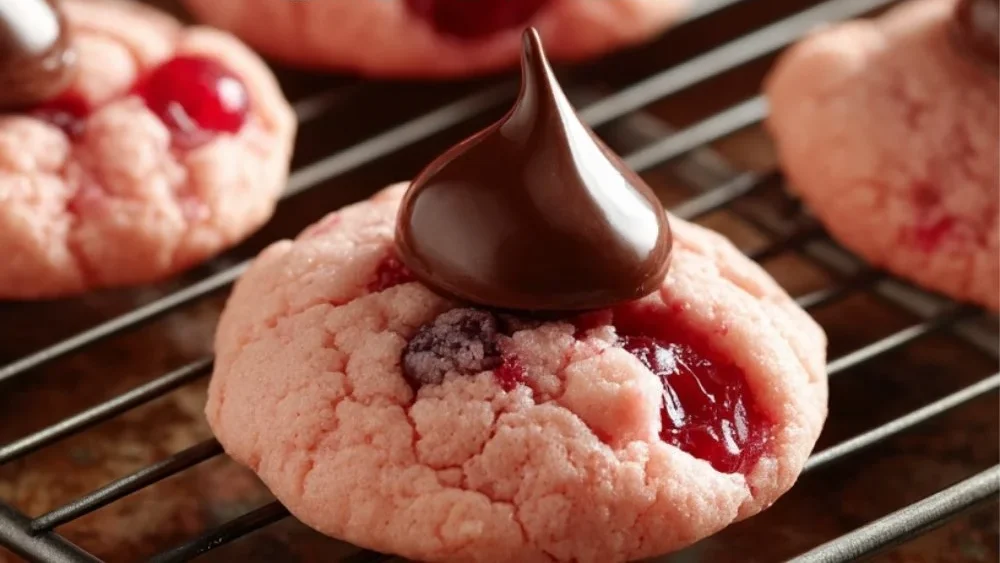
Cherry Kiss Cookies present a disciplined study in balance: a tender, butter-forward shortbread base punctuated by the bright acidity and syrupy texture of maraschino cherries, finished with the tempered kiss of milk chocolate. The construction is intentionally simple—few ingredients, precise technique—and that economy requires attention to detail to achieve an elevated result. My approach emphasizes control of fat crystallization, moisture distribution, and thermal transfer so each cookie exhibits a delicate crumb, a clean edge, and optimal adhesion for the chocolate topping. For comparative technique on similarly shaped cookies that rely on tight crumb structure, see this discussion on chewy maple cinnamon cookies.
The culinary logic behind this dish
At its core, the recipe leverages two primary flavor systems: the rich, rounded flavor of butter and the bright, saccharine-acidic counterpoint from maraschino cherries. Powdered sugar contributes to the cookie’s tender crumb because of its fine particle size and cornstarch content, which interrupts gluten formation compared with granulated sugar. A precise ratio of fat to flour (1 cup butter to 2 cups flour) produces a dough that spreads minimally yet remains soft; therefore, the baking window is narrow—enough heat to set edges but not so long as to dry the center. The Hershey’s Kiss serves as both an aromatic finishing element and a temperature-dependent structural component: pressed while the cookie is still warm, it adheres and slightly melts, forming a cohesive bite. Consider how similar cookies manage sugar and fat balance when planning texture; cross-referencing techniques like those in chewy maple cinnamon cookies can be instructive for adjusting sugar particle interactions.
How to make Cherry Kiss Cookies
Ingredients :
1 cup butter, softened, 1/2 cup powdered sugar, 1 teaspoon vanilla extract, 2 cups all-purpose flour, 1/4 teaspoon salt, 1 cup maraschino cherries, chopped, Hershey’s Kisses, for topping
Directions :
- Preheat the oven to 350°F (175°C)., 2. In a large bowl, cream together the softened butter and powdered sugar until light and fluffy., 3. Stir in the vanilla extract., 4. Gradually mix in the flour and salt until combined., 5. Fold in the chopped maraschino cherries., 6. Roll dough into small balls and place them on a baking sheet lined with parchment paper., 7. Bake for 10-12 minutes or until the edges are lightly golden., 8. Remove from the oven and immediately press a Hershey’s Kiss into the center of each cookie., 9. Allow to cool before serving.
The sequence above is intentionally minimal. Each step is cumulative; correct execution of Step 2 (creaming) sets up the texture for every subsequent action. Crème the butter and powdered sugar until light and fluffy—not merely combined—because entrained air contributes to an even lift and a fine crumb. When incorporating flour, use a low-speed fold rather than vigorous mixing to avoid developing gluten. Folding in maraschino cherries near the end ensures their moisture and syrup do not overly hydrate the dough before shaping.
Ingredient analysis through a chef’s lens
Butter is the principal structuring agent and flavor carrier. Its plasticity at room temperature lets you cream it effectively with powdered sugar to build an aerated matrix; however, if over-creamed the butter can become too soft and cause excessive spread in the oven. Powdered sugar contributes texture control and a subtle satiny mouthfeel because of the finely milled sugar and anti-caking starch. Vanilla is a flavor amplifier; even at 1 teaspoon it rounds the butter’s dairy notes and reduces any cloying sharpness from the cherries. All-purpose flour provides the necessary protein to create a tender but stable crumb—its amount is conservative to avoid chewiness. Maraschino cherries add sugar, acidity, and pigment; chopping them finely disperses pockets of moisture and flavor without creating single wet spots that can destabilize baking. The Hershey’s Kiss is a finishing element: its composition of sugar, cocoa solids, and fats allows it to soften and adhere without fully melting into the cookie, preserving both texture and visual contrast. For complementary cookie frameworks and handling of similar sugar-fat systems, review this resource on chewy maple cinnamon cookies.
Kitchen workflow & technique breakdown
Organize mise en place to control temperature and timing. Start with butter softened to approximately 65–68°F (18–20°C); this range allows the butter to emulsify with the powdered sugar while maintaining some structural integrity. Use a stand mixer with the paddle attachment for consistent creaming—hand mixers can work but require more attention to avoid over-aeration. Measure flour by spooning into the cup and leveling to prevent packing; excess flour yields a dry, dense cookie. Chill time is optional for this dough count but can be useful in warm kitchens to prevent spreading. Line baking sheets with parchment paper to ensure even browning and easy release. When portioning, use a small scoop for uniformity; uniform portioning ensures consistent bake times and predictable insertion timing for the Hershey’s Kiss between 30 and 60 seconds after removal.
Texture control, heat management & timing
The baking window of 10–12 minutes is exacting for desired texture. You want the edges to achieve a light golden tone while the center remains pale—this indicates the moisture is retained in the center and the fats have set without overbrowning. Oven calibration matters: an oven running hot by even 10°F will accelerate Maillard reactions at the edges, producing a firmer bite and potentially brittle centers. Rotate sheets halfway through if your oven has hot spots. Immediately pressing the Hershey’s Kiss into the center while the cookie is still warm (not hot) is crucial: warm cookies are pliable enough for the chocolate to sink slightly and adhere, but cool enough that the Kiss will hold shape rather than fully collapse. Leaving them to cool undisturbed ensures the butter matrix re-crystallizes uniformly, giving a clean, tender fracture when bitten.
Professional variations
From a professional perspective, small modifications can refine the profile without deviating from the given ingredient list. For sharper cherry intensity, drain and pat the maraschino cherries to remove excess syrup before chopping—this concentrates flavor while controlling moisture. For a crisper perimeter, chill the rolled dough balls for 10–15 minutes before baking; the colder dough delays spread and produces a more defined edge. If you prefer a glossy chocolate finish, briefly temper unwrapped Hershey’s Kisses or use a similar tempered chocolate for topping; tempering maintains snap and sheen. For textural contrast, press a few finely chopped, toasted almonds into the cookie edge before baking—do not alter the main ingredients but use a light sprinkle to introduce nutty heat. For insight on how simple swaps adjust outcome in cookies of similar structure, consult the procedural notes in this piece on chewy maple cinnamon cookies.
Finishing touches & plating philosophy
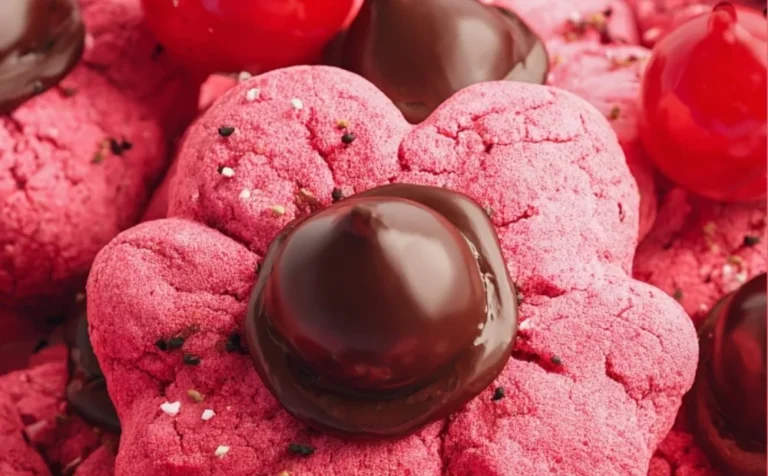
Finishing a Cherry Kiss Cookie is about restraint: allow each cookie to cool on the sheet for at least five minutes after pressing the Kiss to ensure adhesion, then transfer to a rack to cool completely. Presentation favors consistent spacing and alignment—arrange on a neutral platter where the contrast between the cookie’s pale, blushed surface and the chocolate peak is visible. If serving as part of a selection, group in even rows to emphasize uniformity; the eye judges technical execution as much as flavor. Dusting with a whisper of finely sifted powdered sugar is optional but can soften any visual harshness from the chocolate and echo the powdered sugar used in the dough.
Maintaining quality after cooking
Storage strategy hinges on humidity control. These cookies retain best in a single layer at room temperature in an airtight container with a desiccant packet or a folded paper towel to moderate moisture. Stacking while warm causes the Hershey’s Kisses to adhere and deform; always cool completely before stacking. In humid environments, refrigerate in an airtight container, but serve at room temperature to restore tenderness—cold fat will firm the crumb and mute flavors. Freeze unbaked dough balls for up to one month on a tray, then transfer to a sealed container; bake from frozen, adding two to three minutes to the baking time. For reheating previously baked cookies, use a 300°F (150°C) oven for 3–4 minutes to refresh texture without melting the chocolate.
Questions from home cooks (chef answers)
Q: Why powdered sugar instead of granulated sugar? A: Powdered sugar contains cornstarch and finer particles, which limit gluten development and produce a satiny texture. Granulated sugar would create a coarser crumb and increase spread.
Q: Can I use fresh cherries instead of maraschino? A: Fresh cherries have significantly lower sugar and different moisture content; they will not provide the same saccharine acidity and can introduce excess water. If substituting, reduce added moisture elsewhere and consider chopping and macerating briefly with sugar, then patting dry.
Q: My cookies flattened—what happened? A: Over-soft butter, over-creaming, or insufficient flour will cause flattening. Verify butter temperature, measure flour accurately, and chill the dough briefly if your kitchen is warm.
Q: The Hershey’s Kiss sank too much—how to prevent that? A: Press the Kiss into the cookie immediately after removal but wait approximately 20–30 seconds so the surface has begun to set. If cookies are too hot, the Kiss will fully collapse.
Final chef notes
Precision in temperature, measurement, and timing produces the technical integrity that elevates this modest cookie into a reliable patisserie component. Maintain disciplined mise en place, monitor the creaming stage with intent, and treat the maraschino cherries as both flavor and moisture variables. This recipe rewards restraint: small, deliberate actions—draining cherries, calibrating oven, uniform portioning—yield consistent results that showcase both the buttery shortbread and the cherry-chocolate interplay.
Conclusion
For reference and comparative recipes that explore cherry-centric cookies, consult the original Cherry Blossom Cookies Recipe, the detailed exchange submission at Cherry Blossom Cookie recipe – Flour On My Face, and a tested home-kitchen version at Cherry Kiss Cookies | The Girl Who Ate Everything. These resources provide useful context and variations while preserving the technical principles outlined above.