No-Bake Cheesecake Parfait
Introduction
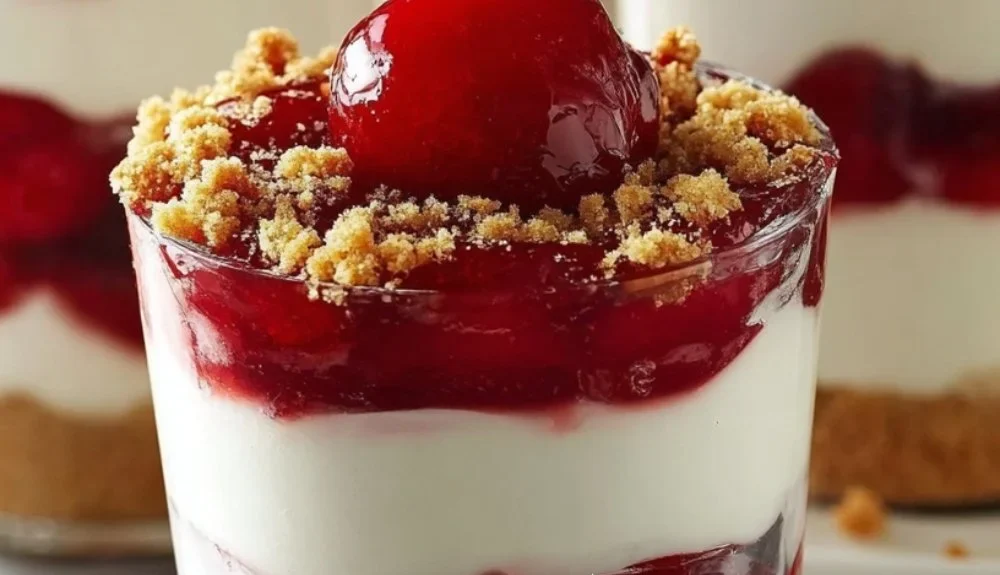
As a professionally trained chef, I approach a simple preparation like the No-Bake Cheesecake Parfait as an exercise in restraint, technique, and balance. This dessert’s elegance depends on precise control of texture, acidity, and layering rather than on lengthy cooking. The result should read as a composed construction: a crisp, slightly oily graham base; a silken, set cheesecake layer that is both creamy and taut; and a glossy, intact fruit topping that provides contrast in acidity, sweetness, and color. In this piece I will outline the reasoning behind each step, explain how ingredient temperatures and handling influence mouthfeel and stability, and provide a disciplined workflow so the dessert can be produced consistently at home or scaled in a professional setting.
The culinary logic behind this dish
The No-Bake Cheesecake Parfait is a study in contrasts that rely on simple chemistry. The graham crumb and butter form a fat-bonded matrix that provides a brittle contrast to the emulsion-like cheesecake layer. Cream cheese contributes structure and mouth-coating fat, sweetened condensed milk supplies sugar and stabilizing solids, and lemon juice introduces acid that precipitates proteins, creating a gentle set without heat. Vanilla extract elevates aromatic perception through volatile compounds. Cherry pie filling functions as both a sweet-tart counterpoint and a visual cap. Each component must be controlled: too-warm cream cheese yields greasy mouthfeel; under- or overworked crumbs produce either loose bases or oily pastes. Timing—how long you rest, chill, or press—dictates final texture and integration of flavors.
How to make No-Bake Cheesecake Parfait
Below are the exact recipe directions followed by focused technical commentary explaining why each step matters and how to optimize execution for consistent results.
Directions :
- In a small mixing bowl, combine the graham cracker crumbs, granulated sugar, and melted butter; set aside.
- In a medium mixing bowl, beat the cream cheese with an electric mixer on medium speed until smooth. Beat in the sweetened condensed milk until combined.
- Add the freshly squeezed lemon juice and vanilla extract and stir well.
- Set 6 plastic, 9-ounce punch cups on the counter or a cookie sheet. Scoop 2 tablespoons of the graham cracker crumb mixture into the bottom of each cup and press down lightly.
- Add 3 tablespoons of the cheesecake mixture to each cup and spread out evenly.
- Evenly distribute half of the cherry pie filling between the 6 cups, reserving the other half of the pie filling for another layer.
- Sprinkle 2 tablespoons of the graham cracker crumb mixture over the cherry layer.
- Divide the remaining cheesecake mixture between the 6 cups and spread out evenly.
- Divide the reserved cherry pie filling evenly between the 6 cups, then sprinkle the top with a little graham cracker crumb mixture.
- Serve immediately or chill for up to 24 hours before serving.
Technical commentary on the steps:
- Step 1: Combining crumbs, sugar, and melted butter creates a cohesive matrix as the hydrophobic butter coats dry particles; when chilled, the fat solidifies and locks crumbs together. Use melted butter at roughly 40–45°C (104–113°F) so it flows to coat effectively but won’t melt your serving vessel or soften the cream cheese prematurely.
- Steps 2–3: Cream cheese must be uniformly softened to avoid lumps; mechanical beating smooths the protein network and incorporates the sweetened condensed milk, which brings both sugar and milk solids that improve texture and mouthfeel. Lemon juice is the functional acid that partially coagulates proteins, giving controlled thickening; add it off the mixer and fold in gently to avoid over-aeration that can cause instability.
- Steps 4–9: Layering in transparent cups is a visual and textural decision. Pressing crumbs lightly creates adhesion without compressing them into a brick; light compression yields a base that holds but still fractures on the bite. Distribute the first cheesecake layer thinly to provide a cushion between crumb and fruit so high-sugar pie filling does not migrate into the base. Reserving half the filling for the top layer ensures freshness and visual balance. Final crumbs on top create a repeating motif and a dry textural element.
- Step 10: Serving immediately preserves the brightest textures: crumb retains loose crispness and the cheese layer remains soft. Chilling for up to 24 hours allows the cheesecake layer to firm further and flavors to marry; beyond 24 hours quality declines due to moisture migration from the filling.
Ingredients :
1 1/2 cups finely crushed graham cracker crumbs, 3 tablespoons granulated sugar, 7 tablespoons butter (melted), 1 (8 ounce) package cream cheese, softened, 1 (14 ounce) can sweetened condensed milk, 1/3 cup freshly squeezed lemon juice, 1 teaspoon vanilla extract, 1 (21 ounce) can cherry pie filling
Ingredient analysis through a chef’s lens
- Graham cracker crumbs + butter: This is a shortcrust analogue. The butter content (7 tablespoons to 1.5 cups crumbs) gives adequate fat to bind without becoming greasy. Finely crushed crumbs increase surface area for fat adhesion; if your crumbs are too coarse, the base will be fragile.
- Granulated sugar: Small inclusion boosts contrast and helps dry binding. Sugar crystals in the crumb layer also create a slight textural grit that reads as a purposeful crunch.
- Cream cheese: A high-fat, acidified dairy protein that supplies both richness and structural elements. Temperature control is essential; warm cream cheese will deliver an oily, separated mouthfeel.
- Sweetened condensed milk: Adds sweetness, lactose, and milk solids; its viscosity integrates with cream cheese to form a dense, spreadable matrix without the need for whipping cream or gelatin.
- Lemon juice: The acid that sets the mix chemically. It also cuts through fat, sharpening perception and preventing cloying sweetness.
- Vanilla extract: Low percentage but high impact; aromatic volatiles bloom upon tasting.
- Cherry pie filling: Provides acidity, texture, and visual appeal. The gel matrix in the filling helps reduce weep but contains syrups that can migrate; hence layering strategy is important.
Kitchen workflow & technique breakdown
Efficient production comes from mise en place and parallel tasks. Soften cream cheese at room temperature for 30–45 minutes prior to assembly; do not microwave—uneven heating creates pockets of melted fat. Measure and melt butter while the cream cheese sits; allow butter to cool slightly to avoid softening the cream cheese when combined. Crush the grahams and mix with sugar in a bowl large enough to accept melted butter; combine immediately to prevent clumping.
While the mixer is running for the cream cheese, prepare cups and the chilled cookie sheet. Assemble in an assembly-line fashion: portion crumbs, portion cheesecake mixture, portion fruit. Use a two-table setup—one for assembly, one for chilling or staging—so you can move finished cups into a cooler zone immediately. Clean tools between layers to maintain visual clarity.
Texture control, heat management & timing
Temperature dictates texture at every junction. Cream cheese should be soft but not warm—think 15–18°C (59–64°F). Melted butter should be lukewarm; too hot will partially melt the cream cheese when layers are combined. Refrigeration for up to 24 hours firms the cheesecake layer through cold-set mechanisms and reduces the mobility of syrup from the fruit. If serving immediately, expect a softer, mousse-like interior; if chilled, expect a denser, sliceable texture. Avoid freezing: ice crystals will fracture the emulsion and release water on thawing.
Timing of acid addition matters. Add lemon juice after initial emulsification to avoid destabilizing a cold, unmixed mass. Mix just until combined; excessive mechanical work introduces air, which can lead to collapse or weep as trapped air deflates.
Professional variations
As a working professional, I present options that preserve the original recipe’s balance while offering textural or flavor permutations without altering the provided measurements or steps:
- Swap presentation vessels: use short, wide glasses for a broader surface display. This changes the perceived ratio of crumb to cream to fruit.
- Integrate a toasted element: toast graham crumbs briefly to intensify caramel notes, cooling them fully before adding butter.
- Infuse aromatics: steep vanilla beans in warmed condensed milk before incorporating (cool to original temperature), then stir in seeds; this builds depth without changing volumes.
- Textural contrast: add a thin layer of chopped toasted nuts between the first cheesecake and the fruit for crunch. Note: this is an add-on; maintain the original recipe if strict adherence is desired.
These variations are execution-level changes rather than recipe rewrites—appropriate in professional kitchens to tune offerings for clientele while retaining foundational ingredient ratios.
Finishing touches & plating philosophy
Finish with restraint. The visual goal is clarity: clear strata, clean rim, and a glossy fruit finish. Use a small offset spatula to level layers and remove any stray crumbs from the rim. For service in a restaurant, consider a micro-squeeze of lemon zest over the top just before service to awaken aromas; apply sparingly so the zest does not introduce bitterness. Serve with a chilled spoon to minimize thermal shock and maintain the textural difference between cool cheese and room-temperature throat.
For catering, keep individual lidded containers to prevent condensation. If serving immediately, avoid placing the cups under heat lamps or direct ambient heat which will soften the cream layer and mobilize syrup.
Maintaining quality after cooking
No-bake desserts rely on cold storage to maintain integrity. Refrigerate at 2–4°C (35–39°F) and consume within 24 hours as the recipe specifies; beyond that, the syrup from pie filling will gradually migrate into the porous crumb and the crumb will soften. Microbiologically, the acid and sugar content reduce risk but do not eliminate it—observe general cold-chain rules and do not store beyond 48 hours. If transporting, pack in insulated containers with ice packs and minimize vertical agitation to prevent layer mixing.
Questions from home cooks (chef answers)
Q: Why does my cheesecake mixture taste too sweet?
A: The sweetened condensed milk is concentrated sugar. Balance comes from freshly squeezed lemon juice and vanilla. If sweetness persists, serve chilled—cold reduces perceived sweetness—or use a tart fruit topping to offset it.
Q: My crumb layer is soggy after chilling—what went wrong?
A: Likely syrup migration from the cherry filling. Press crumbs more firmly initially, or create a thin barrier by sprinkling a very light dusting of crumbs between the first cheesecake and fruit layer. Ensure you portion fruit cleanly and don’t over-saturate layers with syrup.
Q: Why did the cream cheese get grainy?
A: Overmixing cold cream cheese or working it at an improper temperature can cause graininess. Soften to room temperature, mix on medium speed until smooth, and avoid extended high-speed whipping which aerates and destabilizes the fat-protein network.
Q: Can I substitute fresh cherries?
A: Fresh cherries change moisture content and lack a gel matrix, so they will bleed more liquid. If using fresh fruit, macerate briefly with a small amount of sugar and cornstarch to create a similar viscosity; however this alters the recipe’s components.
Final chef notes
Precision in temperature, timing, and layering yields a No-Bake Cheesecake Parfait that reads as intentional and composed. Respect the roles of each ingredient: crumbs for texture, cream cheese and condensed milk for body, lemon for balance, and cherry filling for lift. Execute with a calm mise en place and a focus on minimizing moisture migration. The dessert scales well and rewards exacting technique more than elaborate additions.
Conclusion
For additional no-bake parfait techniques and flavor variations, these resources provide complementary approaches and plating ideas: Strawberry Cheesecake Parfait (No Bake) – Fifteen Spatulas, Easy No-Bake Cheesecake Parfaits – Just a Taste, and Creamy No-Bake Cheesecake Parfait — CAMP KITCHEN. These references showcase alternative fruit treatments, textural finishes, and presentation approaches that complement the technique outlined above.
No-Bake Cheesecake Parfait
Ingredients
Method
- In a small mixing bowl, combine the graham cracker crumbs, granulated sugar, and melted butter; set aside.
- In a medium mixing bowl, beat the cream cheese with an electric mixer on medium speed until smooth. Beat in the sweetened condensed milk until combined.
- Add the freshly squeezed lemon juice and vanilla extract and stir well.
- Set 6 plastic, 9-ounce punch cups on the counter or a cookie sheet.
- Scoop 2 tablespoons of the graham cracker crumb mixture into the bottom of each cup and press down lightly.
- Add 3 tablespoons of the cheesecake mixture to each cup and spread out evenly.
- Evenly distribute half of the cherry pie filling between the 6 cups, reserving the other half for another layer.
- Sprinkle 2 tablespoons of the graham cracker crumb mixture over the cherry layer.
- Divide the remaining cheesecake mixture between the 6 cups and spread out evenly.
- Divide the reserved cherry pie filling evenly between the 6 cups, then sprinkle the top with a little graham cracker crumb mixture.
- Serve immediately or chill for up to 24 hours before serving.